ignition OLDSMOBILE BRAVADA 1997 Owner's Guide
[x] Cancel search | Manufacturer: OLDSMOBILE, Model Year: 1997, Model line: BRAVADA, Model: OLDSMOBILE BRAVADA 1997Pages: 358, PDF Size: 18.02 MB
Page 159 of 358

If the water isn’t too deep, then drive through it slowly. At
fast speeds, water splashes on your ignition system and
your vehicle can stall. Stalling can also occur
if you get
your tailpipe under water. And, as long
as your tailpipe is
under water, you‘ll never be able to stzt your engine.
When you go through water. remember that when your
brakes get wet,
it may take you longer to stop.
I
Driving through rushing water can be dangerous.
Deep water can sweep your vehicle downstream and you and your passengers could drown. If it’s
only shallow water, it can still wash away the
ground from under your tires, and you could lose
traction and roll the vehicle over. Don’t drive
through rushing water.
See “Driving Through Water‘. in the Index for more
information
on driving through water.
After Off-Road Driving
Remove any brush or debris that has collected on the
underbody, chassis or under the hood. These
accumulations can be a fire hazard.
After operation
in mud or sand, have the brake linings
cleaned and checked. These substances can cause
steering, suspension, wheels, tires and exhaust system
for damage. Also, check the fuel lines and cooling
system for any leakage.
2 (.lazing and uneven braking. Check the body structure,
Your vehicle will require more frequent service due to
off-road use. Refer to the Maintenance Schedule for
additional information.
4-27
ProCarManuals.com
Page 169 of 358
If you drive regularly in steep country, or if you’re
planning
to visit there, here are some tips that can make
your trips safer and more enjoyable. (See “Off-Road
Driving”
in the Index for information about driving
off-road.)
Keep your vehicle in good shape. Check all fl~lid
levels and also the brakes, tires. cooling system and
transmission. These parts can work hard on
mountain roads.
Know how to go down hills. The most important
thing to know is this: let your engine do some
of the
slowing down. Shift to a lower gear
when you go
down a steep or long hill.
A CAUTION:
If you don’t shift down, your brakes could get
so hot that they wouldn’t work well. You would
then have poor braking or even none going
down
a hill. You could crash. Shift down to let
your engine assist your brakes on
a steep
downhill slope. Coasting
downhill in NEUTRAL
(N) or with the
ignition
off is dangerous. Your brakes will have to
do all the work of slowing down. They could get so
hot that they wouldn’t work well. You would then
have poor braking or even none going down
a hill.
You could crash.
Always have your engine running
and your vehicle in gear when you go downhill.
Know how to go uphill. You may want to shift down to a
lower gear. The lower gears help cool your engine and
transmission, and you can climb the
hill better.
Stay in your own lane when driving on two-lane
roads
in hills or mountains. Don*t swing wide or cut
across the center of the road. Drive at speeds that let
you stay
in your own lane.
As you go over the top of a hill, be alert. There could be
something
in your lane, like a stalled car or an accident.
You may see highway signs on mountains that warn of
special problems. Examples are long grades, passing or
no-passing zones, a falling rocks area or winding
roads. Be alert to these and take appropriate action.
4-37
ProCarManuals.com
Page 190 of 358

2. Get the vehicles close enough so the jumper cables
can reach, but be sure the vehicles aren’t touching
each other. If they are, it could cause a ground
connection you don’t want. You wouldn’t be able
to start your vehicle, and the bad grounding could
damage the electrical systems.
You could be injured if the vehicles roll. Set the
parking brake firmly on each vehicle. Put an
automatic transmission in
PARK (P). Put a
manual transmission in NEUTRAL (N).
I unnecessary accessories plugged into the cigarette
lighter, or accessory power outlets, if you have this
option. Turn
off all lamps that aren’t needed as well
as radios. This will avoid sparks and help to save
both batteries. In addition, it could save your radio!
3. Turn off the ignition on both vehicles. Unplug
NOTICE:
If you leave your radio on, it could be badly
damaged. The repair wouldn’t be covered by
your warranty.
An electric fan can start up even when the engine
is not running and can injure you. Keep hands,
clothing and tools away from any underhood
electric fan.
I ‘ 5-4
ProCarManuals.com
Page 194 of 358
-
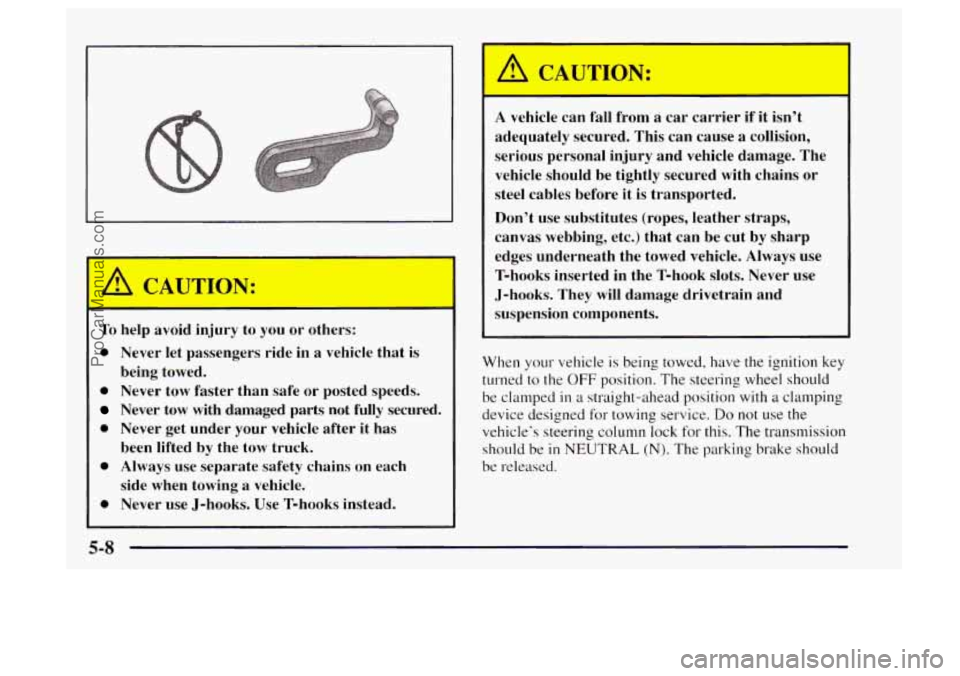
To help avoid injury to you or others:
0 Never let passengers ride in a vehicle that is
0 Never tow faster than safe or posted speeds.
Never tow with damaged parts not fully secured.
0 Never get under your vehicle after it has
0 Always use separate safety chains on each
0 Never use J-hooks. Use T-hooks instead.
being towed.
been lifted
by the tow truck.
side when towing a vehicle.
A vehicle can fall from a car carrier if it isn’t
adequately secured. This can cause
a collision,
serious personal injury and vehicle damage. The
vehicle should be tightly secured with chains
or
steel cables before it is transported.
Don’t use substitutes (ropes, leather straps,
canvas webbing, etc.) that can be cut by sharp
edges underneath the towed vehicle. Always use
T-hooks inserted in the T-hook slots. Never use
J-hooks. They will damage drivetrain and
suspension components.
When your vehicle is being towed, have
the ignition key
turned
to the OFF position. The steering wheel should
be clamped
in a straight-ahead position with a clamping
device designed for
towing service. Do not use the
vehicle’s steering column lock for this.
The transmission
should
be in NEUTRAL (N). The parking brake should
be released.
5-8
ProCarManuals.com
Page 277 of 358

FuseKircuit Breaker Usage
4
5
6
7
A/C Compressor Relay, Cluster
Chime Module, DRL Relay Coil,
Four-Wheel-Drive Indicator Lamp,
DRL Module, Rear Defog Timer,
Transfer Case Control Module Ignition, SIR Redundant Ignition,
RKE Ignition, Fuel Sender Module
Oxygen Sensor Heater, Exhaust Gas
Recirculation, Cam Sensor, CANN.
Purge, Canister Vent Solenoid, Mass
Airflow Sensor, Cam Shaft Sensor
Blower Motor, Temperature Door
Motor, HI Blower Relay Coil
Power Auxiliary Outlets, Assembly
Line Diagnostic Link
FuseKircuit
Breaker Usage
8
9
10
11
12
13
14
15
Rear Window Defogger
PCMNCM Battery, Fuel Pump
PCMNCM Ignition, Injectors, Crank
Sensor, Coil Driver Module
Radio, Inside Rearview Mirror Map
Lamp, Overhead Console Reading
Lamps, Rear Wiper, Rear Washer,
Overhead Console Display
Anti-Lock Braking System,
VCM IGN-3
Clock, Radio Battery, CD Player
A/C Compressor Battery Feed
Daytime Running Lamps, Fog Lamps,
Fog Lamp Relay
6-57
ProCarManuals.com
Page 324 of 358

Steering Column Park Lock Check
While parked, and with the parking brake set, try to turn
the ignition key to LOCK in each shift lever position.
The key should turn to LOCK only when the shift
lever is
in PARK (P).
0 The key should come out only in LOCK.
Parking Brake and Automatic Transmission
PARK (P) Mechanism Check
When you are doing this check, your vehicle
could begin to move.
You or others could be
injured and property could be damaged. Make
sure there is room in front
of your vehicle in case
it begins to
roll. Be ready to apply the regular
brake at once should the vehicle begin to move.
Park on a hirly steep hill, with the vehicle facing
downhill. Keeping your foot on the regular brake, set the
parking brake.
To check the parking brake’s holding ability:
With the engine running and transmission
in
NEUTRAL (N), slowly remove foot pressure from
the regular brake pedal. Do this until the vehicle is
held by the parking brake only.
0 To check the PARK (P) mechanism’s holding ability:
With the engine running,
shift to PARK (P). Then
release all brakes.
Underbody Flushing Service
At least every spring, use plain water to flush any
corrosive materials from the underbody. Take care
to
clean thoroughly any areas where mud and other debris
can collect.
7-42
ProCarManuals.com
Page 347 of 358

GloveBox .................................... 2-35
Gross Axle Weight Rating
........................ 4-42
Gross Vehicle Weight Rating
...................... 4-42
GVWR
....................................... 4-42
Halogen Bulbs
................................ 6-30
Hazard Warning Flashers
.......................... 5-2
Head Restraints
................................. 1-5
Headlarnps .................................... 2-31
Bulb Replacement
............................ 6-30
Highkow Beam Changer
...................... 2-26
On Reminder
................................ 2-32
Wiring
..................................... 6-54
Hearing Impaired. Customer Assistance
.............. 8-4
Heating
........................................ 3-3
Highway Hypnosis
.............................. 4-36
Hill and Mountain Roads
......................... 4-36
Hitches. Trailer
................................. 4-47
Horn ......................................... 2-24
Hydroplaning
................................ 4-32
Hood
.......................................... 6-6
Ignition
Positions .............................. 2- I 2
Inflation. Tire
............................. 6-37. 7-39
Inside Day/Night Rearview Mirror
................. 2-34
Inspections Brake System
.................... ......... 7-44 Drive Axle
.................................. 7-44
Exhaust Systems
............................. 7-43
Front Drive Axle Boot
......................... 7-43
Radiator and Heater Hose
...................... 7-43
Steering
.................................... 7-43
Suspension
.................................. 7-43
Throttle Linkage
.............................. 7-44
Transfer Case
................................ 7-44
Instrument Panel
............................... 2-48
Cleaning .................................... 6-47
Cluster
..................................... 2-50
FuseBlock
.................................. 6-55
Interior Lamps ................................. 2-33
Jacking Equipment
............................. 5-22
Jump Starting
................................... 5-3
Keyless Entry System
........................... 2-6
Keys
.......................................... 2-2
Labels Certification/Tire
............................. 4-42
Fuse ....................................... 6-56
Safety Belt
.................................. 1-45
Service Parts Identification
..................... 6-53
Vehicle Identification Number
................... 6-53
ProCarManuals.com