turn signal OLDSMOBILE BRAVADA 1997 User Guide
[x] Cancel search | Manufacturer: OLDSMOBILE, Model Year: 1997, Model line: BRAVADA, Model: OLDSMOBILE BRAVADA 1997Pages: 358, PDF Size: 18.02 MB
Page 162 of 358

Driving in Rain and on Wet Roads
Rain and wet roads can mean driving trouble. On a wet
road, you can’t stop, accelerate or turn as well because your tire-to-road traction isn’t as
good
as on dry roads.
And,
if your tires don’t have much tread left, you’ll get
even less traction. It’s always wise to go slower and be
cautious
if rain starts to fall while you are driving. The
surface may get wet suddenly when your reflexes are
tuned
for driving on dry pavement.
The heavier the rain, the harder
it is to see. Even if your
windshield wiper blades are
in good shape, a heavy rain
can make
it harder to see road signs and traffic signals,
pavement markings, the edge
of the road and even
people walking.
It’s wise to keep your wiping equipment in good shape
and keep your windshield washer tank filled with
washer fluid. Replace your windshield wiper inserts
when they show signs of streaking or missing areas on
the windshield, or when strips of rubber start to separate
from the inserts.
4-30
ProCarManuals.com
Page 165 of 358
City Driving Here are ways to increase your safety in city driving:
0
0
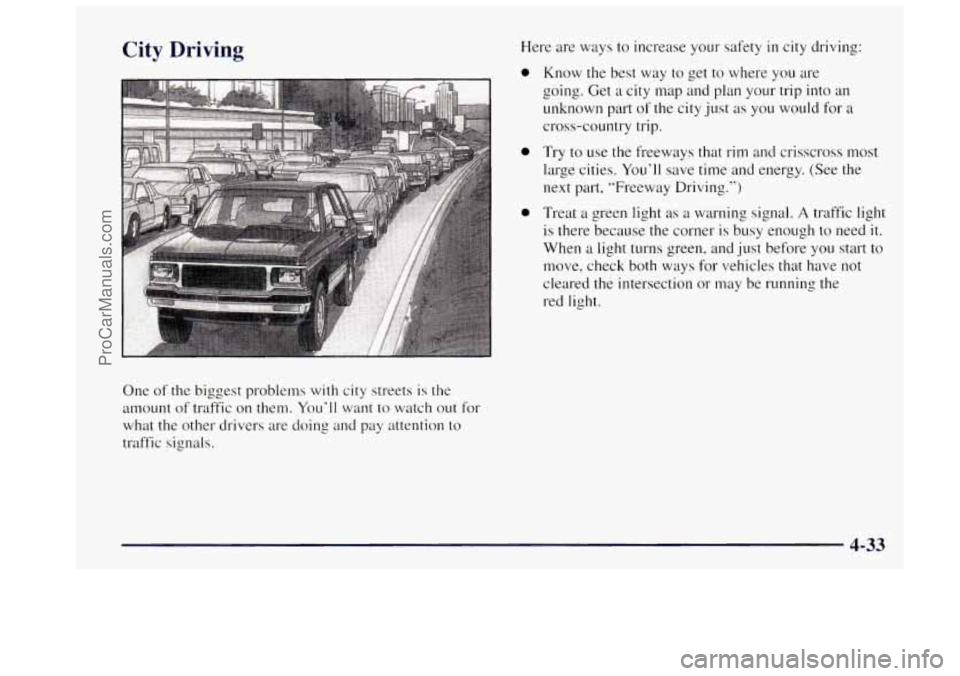
One of the biggest problems with city streets is the
amount of traffic on them.
You’ll want to watch out for
what the other drivers are doing and pay attention to
traffic signals.
e
Know the best way to get to where you are
going. Get
a city map and plan your trip into an
unknown part of the city just
as you would for a
cross-country trip.
Try to use
the freeways that rim and crisscross most
large cities. You’ll save time and energy. (See the
next part, “Freeway Driving.”)
Treat a green light as
a warning signal. A traffic light
is there because the corner is busy enough
to need it.
When a light turns green, and just before you start to
move, check both ways for vehicles that have not
cleared the intersection or may be running the
red light.
4-33
ProCarManuals.com
Page 166 of 358
Freeway Driving
Mile for mile, freeways (also called thruways, parkways,
expressways, turnpikes or superhighways) are the safest
of all roads. But they have their own special rules. The
most important advice on freeway driving
is: Keep
up with traffic and keep to the right. Drive at the same
speed most
of the other drivers are driving. Too-fast or
too-slow driving breaks a smooth traffic flow. Treat the
left lane on a freeway as a passing lane.
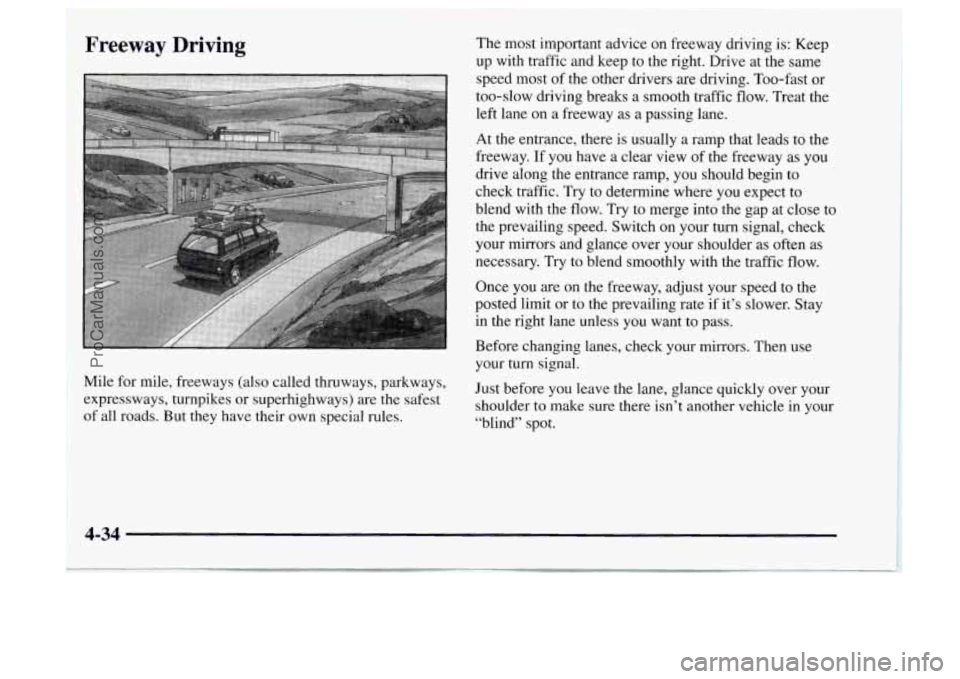
At the entrance, there is usually a ramp that leads
to the
freeway. If you have a clear view
of the freeway as you
drive along the entrance ramp, you should begin
to
check traffic. Try to determine where you expect to
blend with the flow.
Try to merge into the gap at close to
the prevailing speed. Switch on your turn signal, check
your mirrors and glance over your shoulder as often as
necessary, Try to blend smoothly with the traffic flow.
Once you are on the freeway, adjust your speed
to the
posted limit or to the prevailing rate if it’s slower. Stay
in the right lane unless you want to pass.
Before changing lanes, check your mirrors. Then use
your turn signal.
Just before you leave the lane, glance quickly over your
shoulder
to make sure there isn’t another vehicle in your
“blind” spot.
4-34
ProCarManuals.com
Page 182 of 358
Passing
You’ll need more passing distance up ahead when
you’re towing a trailer. And, because you’re a good deal
longer, you’ll need to
go much farther beyond the
passed vehicle before
you can return to your lane.
Backing Up
Hold the bottom of the steering wheel with one hand.
Then, to move the trailer to the left, just move that hand
to the left.
To move the trailer to the right, move your
hand to the right. Always back
up slowly and, if
possible, have someone guide you.
Making Turns
NOTICE:
Making very sharp turns while trailering could
cause the trailer to come in contact with the
vehicle.
Your vehicle could be damaged. Avoid
making very sharp turns while trailering.
When you’re turning with a trailer, make wider turns
than normal.
Do this so your trailer won’t strike soft
shoulders, curbs, road signs, trees or other objects.
Avoid jerky or sudden maneuvers. Signal
well
in advance.
Turn Signals When Towing a Trailer
When you tow a trailer, your vehicle has to have extra
wiring and a heavy-duty turn signal flasher (included
in
the optional trailering package).
The arrows on your instrument panel will flash
whenever you signal a turn or lane change. Properly
hooked up, the trailer lamps will also flash, telling other
drivers you’re about to
turn, change lanes or stop.
When towing
a trailer, the arrows on your instrument
panel will flash for turns even
if the bulbs on the trailer
are burned out. Thus,
you may think drivers behind you
are seeing your signal when they are not. It’s important
to check occasionally to be sure the trailer bulbs are
still working.
4-50
ProCarManuals.com
Page 185 of 358

Trailer Wiring Harness
The light duty trailer wiring is a six-wire harness
assembly. The optional heavy-duty trailer wiring is an
eight-wire harness assembly. The harnesses are stored
under the vehicle,
on the driver’s side corner frame
crossmember. The heavy-duty trailer wiring has
a
30-amp feed wire with an inline fuse located by the
junction block. See “Fuses and Circuit Breakers”
in the
Index. Both harnesses have no connector and should be
wired by
ilt qualified electrical technician. The technician
can use the following color code chart when connecting
the wiring harness to your trailer.
Dark Blue: Use for electric trailer brakes or
auxiliary wiring.
Red: Use for battery charging: it connects to the
starter solenoid (eight-wire harness only).
Light Green: Back-up lamps (eight-wire
harness only).
Brown: Taillamps and parking lamps.
Yellow: Left stoplamp and turn signal.
Dark Green: Right stoplamp and turn signal.
0 White (Heavy Gage): Ground wire.
White (Light Gage): Auxiliary stoplamp.
Securely attach the harness to the trailer, then tape or
strap
it to your vehicle’s frame rail. Be sure you leave it
loose enough so the wiring doesn’t bend or break, but
not
so loose that it drags on the ground. Store the
harness
in its original place. Wrap the harness together
and tie
it neatly so it won’t be damaged.
4-53
ProCarManuals.com
Page 188 of 358
Hazard Warning Flashers
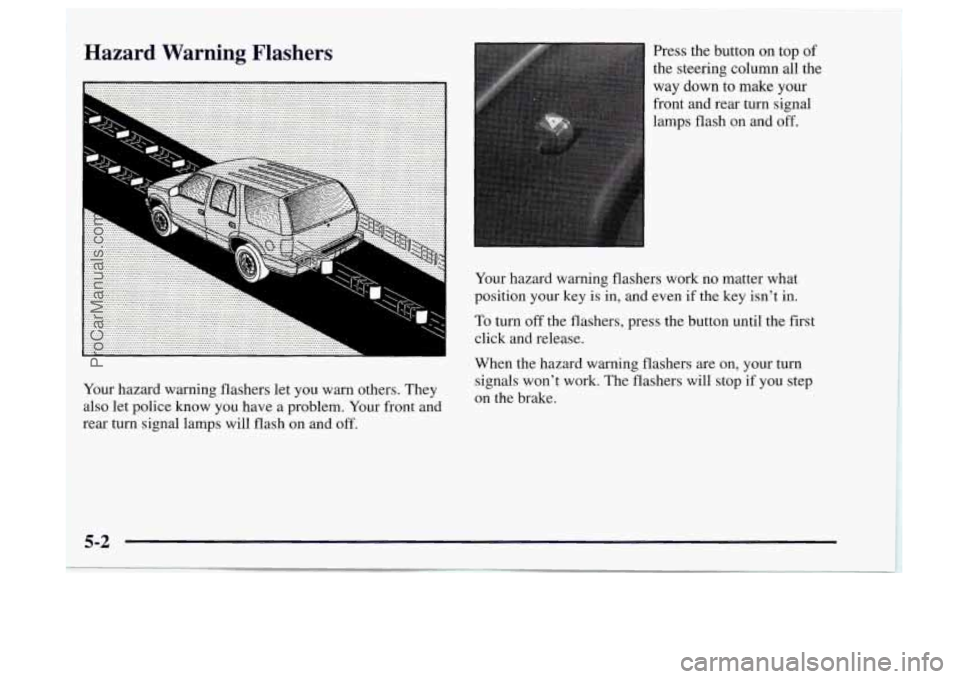
Your hazard warning flashers let you warn others. They
also let police know you have
a problem. Your front and
rear turn signal lamps will flash
on and off. Press the button
on top
of
the steering column all the
way down to make your
front and rear turn signal
lamps flash on and off.
Your hazard warning flashers work no matter what
position your key is in, and even if the key isn’t in.
To turn off the flashers, press the button until the first
click and release.
When the hazard warning flashers are
on, your turn
signals won’t work. The flashers will stop if you step
on the brake.
5-2
ProCarManuals.com
Page 251 of 358

5. Turn the bulb
counterclockwise to
remove it.
6. Put the new bulb into the headlarnp lens assembly
and turn
it clockwise until it is tight.
7. Plug in the electrical connector.
8. Put the headlamp lens assembly back into the
vehicle. Install and tighten the screws.
Front Turn Signal Lamps
1. Remove the headlamp assembly.
2. Reach down and behind the turn signal
lamp assembly.
3. Turn the socket counterclockwise and pull it out.
4. Holding the base of the bulb, pull the bulb straight
out
of the socket.
5. Push the new bulb into the socket until it clicks.
6. Put the socket back into the turn signal lamp assembly
and
turn it clockwise until it locks into place.
6-31
ProCarManuals.com
Page 278 of 358

17
18
19
20
21
22
Fuse/Circuit Breaker Usage
16 Turn Signals and Back-up Lamps,
Brake-Transmission Shift
Interlock Solenoid
Windshield Washer, Windshield
Wiper Motor
Not Used
Electric Shift Transfer Case
Crank Relay, Air Bag Module
Not Used
Air Bag Module
FuseKircuit
Breaker Usage
23
24
Cluster Illurnination, Radio Illumination, Heater Lamp,
4WD
Illumination, Chime Module, Fog
Lamp Illumination, Rear Wiper
Switch Illumination, Rear Defogger
Switch Illumination, Liftglass Release
Switch Illumination, Overhead
Console Illumination
PRNDL Power,
4L6OE
Automatic Transmission
ProCarManuals.com
Page 279 of 358
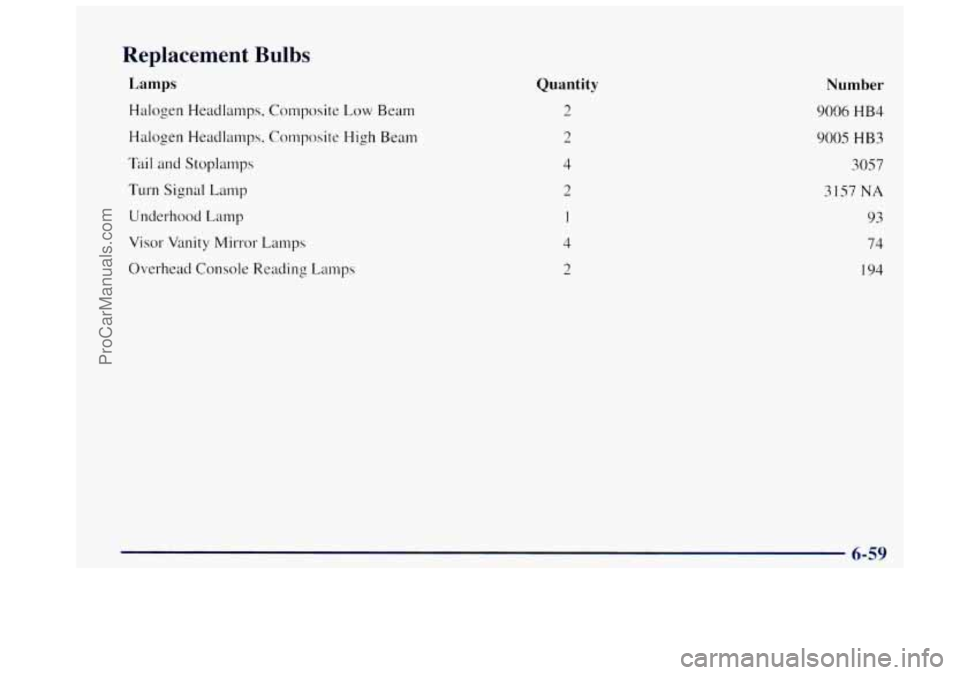
Replacement Bulbs
Lamps
Halogen Headlamps, Composite Low Beam
Halogen Headlamps, Composite
High Beam
Tail and Stoplamps
Turn Signal Lamp
Underhood
Lamp
Visor Vmity Mirror Lamps
Overhead Console Reading Lamps
Quantity
2
2
4
2
1
4
2
Number
9006 HB4
9005 HB3
3057
3157 NA
93
74
194
6-59
ProCarManuals.com
Page 346 of 358
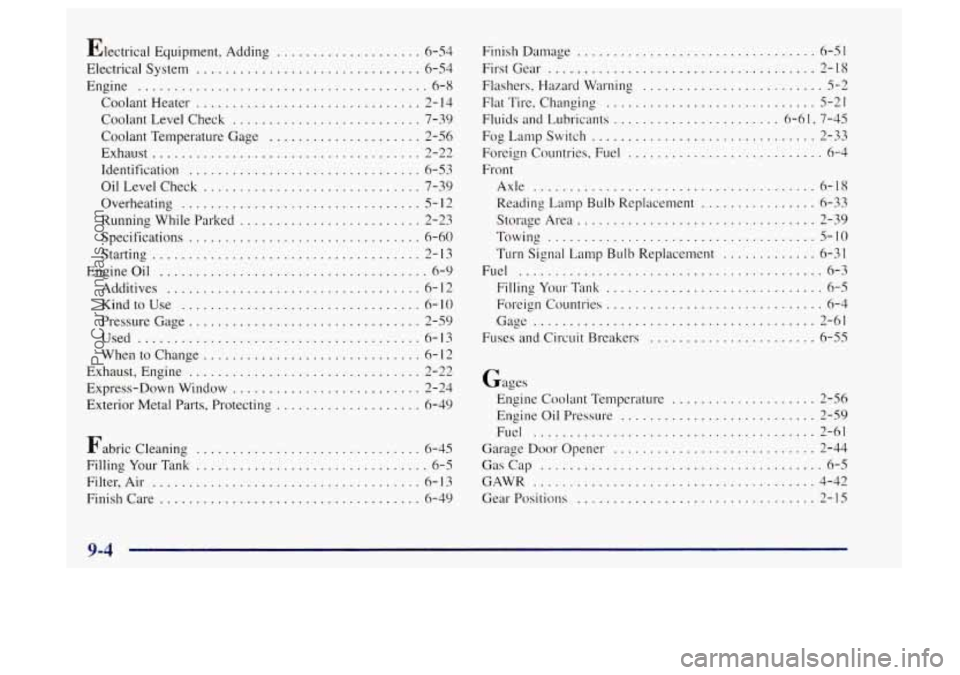
Electrical Equipment. Adding .................... 6-54
Electrical System
............................... 6-54
Engine
........................................ 6-8
Coolant Heater
............................... 2- 14
Coolant Level Check
.......................... 7-39
Coolant Temperature Gage
..................... 2-56
Exhaust
..................................... 2-22
Identification
................................ 6-53
OilLevelCheck
.............................. 7-39
Overheating
................................. 5-12
Running While Parked
......................... 2-23
Specifications
................................ 6-60
Starting
..................................... 2-13
Engineoil
..................................... 6-9
Additives
................................... 6-12
Kind to Use
................................. 6-10
Pressure Gage
................................ 2-59
Used
....................................... 6-13
Whentochange
.............................. 6-12
Exhaust. Engine
................................ 2-22
Express-Down Window
.......................... 2-24
Exterior Metal Parts. Protecting
.................... 6-49
Fabric cleaning
............................... 6-45
FillingYourTank
................................ 6-5
Filter.
Air ..................................... 6-13
Finish Care
.................................... 6-49 Finish
Damage
.................................
Flat Tire. Changing ............................. 5-21
Fluids and Lubricants
....................... 6-61. 7-45
Fog Lamp Switch
............................... 2-33
Foreign Countries. Fuel
........................... 6-4
Front Axle
....................................... 6-18
Reading Lamp Bulb Replacement
................ 6-33
Towing
..................................... 5-10
Turn Signal Lamp Bulb Replacement
............. 6-31
Fuel
.......................................... 6-3
Filling Your Tank
.............................. 6-5
Foreign Countries
.............................. 6-4
Gage
....................................... 2-61
Fuses and Circuit Breakers
....................... 6-55
Flashers.
Hazard Wdrning
......................... 5-2
Storage Area
................................. 2-39
Gages
Engine Coolant Temperature .................... 2-56
Engine Oil Pressure
........................... 2-59
Fuel
....................................... 2-61
Garage Door Opener
............................ 2-44
GasCap
....................................... 6-5
Gear Positions
................................. 2-15
GAWR ....................................... 4-42
ProCarManuals.com