ECU OLDSMOBILE BRAVADA 1997 Owner's Manual
[x] Cancel search | Manufacturer: OLDSMOBILE, Model Year: 1997, Model line: BRAVADA, Model: OLDSMOBILE BRAVADA 1997Pages: 358, PDF Size: 18.02 MB
Page 148 of 358
Before You Go Off-Roading
There are some things to do before you go out. For
example, be sure to have all necessary maintenance and
service work done. Check to make sure all underbody
shields (if
so equipped) are properly attached. Be sure
you read all the information about your
four-wheel-drive vehicle in this manual.
Is there enough
fuel?
Is the spare tire fully inflated? Are the fluid levels
up where they should be? What are the local laws that
apply to off-roading where you’ll be driving? If you
don’t know, you should check with law enforcement
people in the area. Will you be on someone’s private
land? If
so, be sure to get the necessary permission.
Loading Your Vehicle for Off-Road Driving
There are some important things to remember about
how to load your vehicle.
0 The heaviest things should be on the load floor and
forward of your rear axle. Put heavier items as far
forward as you can.
0 Be sure the load is secured properly, so driving on
the off-road terrain doesn’t toss things around.
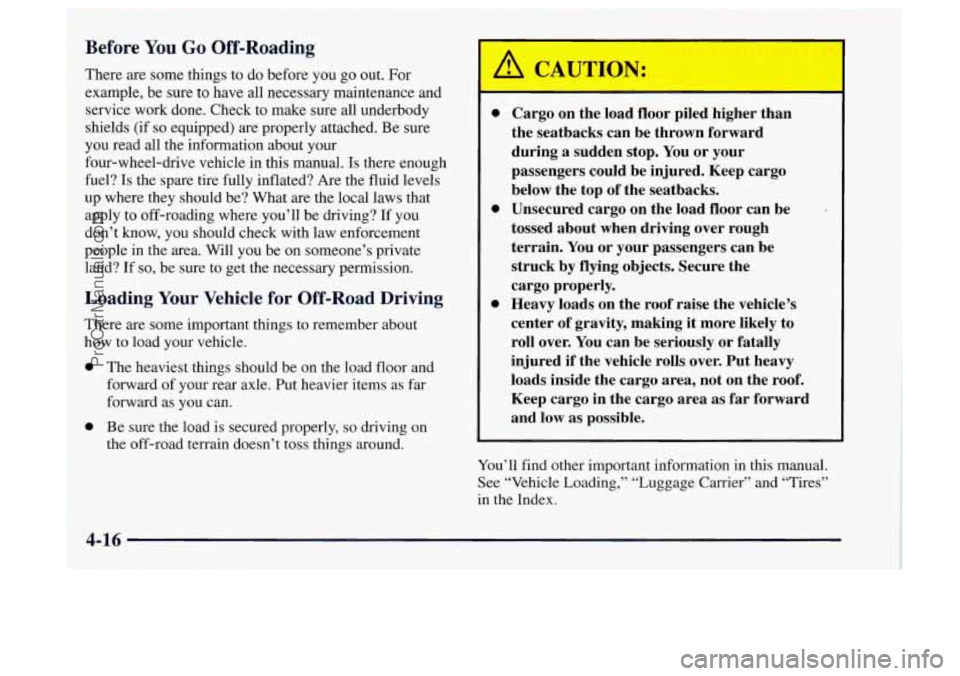
0 Cargo on the load floor piled higher than
the seatbacks can be thrown forward
during
a sudden stop. You or your
passengers could be injured. Keep cargo
below the top of the seatbacks.
0 Unsecured cargo on the load floor can be
tossed about when driving over rough
terrain. You or your passengers can be
struck by flying objects. Secure the
cargo properly.
0 Heavy loads on the roof raise the vehicle’s
center of gravity, making
it more likely to
roll over. You can be seriously or fatally
injured if the vehicle rolls over. Put heavy
loads inside the cargo area, not on the roof.
Keep cargo in the cargo area
as far forward
and low
as possible.
You’ll find other important information in this manual.
See “Vehicle Loading,” “Luggage Carrier” and “Tires’’
in the Index.
ProCarManuals.com
Page 170 of 358
Winter Driving
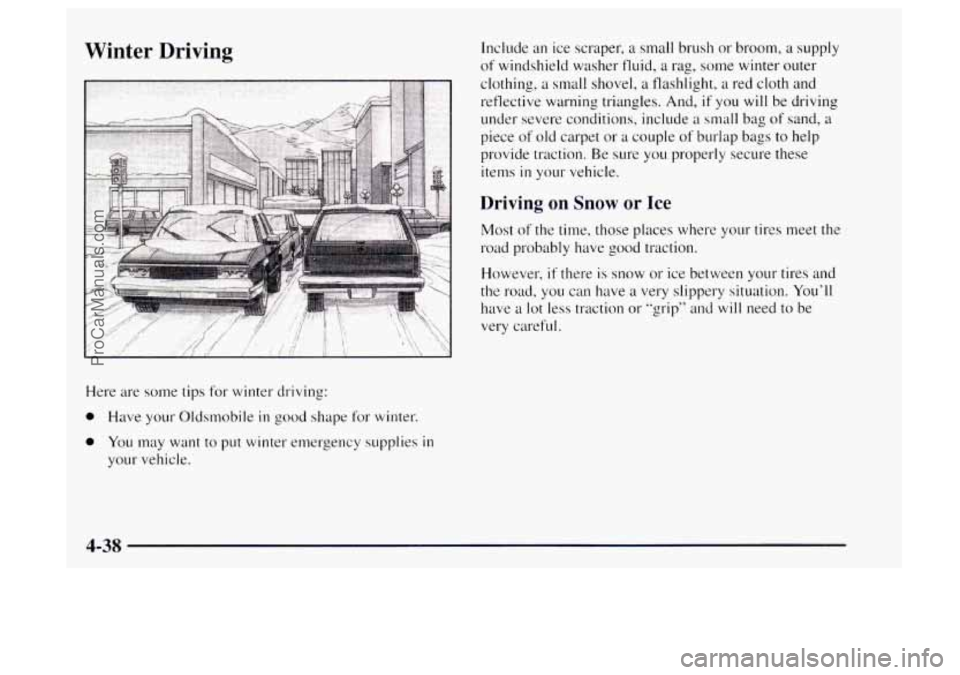
Here are some tips for winter driving:
0 Have your Oldsmobile in good shape for winter.
0 You may want to put winter emergency supplies in
your vehicle. Include
an ice scraper, a small brush or broom,
a supply
of windshield washer fluid, a rag,
some winter outer
clothing, a small shovel, a flashlight,
a red cloth and
reflective warning triangles. And,
if you will be driving
under severe conditions, include
a small bag of sand, a
piece of old carpet or a couple of burlap bags to help
provide traction. Be sure you properly secure these
items
in your vehicle.
Driving on Snow or Ice
Most of the time, those places where your tires meet the
road probably have good traction.
However,
if there is snow or ice between your tires and
the road, you can have
a very slippery situation. You’ll
have
a lot less traction or “grip” and will need to be
very careful.
4-38
ProCarManuals.com
Page 175 of 358
Using heavier suspension components to get added
durability might not change your weight ratings.
Ask
your retailer to help you load your vehicle the right way.
I NOTICE:
Your warranty does not cover parts or
components that fail because of overloading.
If you put things inside your vehicle -- like suitcases,
tools, packages or anything else
-- they will go as fast as
the vehicle goes.
If you have to stop or turn quickly, or
if there is a crash, they’ll keep going.
There’s
also important loading information for off-road
driving in this manual. See “Loading Your Vehicle’’ in
the Index.
Things you put inside your vehicle can strike
and injure people in a sudden stop or turn,
or in a crash.
0
0
0
0
0
Put things in the cargo area of your vehicle.
Try to spread the weight evenly.
Never stack heavier things, like suitcases,
inside the vehicle
so that some of them are
above the tops of the seats.
Don’t leave an unsecured child restraint in
your vehicle.
When you carry something inside the
vehicle, secure it whenever you can.
Don’t leave a seat folded down unless you
need to.
4-43
ProCarManuals.com
Page 181 of 358

Driving with a Trailer
mmm
If you have a rear-most window open and you
pull a trailer with your vehicle, carbon monoxide
(CO) could come into your vehicle. You can’t see
or smell
CO. It can cause unconsciousness or
death. (See “Engine Exhaust” in the Index.)
To
maximize your safety when towing a trailer:
Have your exhaust system inspected for
leaks, and make necessary repairs before
starting on your trip.
Keep the rear-most windows closed.
If exhaust does come into your vehicle
through a window in the rear or another
opening, drive with your front, main
heating or cooling system
on and with the
fan on any speed. This will bring fresh,
outside air into your vehicle.
Do not use
MAX A/C because it only recirculates the
air inside your vehicle. (See
“ Comfort
Controls”
in the Index.) Towing
a trailer requires a certain amount
of experience.
Before setting out for the open road, you’ll want to get
to know your rig. Acquaint yourself with the feel of
handling and braking with the added weight of the
trailer. And always keep
in mind that the vehicle you are
driving
is now a good deal longer and not nearly as
responsive as your vehicle is by itself.
Before you start, check the trailer hitch and platform
(and attachments), safety chains, electrical connector,
lamps, tires and mirror adjustment.
If the trailer has
electric brakes, start your vehicle and trailer moving and
then apply the trailer brake controller by hand to be sure
the brakes are working. This lets you check your
electrical connection at the same time.
During your trip, check occasionally to be sure that the
load is secure, and that the lamps and any trailer brakes
are still working.
Following Distance
Stay at least twice as far behind the vehicle ahead as you
would when driving your vehicle without a trailer. This
can help you avoid situations that require heavy braking
and sudden turns.
4-49
ProCarManuals.com
Page 185 of 358

Trailer Wiring Harness
The light duty trailer wiring is a six-wire harness
assembly. The optional heavy-duty trailer wiring is an
eight-wire harness assembly. The harnesses are stored
under the vehicle,
on the driver’s side corner frame
crossmember. The heavy-duty trailer wiring has
a
30-amp feed wire with an inline fuse located by the
junction block. See “Fuses and Circuit Breakers”
in the
Index. Both harnesses have no connector and should be
wired by
ilt qualified electrical technician. The technician
can use the following color code chart when connecting
the wiring harness to your trailer.
Dark Blue: Use for electric trailer brakes or
auxiliary wiring.
Red: Use for battery charging: it connects to the
starter solenoid (eight-wire harness only).
Light Green: Back-up lamps (eight-wire
harness only).
Brown: Taillamps and parking lamps.
Yellow: Left stoplamp and turn signal.
Dark Green: Right stoplamp and turn signal.
0 White (Heavy Gage): Ground wire.
White (Light Gage): Auxiliary stoplamp.
Securely attach the harness to the trailer, then tape or
strap
it to your vehicle’s frame rail. Be sure you leave it
loose enough so the wiring doesn’t bend or break, but
not
so loose that it drags on the ground. Store the
harness
in its original place. Wrap the harness together
and tie
it neatly so it won’t be damaged.
4-53
ProCarManuals.com
Page 194 of 358
-
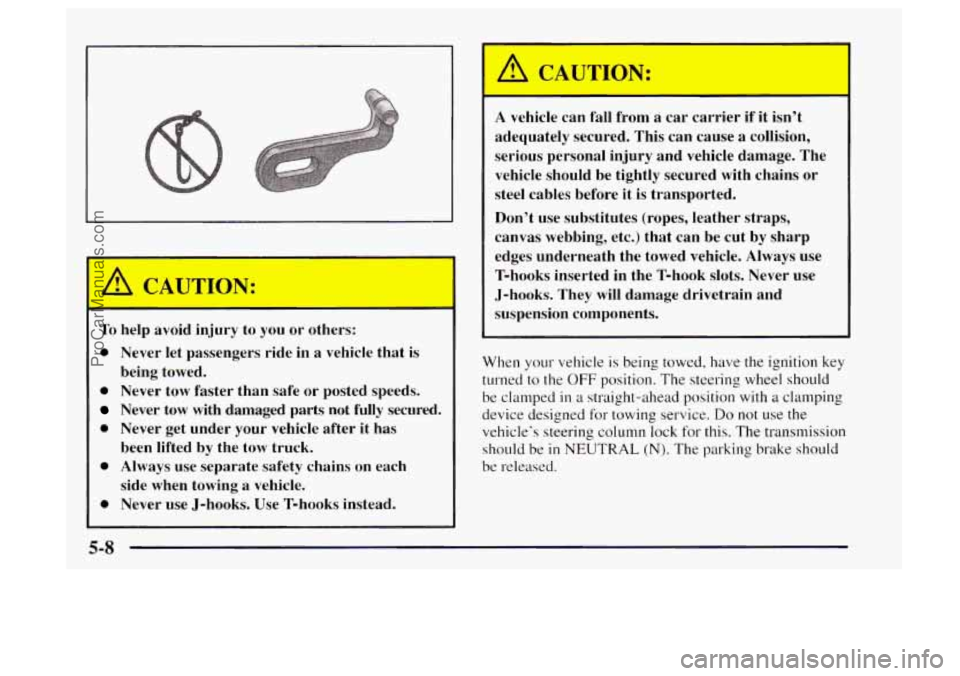
To help avoid injury to you or others:
0 Never let passengers ride in a vehicle that is
0 Never tow faster than safe or posted speeds.
Never tow with damaged parts not fully secured.
0 Never get under your vehicle after it has
0 Always use separate safety chains on each
0 Never use J-hooks. Use T-hooks instead.
being towed.
been lifted
by the tow truck.
side when towing a vehicle.
A vehicle can fall from a car carrier if it isn’t
adequately secured. This can cause
a collision,
serious personal injury and vehicle damage. The
vehicle should be tightly secured with chains
or
steel cables before it is transported.
Don’t use substitutes (ropes, leather straps,
canvas webbing, etc.) that can be cut by sharp
edges underneath the towed vehicle. Always use
T-hooks inserted in the T-hook slots. Never use
J-hooks. They will damage drivetrain and
suspension components.
When your vehicle is being towed, have
the ignition key
turned
to the OFF position. The steering wheel should
be clamped
in a straight-ahead position with a clamping
device designed for
towing service. Do not use the
vehicle’s steering column lock for this.
The transmission
should
be in NEUTRAL (N). The parking brake should
be released.
5-8
ProCarManuals.com
Page 215 of 358

Storing a Flat or Spare Tire and Tools
' CAT' I ION:
Storing a jack, a tire or other equipment in the
passenger compartment of the vehicle could
cause in.jury. In a sudden stop
or collision, loose
equipment could strike someone. Store
all these
in the proper place.
An aluminum wheel with a flat tire should always
be stored under the vehicle with the hoist.
However, storing it that way for an extended
period could damage the wheel.
To avoid this,
have the wheel repaired as soon as possible. Follow this diagram
to store the spare or flat tire.
BJ
A. Retainer
B. Valve
Stem
(Pointed Down)
C. Spare Tire
D. Spring
E. Wheel Wrench
F. Lower
G. Raise
H. Hoist
Arm
1. Put the tire on the ground at the rear of the vehicle.
with the valve stem pointed down and to the rear.
2. P~dl the retainer through the wheel.
3. Put the chisel end of the wheel wrench. on an angle,
through the hole
in the rear bumper and into the hoist
shaft. Turn the wheel wrench clockwise
until the tire
is raised against the underside of the vehicle.
You will hear two "clicks" when the tire is secure,
but pull on the tire to make sure.
Return
the jack. wheel wrench and wheel blocks to the
proper location
in your vehicle's rear area. Secure the
items and replace the
jack cove]:
5-29
- _-
ProCarManuals.com
Page 216 of 358

h CAUTION:
--
Make sure the tire and carrier are secure.
Driving with the tire or carrier unlatched could
injure pedestrians or damage the vehicle.
rA
A. Retainer
B. Rubber Band
(Some Models)
C. Work Gloves
D. Mat
E. Jack Storage Cover
E Wheel Blocks
G. Hub Cap
Removal Tool
H. Wheel Wrench
I. Jack
J. Jacking Instructions
Compact Spare Tire (If Equipped)
Alt.hough the compact spare tire was fully inflated
when your vehicle was new, it can lose air after
a
time. Check the inflation pressure regularly. It should
be
60 psi (420 kPa).
After installing the compact spare on your vehicle,
you should stop as soon as possible and make sure
your spare tire
is correctly inflated. The compact
spare is made to perform well at speeds up to
65 mph
(105 km/h) for distances up to 3,000 miles (5 000 km),
so you can finish your trip and have your full-size tire
repaired or replaced where you want. Of course, it’s best
to replace your spare with a full-size tire as soon as you
can. Your spare will last longer and be
in good shape in
case you need it again.
5-30
ProCarManuals.com
Page 232 of 358
Engine Oil Additives
Don’t add anything to your oil. Your Oldsrnobile retailer
is ready to advise
if you think something should
be added.
When to Change Engine Oil
If any one of these is true for you, use the short tripkity
maintenance schedule:
a
a
a
a
a
Most trips are less than 5 to 10 miles (8 to 16 km).
This
is particularly important when outside
temperatures are below freezing.
Most trips include extensive idling (such
as frequent
driving
in stop-and-go traffic).
You operate your vehicle in dusty areas or
off-road frequently.
You frequently tow a trailer or use a carrier on top of
your vehicle.
The vehicle is used for delivery service, police, taxi
or other commercial application. Driving under these conditions causes
engine
oil to
break down sooner.
If any one of these is true for your
vehicle, then you need
to change your oil and filter
every
3,000 miles (5 000 km) or 3 months -- whichever
occurs first.
If none of them is true, use the long trip/highway
maintenance schedule. Change the oil and filter every
7,500 miles (1 2 500 km) or 12 months -- whichever
occurs first. Driving a vehicle with a
fully warmed
engine under highway conditions causes engine oil to
break down slower.
Remote Oil Filter
The access door for the remote oil filter is in the steering
linkage shield assembly located under the radiator
support. Twist the screw to unlock
or lock the door.
Make sure
if you open the door, it is securely closed
when
you are finished.
ProCarManuals.com
Page 344 of 358

Better Business Bureau Mediation ................... 8-7
Blizzard. Driving In ............................. 4-40
BrakeFluid
.................................... 6-25
Brake. Parking
................................. 2-18
Brake System Warning Light
...................... 2-55
Brakes Adjustment
.................................. 6-28
Master Cylinder .............................. 6-25
PedalTravel ................................. 6-28
Replacing System Parts
........................ 6-29
Trailer
...................................... 4-48
Wear ....................................... 6-28
Brake-Transmission
Shift Interlock Check ........... 7-41
Braking
........................................ 4-6
In Emergencies ................................ 4-9
Brightness Control .............................. 2-31
BTSICheck ................................... 7-41
Bulb Replacement
.............................. 6-30
Capacities and Specifications
............... 6-60.6-6 1
Carbon Monoxide ................ 2.8. 2-22.4-41,4-49
Cargo Security Shade
............................ 2-40
Cargo Tie
Downs ............................... 2-41
Certificatian/Tire Label
.......................... 4-42
Chains Safety
........................ ......... 4-48
Tire ........................................ 6-43
Changing a Flat Tire ............................. 5-21
Charging System Light
.......................... 2-53
Checking Your Restraint Systems
.................. 1-44
Chcrnical
Paint Spotting .......................... 6-51
Child Restraints
................................ 1-34
Center Seat Positions
.......................... 1-38
Securing in a Rear Outside Seat Position ........... 1-36
Securing
in the Right Front Seat Position .......... 1-38
Where to Put
................................ 1-34
Cigarette Lighter
............................... 2-42
Circuit Breakers and Fuses
....................... 6-55
Cleaner. Air
................................... 6-13
Cleaning
Aluminum Wheels ............................ 6-50
Fabric ...................................... 6-45
Glass ....................................... 6-47
Inside
of Your Oldsmobile ...................... 6-44
Instrument Panel
............................. 6-47
Leather
..................................... 6-47
Outside
of Your Oldsmobile .................... 6-48
Stains
...................................... 6-46
Tires
....................................... 6-50
Vinyl ....................................... 6-46
Weatherstrips
................................ 6-48
Wheels ..................................... 6-50
Windshield . Backglass and Wiper Blades .......... 6-48
Check
Gages Light
.............................. 2-57
Topstrap
................................... 1-35
9-2
.. ~ . _._- -
ProCarManuals.com