ground clearance OLDSMOBILE BRAVADA 1997 Owners Manual
[x] Cancel search | Manufacturer: OLDSMOBILE, Model Year: 1997, Model line: BRAVADA, Model: OLDSMOBILE BRAVADA 1997Pages: 358, PDF Size: 18.02 MB
Page 147 of 358

Driving Guidelines
This multiplrpose passenger vehicle is defined as a utility
vehicle in Consumer Information Regulations issued by
the National Highway Traffic Safety Administration
(NHTSA) of the United States Department of
Transportation.
Utility vehicles have higher ground
clearance and a narrower track to make them capable
of
performing in a wide variety of off-road applications.
Specific design characteristics give them a higher center of
gravity than ordinary cars.
An advantage of the higher
ground clearance is
a better view of the road allowing you
to anticipate problems. They are not designed
for
cornering at the same speeds as conventional
two-wheel-drive vehicles any more than low-slung sports
cars are designed to perform satisfactorily under off-road
conditions.
If at all possible, avoid sharp turns or abrupt
maneuvers.
As with other vehicles of this type, failure to
operate this vehicle correctly may result
in loss of control
or vehicle rollover.
Operating Your Bravada Off Paved Roads
Many of the same design features that help make
Bravada responsive on paved roads during poor weather
conditions
-- features like the locking rear axle and
all-wheel drive
-- help make it much better suited for
off-road use than
a conventional passenger car. Its
higher ground clearance also helps Bravada step over
some off-road obstacles.
But Bravada doesn’t have
features like special underbody shielding and a transfer
case low gear range. things that are
LISLI~~~Y thought
necessary for extended or severe off-road service. This
guide is for operating your Bravada off paved roads.
Also, see “Anti-Lock Brakes’’
in the Index.
Off-road driving can be great fun.
But it does have some
definite hazards. The greatest
of these is the terrain itself.
“Off-roading” means you’ve left the great North
American
road system behind. Traffic lanes aren’t
marked. Curves aren’t banked. There are
no road signs.
Surfaces can
be slippery, rough, uphill or downhill. In
short, you’ve gone right back to nature.
Off-road driving involves some new skills. And that’s
why it’s very important that you read this guide. You’ll
find many driving tips and suggestions. These will help
make your off-road driving safer and more enjoyable.
ProCarManuals.com
Page 196 of 358
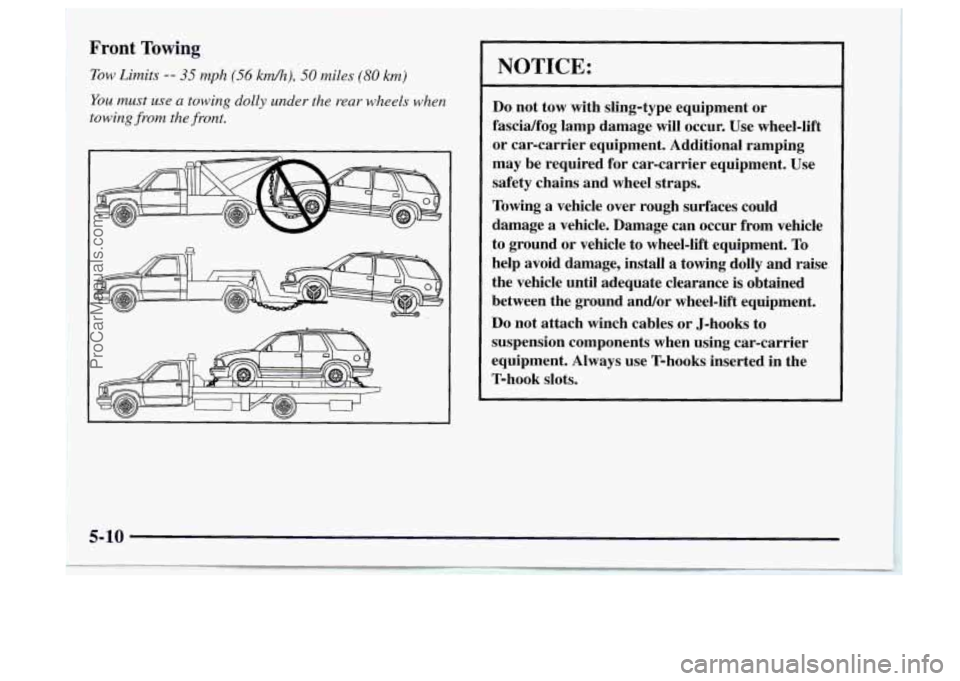
Front Towing
Tow Limits -- 35 mph (56 kd), 50 miles (80 km)
You must use a towing dolly under the rear wheels when
towing
from the front.
NOTICE:
Do not tow with sling-type equipment or
fascidfog lamp damage will occur. Use wheel-lift
or car-carrier equipment. Additional ramping
may be required for car-carrier equipment. Use
safety chains and wheel straps.
Towing
a vehicle over rough surfaces could
damage
a vehicle. Damage can occur from vehicle
to ground or vehicle to wheel-lift equipment. To
help avoid damage, install
a towing dolly and raise
the vehicle until adequate clearance is obtained
between the ground and/or wheel-lift equipment.
Do not attach winch cables or
J-hooks to
suspension components when using car-carrier
equipment. Always use T-hooks inserted in the
T-hook slots.
5-10
ProCarManuals.com
Page 197 of 358
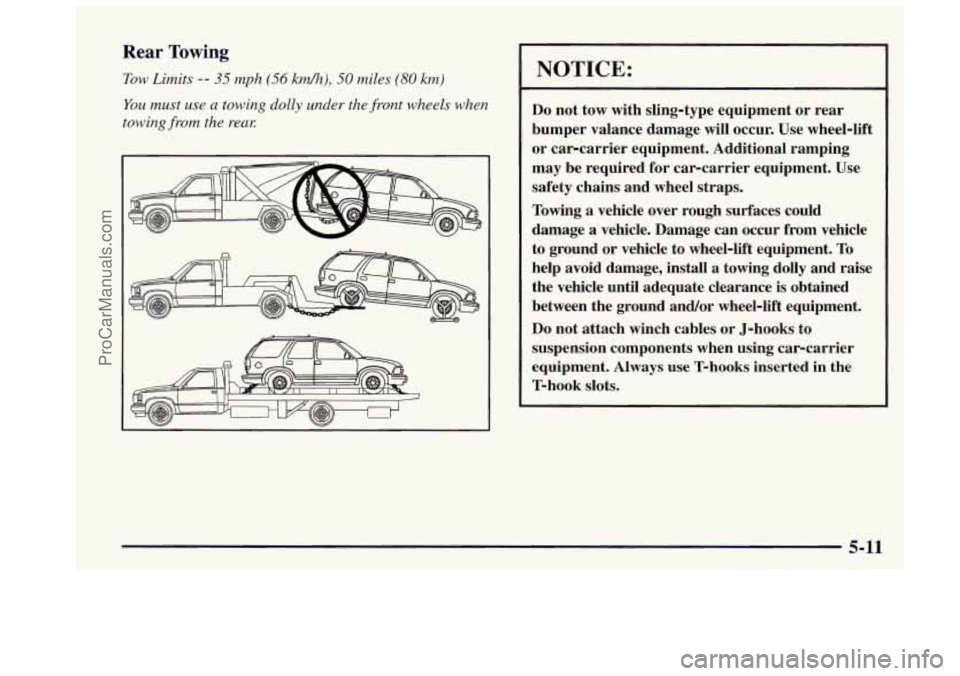
Rear Towing
Tow Limits -- 35 mph (56 km/h), 50 miles (80 km)
YOU must use a towing dolly under the front wheels when
towing from the reax
NOTICE:
Do not tow with sling-type equipment or rear
bumper valance damage will occur. Use wheel-lift
or car-carrier equipment. Additional ramping
may be required for car-carrier equipment. Use
safety chains and wheel straps.
Towing a vehicle over rough surfaces could
damage a vehicle. Damage can occur from vehicle
to ground or vehicle to wheel-lift equipment.
To
help avoid damage, install a towing dolly and raise
the vehicle until adequate clearance is obtained
between the ground and/or wheel-lift equipment.
Do not attach winch cables or J-hooks to
suspension components when using car-carrier
equipment. Always use
T-hooks inserted in the
T-hook slots.
5-11
ProCarManuals.com
Page 262 of 358

Wheel Alignment and Tire Balance
The wheels on your vehicle were aligned and balanced
carefully at the factory
to give you the longest tire life
and best overall performance.
Scheduled wheel alignment and wheel balancing are not
needed. However,
if you notice unusual tire wear or
your vehicle pulling one way or the other, the alignment
may need to be met.
If you notice your vehicle
vibrating when driving
on a smooth road, your wheels
may need to be rebalanced.
Wheel Replacement
Replace any wheel that is bent, cracked, or badly rusted
or corroded.
If wheel nuts keep coming loose, the wheel,
wheel bolts and wheel nuts should be replaced.
If the
wheel leaks air, replace it (except some aluminum
wheels, which can sometimes be repaired). See your
Oldsmobile retailer
if any of these conditions exist.
Your retailer
will know the kind of wheel you need.
Each new wheel should have the same load-carrying
capacity, diameter, width, offset and be mounted the
same way as the one
it replaces.
If you need to replace any of your wheels, wheel bolts or
wheel nuts, replace them only with new GM original
equipment parts. This way, you will be sure to have the right
wheel, wheel bolts and wheel nuts for your Oldsmobile.
I
Using the wrong replacement wheels, wheel bolts
or wheel nuts on your vehicle can be dangerous.
It could affect the braking and handling of your
vehicle, make your tires lose air and make you
lose control. You could have
a collision in which
you
or others could be injured. Always use the
correct wheel, wheel bolts and wheel nuts
for replacement.
NOTICE:
The wrong wheel can also cause problems with
bearing life, brake cooling, speedometer or
odometer calibration, headlamp aim, bumper height, vehicle ground clearance and tire
clearance to the body and chassis.
See "Changing a Flat Tire"
in the Index for
more information.
ProCarManuals.com