oil OLDSMOBILE BRAVADA 1997 Owners Manual
[x] Cancel search | Manufacturer: OLDSMOBILE, Model Year: 1997, Model line: BRAVADA, Model: OLDSMOBILE BRAVADA 1997Pages: 358, PDF Size: 18.02 MB
Page 7 of 358

Vehicle Symbols
These are some of the symbols you may find on your vehicle.
For exumple,
thesc bymbols
aIe used on an
original battery:
POSSIBLE A
CAUTION
INJURY
PROTECT EYES BY
SHIELDING
CAUSTIC
ACID COULD
BATTERY
CAUSE
BURNS
AVOID
SPARKS
OR
FLAMES
SPARK
OR ,111,
COULD FLAME
EXPLODE BATTERY DOOR
LOCK
UNLOCK
FASTEN
&
BELTS SEAT
WINDOW
f j
POWER '* __ I
SIGNALS 6 @
TURN
RUNNING
* 0 DAYTIME . .
LAMPS *'*
FOG LAMPS # 0
WINDSHIELD
WIPER
WINDSHIELD DEFROSTER
WINDOW
DEFOGGER
VENTILATING
**
These sylnbols
are used on
warning and
indicator lights:
COOLANT -
TEMP -
CHARGING I-1
BATTERY SYSTEM
BRAKE
(a)
COOLANT a
ENGINE OIL
PRESSURE
Wb
ANTI-LOCK (@)
BRAKES
Here are some
other synbols
you may see:
FUSE
P
LIGHTER
HORN
)tr
SPEAKER
b
FUEL I&
V
ProCarManuals.com
Page 69 of 358

To Use the Coolant Heater
1. Turn off the engine.
2. Open the hood and unwrap the electrical cord.
3. Plug it into a normal, grounded 1 10-volt AC outlet.
[ON:
-
Plugging the cord into an ungrounded outlet
could cause an electrical shock.
Also, the wrong
kind
of extension cord could overheat and cause
a fire.
You could be seriously injured. Plug the
cord into a properly grounded three-prong
110-volt
AC outlet. If the cord won’t reach, use a
heavy-duty three-prong extension cord rated for
at least
15 amps.
4. Before starting the engine, be sure to unplug and store
the cord as it was before to keep it away fi-om moving
engine
parts. If you don’t, it could be damaged. How
long should you keep the coolant heater plugged
in? The answer depends on the outside temperature, the
kind
of oil you have, and some other things. Instead of
trying to list everything here, we ask that you contact
your Oldsrnobile retailer in the area where you’ll be
parking your vehicle. The retailer can give you the best
advice for that particular area.
Automatic Transmission Operation
P
R
N
03
3
2
1
There are several different
positions for your
shift lever.
PARK (P): This locks your rear wheels. It’s the best
position to use when you start your engine because your
vehicle can’t move easily.
2-15
ProCarManuals.com
Page 113 of 358
Have you recently changed brands of fuel‘?
If so, be sure to fuel your vehicle with quality fuel (see
“Fuel” in the Index). Poor fuel quality will cause your
engine not
to run as efficiently as designed. You may
notice this as stalling after start-up, stalling when you
put the vehicle into gear, misfiring, hesitation
on
acceleration or stumbling on acceleration. (These
conditions may go away once the engine is warmed up.)
This will
be detected by the system and cause the light
to turn on.
If you experience one or more of these conditions,
change the fuel brand you use.
It will require at least one
full tank of the proper fuel to turn the light off.
If none of the above steps have made the light turn off,
have your retailer or qualified service center check the
vehicle. Your retailer has
the proper test equipment and
diagnostic tools to fix any mechanical
or electrical
problems that may have developed.
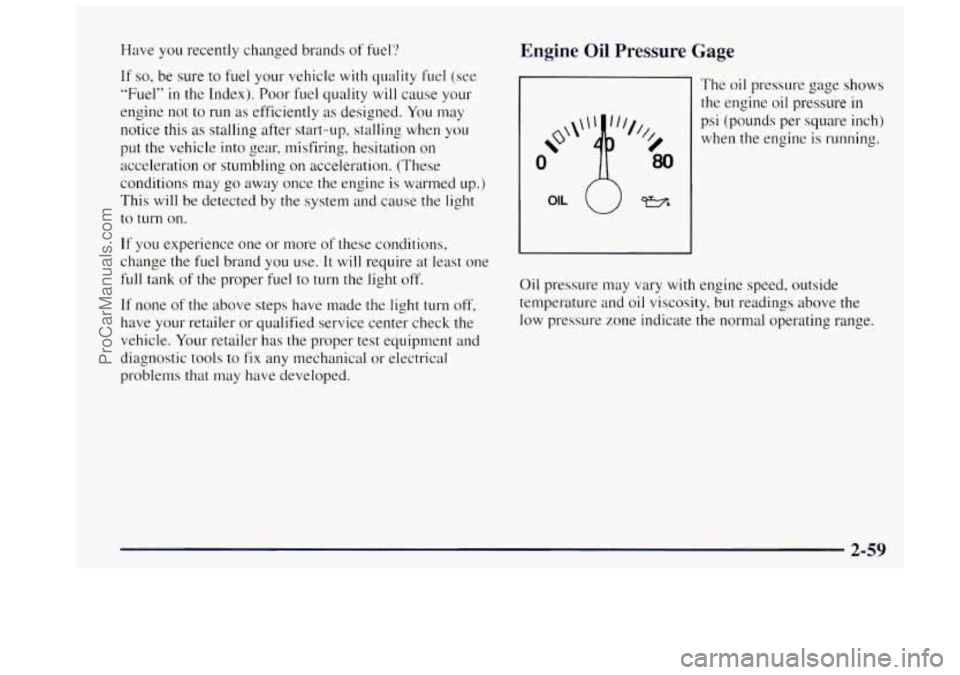
Engine Oil Pressure Gage
OIL 0-
The oil pressure gage shows
the engine oil pressure
in
psi (pounds per square inch)
when the engine is running.
Oil pressure may vary with engine speed, outside
temperature and
oil viscosity, but readings above the
low pressure zone indicate the normal operating range.
2-59
ProCarManuals.com
Page 114 of 358

A reading in the low pressure zone may be caused by a
dangerously low oil level or other problems causing low
oil pressure.
Don’t keep driving if the oil pressure is low. If
you do, your engine can become so hot that it
catches fire. You or others could be burned.
Check your
oil as soon as possible and have yo1
vehicle serviced.
NOTICE:
Damage to your engine from neglected oil
problems can be costly and is not covered by
your warranty.
Daytime Running Lamps Indicator Light
:::(-J 0.0
Check Gages Light
CHECK
GAGES
You may have t.his light on
the instrument panel.
It goes on whenever the
DRL are on, the ignition is
on, the headlamp switch is
off and the parking brake
is released.
The
CHECK GAGES light
will come on briefly when
you are starting the engine.
If the light comes on and
stays on while
you are
driving, check your coolant
temperature and engine oil
pressure gages to see
if they
are
in the warning zones.
2-60
ProCarManuals.com
Page 132 of 358

Care of Your Cassette Tape Player
A tape player that is not cleaned regularly can cause
reduced sound quality, ruined cassettes or a damaged
mechanism. Cassette tapes should be stored
in their
cases away from contaminants, direct sunlight and
extreme heat. If they aren’t,
they may not operate
properly or may cause failure of the tape player.
Your tape player should be cleaned regularly after every
50 hours of use. If you notice a reduction in sound
quality, try
a known good cassette to see if it is the tape
or the tape player at fault.
If this other cassette has no
improvement in sound quality, clean the tape player.
Cleaning may be done with
a scrubbing action,
non-abrasive cleaning cassette
with pads which scrub
the tape head
as the hubs of the cleaner cassette turn. It
is normal for the cassette to eject while cleaning. Insert
the cassette at least three times to ensure thorough
cleaning.
A scrubbing action cleaning cassette is
available through your Oldsmobile retailer.
You may also choose
a non-scrubbing action, wet-type
cleaner which uses
a cassette with a fabric belt to clean
the tape head. This type of cleaning cassette
will not
eject and, it may not clean as thoroughly as the
scrubbing type cleaner. Cassettes are subject to wear and the sound quality
may
degrade over time. Always make sure the cassette tape is in
good condition before you have your tape player serviced.
Care of Your Compact Discs
Handle discs carefully. Store
them in their original cases
or other protective cases and away from direct sunlight
and dust.
If the surface of a disc is soiled, dampen a
clean, soft cloth in a mild, neutral detergent solution and
clean
it, wiping from the center to the edge.
Be sure never to touch the signal surface when handling
discs. Pick
up discs by grasping the outer edges or the
edge of the hole and the outer edge.
Fixed Mast Antenna
The fixed mast antenna can withstand most car washes
without being damaged.
If the mast should ever become
slightly bent, you can straighten
it out by hand. If the
mast is badly bent,
as it might be by vandals, you should
rep1 ace
it .
Check every once in a while to be sure the mast is still
tightened
to the fender.
3-16
ProCarManuals.com
Page 167 of 358

Once you are moving on the freeway, make certain you
allow a reasonable following distance. Expect to move
slightly slower at night.
When you want to leave the freeway, nwve to the proper
lane well
in advance. If you miss your exit, do not,
under any circumstances, stop and back up. Drive on to
the next exit.
The exit ramp can be curved, sometimes quite sharply.
The exit speed is usually posted.
Reduce your speed according to your speedometer, not
to your sense
of motion. After driving for any distance
at higher speeds, you may tend to
think you are going
slower than you actually are.
Before Leaving on a Long Trip
Make sure you're ready. Try to be well rested. lf you
must start when you're not fresh
-- such as after a day's
work
-- don't plan to make too many miles that first part
of the journey. Wear comfortable clothing and shoes you
can easily drive
in.
Is your vehicle ready for a long trip'! If you keep it
serviced and maintained, it's ready to go. If it needs
service, have
it done before starting out. Of course,
you'll find experienced and able service experts
in
Oldsmobile retailers all across North America. They'll
be ready and
willing to help if you need it.
Here are some things you can check before a trip:
0
0
0
0
0
0
0
Wildshield Wnsher Fluid: Is the reservoir full'? Are
all windows clean inside and outside'?
Wiper
Blades: Are they in good shape'?
Frwl, EIlgirw Oil, Other Fluids: Have YOU checked
all levels'?
Lcrnzps: 4re they all working? Are the lenses clean'?
Tires: They are vitally important to
a safe,
trouble-free trip.
Is the tread good enough for
long-distance driving? Are the tires
a11 inflated to the
recommended pressure?
Welrther
Forcmsts: What's the weather outlook
along your route? Should you delay your trip a short
time to avoid
a major storm system'?
A4ups: Do you have up-to-date maps'?
4-35
ProCarManuals.com
Page 184 of 358

When You Are Ready to Leave After
Parking on a Hill
1. Apply your regular brakes and hold the pedal down
while you:
0 Start your engine;
0 Shift into a gear; and
0 Release the parking brake.
2. Let up on the brake pedal.
3. Drive slowly until the trailer is clear of the chocks.
4. Stop and have someone pick up and store the chocks.
Maintenance When Trailer Towing
Your vehicle will need service more often when you’re
pulling a trailer. See the Maintenance Schedule for more
on this. Things that are especially important
in trailer
operation are automatic transmission fluid (don’t
overfill), engine
oil, axle lubricant, belt, cooling system
and brake adjustment. Each of these
is covered in this
manual, and the Index will help you find them quickly.
If you’re trailering, it’s a good idea to review these
sections before you start your trip.
Check periodically to see that all hitch nuts and bolts
are tight.
4-52
ProCarManuals.com
Page 200 of 358

When you decide it’s safe to lift the hood, here’s what
you’ll see:
A. Coolant Recovery Tank
B. Radiator Pressure Cap
C. Engine Fan
/II CAUTION:
An electric fan under the hood can start up even
when the engine is not running and can injure
you. Keep hands, clothing and
tools away from
any underhood electric fan.
If the coolant inside the coolant recovery tank is boiling,
don’t
do anything else until it cools down.
5-14
ProCarManuals.com
Page 202 of 358

How to Add Coolant to the Coolant
Recovery Tank
If you haven’t found a problem yet, but the coolant level
isn’t at the
ADD mark, add a 50/50 mixture of clean
water (preferably distilled) and DEX-COOL TM
(silicate-free) antifreeze at the coolant recovery tank.
(See “Engine Coolant’’ in the Index for more
information.)
Adding only plain water to your cooling system
can be dangerous. Plain water, or some other
liquid like alcohol, can boil before the proper
coolant mix will. Your vehicle’s coolant warning
system is set for the proper coolant mix. With
plain water or the wrong mix, your engine could
get too hot but you wouldn’t get the overheat
warning. Your engine could catch fire and you or
others could be burned. Use a
50/50 mix of clean
water and
DEX-COOL coolant.
I NOTICE:
In cold weather, water can freeze and crack the
engine, radiator, heater core and other parts.
Use the recommended coolant and the proper
coolant mix.
5-16 -
ProCarManuals.com
Page 213 of 358

A CAUTION:
I - -
Never use oil or grease on studs or nuts. If YOU
do, the nuts might come loose. Your wheel could
fall off, causing
a serious accident.
1
7. Place the spare on the wheel mounting surface.
8. Put the nuts on by
hand. Make sure the
cone-shaped end
is
toward the wheel.
Tighten each
nut by hand
until the wheel
is held
against the hub.
If a nut
can’t be turned by hand,
use the wheel wrench
and see your retailer
as
soon as possible.
I
9. Lower the vehicle by turning the jack handle
counterclockwise. Lower the jack completely.
5-27
-
ProCarManuals.com