tires OLDSMOBILE BRAVADA 1998 User Guide
[x] Cancel search | Manufacturer: OLDSMOBILE, Model Year: 1998, Model line: BRAVADA, Model: OLDSMOBILE BRAVADA 1998Pages: 380, PDF Size: 19.2 MB
Page 184 of 380

Driving Through Deep Standing Water
NOTICE:
If you drive too quickly through deep puddles or
standing water, water can come in through your
engine’s air intake and badly damage your
engine. Never drive through water that
is slightly
lower than the underbody
of your vehicle. If you
can’t avoid deep puddles or standing water, drive
through them very slowly.
Some Other Rainy Weather Tips
0 Besides slowing down, allow some extra following
distance. And be especially careful when you pass
another vehicle.
Allow yourself more clear room
ahead, and be prepared to have your view restricted
by road spray.
Have good tires with proper tread depth.
(See “Tires”
in the Index.)
City Driving
One of the biggest problems with city streets is the
amount of traffic on them.
You’ll want to watch out for
what the other drivers are doing and pay attention
to
traffic signals.
4-32
ProCarManuals.com
Page 187 of 380
Here are some things you can check before a trip:
Windshield Washer Fluid: Is the reservoir full? Are
all windows clean inside and outside?
Wiper Blades: Are they in good shape?
Fuel, Engine Oil, Other Fluids: Have you checked
all levels?
Lamps: Are they all working? Are the lenses clean?
Tires: They are vitally important to a safe,
trouble-free trip.
Is the tread good enough for
long-distance driving? Are the tires all inflated to the
recommended pressure?
Weather Forecasts: What’s the weather outlook
along your route? Should you delay your trip a short
time to avoid
a major storm system?
Maps: Do you have up-to-date maps?
Highway Hypnosis
Is there actually such a condition as “highway hypnosis”?
Or is it just plain falling asleep at the wheel? Call
it
highway hypnosis, lack of awareness, or whatever.
There is something about an easy stretch of road with the
same scenery, along with the
hum of the tires on the road,
the drone of the engine, and the rush
of the wind against
the vehicle that can make you sleepy. Don’t let it happen
to you! If
it does, your vehicle can leave the road in less
than a second, and you could crash and be injured.
What can you do about highway hypnosis? First, be
aware that it can happen.
Then here are some tips:
Make sure your vehicle is well ventilated, with a
comfortably cool interior.
Keep your eyes moving. Scan the road ahead
and to the sides. Check your mirrors and your
instruments frequently.
If you get sleepy, pull off the road into a rest, service
or parking area and take a nap, get some exercise, or
both. For safety, treat drowsiness on the highway as
an emergency.
4-35
ProCarManuals.com
Page 188 of 380

Hill and Mountain Roads
Driving on steep hills or mountains is different from
driving in flat or rolling terrain.
If
you drive regularly in steep country, or if you're
planning to visit there, here are some tips that
can make
your trips safer and more enjoyable. (See "Off-Road
Driving" in the Index
for information about driving
off-road.)
0
0
Keep your vehicle in good shape. Check all fluid
levels and
also the brakes, tires, cooling system and
transmission. These
parts can work hard on
mountain roads.
Know how to
go down hills. The most important
thing to know is this: let
your engine do some of the
slowing down. Shift to a lower gear when
you go
down a steep or long hill.
If you don't shift down, your brakes could get
so hot that they wouldn't work well. You would
then have poor braking or even none going
down
a hill. You could crash. Shift down to let
your engine assist your brakes on
a steep I
1 downhill slope.
4-36
ProCarManuals.com
Page 190 of 380

Winter Driving
Here are some tips for winter driving:
Have your vehicle in good shape for winter.
0 You may want to put winter emergency supplies in
your vehicle. Include
an ice scraper, a small brush or broom, a supply
of windshield washer fluid, a rag, some winter outer
clothing,
a small shovel, a flashlight, a red cloth and
reflective warning triangles. And,
if you will be driving
under severe conditions, include
a small bag of sand, a
piece of old carpet or a couple of burlap bags to help
provide traction. Be sure you properly secure these
items in your vehicle.
Driving on Snow or Ice
Most of the time, those places where your tires meet the
road probably have good traction.
However, if there is snow or ice between your tires and
the road, you can have a very slippery situation. You’ll
have a lot less traction or “grip” and will need to be
very careful.
4-38
ProCarManuals.com
Page 191 of 380
--
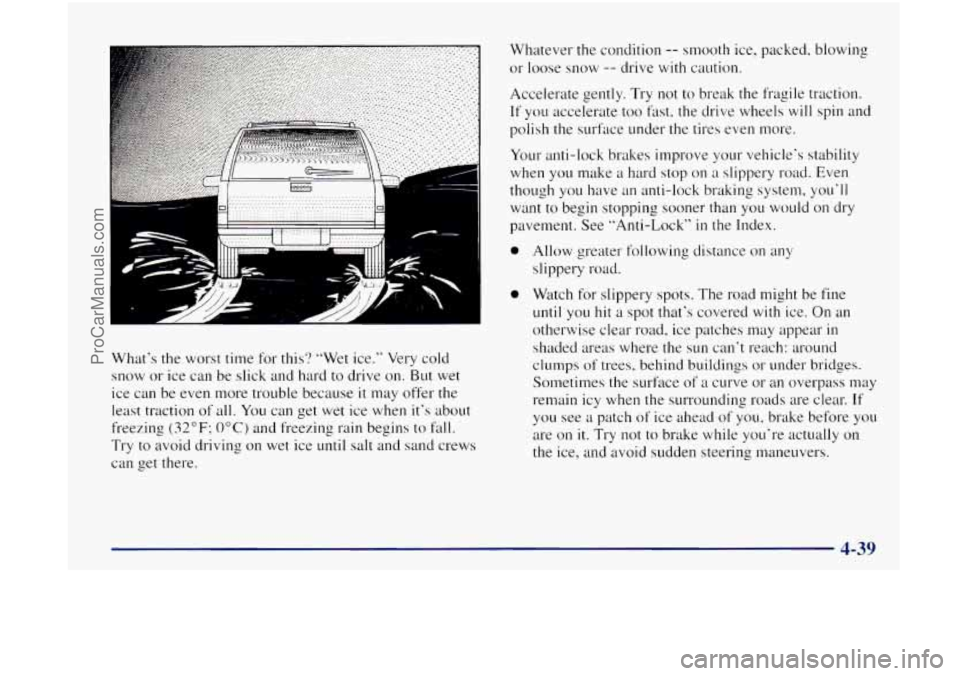
What’s the worst time for this? “Wet ice.” Very cold
snow
or ice can be slick and hard to drive on. But wet
ice can be even more trouble because
it may offer the
least traction of all. You can get wet ice when it’s about
freezing
(32°F; 0°C) and freezing rain begins to fall.
Try to avoid driving on wet ice until salt and sand crews
can get there. Whatever
the condition
-- smooth ice, packed
or loose snow
-- drive with caution.
Accelerate gently. Try
not to break the fragile
If you accelerate too fast, the drive wheels wil
polish the surface under the tires even more.
, blowing
traction.
.I spin and
Your anti-lock brakes improve your vehicle’s stability
when
you make a hard stop on a slippery road. Even
though you have an anti-lock braking system, you‘ll
want to begin stopping sooner- than
you would on dry
pavement. See “Anti-Lock“
in the Index.
0 Allow greater following distance on any
slippery road.
0 Watch for slippery spots. The road might be fine
until you hit a spot that’s covered with ice. On an
otherwise clear road, ice patches may appear
in
shaded areas where the sun can’t reach: around
clumps
of trees, behind buildings or under bridges.
Sometimes the surface of a curve
or an overpass may
remain icy when the surrounding roads are clear.
If
you see a patch of ice ahead of you, brake before you
are
on it. Try not to brake while you’re actually on
the ice, and avoid sudden steering maneuvers.
4-39
ProCarManuals.com
Page 194 of 380
Loading Your Vehicle
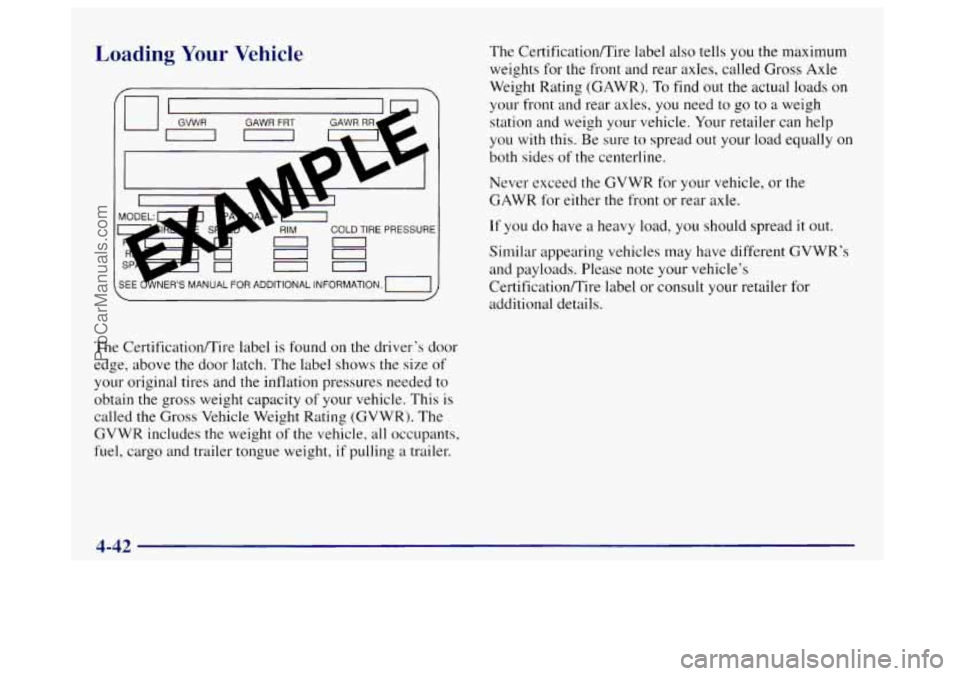
The Certificationnire label is found on the driver’s door
edge, above the door latch. The label shows the size of
your original tires and the inflation pressures needed to
obtain the gross weight capacity of your vehicle. This is
called the Gross Vehicle Weight Rating (GVWR). The
GVWR includes the weight
of the vehicle, all occupants,
fuel, cargo and trailer tongue weight,
if pulling a trailer. The
Certificatioflire label also tells you the maximum
weights for the front and rear axles, called Gross Axle
Weight Rating (GAWR).
To find out the actual loads on
your front and rear axles, you need to go to a weigh
station and weigh your vehicle. Your retailer can help
you with this. Be sure to spread out your load equally on
both sides of the centerline.
Never exceed the GVWR
for your vehicle, or the
GAWR for either the front
or rear axle.
If you do have a heavy load, you should spread it out.
Similar appearing vehicles may have different GVWR’s
and payloads. Please note your vehicle’s
CertificationITire label or consult your retailer for
additional details.
ProCarManuals.com
Page 198 of 380

Three important considerations have to do with weight:
the weight of the trailer,
0 the weight of the trailer tongue
and the weight on your vehicle’s tires.
Weight of the Trailer
How heavy can a trailer safely be?
It should never weigh more than
5,000 lbs. (2 270 kg).
But even that can be too heavy.
It depends on how you plan to use your rig. For
example, speed, altitude, road grades, outside
temperature and how much your vehicle is used to pull a
trailer are all important. And, it can also depend on any
special equipment that you have on your vehicle.
You can ask your retailer for our trailering information
or advice, or you can write
us at:
Oldsmobile Customer Assistance
P.O. Box 30095
Lansing,
MI 48909
In Canada, write to:
General Motors
of Canada Limited
Customer Communication Centre
1908 Colonel Sam Drive
Oshawa, Ontario L1H 8P7
Weight of the Trailer Tongue
The tongue load (A) of any trailer is an important
weight to measure because it affects the total or gross
weight
of your vehicle. The Gross Vehicle Weight
(GVW) includes the curb weight of the vehicle, any
cargo you may carry in it, and the people who will be
riding in the vehicle. And if you will tow
a trailer, you
must add the tongue load to the GVW because your
vehicle will be carrying that weight, too. See “Loading
Your Vehicle” in the Index for more information about
your vehicle’s maximum load capacity.
4-46
ProCarManuals.com
Page 199 of 380

Total Weight on Your Vehicle’s Tires
Be sure your vehicle’s tires are inflated to the upper
limit for cold tires. You’ll find these numbers on the
CertificatiodTire label on the driver‘s door edge, above
the door latch or see “Tire Loading”
in the Index. Then
be sure you don‘t go over the
GVW limit for your
vehicle, including the weight
of the trailer tongue.
A B
If you’re using a weight-carrying hitch, the trailer
tongue
(A) should weigh 10 percent of the total loaded
trailer weight
(B). If you’re using a weight-distributing
hitch, the trailer tongue (A) should weigh 12 percent of
the total loaded trailer weight
(B).
After you‘ve loaded your trailer, weigh the trailer and
then the tongue, separately, to see if the weights are
proper. If they aren’t,
you may be able to get them right
simply by moving
some items around in the trailer.
Hitches
It’s important to have the correct hitch equipment.
Crosswinds, large trucks going by and rough roads are
a few reasons why you’ll need the right hitch. Here are
some rules to follow:
0 If you’ll be pulling a trailer that, when loaded, will
weigh more than
2,000 lbs. (900 kg), be sure to use
a properly mounted, weight-distributing hitch and
sway control
of the proper size. This equipment is
very important for proper vehicle loading and good
handling
when you‘re driving.
0 Will you have to make any holes in the body of your
vehicle when you install
a trailer hitch?
If you do, then be sure to seal the holes later when
you remove the hitch.
If you don‘t seal them, deadly
carbon monoxide
(CO) from your exhaust can get
into your vehicle (see “Carbon Monoxide?’
in the
Index). Dirt and water can,
too.
4-47
ProCarManuals.com
Page 201 of 380

Driving with a Trailer
If you have a rear-most window open and you
pull
a trailer with your vehicle, carbon monoxide
(CO) could come into your vehicle. You can’t see
or smell CO. It can cause unconsciousness or
death. (See “Engine Exhaust”
in the Index.) To
maximize your safety when towing a trailer:
Have your exhaust system inspected for leaks,
and make necessary repairs before
starting on your trip.
Keep the rear-most windows closed.
0 If exhaust does come into your vehicle
through
a window in the rear or another
opening, drive with your front, main
heating or cooling system on and with the
fan on any speed. This will bring fresh,
outside air into your vehicle.
Do not use
MAX A/C because it only recirculates the
air inside your vehicle. (See “Comfort
Controls” in the Index.) Towing
a trailer requires a certain amount
of experience.
Before setting out for the open road, you’ll want to get
to know your rig. Acquaint yourself with the feel
of
handling and braking with the added weight of the
trailer. And always keep
in mind that the vehicle you are
driving is now
a good deal longer and not nearly as
responsive as your vehicle is
by itself.
Before you start, check the trailer hitch and platform
(and attachments), safety chains, electrical connector,
lamps, tires and mirror adjustment.
If the trailer has
electric brakes, start your vehicle and trailer moving and
then apply the trailer brake controller by hand to be sure
the brakes are working.
This lets you check your
electrical connection at the same time.
During your
trip, check occasionally to be sure that the
load is secure,
and that the lamps and any trailer brakes
are still working.
4-49
ProCarManuals.com
Page 214 of 380

Towing Your Vehicle
Try to have a GM retailer or a professional towing
service tow your vehicle. See “Roadside Assistance”
in
the Index.
If your vehicle has been changed since
it was
factory-new
by adding things like fog lamps, aero
skirting, or special tires and wheels, these instructions
may
not be correct.
Before you do anything, turn on the hazard
warning flashers.
When you call, tell
the towing service:
0 That your vehicle has all-wheel drive.
0 The make, model and year of your vehicle.
0 Whether you can move the shift lever for
the transmission.
0 If there was an accident, what was damaged. When
the towing service
arrives, let the tow operator
know that this manual contains these towing
instructions. The operator may want to see them.
5-8
ProCarManuals.com