lights Oldsmobile Bravada 2003 s User Guide
[x] Cancel search | Manufacturer: OLDSMOBILE, Model Year: 2003, Model line: Bravada, Model: Oldsmobile Bravada 2003Pages: 410, PDF Size: 20.1 MB
Page 224 of 410

When you drive over obstacles or rough terrain, keep a
firm grip on the steering wheel. Ruts, troughs or
other surface features can jerk the wheel out of your
hands
if you’re not prepared.
When you drive over bumps, rocks, or other obstacles,
your wheels can leave the ground.
If this happens,
even with one or two wheels, you can’t control
the vehicle as well or at all.
Because you will be on an unpaved surface, it’s
especially important
to avoid sudden acceleration,
sudden turns or sudden braking.
In a way, off-road driving requires a different kind of
alertness from driving on paved roads and highways.
There are no road signs, posted speed limits or
signal lights.
You have to use your own good judgment
about what is safe and what isn’t.
Drinking and driving can be very dangerous on any
road. And this is certainly true for off-road driving. At the
very time you need special alertness and driving
skills, your reflexes, perceptions and judgment can be
affected by even a small amount of alcohol.
You
could have a serious - or even fatal - accident if you
drink and drive or ride with a driver who has been
drinking. See
Drunken Driving on page 4-2.
Driving on Off-Road Hills
Off-road driving often takes you up, down or across a
hill. Driving safely on hills requires good judgment
and understanding of what your vehicle can and can’t
do. There are some hills that simply can’t be driven, no
matter how well bui he vehicle.
Man) ills are ~..-.ply .,o steep for any vehicle.
If you drive up them, you will stall. If you drive
down them, you can’t control your speed.
If you
drive across them, you
will roll over. You could
be seriously injured or killed. If you have any
doubt about the steepness, don’t drive the hill.
Approaching a Hill
When you approach a hill, you need to decide if it’s one
of those hills that’s just
too steep to climb, descend
or cross. Steepness can be hard to judge. On a very
small hill, for example, there may be a smooth, constant
incline with only a small change in elevation where
you can easily see all the way to the top. On a large hill,
the incline may get steeper as you near the top, but
you may not see this because the crest
of the hill
is hidden by bushes, grass or shrubs.
4-1 9
Page 281 of 410
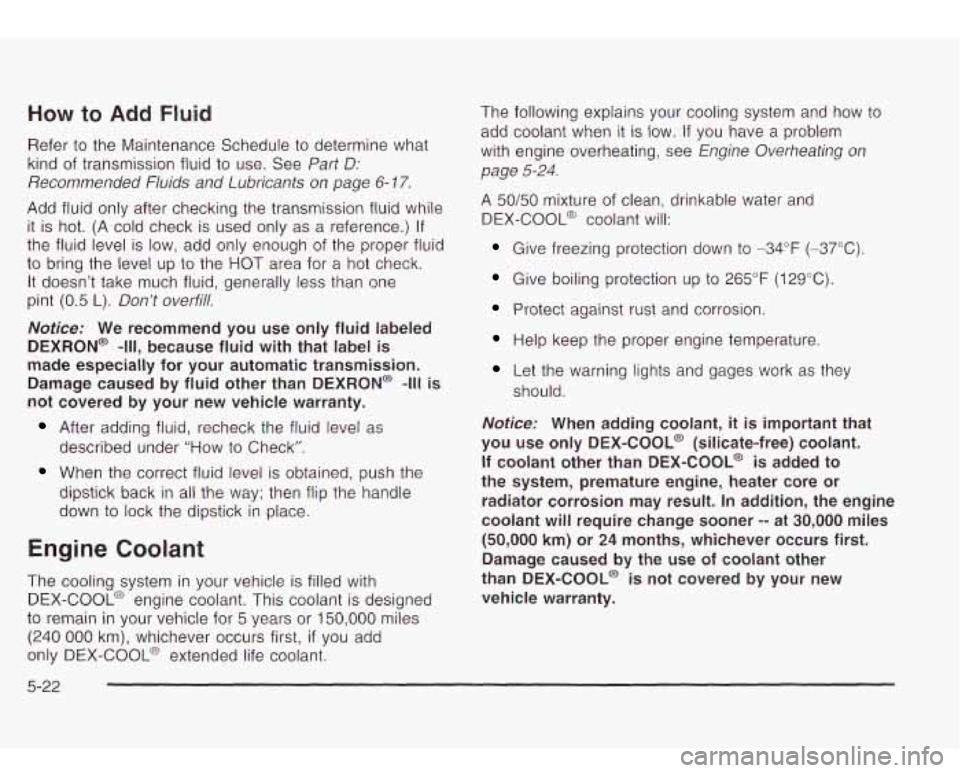
How to Add Fluid
Refer to the Maintenance Schedule to determine what
kind of transmission fluid
to use. See Part D:
Recommended Fluids and Lubricants on page 6- 17.
Add fluid only after checking the transmission fluid while
it is hot.
(A cold check is used only as a reference.) If
the fluid level is low, add only enough of the proper fluid
to bring the level up
to the HOT area for a hot check.
It doesn’t take much fluid, generally less than one
pint (0.5 L).
Don’t overfill.
Notice: We recommend you use only fluid labeled
DEXRON@
-111, because fluid with that label is
made especially for your automatic transmission.
Damage caused by fluid other than DEXRON@
-111 is
not covered by your new vehicle warranty.
After adding fluid, recheck the fluid level as
described under “How
to Check”.
When the correct fluid level is obtained, push the
dipstick back
in all the way; then flip the handle
down
to lock the dipstick in place.
Engine Coolant
The cooling system in your vehicle is filled with
DEX-COOL@ engine coolant. This coolant is designed
to remain in your vehicle for 5 years or 150,000 miles
(240 000 km), whichever occurs first, if you add
only DEX-COOL@ extended life coolant. The following explains
your cooling system and how
to
add coolant when it is low. If you have a problem
with engine overheating, see
Engine Overheating on
page 5-24.
A 50/50 mixture of clean, drinkable water and
DEX-COOL@ coolant will:
Give freezing protection down to -34°F (-37°C).
Give boiling protection up to 265°F (129°C).
Protect against rust and corrosion.
Help keep the proper engine temperature.
Let the warning lights and gages work as they
should.
Notice: When adding coolant, it is important that
you use only
DEX-COOL@ (silicate-free) coolant.
If coolant other than DEX-COOL@ is added to
the system, premature engine, heater core or
radiator corrosion may result. In addition, the engine
coolant will require change sooner
-- at 30,000 miles
(50,000 km) or 24 months, whichever occurs first.
Damage caused by the
use of coolant other
than DEX-COOL@
is not covered by your new
vehicle warranty.
5-22
Page 402 of 410
Underbody Flushing Service ..... ..... 6-14
Understanding Radio Reception
..................... 3-89
Uniform Tire Quality Grading
............................ 5-57
United States ................................................... 7-4
Using
Using
Using
Using Cleaner
on Fabric
.................................. 5-78
HomeLinka
........................................... 2-39
Song List Mode
..................................... 3-75
RDS ............................................ 3-60, 3-69
v
Vehicle
Control
........................................................ 4-5
Damage Warnings
........................................... iv
Loading
...................................................... 4-41
Symbols ..................................................... iv
Number (VIN)
............................................. 5-85
Service Parts Identification Label
................... 5-85
Vehicle Personalization
Memory Seat
.............................................. 2-47
Vehicle Storage
.............................................. 5-38
Video Screen ................................................. 3-78
Vinyl
............................................................. 5-79
Visor Vanity Mirror
.......................................... 2-15
Visors
........................................................... 2-1 5
Voltmeter Gage .............................................. 3-32
Vehicle
Identification
W
Warning Lights. Gages and Indicators ................ 3-28
Warnings DIC Warnings and Messages
........................ 3-52
Hazard Warning Flashers
............................... 3-5
Other Warning Devices
.................................. 3-6
Safety and Symbols
......................................... III
Vehicle Damage .............................................. iv
Washing Your Vehicle
......................... ...... 5-80
Weatherstrip Lubrication ............................... 6-11
Weight of the Trailer
........................................ 4-47
Weight of the Trailer Tongue
............................. 4-48
What Kind of Engine Oil
to Use ........................ 5-16
What to Add
.................................................. 5-36
What
to Do with Used Oil ................................ 5-18
What
to Use .................................. 5-23, 5-33, 5-46
Wheels
...
Alignment and Tire Balance .......................... 5-58
Replacement
............................................... 5-58
When to Add Engine Oil .................................. 5-15
When to Change Engine Oil
(GM Oil Life System)
................................... 5-17
When to Check .............................................. 5-53
When
to Check and Change ............................ 5-20
When
to Check Lubricant ................................. 5-46
When
to Check Power Steering Fluid ................ 5-33
When
You Are Ready to Leave After
Parking on a Hill
......................................... 4-52
Where
to Put the Restraint ............................... 1-35
15