maintenance Oldsmobile Bravada 2003 s User Guide
[x] Cancel search | Manufacturer: OLDSMOBILE, Model Year: 2003, Model line: Bravada, Model: Oldsmobile Bravada 2003Pages: 410, PDF Size: 20.1 MB
Page 263 of 410
Doing Your Own Service Work
-
1 If you want to do some of your own service work, you’ll
want
to use the proper service manual. It tells you
much more about how
to service your vehicle than this
manual can. To order the proper service manual,
see
Service Publications Ordering Information on
page
7-10.
Your vehicle has an air bag system. Before attempting
to do your own service work, see Servicing Your Air
Bag-Equipped Vehicle on page
1-55.
You should keep a record with all parts receipts and list
the mileage and the date of any service work you
perform. See
Part E: Maintenance ”lcord on page 6-19.
__ --Jre you have s __ nowle e,
experience, the proper replacement parts
and tools before you attempt any vehicle
maintenance task.
Be sure to use the proper nuts, bolts and
other fasteners. “English” and “metric”
fasteners can be easily confused.
If you
use the wrong fasteners, parts can later
break or fall
off. You could be hurt.
Adding Equipment to the Outside of
Your Vehicle
-1 Things you might add to the outside of your vehicle can
affect the airflow around
it. This may cause wind
noise and affect windshield washer performance. Check
with your dealer before adding equipment
to the
outside
of your vehicle.
1 A can be injured an, jour vehicle could be
damaged
if you try to do service work on a
vehicle without knowing enough about
it.
CAUTION: (Continued)
5-4
Page 264 of 410
Fuel
Use of the recommended fuel is an important part of the
proper maintenance of your vehicle.
Gasoline Octane
Use regular unleaded gasoline with a posted octane
of
87 or higher. If the octane is less than 87, you may
get a heavy knocking noise when you drive. If this
occurs, use a gasoline rated at
87 octane or higher as
soon as possible. Otherwise, you might damage
your engine.
A little pinging noise when you accelerate
or drive uphill is considered normal. This does not
indicate a problem exists or that a higher-octane fuel is
necessary. If you are using
87 octane or higher-octane
fuel and hear heavy knocking, your engine needs
service.
Gasoline Specifications
It is recommended that gasoline meet specifications
which were developed by the American Automobile
Manufacturers Association and endorsed by the
Canadian Vehicle Manufacturers Association for better
vehicle performance and engine protection. Gasoline meeting these specifications could provide improved
driveability and emission control system performance
compared
to other gasoline.
-1 In Canada, look for the
“Auto Makers’ Choice” label on the pump.
Canada Only
5-5
Page 278 of 410
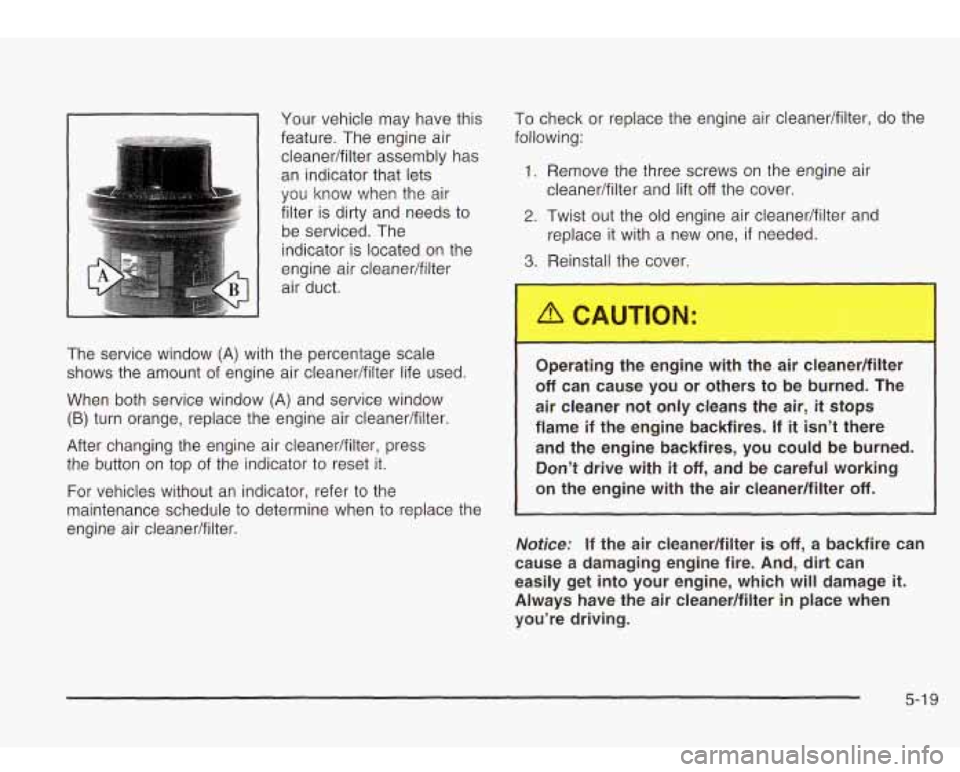
1-1 Your vehicle may have this
feature. The engine air cleanedfilter assembly has
an indicator that lets
you know when the air
filter is dirty and needs to
be serviced. The
indicator is located on the
engine air cleaner/filter
air duct.
The service window
(A) with the percentage scale
shows the amount of engine air cieanedfilter life used.
When both service window
(A) and service window
(B) turn orange, replace the engine air cleanedfilter
After changing the engine air cleaner/filter, press
the button on top of the indicator to reset it.
For vehicles without an indicator, refer
to the
maintenance schedule to determine when
to replace the
engine air cleaner/filter. To
check or replace the engine air cleaner/filter, do the
following:
1. Remove the three screws on the engine air
2. Twist out the old engine air cleaner/filter and
3. Reinstall the cover.
cleanedfilter and lift
off the cover.
replace it with a new one,
if needed.
per
______ ~ ---e eng.--> with the air cleaner/filter
off can cause you or others to be burned. The
air cleaner not only cleans the air,
it stops
flame if the engine backfires.
If it isn’t there
and the engine backfires, you could be burned. Don’t drive with
it off, and be careful working
on the engine with the air cleanedfilter
off.
Notice: If the air cleaner/filter is off, a backfire can
cause a damaging engine fire.
And, dirt can
easily get into your engine, which will damage
it.
Always have the air cleaner/filter in place when
you’re driving.
5-1 9
Page 281 of 410
How to Add Fluid
Refer to the Maintenance Schedule to determine what
kind of transmission fluid
to use. See Part D:
Recommended Fluids and Lubricants on page 6- 17.
Add fluid only after checking the transmission fluid while
it is hot.
(A cold check is used only as a reference.) If
the fluid level is low, add only enough of the proper fluid
to bring the level up
to the HOT area for a hot check.
It doesn’t take much fluid, generally less than one
pint (0.5 L).
Don’t overfill.
Notice: We recommend you use only fluid labeled
DEXRON@
-111, because fluid with that label is
made especially for your automatic transmission.
Damage caused by fluid other than DEXRON@
-111 is
not covered by your new vehicle warranty.
After adding fluid, recheck the fluid level as
described under “How
to Check”.
When the correct fluid level is obtained, push the
dipstick back
in all the way; then flip the handle
down
to lock the dipstick in place.
Engine Coolant
The cooling system in your vehicle is filled with
DEX-COOL@ engine coolant. This coolant is designed
to remain in your vehicle for 5 years or 150,000 miles
(240 000 km), whichever occurs first, if you add
only DEX-COOL@ extended life coolant. The following explains
your cooling system and how
to
add coolant when it is low. If you have a problem
with engine overheating, see
Engine Overheating on
page 5-24.
A 50/50 mixture of clean, drinkable water and
DEX-COOL@ coolant will:
Give freezing protection down to -34°F (-37°C).
Give boiling protection up to 265°F (129°C).
Protect against rust and corrosion.
Help keep the proper engine temperature.
Let the warning lights and gages work as they
should.
Notice: When adding coolant, it is important that
you use only
DEX-COOL@ (silicate-free) coolant.
If coolant other than DEX-COOL@ is added to
the system, premature engine, heater core or
radiator corrosion may result. In addition, the engine
coolant will require change sooner
-- at 30,000 miles
(50,000 km) or 24 months, whichever occurs first.
Damage caused by the
use of coolant other
than DEX-COOL@
is not covered by your new
vehicle warranty.
5-22
Page 294 of 410
If it is, you should have your brake system fixed, since a
leak means that sooner or later your brakes won’t
work well, or won’t work at all.
So, it isn’t a good idea to “top off’ your brake fluid.
Adding brake fluid won’t correct a leak. If you add fluid
when your linings are worn, then you’ll have too
much fluid when you get new brake linings. You should
add (or remove) brake fluid, as necessary, only when
work is done on the brake hydraulic sys+-n.
Checking Brake Fluid
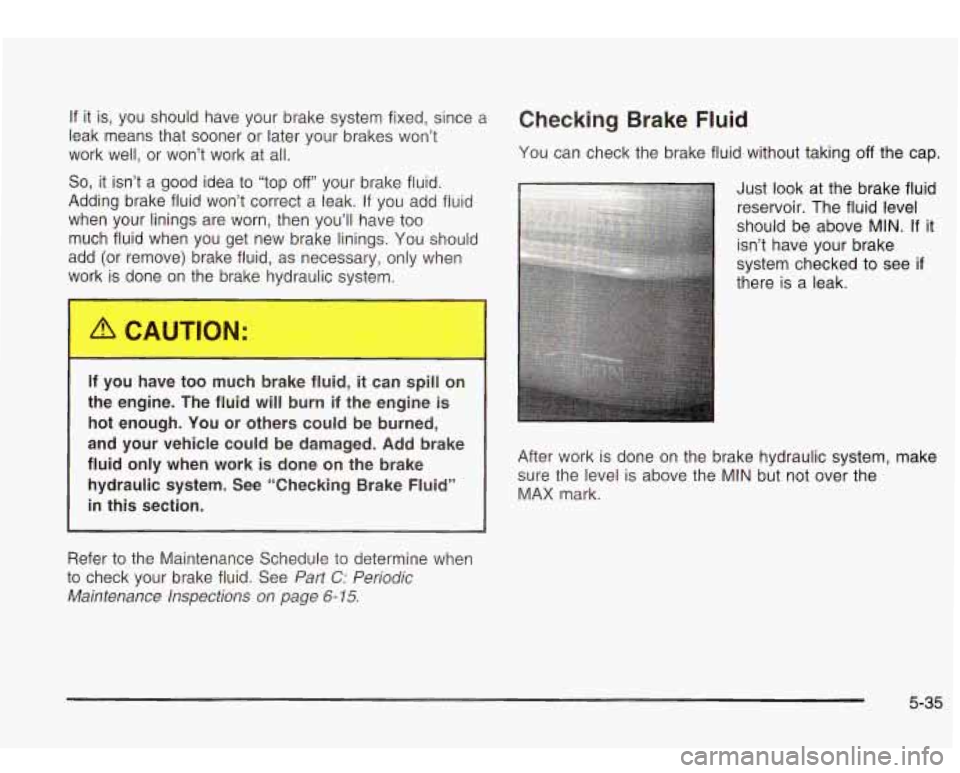
You can check the brake fluid without taking off the cap.
If you have too much brake fluid, it can spill on
the engine. The fluid will burn if the engine is
hot enough. You or others could be burned,
and your vehicle could be damaged. Add brake
fluid only when work is done
on the brake
hydraulic system. See “Checking Brake Fluid”
in this section.
Refer to the Maintenance Schedule to determine when
to check your brake fluid. See
farf C: Periodic
Maintenance Inspections on
page 6- 15.
After work is done on the brake hydraulic system, make
sure the level is above the MIN but not
over the
MAX mark.
5-35
Page 297 of 410
Battery
Your new vehicle comes with a maintenance free
ACDelco@ battery. When it’s time for a new battery, get
one that has the replacement number shown on the
original battery’s label. We recommend an ACDelco@
battery. See
Engine Compartment Overview on
page
5-72 for battery location.
Warning: Battery posts, terminals and related
accessories contain lead and lead compounds,
chemicals known to the State of California to cause
cancer and reproductive harm. Wash hands after handling.
Vehicle Storage
If you’re not going to drive your vehicle for 25 days or
more, remove the black, negative
(-) cable from the
battery. This will help keep your battery from
running down.
Batteries ~ -.-ve acid tha- -an burn , -u and gas
that can explode. You can be badly hurt if you
aren’t careful. See “Jump Starting” next for
tips on working around a battery without
getting hurt.
Contact your dealer to learn how to prepare your
vehicle for longer storage periods.
Also, for your audio system, see
Theft-Deterrent
Feature on page
3-88.
5-38
Page 303 of 410

All-Wheel Drive
Lubricant checks in this section also apply to these
vehicles. However, there are
two additional systems that
need lubrication.
Transfer Case
When to Check Lubricant
Refer to the Maintenance Schedule to determine how
often to check the lubricant. See
Part C: Periodic
Maintenance Inspections on page
6- 15.
How to Check Lubricant
To get an accurate
reading, the vehicle should
be on a level surface.
If the level is below the bottom of the filler plug hole,
you’ll need
to add some lubricant. Add enough lubricant
to raise the level
to the bottom of the filler plug hole.
Use care not to overtighten the plug.
What to Use
Refer to the Maintenance Schedule to determine what
kind
of lubricant to use. See Part D: Recommended
Fluids and Lubricants on page
6- 17.
Front Axle
When to Check and Change Lubricant
Refer to the Maintenance Schedule to determine how
often to check the lubricant and when to change it.
5-44
Page 304 of 410

How to Check Lubricant
To get an accurate reading, the vehicle should be on a
level surface. If
the level is below the bottom of the filler plug hole,
you may need to add some lubricant.
When the differential is cold, add enough lubricant to
raise the level to
1/2 inch (12 mm) below the filler plug
hole.
When the differential is at operating temperature
(warm), add enough lubricant to raise the level to the
bottom
of the filler plug hole.
What to Use
Refer to the Maintenance Schedule to determine what
kind
of lubricant to use. See Part D: Recommended
Fluids
and Lubricants on page 6-1 7.
5-45
Page 305 of 410

Rear Axle
When to Check Lubricant
Refer to the Maintenance Schedule to determine how
often to check the lubricant.
How to Check Lubricant
To get an accurate reading, the vehicle should be on a
level surface.
The proper level is from
0 to 3/8 inch (0 to 10 mm)
below the
bottom of the filler plug hole.
What to Use
Refer to the Maintenance Schedule to determine what
kind of lubricant
to use. See Part D: Recommended
Fluids and Lubricants on page
6-17.
5-46
Page 308 of 410

Windshield Wiper Blade Replacement
Windshield wiper blades should be inspected at least
twice a year for wear or cracking.
See
Normal Maintenance Replacement Parts on
page 5-94 for the proper type of replacement blade.
Notice: Use care when removing or installing
a blade assembly. Accidental bumping can cause
the arm
to fall back and strike the windshield.
1. To remove the old wiper blades, lift the wiper arm
until it locks into a vertical position.
A. Blade Assembly
B. Arm Assembly
C. Locking Tab
D. Blade Pivot
E. Hook Slot
F. Arm Hook
5-49