instrument panel OLDSMOBILE CUTLASS 1997 User Guide
[x] Cancel search | Manufacturer: OLDSMOBILE, Model Year: 1997, Model line: CUTLASS, Model: OLDSMOBILE CUTLASS 1997Pages: 353, PDF Size: 16.72 MB
Page 94 of 353
Fog Lamps
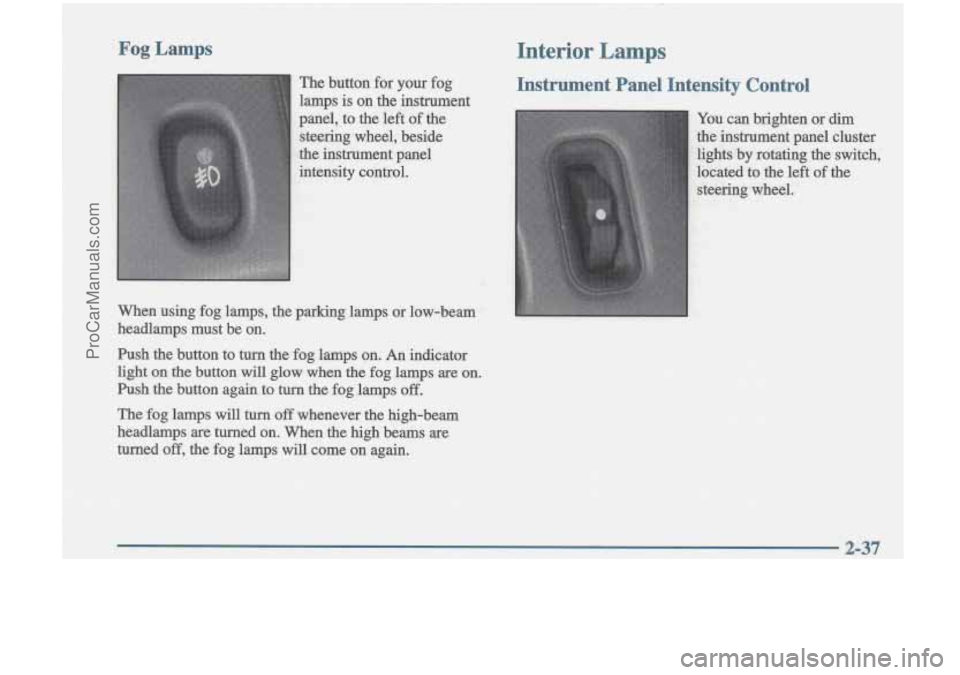
The button for your fog
lamps is on the instrument
panel, to
the left of the
steering .wheel,
beside
the instrument panel
intensity
control.
.
Interior Lamps
Instrument Panel Intensity Control
ProCarManuals.com
Page 103 of 353
Instrument Panel
I
2-46
ProCarManuals.com
Page 104 of 353
Your instrument panel is designed to let you know at a
glance how your vehicle is running. You’ll know how
fast you’re going, how much fuel you’re using, and
many other things you’ll need to drive safely and
economically.
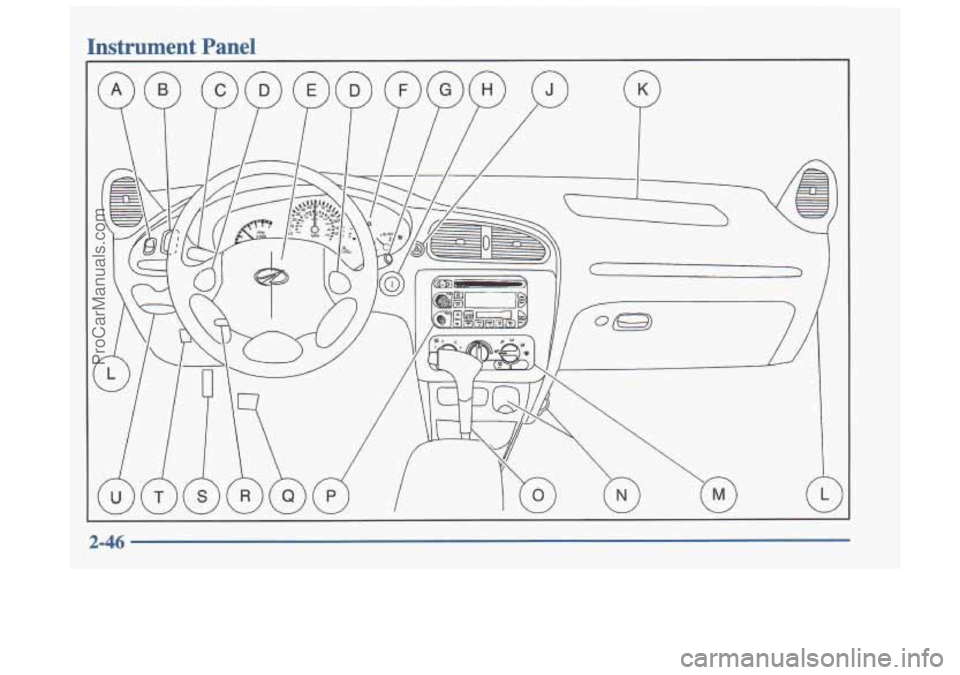
The main components of your instrument panel are:
A. Fog Lamp Switch
B. Instrument Panel intensity Control
C. Turn SignalMultifunction Lever
D. Cruise Control Switches (If Equipped)
E. Supplemental Restraint System (SRS) and Horn
F. Instrument Panel Cluster
G. Windshield Wipermasher Lever
H. Ignition Switch
J. Hazard Warning Flashers Switch
K. Supplemental Restraint System (SRS)
L. Fuse Panels
M. Climate Control System
N. Accessory Power Outlets
0. Gear Shift Lever
P. Audio System
Q. Park Brake Pedal
R. Tilt Wheel Lever
S. Hood Release Lever
T. Trunk Release Button
U. Instrument Panel Cupholder
2-47
-
ProCarManuals.com
Page 105 of 353

Instrument Panel Cluster
Your Oldsmobile is equipped with this cluster, which includes indicator warning lights and gages \
that are explained
on the following pages. Be sure to read them.
I 2-48
ProCarManuals.com
Page 109 of 353
Air Bag Readiness Light
There is an air bag readiness light on the instrument
panel, which shows the air bag symbol. The system
checks the air bag’s electrical system for malfunctions.
The light tells you
if there is an electrical problem.
The system check includes the
air bag sensor, the air
bag modules, the wiring
and the crash sensing and
diagnostic module. For more information on the air
bag system, see “Air Bag” in the Index.
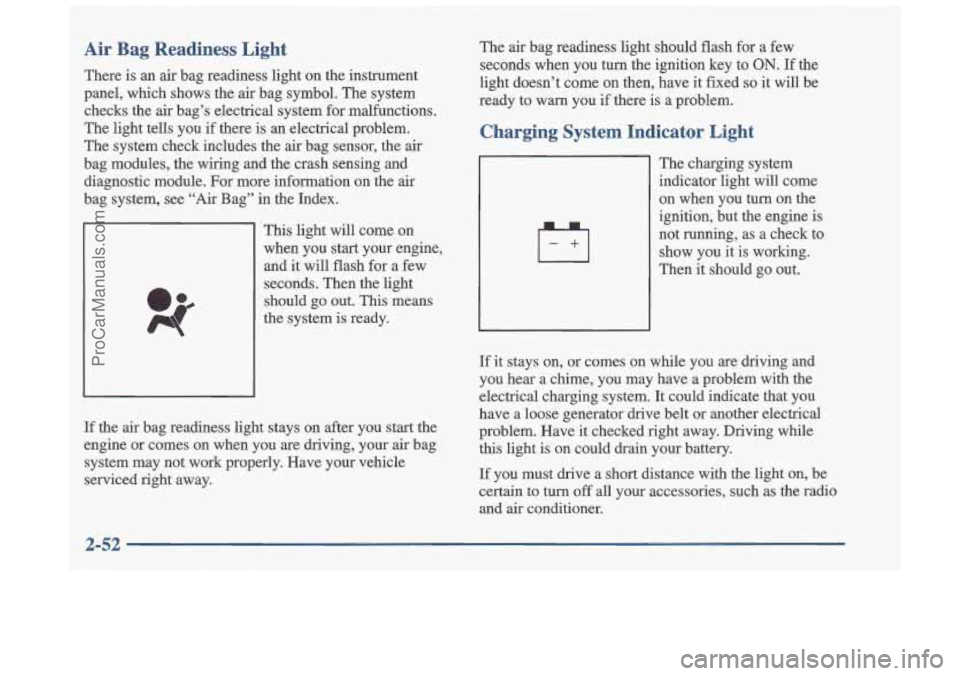
This light will come on
when you start your engine,
and it will flash for a few
seconds. Then the light
should
go out. This means
If the air bag readiness light stays on after you start the
engine
or comes on when you are driving, your air bag
system may not work properly. Have your vehicle
serviced right away. The
air bag readiness light should flash
for a few
seconds when you turn the ignition key to
ON. If the
light doesn’t come on then, have it fixed
so it will be
ready to
warn you if there is a problem.
Charging System Indicator Light
The charging system
indicator light will come
on when you turn
on the
ignition, but the engine is
not running, as a check to
show you it is worhg.
Then it should go out.
If it stays on, or comes on while you are driving and
you hear
a chime, you may have a problem with the
electrical charging system. It could indicate that you
have a loose generator drive belt or another electrical
problem. Have
it checked right away. Driving while
this light is on could drain your battery.
If you must drive a short distance with the light on, be
certain to turn
off all your accessories, such as the radio
and air conditioner.
2-52
ProCarManuals.com
Page 123 of 353
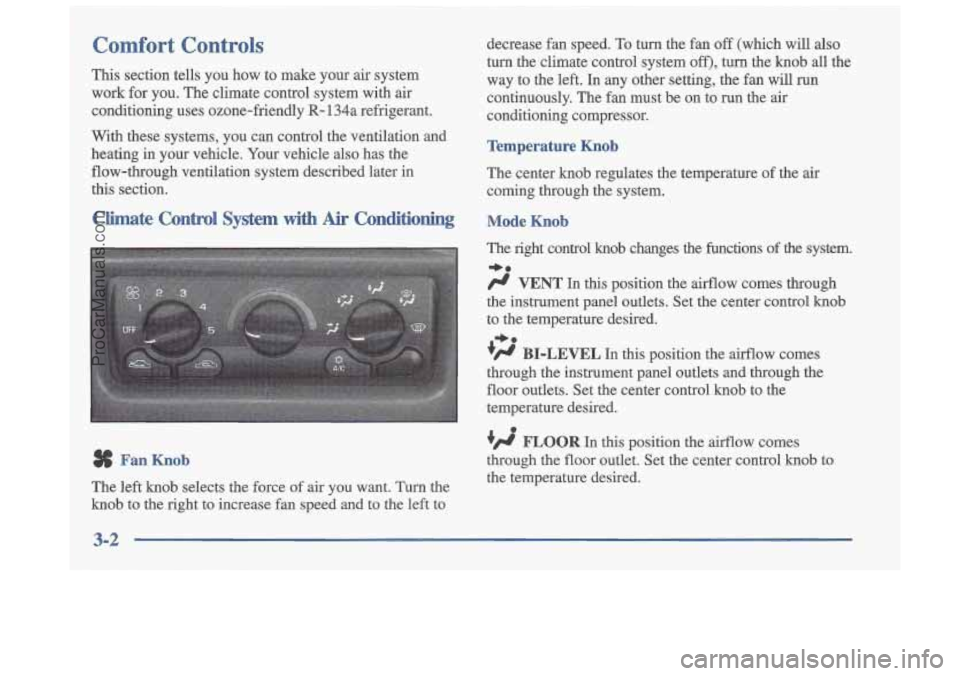
decrease fan speed. To turn the fan off (which will also
turn the climate control system
off), turn the knob all the
Comfort Controls
This section tells you how to make your air system
work for you. The climate control system with air
conditioning uses ozone-friendly
R- 134a refrigerant.
With these systems, you can control the ventilation and heating in your vehicle. Your vehicle also has the
flow-through ventilation system described later in
this section.
Climate Control System with Air Conditioning
sf Fan Knob
The left knob selects the force of air you want. Turn the
knob to the right to increase fan speed and to the left to way to
the left. In any other setting, the fan will
run
continuously. The fan must be on to run the air
conditioning compressor.
Temperature Knob
The center knob regulates the temperature of the air
coming through the system.
Mode Knob
The right control knob changes the functions of the system.
/J VENT In this position the airflow comes through
the instrument panel outlets. Set the center control knob
to the temperature desired.
+# BI-LEVEL In this position the aifflow comes
through the instrument panel outlets and through the
floor outlets. Set the center control knob to the
temperature desired.
+' FLOOR In this position the airflow comes
through the
floor outlet. Set the center control knob to
the temperature desired.
-bo
*e
0
-3-2
ProCarManuals.com
Page 125 of 353
Heating
On cold days, use FLOOR with the temperature knob all
the way in the red area. The system will bring in outside
air, heat it and send it to the floor ducts.
Your vehicle has heat ducts that are directed toward the
rear seat. Keep the area under the front seats clear
of
obstructions so the heated air can reach the rear
seat passengers.
If your vehicle has an engine coolant heater, you can use
it to help your system provide warm
air faster when it’s
cold outside (0°F
(- 18 O C) or lower). An engine coolant
heater warms the coolant your engine and heating system use to provide heat. See “Engine Coolant
Heater” in the Index.
Defogging and Defrosting Windows
Your system has two settings for clearing the front and
side windows. For each setting, adjust the temperature
control as desired.
To defrost the windows quickly, rotate the temperature
control
knob all the way in the red area. Use
DEFROST and adjust the fan to the highest speed.
To warm passengers while keeping the windows clean,
use DEFOG.
Your vehicle is equipped with side window defogger
vents. The side window defogger vents are located on
the outside of the side instrument panel vents. For
additional side window defogging, rotate the mode
control to VENT, rotate the
fan control to the highest
speed, press A/C and aim the side vents on the
instrument panel to the windows. For increased airflow
to the side windows, close the center vents.
RECIRCULATION will not work in DEFROST and
DEFOG. This is done to prevent recirculation of humid
inside air and allow the system to work properly.
ProCarManuals.com
Page 174 of 353
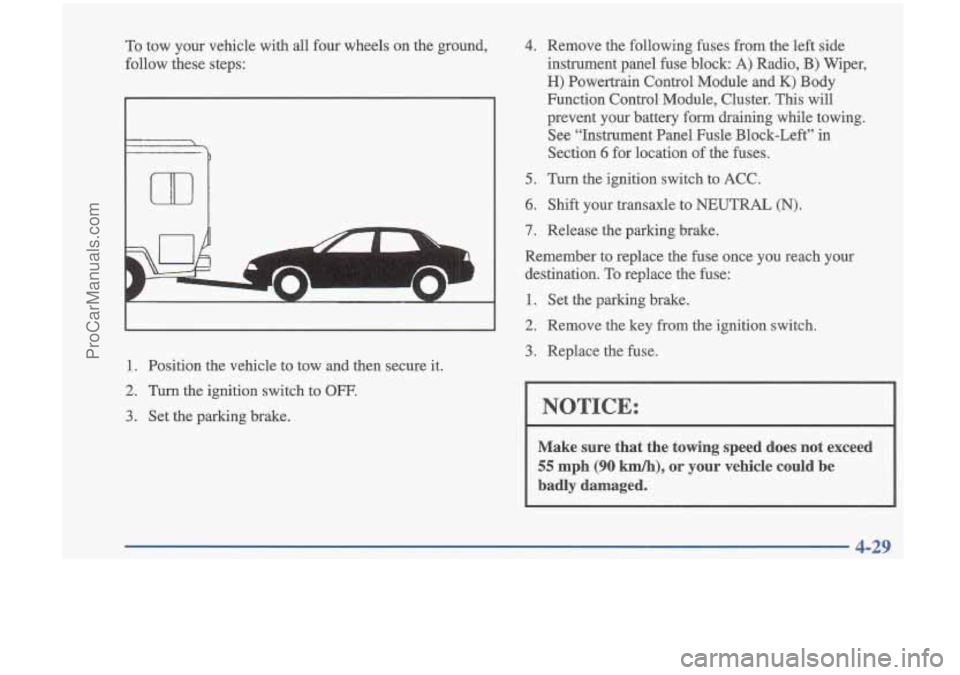
To tow your vehicle with all four wheels on the ground,
follow these steps:
7 ---
1. Position the vehicle to tow and then secure it.
2. Turn the ignition switch to OFF.
3. Set the parking brake.
4. Remove the following fuses from the left side
instrument panel fuse block:
A) Radio, B) Wiper,
H) Powertrain Control Module and K) Body
Function Control Module, Cluster. This will
prevent your battery
form draining while towing.
See “Instrument Panel Fusle Block-Left” in
Section
6 for location of the fuses.
5. Turn the ignition switch to ACC.
6. Shift your transaxle to NEUTRAL (N).
7. Release the parking brake.
Remember
to replace the fuse once you reach your
destination. To replace the fuse:
1. Set the parking brake.
2. Remove the key from the ignition switch.
3. Replace the fuse.
I NOTICE:
Make sure that the towing speed does not exceed
55 mph (90 km/h), or your vehicle could be
badly damaged.
4-29
ProCarManuals.com
Page 183 of 353
Turn Signals When Towing a Trailer
When you tow a trailer, your vehicle may need a
different turn signal flasher and/or extra wiring. Check
with your Oldsmobile retailer. The green arrows on your
instrument panel will flash whenever you signal a
turn
or lane change. Properly hooked up, the trailer lamps
will
also flash, telling other drivers you’re about to turn,
change lanes or stop.
When towing a trailer, the green arrows on your
instrument panel will flash
for turns even if the bulbs on
the trailer are burned out. Thus, you may
think drivers
behind you
are seeing your signal when they are not. It’s
important to check occasionally to be sure the
trailer
bulbs are still working.
Driving On Grades
I NOTICE:
Do not tow on steep continuous grades exceeding
6 miles (9.6 km). Extended, higher than normal
engine and transaxle temperatures may result
and damage your vehicle. Frequent stops are
very important to allow the engine and transaxle
to cool.
Reduce speed and shift to a lower gear before you start
down a long or steep downgrade. If you don’t shift
down, you might have to use your brakes
so much that
they would get hot and no longer work well.
On a long uphill grade, shift down and reduce your speed to around
45 mph (70 kmk) to reduce the
possibility
of engine and transaxle overheating.
Pay attention to the engine coolant gage.
If the indicator
is in the red area,
turn off the air conditioning (if you
have
this option) to reduce engine load (see “Engine
Overheating” in the Index).
4-38
ProCarManuals.com
Page 199 of 353
Engine Overheating
You will find a coolant temperature gage on your
Oldsmobile’s instrument panel. See “Engine Coolant
Temperature Gage” in the Index.
You will also find a
low coolant level warning light on your Oldsmobile’s
instrument panel. See “Low Coolant Warning Light”
in the Index.
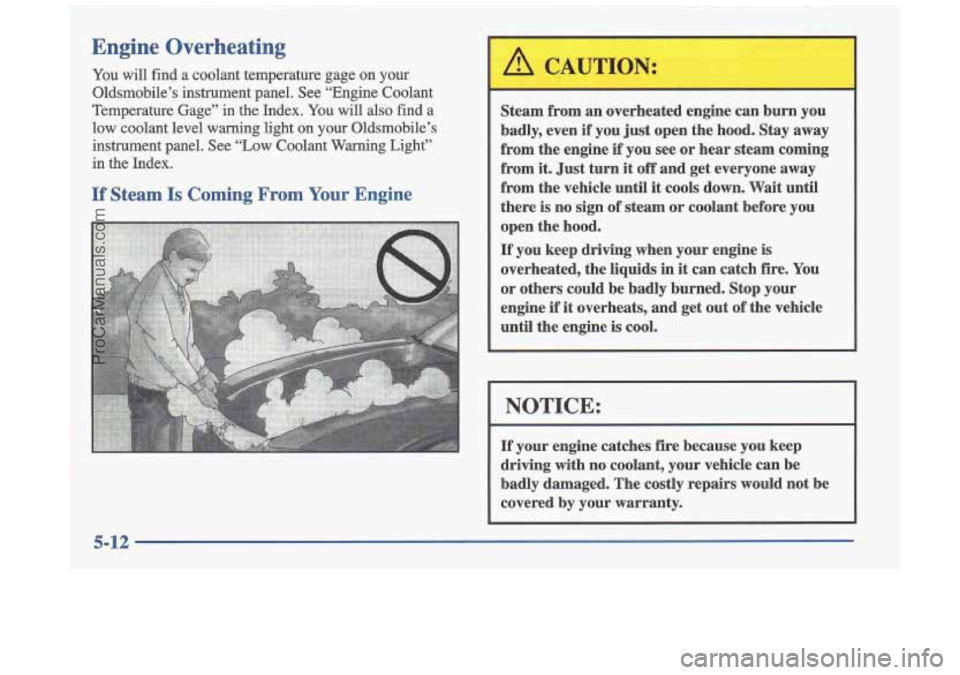
If Steam Is Coming From Your Engine
Steam from an overheated engine can burn you
badly, even if you just open the hood. Stay away
from the engine
if’ you see or hear steam coming
from it. Just turn it
off and get everyone away
from the vehicle until it cools down. Wait until
there
is no sign of steam or coolant before you
open the hood.
If you keep driving when your engine is
overheated, the liquids in it can catch fire. You
or others could be badly burned. Stop your
engine if
it overheats, and get out of the vehicle
until the engine is cool.
I NOTICE:
If your engine catches fire because you keep
driving with no coolant, your vehicle can be
badly damaged. The costly repairs would not be
covered by your warranty.
ProCarManuals.com