steering wheel OLDSMOBILE CUTLASS 1997 User Guide
[x] Cancel search | Manufacturer: OLDSMOBILE, Model Year: 1997, Model line: CUTLASS, Model: OLDSMOBILE CUTLASS 1997Pages: 353, PDF Size: 16.72 MB
Page 158 of 353
0
0
0
0
Check your mirrors, glance over your shoulder, and start your left lane change signal before moving out
of the right lane to pass. When you are far enough
ahead of the passed vehicle to see its front in your
inside mirror, activate your right lane change signal
and move back into the right lane. (Remember that
your right outside mirror is convex. The vehicle you
just passed may seem to be farther away from you
than it really is.)
Try not to pass more than one vehicle at a time on
two-lane roads. Reconsider before passing the
next vehicle.
Don’t overtake a slowly moving vehicle too rapidly.
Even though the brake lamps are not flashing, it may
be slowing down or starting to
turn.
If you’re being passed, make
following driver to get ahead
can ease a little to the right. it easy
for the
of you. Perhaps
you
Loss of Control
Let’s review what driving experts say about what
happens when the three control systems (brakes, steering
and acceleration) don’t have enough friction where the
tires meet the road
to do what the driver has asked.
In any emergency, don’t give up. Keep trying to steer and
constantly seek
an escape route or area of less danger.
Skidding
In a skid, a driver can lose control of the vehicle.
Defensive drivers avoid most skids by taking reasonable
care suited to existing conditions, and by not “overdriving”\
those conditions. But skids are always possible.
The three types
of skids correspond to your
Oldsmobile’s three control systems. In the braking
skid,
your wheels aren’t rolling. In the steering or cornering
skid, too much speed or steering
in a curve causes tires
to slip and lose cornering force. And in the acceleration
skid, too much throttle causes the driving wheels to spin.
4-13
ProCarManuals.com
Page 173 of 353
Run your engine only as long as you must. This saves fuel. When you run the engine, make it go a little faster
than just idle. That is, push the accelerator slightly. Ths
uses less fuel for the heat that you get and it keeps the
battery charged. You will need a well-charged battery to
restart the vehicle, and possibly for signaling later on
with your headlamps. Let the heater run for a while.
Then, shut the engine
off and close the window almost
all the way to preserve the heat. Start the engine again
and repeat this only when you feel really uncomfortable
from the cold. But do it as little as possible. Preserve the
fuel as long as you can. To help keep warm, you can get
out of the vehicle and do some fairly vigorous exercises
every half hour or
so until help comes.
Recreational Vehicle Towing
You can tow your vehicle behind another vehicle for use
at your destination. Be sure to use the proper towing
equipment designed for recreational towing. Follow the
instructions for the towing equipment.
Towing Your Vehicle from the Front
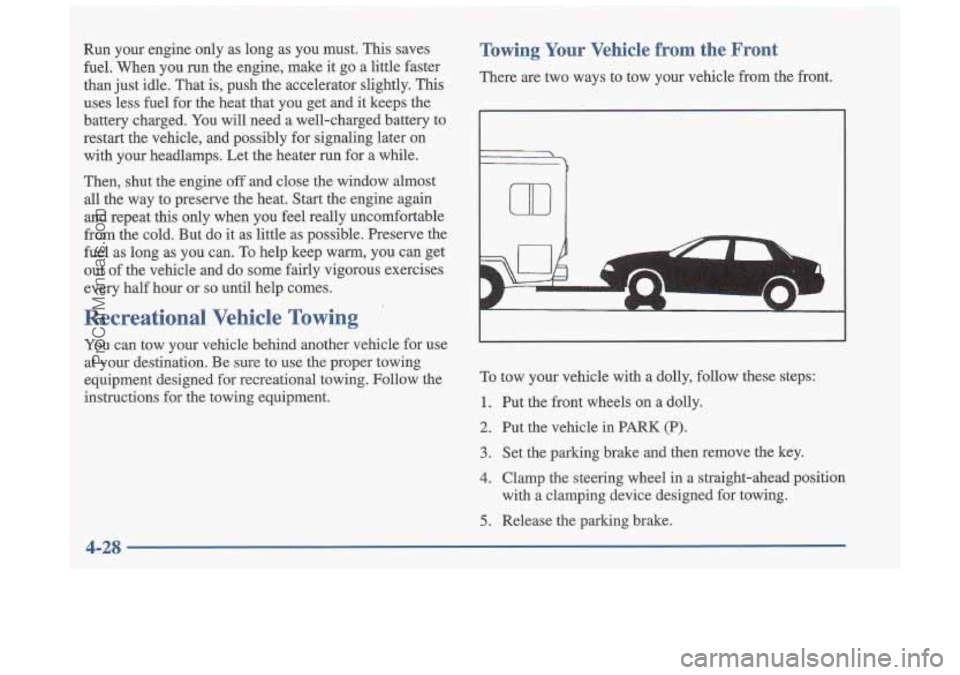
There are two ways to tow your vehicle from the front.
€
m
To tow your vehicle with a dolly, follow these steps:
1. Put the front wheels on a dolly.
2. Put the vehicle in PARK (P).
3. Set the parking brake and then remove the key.
4. Clamp the steering wheel in a straight-ahead position
with a clamping device designed for towing.
5. Release the parking brake.
ProCarManuals.com
Page 182 of 353
Following Distance Making Turns
Stay at
least twice as far behind the vehicle ahead as you
would when driving your vehicle without a trailer. This can help you avoid situations that require heavy braking
and sudden turns.
Passing
You’ll need more passing distance up ahead when
you’re towing a trailer. And, because you’re
a good deal
longer, you’ll need to go much farther beyond the
passed vehicle before you can return to your lane.
Backing Up
Hold the bottom of the steering wheel with one hand.
Then, to move the trailer to the left, just move that hand
to the left.
To move the trailer to the right, move your
hand to the right. Always back up slowly and, if
possible, have someone guide you.
NOTICE:
Making very sharp turns while trailering could
cause the trailer
to come in contact with the
vehicle. Your vehicle could be damaged. Avoid
making very sharp turns while trailering.
When you’re turning with a trailer, make wider turns
than normal. Do this so your trailer won’t strike soft
shoulders, curbs, road signs, trees or other objects.
Avoid jerky or sudden maneuvers. Signal well
in advance.
4-37
ProCarManuals.com
Page 207 of 353
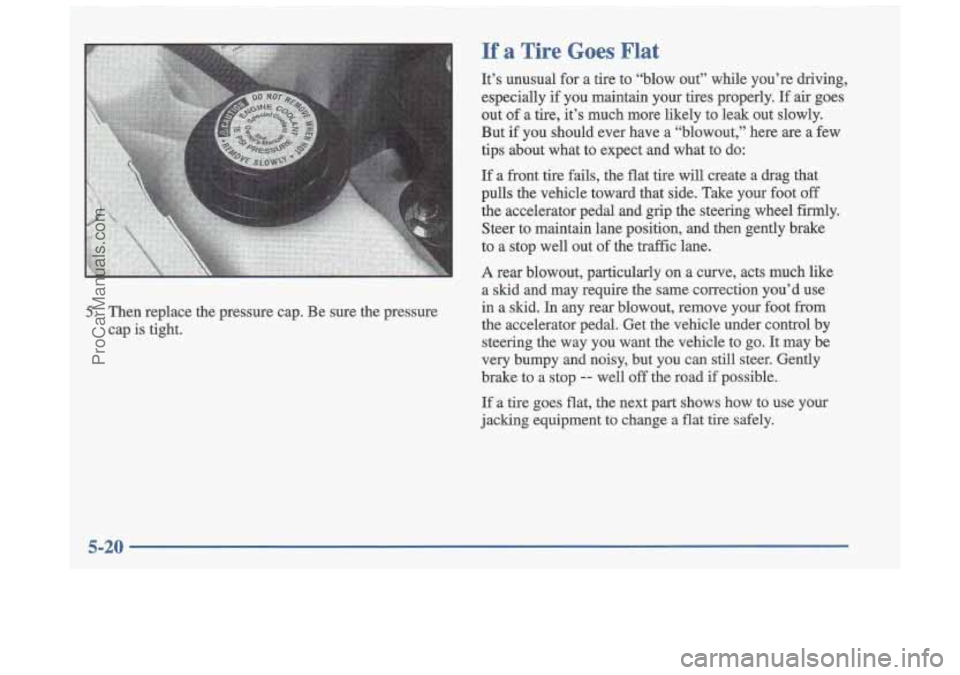
5. Then replace the pressure cap. Be sure the pressure
cap is tight.
If a Tire Goes Flat
It’s unusual for a tire to “blow out” while you’re driving,
especially if you maintain your tires properly. If air goes
out of a tire, it’s much more likely to leak out slowly.
But if you should ever have a “blowout,” here are a few\
tips about what to expect and what to do:
If a front tire
fails, the flat tire will create a drag that
pulls the vehicle toward that side. Take your foot
off
the accelerator pedal and grip the steering wheel firmly.
Steer to maintain lane position, and then gently brake
to a stop well out of the traffic lane.
A rear blowout, particularly on a curve, acts much like
a skid and may require the same correction you’d use
in a skid. In any rear blowout, remove your foot from
the accelerator pedal. Get the vehicle under control by
steering the way you want the vehicle to go. It may be
very bumpy and noisy, but you can still steer. Gently
brake to a stop
-- well off the road if possible.
If a tire goes flat, the next part shows how to use your
jacking equipment to change a flat tire safely.
5-20
ProCarManuals.com
Page 220 of 353
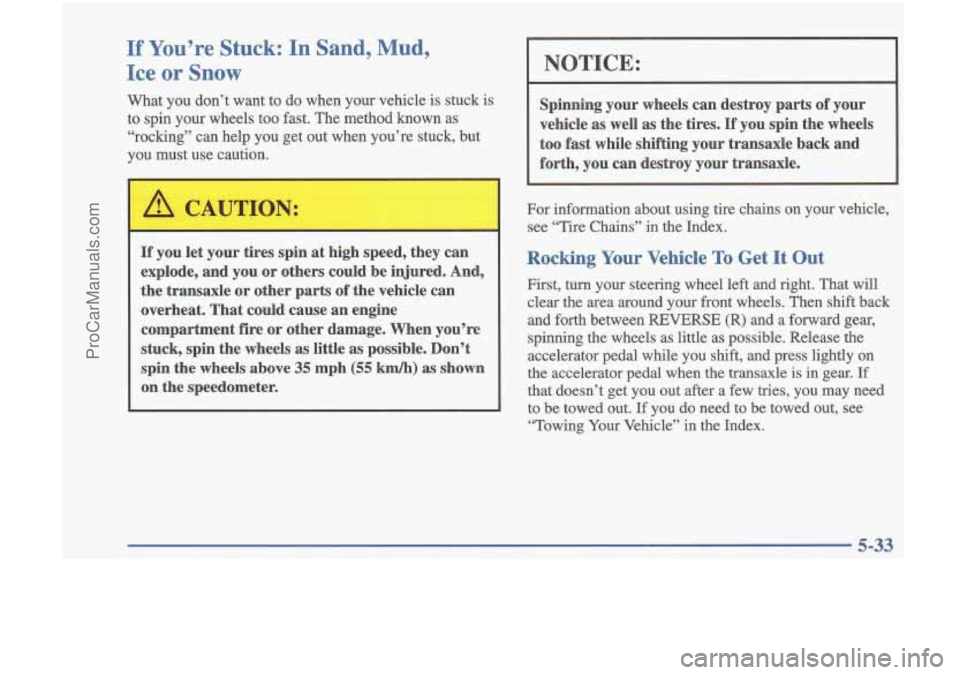
If You’re Stuck: In Sand, Mud,
Ice
or Snow
What you don’t want to do when your vehicle is stuck is
to
spin your wheels too fast. The method known as
“rocking” can help you get out when you’re stuck, but \
you
must use caution.
~ ~~ ~
If you let your tires spin at high speed, they can
explode, and you or others could be injured. And,
the transaxle or other parts of the vehicle can
overheat. That could cause an engine
compartment fire or other damage. When you’re
stuck, spin the wheels as little as possible. Don’t
spin the wheels above
35 mph (55 km/h) as shown
on the speedometer.
NOTICE:
Spinning your wheels can destroy parts of your
vehicle as well as the tires.
If you spin the wheels
too fast whiIe shifting your transaxle back and
forth, you can destroy your transaxle.
For information about using tire chains on your vehicle,
see “Tire Chains” in the Index.
Rocking Your Vehicle To Get It Out
First, turn your steering wheel left and right. That will
clear the area around your front wheels. Then shift back
and forth between REVERSE
(R) and a forward gear,
spinning the wheels as little as possible. Release the
accelerator pedal while you shift, and press lightly
on
the accelerator pedal when the transaxle is in gear. If
that doesn’t get you out after a few tries, you may need
to be towed out. If you do need to be towed out, see
“Towing Your Vehicle” in the Index.
5-33
ProCarManuals.com
Page 324 of 353
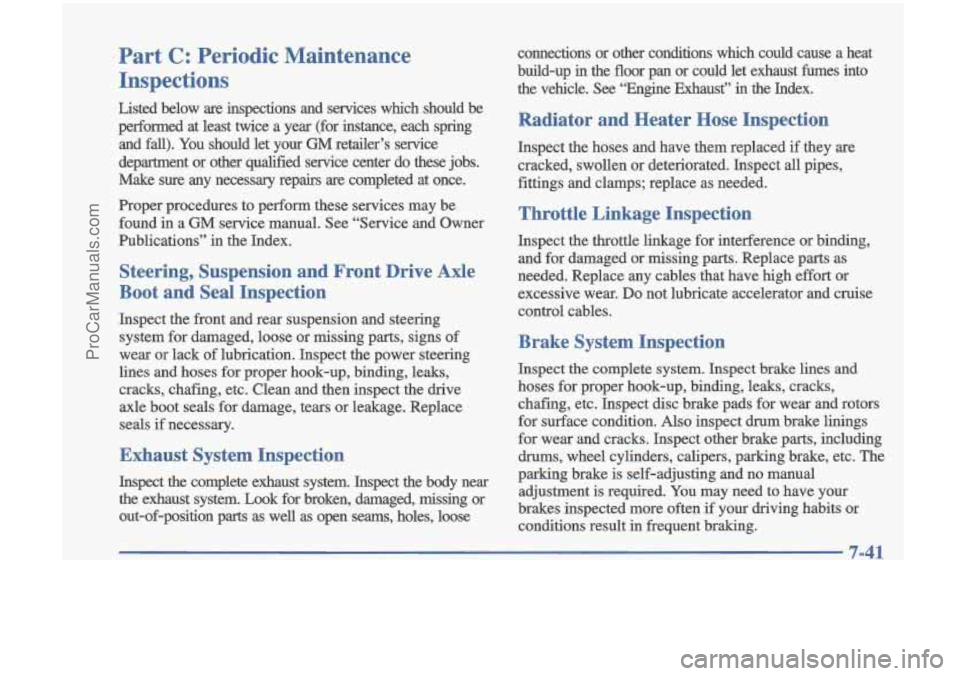
Part C: Periodic Maintenance
Inspections
Listed below are inspections and servlces which should be
performed at least twice a year (for instance, each spring
and fall). You should let your
GM retailer’s service
department or other
qualified service center do these jobs.
Make sure
any necessary repairs are completed at once.
Proper procedures to perform these services may be
found
in a GM service manual. See “Service and Owner
Publications” in the Index.
Steering, Suspension and Front Drive Axle
Boot and Seal Inspection
Inspect the front and rear suspension and steering
system for damaged, loose or missing parts, signs of
wear or lack of lubrication. Inspect the power steering
lines and hoses for proper hook-up, binding, leaks,
cracks, chafing, etc. Clean and then inspect the drive
axle boot seals for damage, tears or leakage. Replace
seals if necessary.
Exhaust System Inspection
Inspect the complete exhaust system. Inspect the body near
the exhaust system.
Look for broken, damaged, missing or
out-of-position parts
as well as open seams, holes, loose connections or other conditions
whch could cause a heat
build-up in the floor pan or could let exhaust fumes into
the vehicle.
See “Engine Exhaust” in the Index.
Radiator and Heater Hose Inspection
Inspect the hoses and have them replaced if they are
cracked, swollen or deteriorated. Inspect all pipes,
fittings and clamps; replace
as needed.
Throttle Linkage Inspection
Inspect the throttle linkage for interference or binding,
and for damaged or missing parts. Replace parts as
needed. Replace
any cables that have high effort or
excessive wear.
Do not lubricate accelerator and cruise
control cables.
Brake System Inspection
Inspect the complete system. Inspect brake lines and
hoses for proper hook-up, binding, leaks, cracks,
chafing, etc. Inspect disc brake pads for wear and rotors
for surface condition.
Also inspect drum brake linings
for wear and cracks. Inspect other brake parts, including
drums, wheel cylinders, calipers, parking brake, etc. The
parking brake is self-adjusting and no manual adjustment is required. You may need
to have your
brakes inspected more often
if your driving habits or
conditions result
in frequent braking.
7-41
ProCarManuals.com
Page 346 of 353
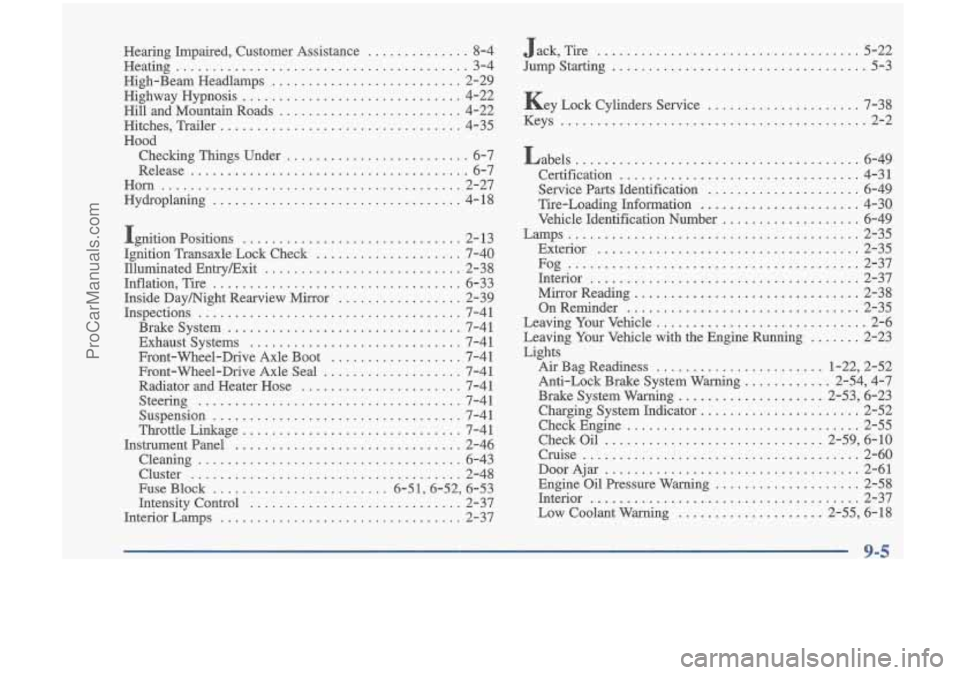
Hearing Impaired. Customer Assistance .............. 8-4
High-Beam Headlamps
.......................... 2-29
Highway Hypnosis
.............................. 4-22
Hill and Mountain Roads
......................... 4-22
Hitches. Trailer
................................. 4-35
Hood
Checking Things Under
......................... 6-7
Release
...................................... 6-7
Horn
......................................... 2-27
Hydroplaning
.................................. 4-18
Ignition Positions
.............................. 2- 13
Ignition Transaxle Lock Check
.................... 7-40
IlluminatedEntryExit
........................... 2-38
Inflation. Tire
.................................. 6-33
Inside Daymight Rearview Mirror
................. 2-39
Inspections
.................................... 7-41
Brake System
................................ 7-41
Exhaust Systems
............................. 7-41
Front-Wheel-Drive Axle Boot
.................. 7-41
Front-Wheel-Drive Axle Seal
................... 7-41
Radiator and Heater Hose
...................... 7-41
Steering
.................................... 7-41
Suspension
.................................. 7-41
Throttle Linkage
.............................. 7-41
Instrument Panel
............................... 2-46
Cleaning
.................................... 6-43
Cluster
............................ .. ........ 2-48
Fuse Block
........................ 6.51.6.52. 6.53
Intensity Control
............................. 2-37
Interior Lamps
................................. 2-37
Heating
........................................ 3-4
Jack. Tire
.................................... 5-22
Jump Starting
................................... 5-3
Key Lock Cylinders Service
..................... 7-38
Keys
.......................................... 2-2
Labels
....................................... 6-49
Certification
................................. 4-31
Service Parts Identification
..................... 6-49
Tire-Loading Information
...................... 4-30
Vehicle Identification Number
.................... 6-49
Lamps
........................................ 2-35
Exterior
.................................... 2-35
Fog
........................................ 2-37
Interior
..................................... 2-37
MirrorReading
............................... 2-38
OnReminder
................................ 2-35
Leaving
Your Vehicle ............................. 2-6
Leaving
Your Vehicle with the Engine Running ....... 2-23
Lights
Air Bag Readiness ....................... 1-22. 2-52
Anti-Lock Brake System Warning
............ 2.54. 4.7
Brake System Warning
.................... 2.53. 6.23
CheckEngine
................................ 2-55
CheckOil
.............................. 2.59. 6.10
Cruise
...................................... 2-60
DoorAjar
................................... 2-61
Engine Oil Pressure Warning
.................... 2-58
Interior ..................................... 2-37
Low Coolant Warning
.................... 2.55. 6.18
Charging System Indicator
...................... 2-52
ProCarManuals.com
Page 350 of 353
1'
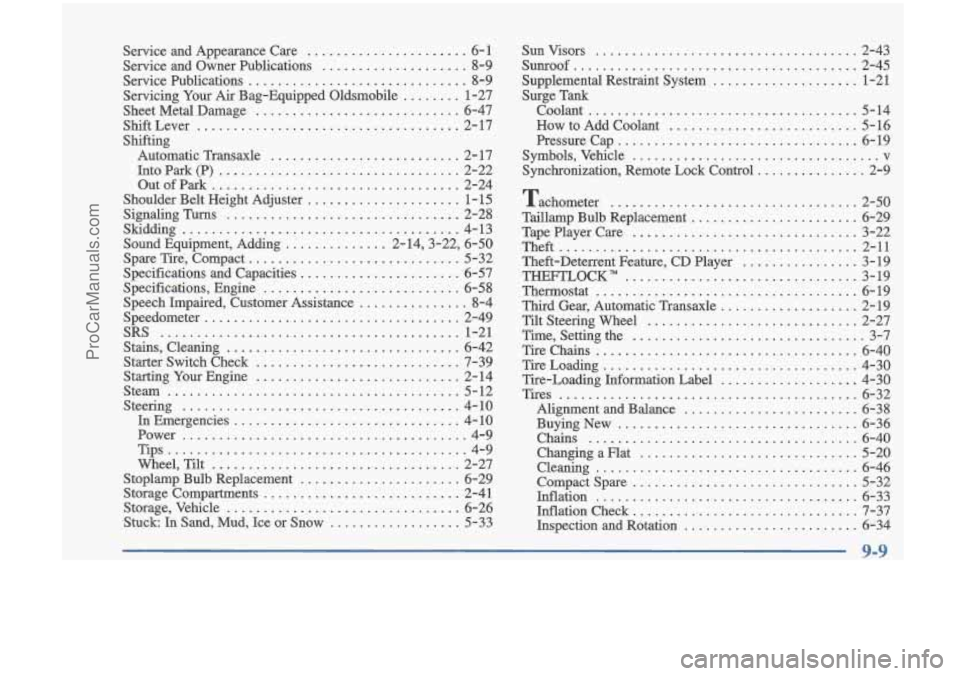
lul Service and Appearance Care ....................... 6-1
Service and Owner Publications
.................... 8-9
Service Publications
.............................. 8-9
Servicing Your
Air Bag-Equipped Oldsmobile ........ 1-27
Sheet Metal Damage
............................ 6-47
ShiftLever
.................................... 2-17
Shifting
Automatic Transaxle
.......................... 2- 17
Into Park (P)
................................. 2-22
OUtofPark
................................... 2-24
Shoulder Belt Height Adjuster
..................... 1-15
Signaling Turns
................................ 2-28
Skidding
...................................... 4-13
Sound Equipment. Adding
.............. 2-14.3-22. 6-50
Spare Tire. Compact
............................. 5-32
Specifications and Capacities
...................... 6-57
Specifications. Engine
........................... 6-58
Speech Impaired. Customer Assistance
............... 8-4
Speedometer
................................... 2-49
SRS
......................................... 1-21
Stains. Cleaning
............................. ' ... 6-42
Starter Switch Check
............................ 7-39
Starting
Your Engine ............................ 2-14
Steam
........................................ 5-12
Steering
...................................... 4-10
In Emergencies ............................... 4- 10
Power
....................................... 4-9
Tips
......................................... 4-9
Wheel. Tilt
.................................. 2-27
Stoplamp Bulb Replacement
...................... 6-29
Storage Compartments
........................... 2-41
Storage. Vehicle
................................ 6-26
Stuck
In Sand. Mud. Ice or Snow .................. 5-33 Sunvisors
.................................... 2-43
Sunroof
....................................... 2-45
Supplemental Restraint System
.................... 1-21
Surge Tank Coolant
..................................... 5-14
How to Add Coolant
.......................... 5-16
Pressure Cap
................................. 6-19
Symbols. Vehicle
.................................. v
Synchronization. Remote Lock Control
............... 2-9
Tachometer
.................................. 2-50
Taillamp Bulb Replacement
....................... 6-29
TapePlayerCare
............................... 3-22
Theft
......................................... 2-11
Theft-Deterrent Feature,
CD Player ................ 3-19
THEFTLOCK"
................................ 3-19
Thermostat
.................................... 6-19
Third Gear, Automatic Transaxle
................... 2-19
Tilt Steering Wheel
............................. 2-27
Time, Setting
the ................................ 3-7
Tire Chains
.................................... 6-40
TireLoading
................................... 4-30
Tire-Loading Information Label
................... 4-30
Tires
......................................... 6-32
Alignment and Balance
........................ 6-38
BuyingNew
................................. 6-36
ChangingaFlat
.............................. 5-20
Cleaning
.................................... 6-46
Compact Spare
............................... 5-32
Inflation
.................................... 6-33
Inflationcheck ............................... 7-37
Inspection and Rotation ........................ 6-34
Chains
..................................... 6-40
ProCarManuals.com