brake OLDSMOBILE CUTLASS 1997 Owner's Guide
[x] Cancel search | Manufacturer: OLDSMOBILE, Model Year: 1997, Model line: CUTLASS, Model: OLDSMOBILE CUTLASS 1997Pages: 353, PDF Size: 16.72 MB
Page 181 of 353
Safety Chains
You should always attach chains between your vehicle
and your trailer. Cross the safety chains under the tongue
of the trailer
so that the tongue will not drop to the road
if it becomes separated from the hitch. Instructions
about safety chains may be provided by the hitch
manufacturer or by the trailer manufacturer. Follow the
manufacturer’s recommendation for attaching safety
chains and do not attach them to the bumper. Always
leave just enough slack
so you can turn with your rig.
And, never allow safety chains to drag on the ground.
Trailer Brakes
Does your trailer have its own brakes?
Be sure to read and follow the instructions for the trailer
brakes so you’ll be able to install, adjust and maintain
them properly. And because you have anti-lock brakes,
do not try to tap into your vehicle’s brake system. If you
do, both systems won’t work well. or at all.
Driving with a Trailer
Towing a trailer requires a certain amount of experience.
Before setting out for the open road, you’ll want to get
to know your rig. Acquaint yourself with the feel of
handling and braking with the added weight of the
trailer. And always keep in mind that the vehicle you are
driving is now a good deal longer and not nearly as
responsive as your vehicle is by itself.
Before you start, check the trailer hitch
and platform
(and attachments), safety chains, electrical connector,
lamps, tires and mirror adjustment.
If the trailer has
electric brakes, start your vehicle and trailer moving and
then apply the trailer brake controller by hand to be sure
the brakes are working. This lets you check your
electrical connection at the same time.
During your trip, check occasionally to be sure that the
load is secure, and that the lamps and any trailer brakes
are still working.
4-36
ProCarManuals.com
Page 183 of 353
Turn Signals When Towing a Trailer
When you tow a trailer, your vehicle may need a
different turn signal flasher and/or extra wiring. Check
with your Oldsmobile retailer. The green arrows on your
instrument panel will flash whenever you signal a
turn
or lane change. Properly hooked up, the trailer lamps
will
also flash, telling other drivers you’re about to turn,
change lanes or stop.
When towing a trailer, the green arrows on your
instrument panel will flash
for turns even if the bulbs on
the trailer are burned out. Thus, you may
think drivers
behind you
are seeing your signal when they are not. It’s
important to check occasionally to be sure the
trailer
bulbs are still working.
Driving On Grades
I NOTICE:
Do not tow on steep continuous grades exceeding
6 miles (9.6 km). Extended, higher than normal
engine and transaxle temperatures may result
and damage your vehicle. Frequent stops are
very important to allow the engine and transaxle
to cool.
Reduce speed and shift to a lower gear before you start
down a long or steep downgrade. If you don’t shift
down, you might have to use your brakes
so much that
they would get hot and no longer work well.
On a long uphill grade, shift down and reduce your speed to around
45 mph (70 kmk) to reduce the
possibility
of engine and transaxle overheating.
Pay attention to the engine coolant gage.
If the indicator
is in the red area,
turn off the air conditioning (if you
have
this option) to reduce engine load (see “Engine
Overheating” in the Index).
4-38
ProCarManuals.com
Page 184 of 353
Parking on Hills
You really should not park your vehicle, with a trailer
attached, on a
hill. If something goes wrong, your rig
could start to move. People can be injured, and both
your vehicle and the trailer can be damaged.
But if you ever have to park your rig on a hill, here’s
how to do it:
1.
2.
3.
4.
5.
Apply your regular brakes, but don’t shift into
PARK (P) yet.
Have someone place chocks under the trailer wheels.
When the wheel chocks are in place, release the
regular brakes until the chocks absorb the load.
Reapply the regular brakes. Then apply your parking
brake and shift into PARK (P).
Release the regular brakes.
When You Are Ready to Leave After
Parking on a
Hill
1. Apply your regular brakes and hold the pedal down
while you:
Start your engine;
Shift into a gear; and
Release the parking brake.
2. Let up on the brake pedal.
3. Drive slowly until the trailer is clear
of the chocks.
4. Stop and have someone pick up and store the chocks.
Maintenance When Trailer Towing
Your vehicle will need service more often when you’re
pulling a trailer. See the Maintenance Schedule for more
on this. Things that
are especially important in trailer
operation
are automatic transaxle fluid (don’t overfill),
engine oil, belt, cooling system and brake adjustment.
Each of these is covered in this manual, and the Index
will help you find them quickly.
If you’re trailering, it’s
a good idea to review these sections before you start
your trip.
Check periodically to see that all hitch nuts and bolts are tight.
ProCarManuals.com
Page 191 of 353
1. Check the other vehicle. It must have a 12-volt
battery with a negative ground system.
NOTICE:
If the other system isn’t a 12-volt system with a
negative ground, both vehicles can be damaged.
2. Get the vehicles close enough so the jumper cables
can reach, but be sure the vehicles aren’t touching
each other.
If they are, it could cause a ground
connection you don’t want. You wouldn’t be able to
start your Oldsmobile, and the bad grounding could
damage the electrical systems.
You could be injured
if the vehicles roll. Set the
parking brake firmly on each vehicle. Put the
transaxle in
PARK (P).
unnecessary accessories plugged into the cigarette
lighter or the accessory power outlet. Turn
off all
lamps that aren’t needed, as well as radios. This will avoid sparks and help save both batteries.
In
addition, it could save your radio.
3. Turn off the ignition on both vehicles. Unplug
I
NOTICE:
Do not leave your radio on while trying to jump
start your vehicle. The radio could be badly
damaged and the repairs wouldn’t be covered by
your warranty. Be sure to turn
off your radio
before following this procedure.
4. Open the hoods and locate the batteries.
I
An electric fan can start up even when the engine
is not running and can injure you. Keep hands,
clothing and tools away from any underhood
electric fan.
5-4
ProCarManuals.com
Page 207 of 353
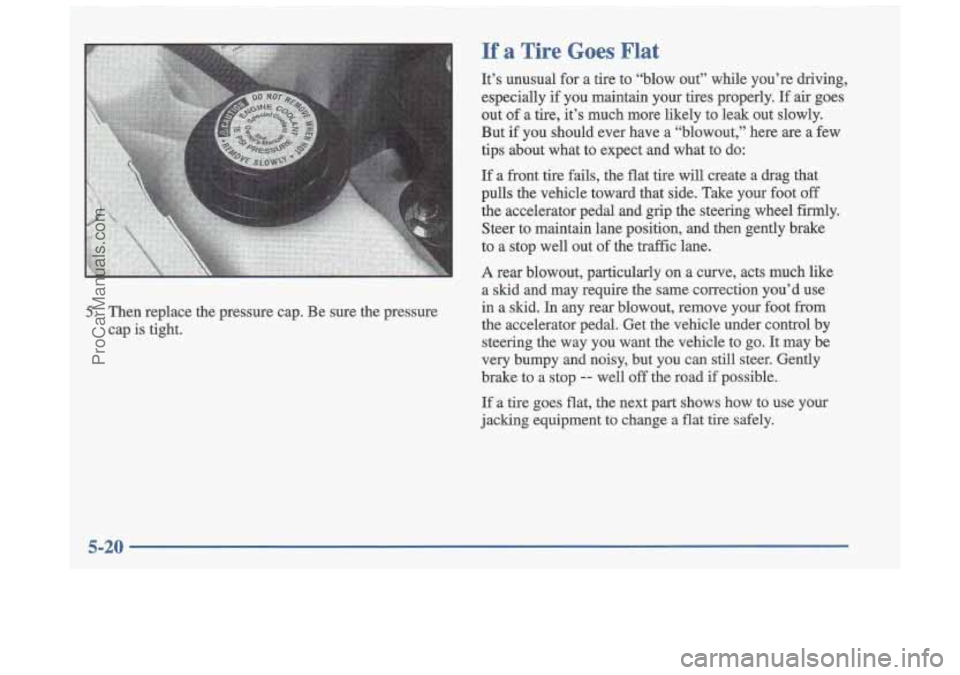
5. Then replace the pressure cap. Be sure the pressure
cap is tight.
If a Tire Goes Flat
It’s unusual for a tire to “blow out” while you’re driving,
especially if you maintain your tires properly. If air goes
out of a tire, it’s much more likely to leak out slowly.
But if you should ever have a “blowout,” here are a few\
tips about what to expect and what to do:
If a front tire
fails, the flat tire will create a drag that
pulls the vehicle toward that side. Take your foot
off
the accelerator pedal and grip the steering wheel firmly.
Steer to maintain lane position, and then gently brake
to a stop well out of the traffic lane.
A rear blowout, particularly on a curve, acts much like
a skid and may require the same correction you’d use
in a skid. In any rear blowout, remove your foot from
the accelerator pedal. Get the vehicle under control by
steering the way you want the vehicle to go. It may be
very bumpy and noisy, but you can still steer. Gently
brake to a stop
-- well off the road if possible.
If a tire goes flat, the next part shows how to use your
jacking equipment to change a flat tire safely.
5-20
ProCarManuals.com
Page 208 of 353
Changing a Flat Tire
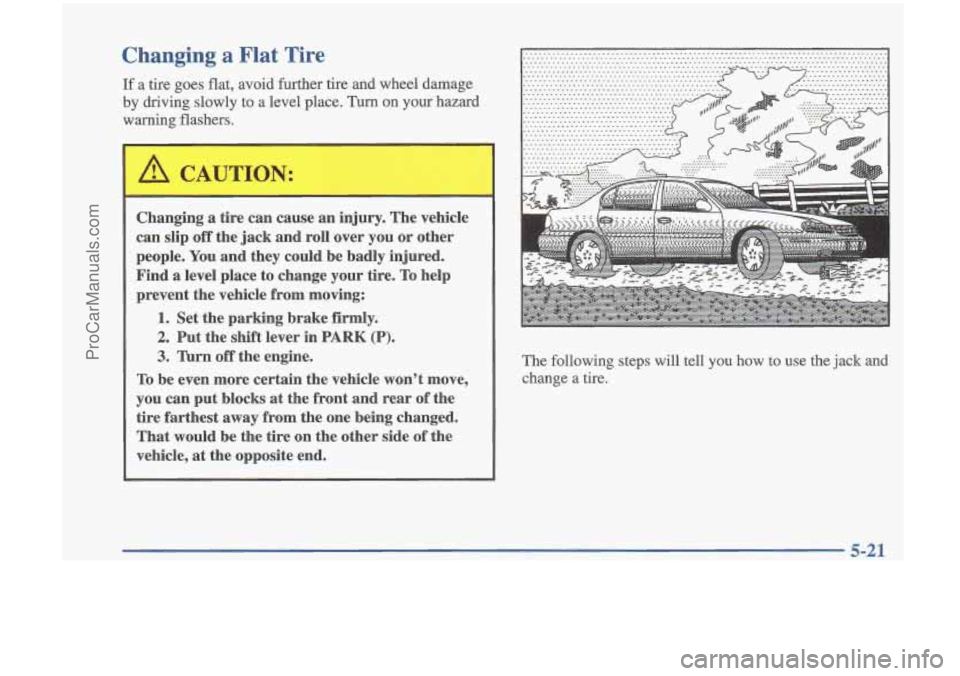
If a tire goes flat, avoid further tire and wheel damage
by driving slowly to a level place. Turn
on your hazard
warning flashers.
Changing a tire can cause an injury. The vehicle
can dip off the jack and roll over you or other
people. You and they could be badly injured.
Find a level place to change your tire. To help
prevent the vehicle from moving:
1. Set the parking brake firmly.
2. Put the shift lever in PARK (P).
3. lhrn off the engine.
To be even more certain the vehicle won't move,
you can put blocks at the front and rear of the
tire farthest away from the one being changed.
The following steps will tell you how to use the jack and
change a tire.
ProCarManuals.com
Page 216 of 353
-
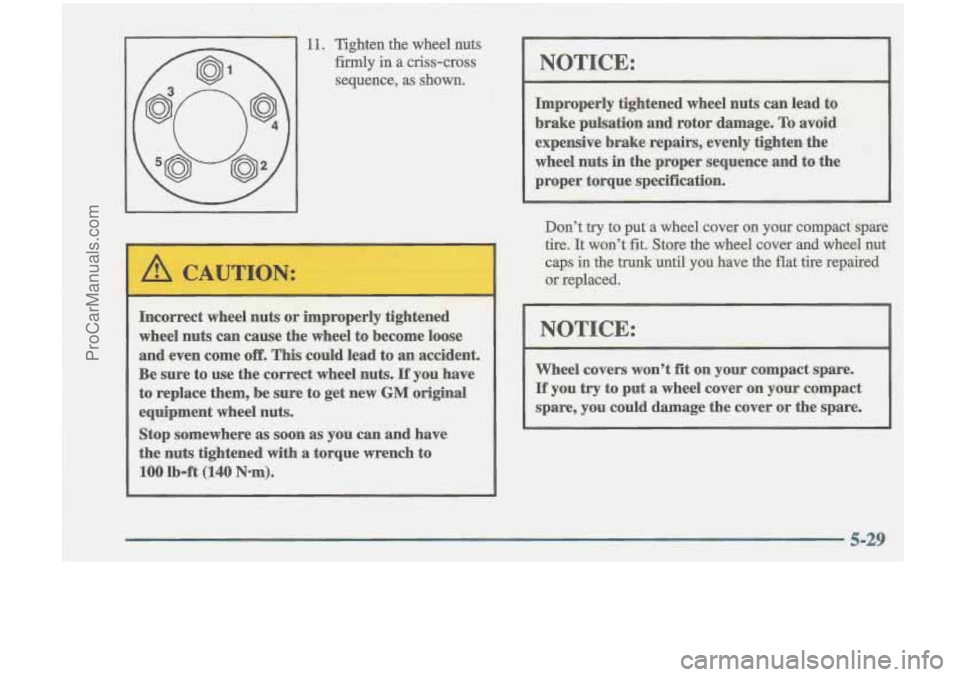
11. Tighten the wheel nuts
firmly in a criss-cross
sequence, as shown. I NOTICE:
Improperly tightened wheel nuts can lead to
brake pulsation .and rotor damage. To avoid
expensive brake repair.., evenly tighten the
wheel nuts in the proper sequenee~ and to the
proper torque specification.
Don’t try to put a wheel cover on YQU~ comp:act spare
tire.
It won’t fit. Store the wheel cover and wheel^ nut
caps in the trunk until you have the flat tire repaired
or replaced.
I NOTICE:
Wheel covers won’t fit on your compact spare.
If you try to put a wheel cover on your compact
spare, you could damage the cover or the spare.
ProCarManuals.com
Page 224 of 353
Section 6 Service and Appearance Care
Here you will find information about the care of your Oldsmobile. This section begins with service and fuel
information, and then it shows how to check important fluid an\
d lubricant levels. There is also technical information
about your vehicle, and a part devoted to its appearance care.\
6-2 6-3
6-5
6-5 6-7
6-11 6- 16
6-16
6-21
6-22
6-25
6-26
6-26
6-32
6-33 Doing
Your Own Service Work
What Kind of Fuel to Use
Using Fuel in Foreign Countries Where to Put the Fuel and Filling the Tank
Checking Things Under the Hood
Checking Your Engine Oil
Automatic Transaxle Fluid
Engine Coolant
Where to Fill the Windshield Washer Fluid
Important Brake Information
Infomation on Your Vehicle’s Battery
Tips on Vehicle Storage
Bulb Replacement Procedures
Windshield Wiper Blade Replacement How and When to Check Tire Inflation When
it is
Time to Buy New Tires
Wheel Alignment Cleaning the Inside of Your Vehicle
Care of the Safety Belts
Cleaning the Outside of Your Vehicle
How to Clean Aluminum Wheels
Underbody Maintenance
Recornended Appearance Care Materials
Your Vehicle Identification Number (VIN)
The Electrical System
Fuses and Circuit Breakers
Replacement Bulb Types for Your Vehicle
Capacities and Specifications
Air Conditioning Specifications
Normal Replacement Parts
6-35
6-38
6-4
1
6-43
6-45 6-46
6-47
6-48
6-49
6-50
6-5 1
6-57
6-57
6-58
6-58
6-1
ProCarManuals.com
Page 230 of 353
NOTICE:
If you need a new cap, be sure to get the right
type. Your retailer can get one
for you. If you get
the wrong type, it may not fit properly. This may
cause your malfunction indicator lamp to light and your fuel tank and emissions system may be
damaged. See “Malfunction Indicator Lamp” in
the Index.
Checking Things Under the Hood
An electric fan under the hood can start up and
injure you even when the engine
is not running.
Keep hands, clothing and tools away from any
underhood electric fan. Things
that burn can get on hot engine parts and
start a fire. These include liquids like gasoline,
oil, coolant, brake fluid, windshield washer and
other fluids, and plastic or rubber. You or others
could be burned. Be careful not to drop
OF spill
things that will burn onto a hot engine.
The following sections tell you how to check fluids,
lubricants and important parts under the hood.
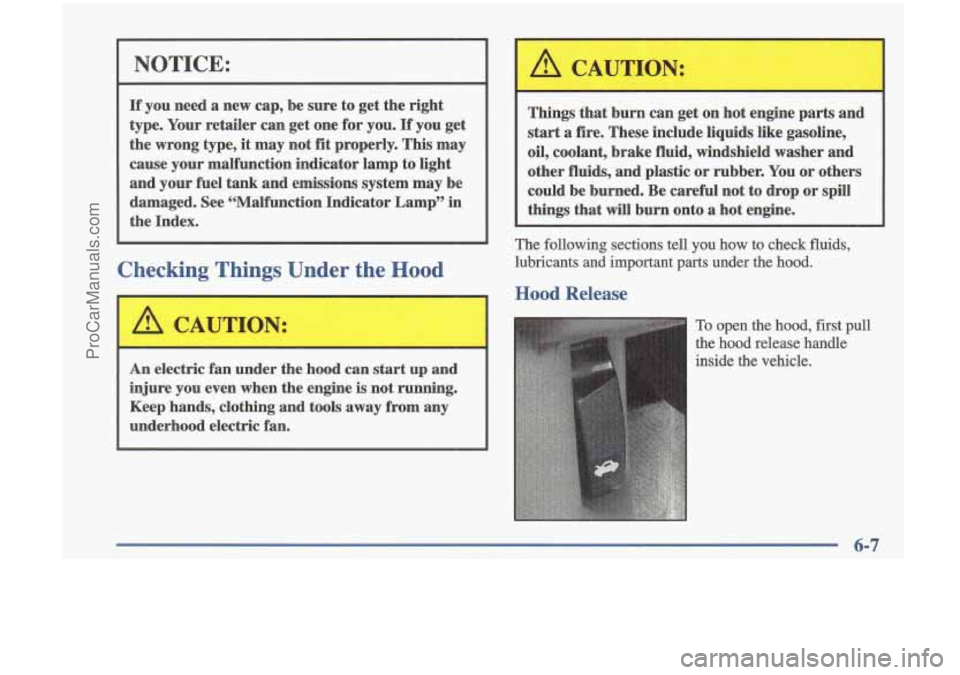
Hood Release
To open the hood, first pull
the hood release handle
inside the vehicle.
ProCarManuals.com
Page 232 of 353
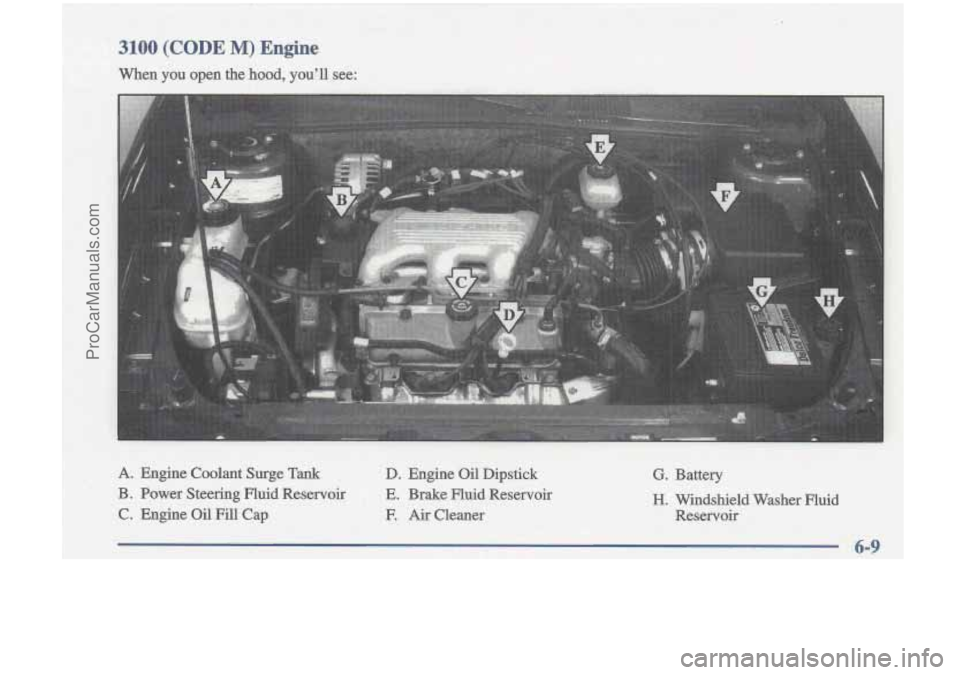
3100 (CODE M) Engine
When you open the hood, you'll see:
I A.. Engine Coalant Surge Tank D. Engine Oi€ Dipstick G. Battery
B. Power Steering Fluid Reservoir E. Brake Fluid Reservoir
C. Engine Oil Fill Cap E Air Cle,aner Reservoir
H. Windshield Washer Fluid
I'
ProCarManuals.com