tow OLDSMOBILE CUTLASS 1997 Owner's Guide
[x] Cancel search | Manufacturer: OLDSMOBILE, Model Year: 1997, Model line: CUTLASS, Model: OLDSMOBILE CUTLASS 1997Pages: 353, PDF Size: 16.72 MB
Page 200 of 353
If Y :-team. Is (- --- 9~ Fron ur Engine
If you get the overheat warmng but see or hear no
steam, the problem may not be too serious. Sometimes
the engine can get a little too hot when you:
~
Climb a long hill on a hot day.
0 Stop after high-speed driving.
Idle for long periods in traffic.
Tow a trailer.
If you get the overheat warning with no sign of steam,
try this for a minute or
so:
1. Turn off your air conditioner.
2. Turn on your heater to full hot at the highest fan
speed and open the window as necessary.
3. If you’re in a traffic jam, shift to NEUTRAL (N);
otherwise, shift to the highest gear while
driving
-- DRIVE (D) or THIRD (3).
If you no longer have the overheat warning, you
can drive. Just to be safe, drive slower for about
10 minutes. If the warning doesn’t come back on,
you can drive normally.
If the warning continues, pull over, stop, and park
your vehicle right away.
If there’s still no sign of steam, you can idle the
engine for two
or three minutes while you’re parked,
to see
if the warning stops. But then, if you still have
the warning,
turn off the engine and get everyone out
ofthe vehicle
until it cools down.
You may decide not to lift the’hood but to get service
help right away.
5-13
ProCarManuals.com
Page 207 of 353
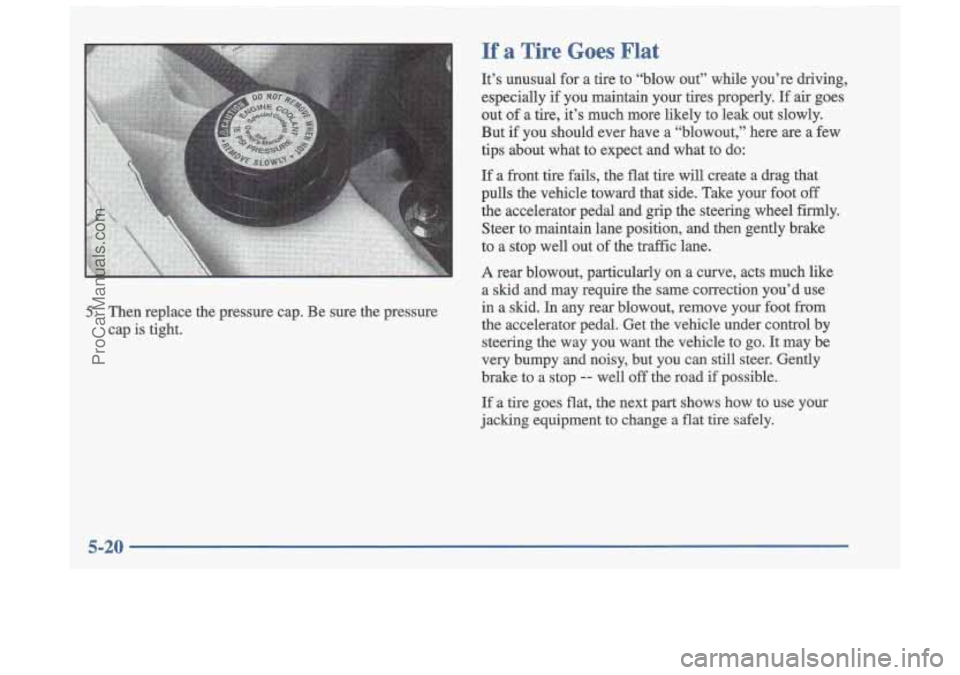
5. Then replace the pressure cap. Be sure the pressure
cap is tight.
If a Tire Goes Flat
It’s unusual for a tire to “blow out” while you’re driving,
especially if you maintain your tires properly. If air goes
out of a tire, it’s much more likely to leak out slowly.
But if you should ever have a “blowout,” here are a few\
tips about what to expect and what to do:
If a front tire
fails, the flat tire will create a drag that
pulls the vehicle toward that side. Take your foot
off
the accelerator pedal and grip the steering wheel firmly.
Steer to maintain lane position, and then gently brake
to a stop well out of the traffic lane.
A rear blowout, particularly on a curve, acts much like
a skid and may require the same correction you’d use
in a skid. In any rear blowout, remove your foot from
the accelerator pedal. Get the vehicle under control by
steering the way you want the vehicle to go. It may be
very bumpy and noisy, but you can still steer. Gently
brake to a stop
-- well off the road if possible.
If a tire goes flat, the next part shows how to use your
jacking equipment to change a flat tire safely.
5-20
ProCarManuals.com
Page 215 of 353
Never use oil or grease on studs or nuts. If you
do, the nuts might come loose. Your wheel could
fall
off, causing a serious accident.
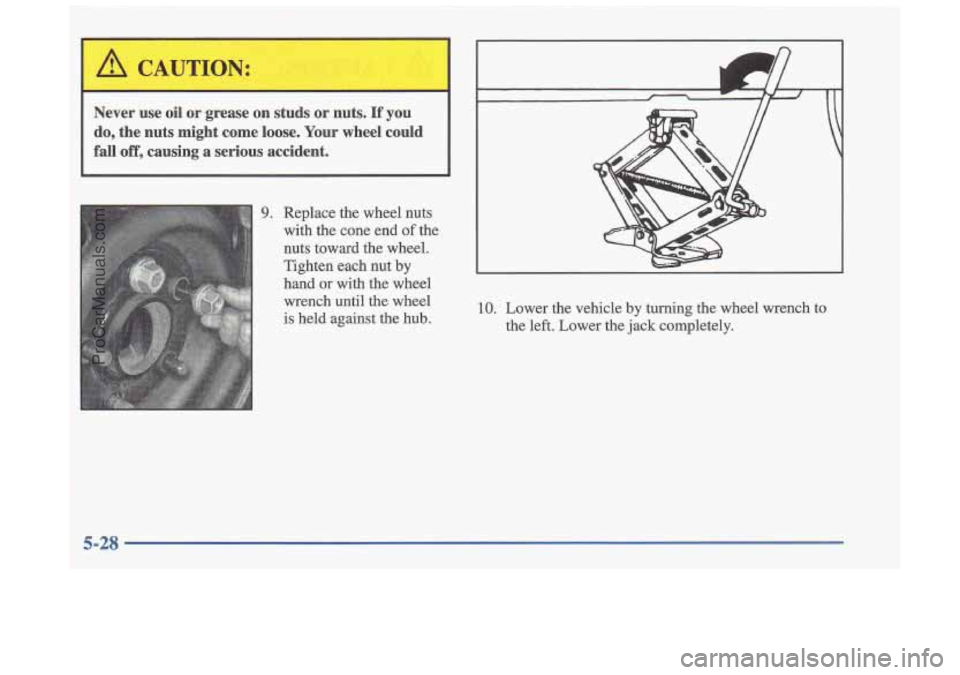
9. Replace the wheel nuts
with the cone end of the
nuts toward the wheel.
Tighten each nut by
hand or with the wheel wrench until the wheel
is held against the hub. 10. Lower the vehicle by turning the wheel wrench to
the left. Lower the jack completely.
5-28
ProCarManuals.com
Page 220 of 353
If You’re Stuck: In Sand, Mud,
Ice
or Snow
What you don’t want to do when your vehicle is stuck is
to
spin your wheels too fast. The method known as
“rocking” can help you get out when you’re stuck, but \
you
must use caution.
~ ~~ ~
If you let your tires spin at high speed, they can
explode, and you or others could be injured. And,
the transaxle or other parts of the vehicle can
overheat. That could cause an engine
compartment fire or other damage. When you’re
stuck, spin the wheels as little as possible. Don’t
spin the wheels above
35 mph (55 km/h) as shown
on the speedometer.
NOTICE:
Spinning your wheels can destroy parts of your
vehicle as well as the tires.
If you spin the wheels
too fast whiIe shifting your transaxle back and
forth, you can destroy your transaxle.
For information about using tire chains on your vehicle,
see “Tire Chains” in the Index.
Rocking Your Vehicle To Get It Out
First, turn your steering wheel left and right. That will
clear the area around your front wheels. Then shift back
and forth between REVERSE
(R) and a forward gear,
spinning the wheels as little as possible. Release the
accelerator pedal while you shift, and press lightly
on
the accelerator pedal when the transaxle is in gear. If
that doesn’t get you out after a few tries, you may need
to be towed out. If you do need to be towed out, see
“Towing Your Vehicle” in the Index.
5-33
ProCarManuals.com
Page 234 of 353
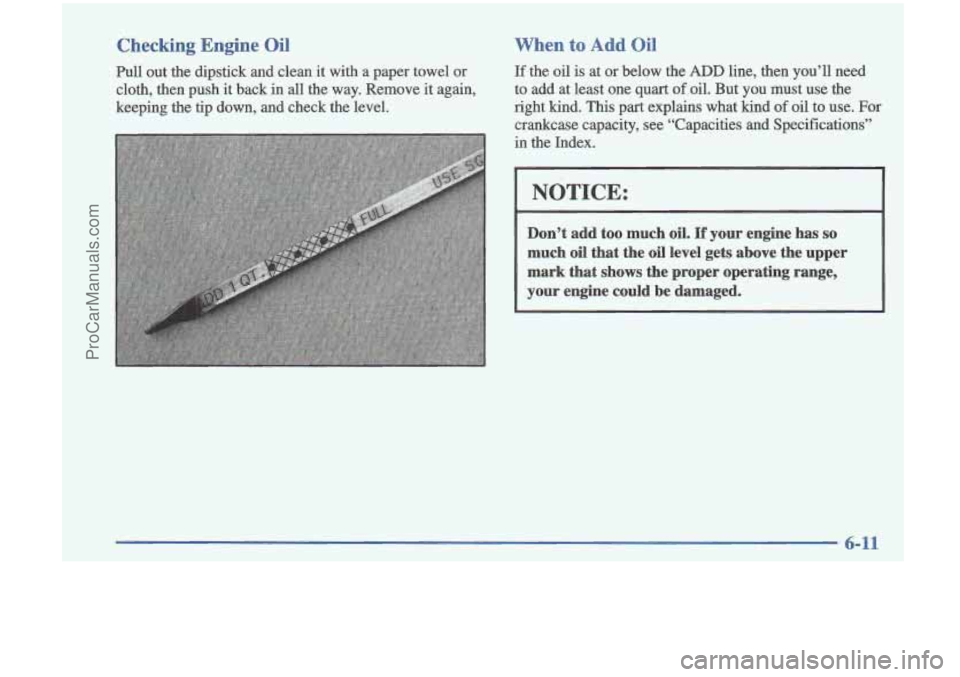
Checking Engine Oil
Pull out the dipstick and clean it with a paper towel or
cloth, then push
it back in all the way. Remove it again,
keeping the tip down, and check the level.
When to Add Oil
If the oil is at or below the ADD line, then you’ll need
to add at least one quart
of oil. But you must use the
right kind.
This part explains what kind of oil to use. For
crankcase capacity, see “Capacities and Specifications”
in the Index.
NOTICE:
Don’t add too much oil. If your engine has so
much oil that the oil level gets above the upper
mark that shows the proper operating range,
your engine could be damaged.
ProCarManuals.com
Page 237 of 353
When to Change Engine Oil
If any one of these is true for you, use the short triphity
maintenance schedule:
0
0
0
0
0
Most trips are less than 5 to 10 miles (8 to 16 km).
This is particularly important when outside
temperatures are below freezing.
Most trips include extensive idling (such as frequent driving in stop-and-go traffic).
Most trips are though dusty areas.
You frequently tow a trailer or use a carrier on top of
your vehicle.
The vehicle is used for delivery service, police, taxi
or other commercial application.
Driving under these conditions causes engine oil to
break down sooner.
If any one of these is true for your
vehicle, then you need to change your oil and filter
every
3,000 miles (5 000 km) or 3 months -- whichever
occurs first.
If none of them is true, use the long triphighway
maintenance schedule. Change the oil and filter every
7,500 miles (12 500 km) or 12 months -- whichever
occurs first. Driving a vehicle with a fully warmed
engine under highway conditions causes engine oil to
break down slower.
What to Do with Used Oil
Did you know that used engine oil contains certain
elements that may be unhealthy for your skin and could
even cause cancer? Don’t let used oil stay on your
skin
for very long. Clean your skin and nails with soap and
water, or a good hand cleaner. Wash or properly throw
away clothing or rags containing used engine oil. (See
the manufacturer’s warnings about the
use and disposal
of oil products.)
Used oil can be a real threat to the environment.
If you
change your own oil, be sure to drain all free-flowing oil
from the filter before disposal. Don’t ever dispose of oil
by putting it in
the trash, pouring it on the ground, into
sewers, or into streams or bodies of water. Instead,
recycle it by taking it to a place that collects used oil.
If
you have a problem properly disposing of your used oil,
ask your retailer, a service station or a local recycling
center for help.
ProCarManuals.com
Page 255 of 353
Windshield Wiper Blade Replacement Tires
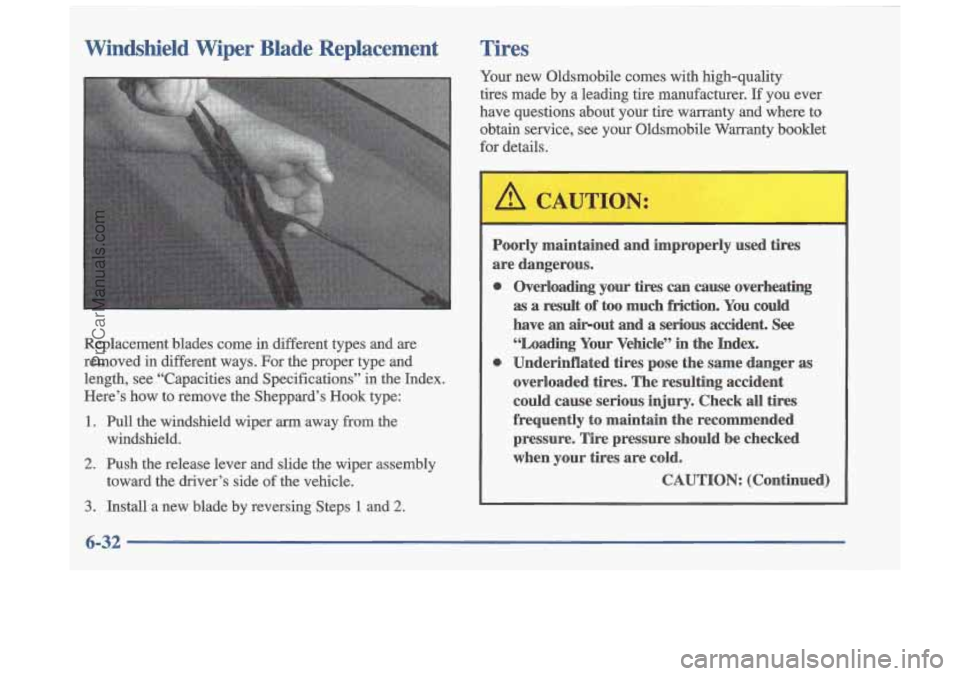
Replacement blades come in different types and are
removed in different ways. For the proper type and
length, see “Capacities and Specifications’’ in the Index.
Here’s how
to remove the Sheppard’s Hook type:
1. Pull the windshield wiper arm away from the
windshield.
2. Push the release lever and slide the wiper assembly
toward the driver’s side of the vehicle.
3. Install a new blade by reversing Steps 1 and 2.
Your new Oldsmobile comes with high-quahty
tires made by
a leading tire manufacturer. If you ever
have questions about your tire warranty and where to
obtain service, see your Oldsmobile Warranty booklet
for details.
I
0
0
Poorly maintained and improperly used tires
are dangerous.
Overloading your
tires can cause overheating
as a result of too much friction. You could
have
an airout and a serious accident. See
“Loading Your Vehicle” in the Index.
Underinflated tires pose the same danger as overloaded tires. The resulting accident
could cause serious injury. Check all tires
frequently to maintain the recommended
pressure. Tire pressure should be checked
when your tires are cold.
CAUTION: (Continued)
6-32
ProCarManuals.com
Page 264 of 353
Don’t use any of these unless this manual says you can.
In many uses, these will damage your vehicle:
Alcohol
Laundry Soap
Bleach
0 Reducing Agents
Cleaning the Inside of Your Oldsmobile
Use a vacuum cleaner often to get rid of dust and loose
dirt. Wipe vinyl or leather with a clean, damp cloth.
Your Oldsmobile retailer has two cleaners, a
solvent-type spot lifter and a foam-type powdered
cleaner. They will clean normal spots and stains very
well. Do not use them on vinyl or leather.
Here are some cleaning tips:
1. Always read the instructions on the cleaner label.
2. Clean up stains as soon as you can -- before they set.
3. Use a clean cloth or sponge, and change to a clean area
4. Use solvent-type cleaners in a well-ventilated area
5. If a ring forms after spot cleaning, clean the entire
often. A soft brush may be used
if stains are stubborn.
only.
If you use them, don’t saturate the stained area.
area immediately or it will set.
Using Foam-Type Cleaner on Fabric
1.
2.
3.
4.
5.
6.
7.
8.
9.
Vacuum and brush the area to remove any loose dirt.
Always clean a whole trim panel or section. Mask
surrounding trim along stitch or welt lines.
Mix Multi-Purpose Powdered Cleaner following the
directions on the container label.
Use suds
only and apply with a clean sponge. Don’t
saturate the material and don’t rub it roughly.
As soon as you’ve cleaned the section, use a sponge
to remove the suds.
Rinse the section with a clean, wet sponge.
Wipe
off what’s left with a slightly damp paper towel
or cloth.
Dry it immediately with a blow dryer.
Wipe with a clean cloth.
6-41
ProCarManuals.com
Page 265 of 353
Using Solvent-‘l[iype Cleaner on Fabric
First, see if you have to use solvent-type cleaner at all.
Some spots and stains will clean
off better with just
water and mild soap.
If you need to use a solvent:
1. Gently scrape excess soil from the trim material with
a clean, dull knife
or scraper.
2. Use very little cleaner, light pressure and clean cloths
(preferably cheesecloth). Cleaning should start at the
outside of the stain, “feathering” toward the center.
3. Keep changing to a clean section of the cloth.
4. When you clean a stain from fabric, immediately
dry the area with a blow dryer to help prevent a
cleaning ring.
Special Cleaning Problems
Greasy or Oily Stains
Stains caused by grease, oil, butter, margarine, shoe
polish, coffee with cream, chewing gum, cosmetic creams, vegetable
oils, wax crayon, tar and asphalt can
be removed as follows:
1. Carefully scrape off excess stain.
2. Follow the solvent-type instructions described earlier. Shoe polish, wax crayon, tar and asphalt will stain
if left
on a vehicle’s seat fabric. They should be removed as
soon as possible. Be careful, because the cleaner
will
dissolve them and may cause them to spread,
Non-Greasy Stains
Stains caused by catsup, coffee (black), egg, fruit, fruit
juice,
milk, soft drinks, wine, vomit, urine and blood can
be removed as follows:
1. Carefully scrape off excess stain, then sponge the
2. If a stain remains, follow the foam-type instructions
3. If an odor lingers after cleaning vomit or urine,
treat the area with a waterhaking soda solution:
1 teaspoon (5 ml) of baking soda to 1 cup (250 ml)
of lukewarm water.
soiled area with
cool water.
described earlier.
4. If needed, clean lightly with solvent-type cleaner.
Combination Stains
Stains caused by candy, ice cream, mayonnaise, chili
sauce and unknown stains can be removed as follows:
1. Carefully scrape off excess stain.
2. Clean with cool water and allow to dry.
3. If a stain remains, clean it with solvent-type cleaner.
ProCarManuals.com
Page 268 of 353
Cleaning the Outside of
Your Oldsmobile
The paint finish on your vehicle provides beauty, depth
of color, gloss retention and durability.
Washing Your Vehicle
The best way to preserve your vehicle’s finish is
to keep it clean by washing it often with lukewarm
or cold water.
Don’t wash your vehicle in the direct rays of the sun.
Don’t use strong soaps or chemical detergents. Use
liquid hand, dish
or car waslung (mild detergent) soaps.
Don’t use cleaning agents that
are petroleum based, or
that contain acid or abrasives. All cleaning agents should be flushed promptly and not allowed to dry on
the surface, or they could stain. Dry the finish with a soft, clean chamois or an all-cotton towel to avoid
surface scratches and water spotting.
High pressure car washes may cause water to enter
your vehicle.
Cleaning Exterior Lamps/Lenses
Use lukewarm or cold water, a soft cloth and a liquid
hand, dish or vehicle washing (mild detergent) soap to
clean exterior lamps and lenses. Follow instructions
under “Washing Your Vehicle.’’
Finish Care
Occasional waxing or mild polishing of your
Oldsmobile by hand may be necessary to remove
residue from the paint finish. You can get GM-approved
cleaning products from your retailer. (See “Appearance
Care
and Materials” in the Index.)
Your Oldsmobile has a “basecoatlclearcoat” paint finish.
The clearcoat gives more depth and gloss to the colored
basecoat. Always use waxes and polishes that are
non-abrasive and made for a basecoatlclearcoat
paint finish.
I NOTICE:
Machine compounding or aggressive polishing on
a basecoatlclearcoat paint
finish may dull the
finish or leave swirl marks.
6-45
ProCarManuals.com