heater OLDSMOBILE CUTLASS 1997 Owners Manual
[x] Cancel search | Manufacturer: OLDSMOBILE, Model Year: 1997, Model line: CUTLASS, Model: OLDSMOBILE CUTLASS 1997Pages: 353, PDF Size: 16.72 MB
Page 58 of 353
Section 2 Features and Controls
2-3
2-4
2-5
2-6
2-8
2-11
2-13
2-13
2- 14
2-
15
2- 17
2-2
1
2-21
2-25
2-26
Here
you can learn about the many standard and optional features on your Oldsmobile, and infomation on starting,
shifting and braking.
Also explained are the instrument panel and the warning systems that tell you if everything is
working properly
-- and what to do if you have a problem.
Important Information About Keys
Door Locks Operation of Child Security Locks
Remote Lock Control
Battery Replacement for Remote
Lock Control
Preventing Theft of Your Vehicle
New Vehicle “Break-In”
Ignition Positions
Tips on Starting Your Engine
Using the Engine Coolant Heater
Automatic Transaxle Operation
Second-Gear Start
Parking Brake Guidelines Important Information on Engine Exhaust
Operation of Your Windows 2-27
2-28
2-29
2-30
2-32
2-35
2-36
2- 37
2-39
2-41
2-45
2-46
2-50 Adjusting
the Tilt Steering Wheel
Functions of the Multifunction Lever
How to Use the High/Low-Beam
Headlamp Changer
Windshield Wipers and Fluid Using Cruise Control
Exterior Lamps
Daytime Running Lamps (Dm) and
Automatic Light Control
(ALC)
Interior Lamps
Rearview Mirrors Storage Compartments
Sunroof
Instrument Panel Overview
All About Your Warning Lights and Gages
2-1
~
ProCarManuals.com
Page 72 of 353
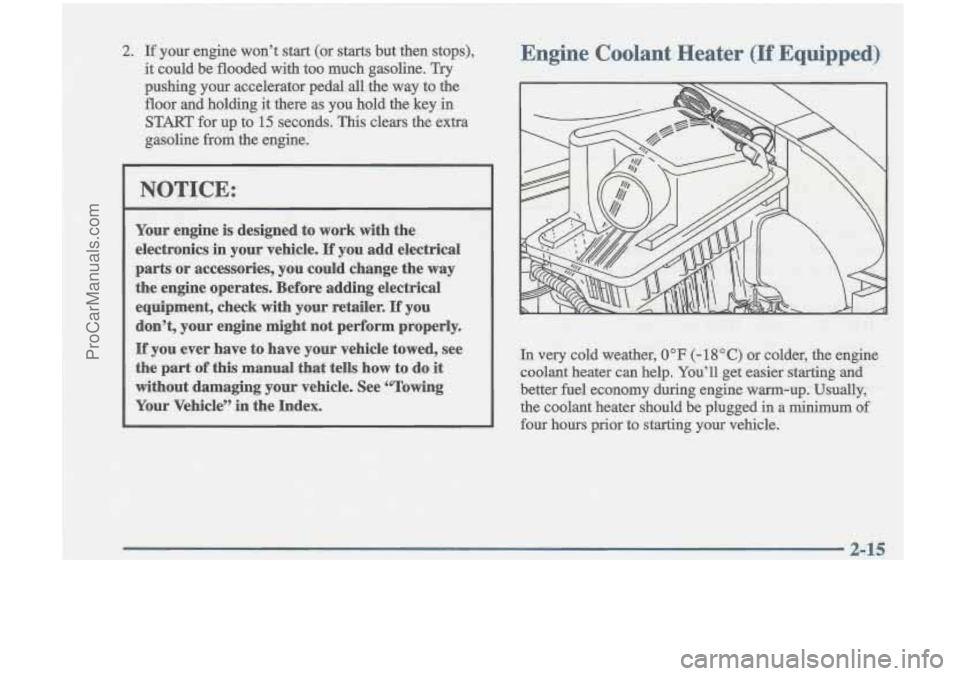
Engine Coolant Heater (If Equipped)
ProCarManuals.com
Page 73 of 353
To Use the Coolant Heater
1. Turn off the engine.
2. Open the hood and unwrap the electrical cord.
3. Plug it into a normal, grounded 110-volt AC outlet.
m
Plugging the cord into an ungrounded outlet
could cause an electrical shock. Also, the wrong
kind of extension cord could overheat and cause
a fire. You could be seriously injured. Plug the
cord into
a properly grounded three-prong
110-volt
AC outlet. If the cord won’t reach, use
a heavy-duty three-prong extension cord rated
for at least
15 amps.
4. Before starting the engine, be sure to unplug and
store the cord as it
was before to keep it away
from moving engine parts.
If you don’t, it could
be damaged.
How long should you keep the coolant heater plugged
in? The answer depends on the outside temperature, the
kind of oil you have, and some other things. Instead of
trying
to list everything here, we ask that you contact
your Oldsmobile retailer in the area where you’ll be
parking your vehicle. The retailer can give you the best
advice for that particular area.
ProCarManuals.com
Page 125 of 353
Heating
On cold days, use FLOOR with the temperature knob all
the way in the red area. The system will bring in outside
air, heat it and send it to the floor ducts.
Your vehicle has heat ducts that are directed toward the
rear seat. Keep the area under the front seats clear
of
obstructions so the heated air can reach the rear
seat passengers.
If your vehicle has an engine coolant heater, you can use
it to help your system provide warm
air faster when it’s
cold outside (0°F
(- 18 O C) or lower). An engine coolant
heater warms the coolant your engine and heating system use to provide heat. See “Engine Coolant
Heater” in the Index.
Defogging and Defrosting Windows
Your system has two settings for clearing the front and
side windows. For each setting, adjust the temperature
control as desired.
To defrost the windows quickly, rotate the temperature
control
knob all the way in the red area. Use
DEFROST and adjust the fan to the highest speed.
To warm passengers while keeping the windows clean,
use DEFOG.
Your vehicle is equipped with side window defogger
vents. The side window defogger vents are located on
the outside of the side instrument panel vents. For
additional side window defogging, rotate the mode
control to VENT, rotate the
fan control to the highest
speed, press A/C and aim the side vents on the
instrument panel to the windows. For increased airflow
to the side windows, close the center vents.
RECIRCULATION will not work in DEFROST and
DEFOG. This is done to prevent recirculation of humid
inside air and allow the system to work properly.
ProCarManuals.com
Page 127 of 353
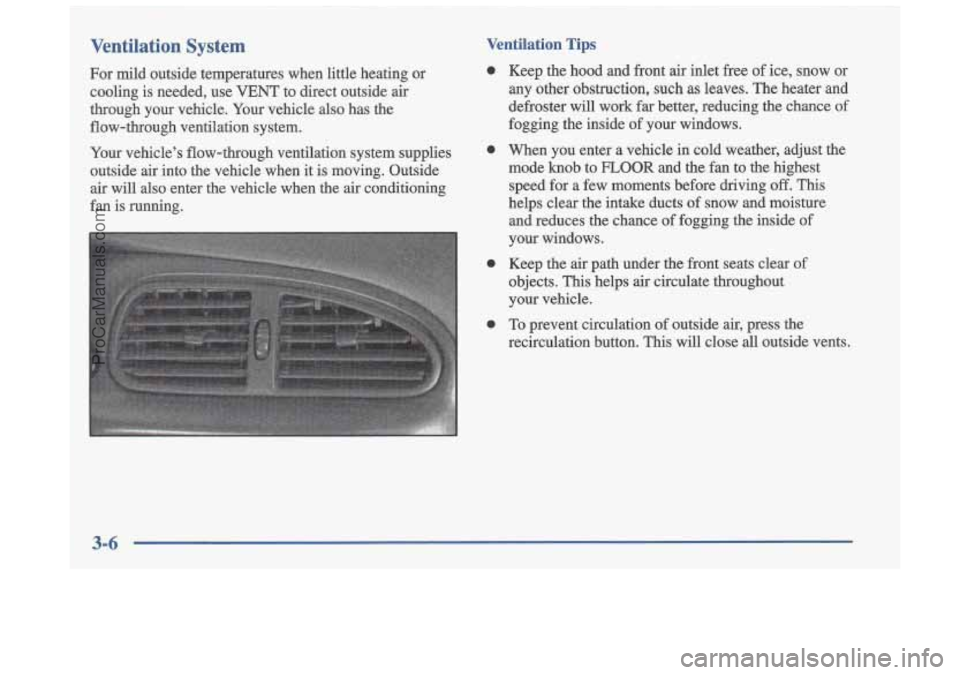
Ventilation System
For mild outside temperatures when little heating or
cooling is needed, use
VENT to direct outside air
through your vehicle. Your vehicle also has the
flow-through ventilation system.
Your vehicle’s flow-through ventilation system supplies
outside
air into the vehicle when it is moving. Outside
air will also enter the vehicle when the
air conditioning
fan is running.
Ventilation Tips
a
a
0
a
Keep the hood and front air inlet free of ice, snow or
any other obstruction, such as leaves. The heater and
defroster will work far better, reducing the chance of
fogging the inside of your windows.
When you enter a vehicle in cold weather, adjust the
mode
knob to FLOOR and the fan to the highest
speed for a few moments before driving
off. This
helps clear the intake ducts of snow and moisture
and reduces the chance of fogging the inside
of
your windows.
Keep the air path under the front seats clear
of
objects. This helps air circulate throughout
your vehicle.
To prevent circulation of outside air, press the
recirculation button. This will close all outside vents.
3-6
ProCarManuals.com
Page 173 of 353
Run your engine only as long as you must. This saves fuel. When you run the engine, make it go a little faster
than just idle. That is, push the accelerator slightly. Ths
uses less fuel for the heat that you get and it keeps the
battery charged. You will need a well-charged battery to
restart the vehicle, and possibly for signaling later on
with your headlamps. Let the heater run for a while.
Then, shut the engine
off and close the window almost
all the way to preserve the heat. Start the engine again
and repeat this only when you feel really uncomfortable
from the cold. But do it as little as possible. Preserve the
fuel as long as you can. To help keep warm, you can get
out of the vehicle and do some fairly vigorous exercises
every half hour or
so until help comes.
Recreational Vehicle Towing
You can tow your vehicle behind another vehicle for use
at your destination. Be sure to use the proper towing
equipment designed for recreational towing. Follow the
instructions for the towing equipment.
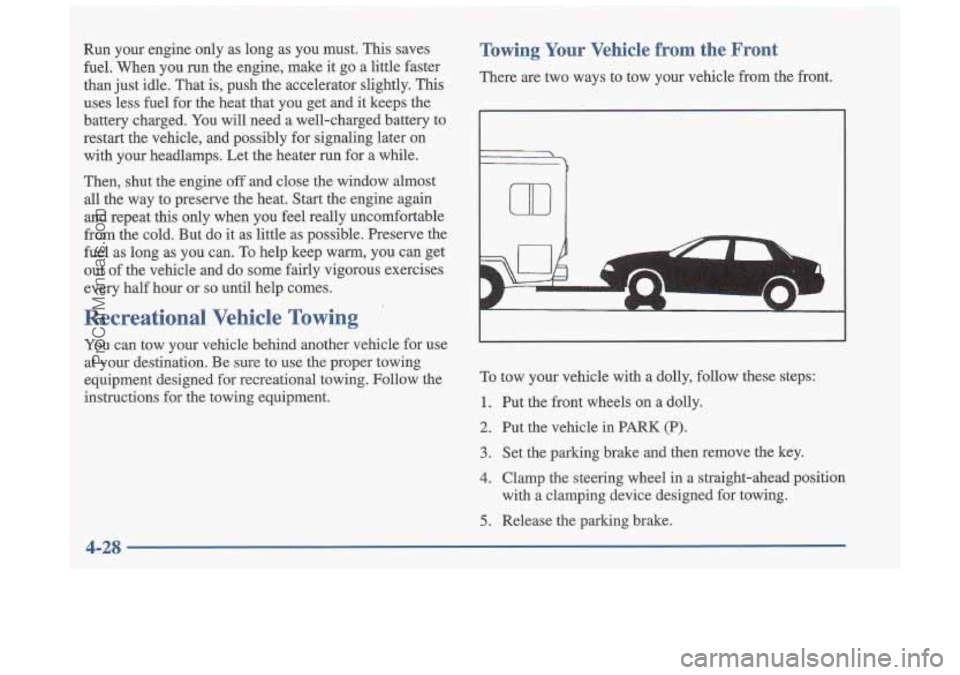
Towing Your Vehicle from the Front
There are two ways to tow your vehicle from the front.
€
m
To tow your vehicle with a dolly, follow these steps:
1. Put the front wheels on a dolly.
2. Put the vehicle in PARK (P).
3. Set the parking brake and then remove the key.
4. Clamp the steering wheel in a straight-ahead position
with a clamping device designed for towing.
5. Release the parking brake.
ProCarManuals.com
Page 200 of 353
If Y :-team. Is (- --- 9~ Fron ur Engine
If you get the overheat warmng but see or hear no
steam, the problem may not be too serious. Sometimes
the engine can get a little too hot when you:
~
Climb a long hill on a hot day.
0 Stop after high-speed driving.
Idle for long periods in traffic.
Tow a trailer.
If you get the overheat warning with no sign of steam,
try this for a minute or
so:
1. Turn off your air conditioner.
2. Turn on your heater to full hot at the highest fan
speed and open the window as necessary.
3. If you’re in a traffic jam, shift to NEUTRAL (N);
otherwise, shift to the highest gear while
driving
-- DRIVE (D) or THIRD (3).
If you no longer have the overheat warning, you
can drive. Just to be safe, drive slower for about
10 minutes. If the warning doesn’t come back on,
you can drive normally.
If the warning continues, pull over, stop, and park
your vehicle right away.
If there’s still no sign of steam, you can idle the
engine for two
or three minutes while you’re parked,
to see
if the warning stops. But then, if you still have
the warning,
turn off the engine and get everyone out
ofthe vehicle
until it cools down.
You may decide not to lift the’hood but to get service
help right away.
5-13
ProCarManuals.com
Page 202 of 353
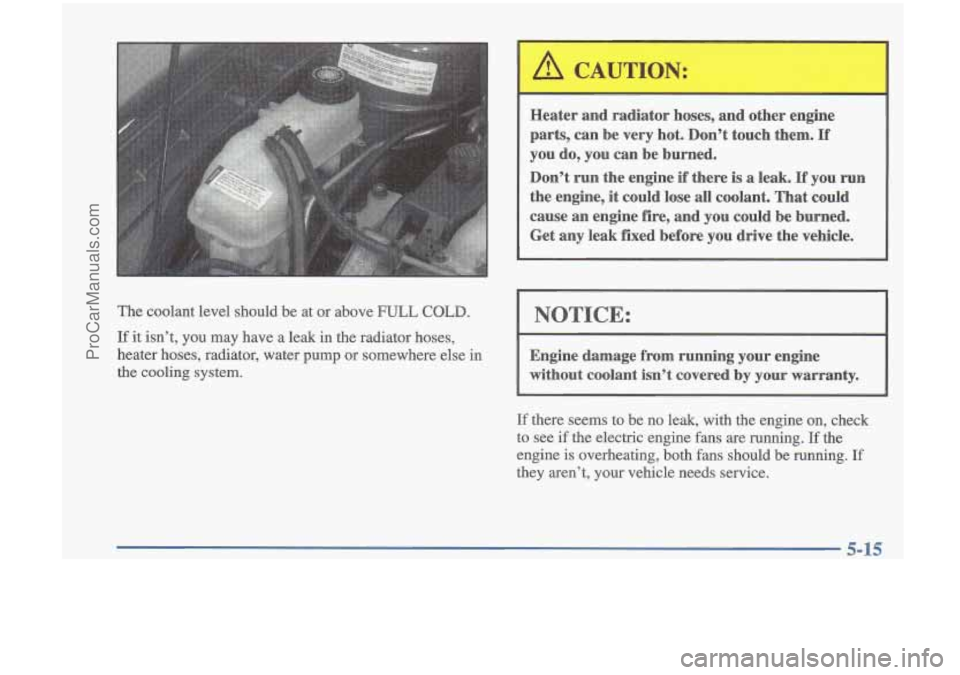
The coolant level should be at or above FULL COLD.
If it isn’t, you may have a leak in the radiator hoses,
heater hoses, radiator, water pump
or somewhere else in
the cooling system. Heater and radiator
hoses, and other engine
parts, can be very hot. Don’t touch them.
If
you do, you can be burned.
Don’t run the engine
if there is a leak. If you run
the engine,
it could lose all coolant. That could
cause an engine fire, and you could be burned.
Get any leak fixed before you drive the vehicle.
I NOTICE:
Engine damage from running your engine
without coolant isn’t covered
by your warranty.
If there seems to be no leak, with the engine on, check
to see if the electric engine fans are running.
If the
engine
is overheating, both fans should be running. If
they aren’t, your vehicle needs service.
ProCarManuals.com
Page 204 of 353
I
Adding only plain water to your cooling system can be dangerous. Plain water, or some other
liquid like alcohol, can boil before the proper
coolant mix will. Your vehicle’s coolant warning
system is set for the proper coolant mix. With
plain water or the wrong
mix, your engine could
get too hot but you wouldn’t get the overheat
warning. Your engine could catch fire and you or
others could be burned. Use a
50/50 mix of clean
water and DEX-COOL
TM coolant.
I NOTICE:
In cold weather, water can freeze and crack the
engine, radiator, heater core and other parts.
So
use the recommended coolant.
c
You can be burned if you spill coolant on hot
engine parts. Coolant contains ethylene glycol
and it will burn
if the engine parts are hot
enough. Don’t spill coolant on a hot engine.
ProCarManuals.com
Page 239 of 353
Automatic Transaxle Fluid
It is not necessary to check the transaxle fluid level. A
transaxle fluid leak is the only reason for fluid loss. If a
leak occurs, take the vehicle to your Oldsmobile retail
facility Service Department and have it repaired as soon
as possible. You may also have your fluid level checked
by your retailer or service center when you have your
oil changed.
Engine Coolant
The cooling system in your vehicle is filled with new
DEX-COOL” engine coolant.
This coolant is designed
to remain
in your vehicle for 5 years or 150,000 miles
(240 000 km), whichever occurs first, if you add only
DEX-COOL
TM extended life coolant.
The following explains your cooling system and how to
add coolant when it is low. If you have a problem with
engine overheating, see “Engine Overheating” in
the Index.
A 50/50 mixture of water and the proper coolant for
your Oldsmobile will:
0 Give freezing protection down to -34°F (-37°C).
0 Give boiling protection up to 265 “F (129 O C).
0 Protect against rust and corrosion.
0 Help keep the proper engine temperature.
Let the warning lights and gages work as they should.
NOTICE:
When adding coolant, it is important that you use
only
DEX-COOL TM (silicate-free) coolant.
If silicated coolant is added to the system,
premature engine, heater core or radiator
corrosion may result. In addition, the engine
coolant will require change sooner
-- at
30,000 miles (50 000 km) or 24 months,
whichever occurs first.
ProCarManuals.com