towing capacity OLDSMOBILE CUTLASS 1997 Owners Manual
[x] Cancel search | Manufacturer: OLDSMOBILE, Model Year: 1997, Model line: CUTLASS, Model: OLDSMOBILE CUTLASS 1997Pages: 353, PDF Size: 16.72 MB
Page 175 of 353
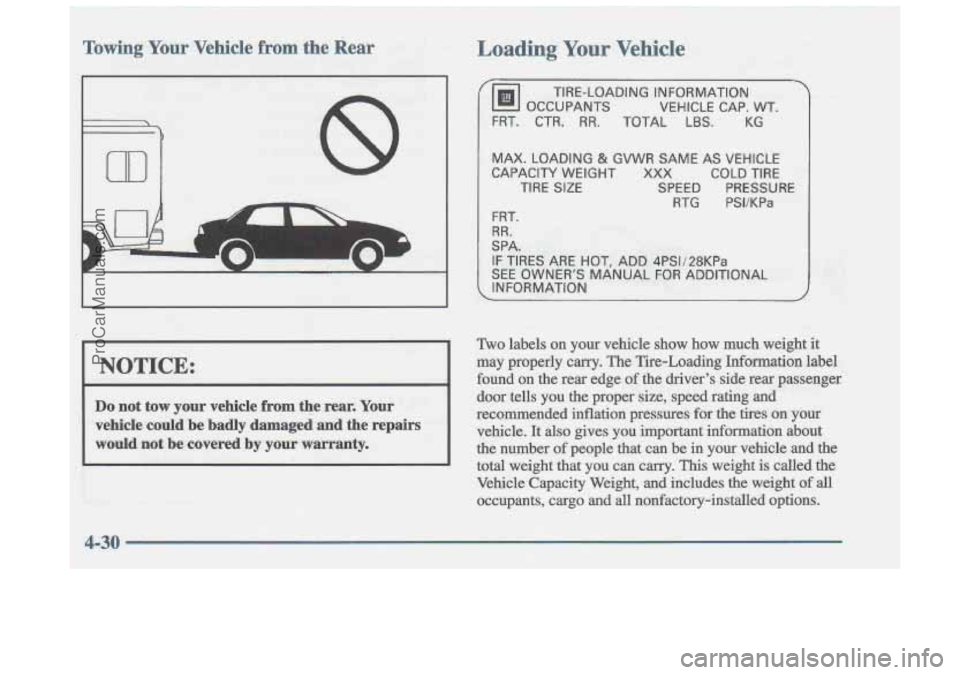
Towing Your Vehicle from the Rear
8
I NOTICE:
Do not tow your vehicle from the rear. Your
vehicle could be badly damaged and the repairs would not be covered by your warranty.
Loading Your Vehicle
Fm OCCUPANTS VEHICLE CAP. WT.
?
TIRE-LOADING INFORMATION
FRT. CTR.
RR. TOTAL LBS. KG
MAX. LOADING & GVWR SAME AS VEHICLE
CAPACITY WEIGHT XXX COLD TIRE
TIRE SIZE SPEED PRESSURE
RTG PSI/KPa
FRT.
RR.
SPA. IF TIRES ARE HOT, ADD 4PS1/28KPa
SEE OWNER'S MANUAL FOR ADDITIONAL
INFORMATION
Two labels on your vehicle show how much weight it
may properly carry. The Tire-Loading Information label
found on the rear edge
of the driver's side rear passenger
door tells you the proper size, speed rating and
recommended inflation pressures
for the tires on your
vehicle. It also gives you important information about
the number
of people that can be in your vehicle and the
total weight that you can carry.
This weight is called the
Vehicle Capacity Weight,
and includes the weight of all
occupants, cargo and all nonfactory-installed options.
4-30
ProCarManuals.com
Page 178 of 353
Your vehicle can tow a trailer if it is equipped with the
proper trailer towing equipment.
To identify what the vehicle trailering capacity is for
your vehicle, you should read the information in
“Weight of the Trailer” that appears later in this section.
But trailering is different than just driving your vehicle
by itself. Trailering means changes
in handling,
durability and fuel economy. Successful, safe trailering
takes correct equipment, and it has to be used properly.
That’s the reason for this part. In it are many
time-tested, important trailering tips and safety rules.
Many of these are important for your safety and that of
your passengers.
So please read this section carefully
before you pull a trailer.
Load-pulling components such as the engine, transaxle,
wheel assemblies and tires are forced to work harder
against the drag of the added weight. The engine is
required to operate at relatively higher
speeds^ and under
greater loads, generating extra heat. What’s more, the
trailer adds considerably to wind resistance, increasing
the pulling requirements.
If You Do Decide To Pull A Trailer
If you do, here are some important points:
0
0
0
0
e
There are many different laws, including speed limit
restrictions, having to
do with trailering. Make sure
your rig will be legal, not only where
you live but
also where you’ll be driving.
A good source for this
information can be state or provincial police.
Consider using a sway control. You can ask a hitch
dealer about sway controls.
Don’t tow a trailer at all during the first
1,000 miles
(1 600 km) your new vehicle is driven. Your engine,
axle or other parts could be damaged.
Then, during the first
500 miles (800 krn) that you
tow a trailer, don’t drive over
50 mph (80 km/h) and
don’t make starts at full throttle.
This helps your
engine and other parts of your vehicle wear
in at the
heavier loads.
Obey speed limit restrictions when towing a trailer.
Don’t drive faster than the maximum posted speed
for trailers (or no more than
55 mph (90 km/h)) to
save wear on your vehicle’s parts.
4-33
ProCarManuals.com