flat tire Oldsmobile Cutlass 1998 s User Guide
[x] Cancel search | Manufacturer: OLDSMOBILE, Model Year: 1998, Model line: Cutlass, Model: Oldsmobile Cutlass 1998Pages: 348, PDF Size: 17.46 MB
Page 217 of 348
F
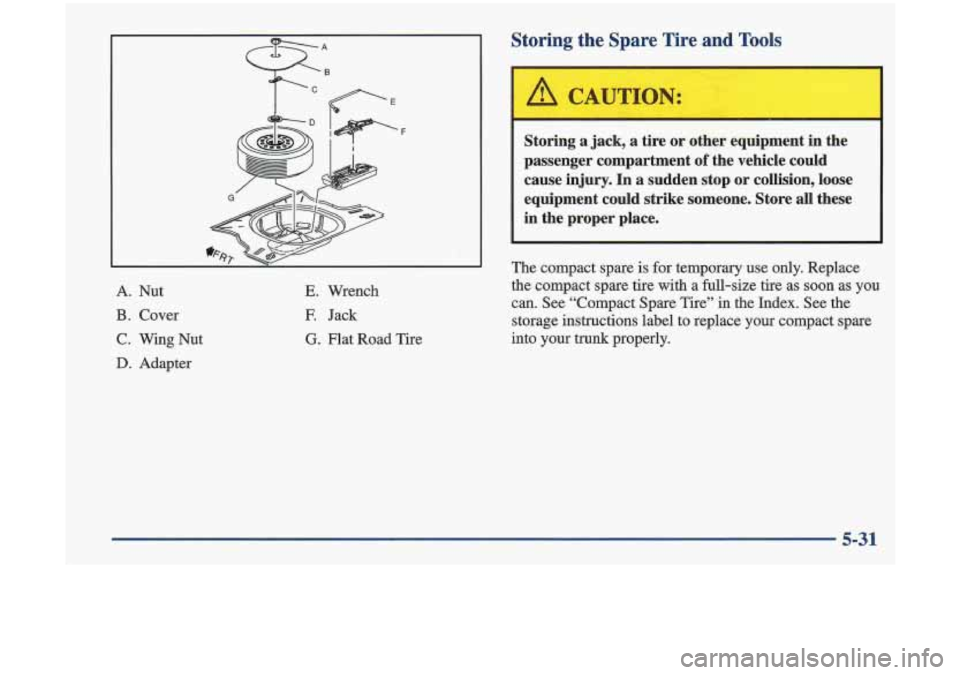
A. Nut
B. Cover
C. Wing Nut
D. Adapter
E. Wrench
F. Jack
G. Flat Road Tire
Storing the Spare Tire and Tools
Storing a jack, a tire or other equipment in the
passenger compartment
of the vehicle could
cause injury.
In a sudden stop or collision, loose
equipment could strike someone. Store all these
in the proper place.
I I.
The compact spare is for temporary use only. Replace
the compact spare tire with a hll-size tire as soon as you
can. See “Compact Spare Tire” in the Index. See the
storage instructions label to replace your compact spare
into your
trunk properly.
5-31
Page 218 of 348
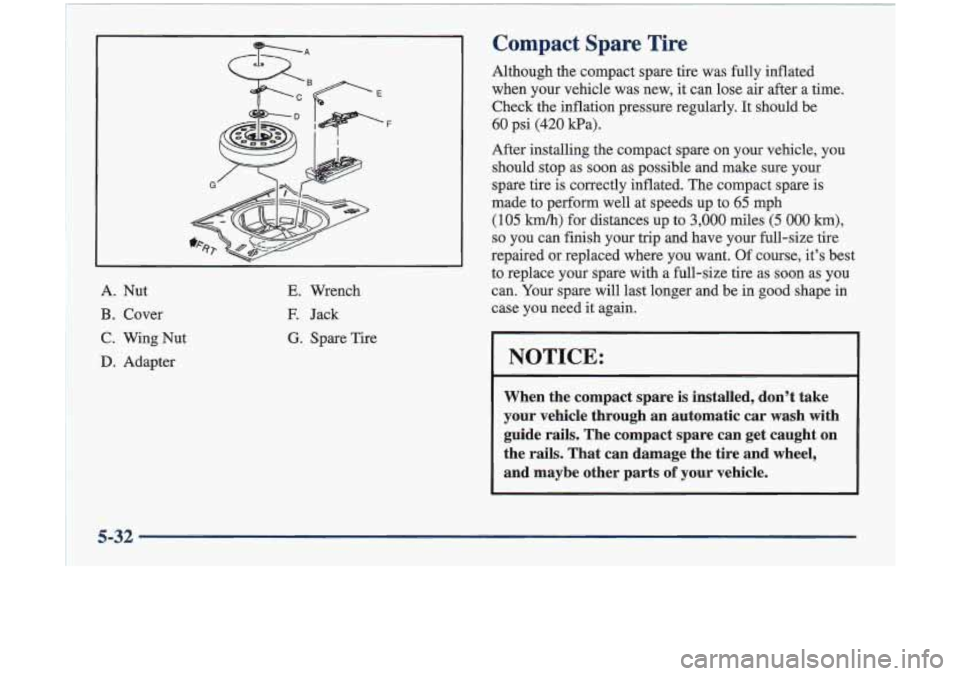
A. Nut
B. Cover
C. Wing Nut
D. Adapter
E. Wrench
E Jack
G. Spare Tire
Compact Spare Tire
Although the compact spare tire was fully inflated when your vehicle was new, it can lose air after a time.
Check the inflation pressure regularly.
It should be
60 psi (420 Pa).
After installing the compact spare on your vehicle, you should stop as soon as possible and make sure your
spare tire is correctly inflated. The compact spare is
made to perform well at speeds up to
65 mph
(105 km/h) for distances up to 3,000 miles (5 000 km),
so you can finish your trip and have your full-size tire
repaired or replaced where you want. Of course, it’s best
to replace your spare with a full-size tire as soon as you
can. Your spare will last longer and be in good shape in
case you need it again.
NOTICE:
When the compact spare is installed, don’t take
your vehicle through an automatic car wash with
guide rails. The compact spare can get caught on
the rails. That can damage the tire and wheel, and maybe other parts
of your vehicle.
5-32
Page 254 of 348
Dome Lamp
To change, your dome lamp bulb, grasp the center front
and center rear portion
of the housing and squeeze
firmly but gently.. The housing should pop off.
If this doesn’t work, you may need to use a small
flat-head screwdriver pder the side
of the housing to
help pry it
.off.
Windshield Wiper Blade Replacement
Replacement blades come in different types and are
removed
in different ways. For the proper type and
length, see “Capacities and Specifications” in the Index.
Here’s how to remove the Sheppard’s
Hook type:
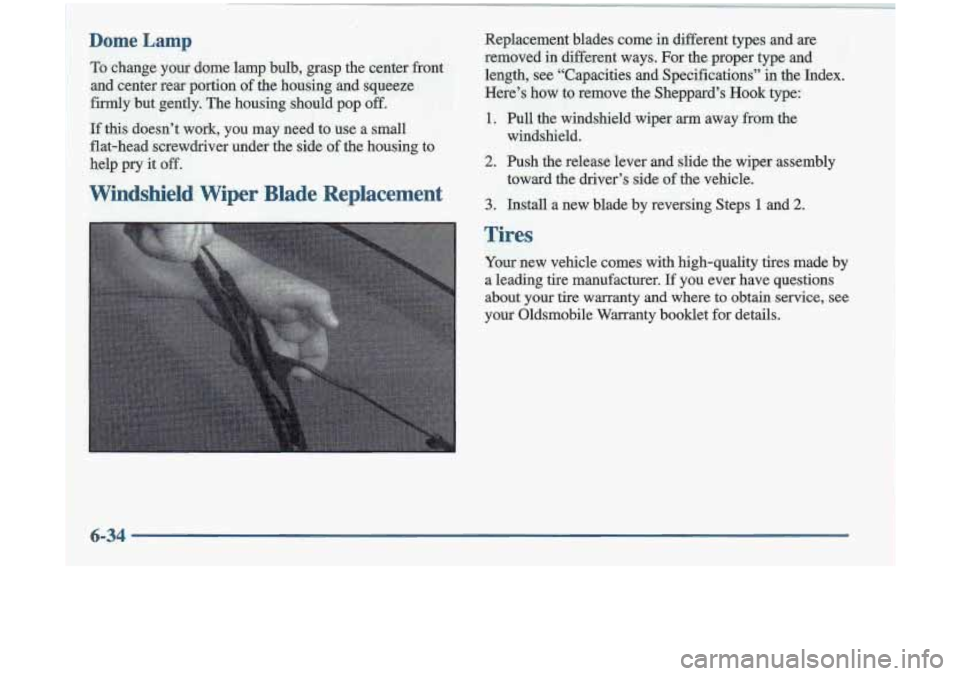
1. Pull the windshield wiper arrn away from the
2. Push the release lever and slide the wiper assembly
3. Install a new blade by reversing Steps 1 and 2.
windshield.
toward the driver’s side
of the vehicle.
Tires
Your new vehicle comes with high-quality tires made by
a leading tire manufacturer. If you ever have questions
about your tire warranty and where to obtain service, see
your Oldsmobile Warranty booklet for details.
.6-34
Page 255 of 348
Poorly maintained and improperly used tires
are dangerous.
0
0
0
0
Overloading your tires can cause
overheating as a result of too much friction.
You could have an air-out and a serious
accident. See “Loading Your Vehicle” in
the Index.
Underinflated tires pose the same danger as
overloaded tires. The resulting accident
could cause serious mjury. Check all tires
frequently
to maintam the recommended
pressure. Tire pressure should be checked
when your tires are cold.
Overinflated tires are more likely
to be
cut, punctured or broken by
a sudden
impact
-- such as when you hit a pothole.
Keep tires at the recommended pressure.
Worn, old tires can cause accidents.
If your
tread is badly worn,
or if your tires have
been damaged, replace them.
Inflation -- Tire Pressure
The Tire-Loading Information label, which is located on
the driver’s side rear passenger door, shows the correct
inflation pressures for
your tires when they’re cold.
“Cold” means your vehicle has been sitting for at least
three hours or driven no more than
1 mile (1.6 km).
NOTICE:
Don’t let anyone tell you that underinflation or
overinflation
is all right. It’s not. If your tires
don’t have enough air (underinflation), you can
get the following:
0 Too much flexing
Too much heat
Tire overloading
0 Bad wear
0 Bad handling
Bad fuel economy.
NOTICE: (Continued)
6-35
I 1
Page 256 of 348
: ,-.. - L ’ . I. -. .. .. .. .;._ :
.>I NOTICE^: (Continued) ’
-1 if If your tires have too much air (overinflation),
.P :: you can get the following: ;$
Y Unusual wear
‘r Bad handling I$
!f 0 Rough ride
3 Needless damage from road hazards.
.:hen to Check
!Check your tires once a month or more.
h
i
I
. ’ !Don’t forget your compact spare tire. It should be at
’ 860 .LI ..I . psi (420 Pa).
How to Check
$.
.:Use a good quality pocket-type gage to check tire
!pressure.
You can’t tell if your tires are properly inflated
lsimply by looking at them. Radial tires may look properly inflated even when they’re underinflated.
@e sure to put
the valve caps back on the valve
’stems. They help prevent leaks by keeping out
dirt
and moisture.
Tire Inspection and Rotation
Tires should be rotated every 6,000 to. 8,000 miles
(10 000 to 13 000 km). Any time you notice unusual
wear, rotate your
tires as soon as possible and check
wheel alignment.
Also check for damaged tires or
wheels. See “When It’s Time for New Tires” and
“Wheel Replacement” later
in this section for
more information.
The purpose
of regular rotation is to achieve more
uniform wear for all tires on the vehicle. The first
rotation is the myst important.
See “Scheduled
Maintenance Services” in the Index for scheduled
rotation intervals.
I
Page 257 of 348
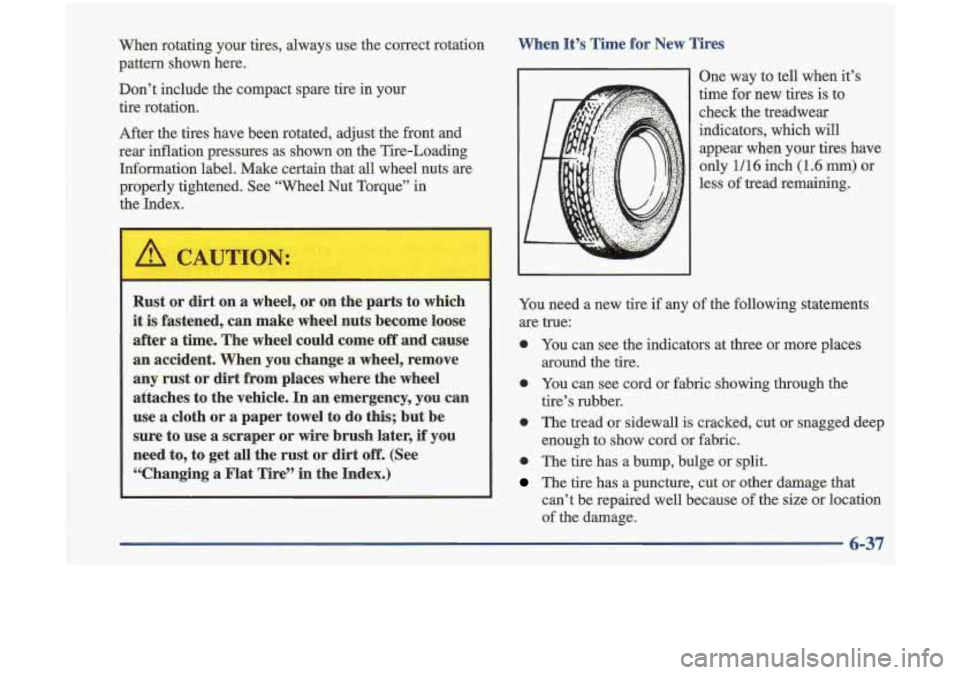
When rotating your tires, always use the correct rotation
pattern shown here.
Don’t include the compact spare tire in your
tire rotation.
After the tires have been rotated, adjust the front and
rear inflation pressures as shown on the Tire-Loading
Information label. Make certain that
all wheel nuts are
properly tightened. See “Wheel Nut Torque” in
the Index.
[ ,A c,
Rust or dirt on a wheel, or on the parts to which
it is fastened, can make wheel nuts become loose
after
a time. The wheel could come off and cause
an accident. When you change a wheel, remove
any rust or dirt from places where the wheel
attaches to the vehicle.
In an emergency, you can
use a cloth or
a paper towel to do this; but be
sure to use
a scraper or wire brush later, if you
need to, to get all the
rust or dirt off. (See
“Changing a Flat Tire” in the Index.) When It’s Time
for New Tires
One way to tell when it’s
time for new tires is to
check the treadwear
indicators, which will appear when your tires have
only 1/16 inch (1 -6 mm) or
less of tread remaining.
You need a new tire
if any of the following statements
are true:
0 You can see the indicators at three or more places
around the tire.
0 You can see cord or fabric showing through the
tire’s rubber.
0 The tread or sidewall is cracked, cut or snagged deep
enough to show cord or fabric.
0 The tire has a bump, bulge or split.
The tire has a puncture, cut or other damage that
can’t be repaired well because
of the size or location
of the damage.
6-37
I
Page 260 of 348
I
Temperature -- A, B, C
The temperature grades are A (the highest), B, and C,
representing the tire’s resistance to the generation of
heat and its ability
to dissipate heat when tested under
controlled conditions on a specified indoor laboratory
test wheel. Sustained high temperature can cause the
material of the tire to degenerate and reduce
tire life, and
excessive temperature can lead to sudden tire failure.
The grade
C corresponds to a level of performance
which
all passenger car tires must meet under the
Federal Motor Vehicle Safety Standard
No. 109. Grades
B and A represent higher levels of performance on the
laboratory test wheel than the minimum required by law.
Warning: The temperature grade for this tire is
established
for a tire that is properly inflated and not
overloaded. Excessive speed, underinflation, or
excessive loading, either separately or in combination,
can cause heat buildup and possible tire failure.
Wheel Alig1:::::Bt and Tire Balance
The wheels on your vehicle were aligned and balanced
carefully at the factory to give
you the longest tire life
and best overall performance.
Scheduled wheel alignment and wheel balancing are not
needed. However,
if you notice unusual tire wear or
your vehicle pulling one way or the other, the alignment
may need to be reset.
If you notice your vehicle
vibrating when driving on a smooth road, your wheels
may need to be rebalanced.
Wheel Replacement
Replace any wheel that is bent, cracked, or badly rusted
or corroded. If wheel nuts keep coming loose, the wheel,
wheel bolts and wheel nuts should be replaced.
If the
wheel leaks
air, replace it (except some aluminum
wheels, which can sometimes be repaired). See your
retailer
if any of these conditions exist.
Your retailer will know the kind of wheel you need.
6-40
-
Page 261 of 348
Each new wheel should have the same load-carrying
capacity, diameter, width, offset and be mounted the
same way as the one it replaces.
If you need to replace any of your wheels, wheel bolts
or wheel nuts, replace them only with new GM original
equipment parts.
This way, you will be sure to have the
right wheel, wheel bolts and wheel nuts for your
Oldsmobile model.
I
Using the wrong -)la( nent wheels, wk 1.
bolts or wheel nuts on your vehicle can be
dangerous.
It could affect the braking and
handling of your vehicle, make your tires lose air
and make you lose control. You could have a
collision in which you or others could be injured.
Always use the correct wheel, wheel bolts and
wheel nuts for replacement.
NOTICE:
The wrong wheel can also cause problems with
bearing life, brake cooling, speedometer
or
odometer calibration, headlamp aim, bumper
height, vehicle ground clearance and tire or tire
chain clearance to the body and chassis.
See “Changing a Flat Tire” in the Index for
more information.
Used Replacement Wheels
Putting
a used wheel on your vehicle is
dangerous. You can’t know how it’s been used or
how far it’s been driven. It could
fail suddenly
and cause an accident.
If you have to replace a
wheel, use a new
GM original equipment wheel.
I
6-41
Page 308 of 348
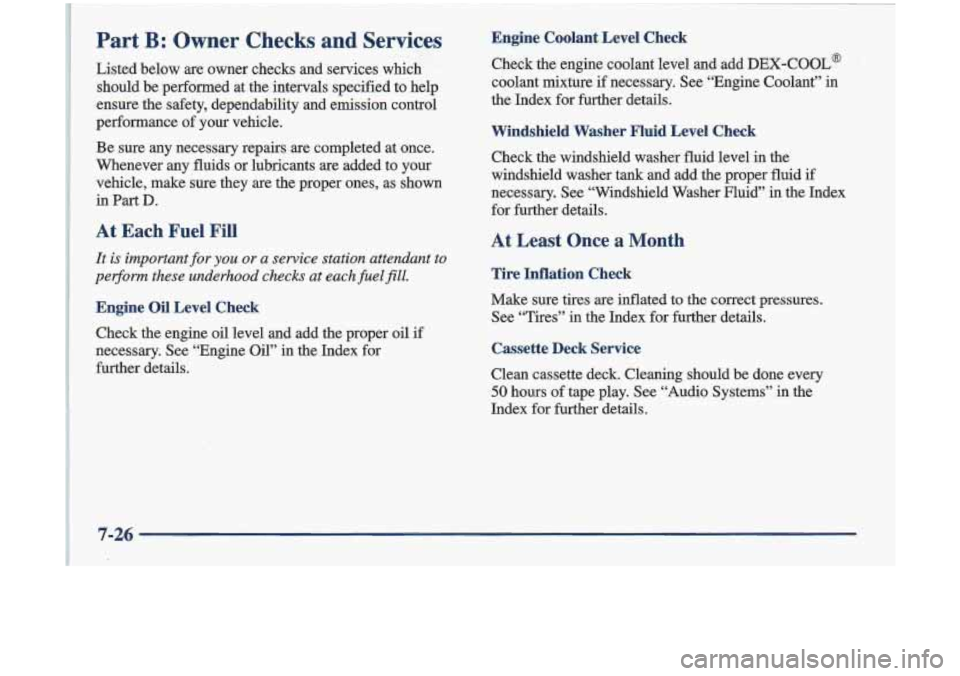
Windshield Washer Fluid Level Check
Check the windshield washer fluid level in the
windshield washer tank and add the proper fluid if
necessary. See “Windshield Washer Fluid”
in the Index
for further details.
At Least Once a Month
Tire Inflation Check
Make sure tires are inflated to the correct pressures.
See “Tires”
in the Index for fbrther details.
Cassette Deck Service
Clean cassette deck. Cleaning should be done every
50 hours of tape play. See “Audio Systems” in the
Index for further details.
7-26
Page 331 of 348
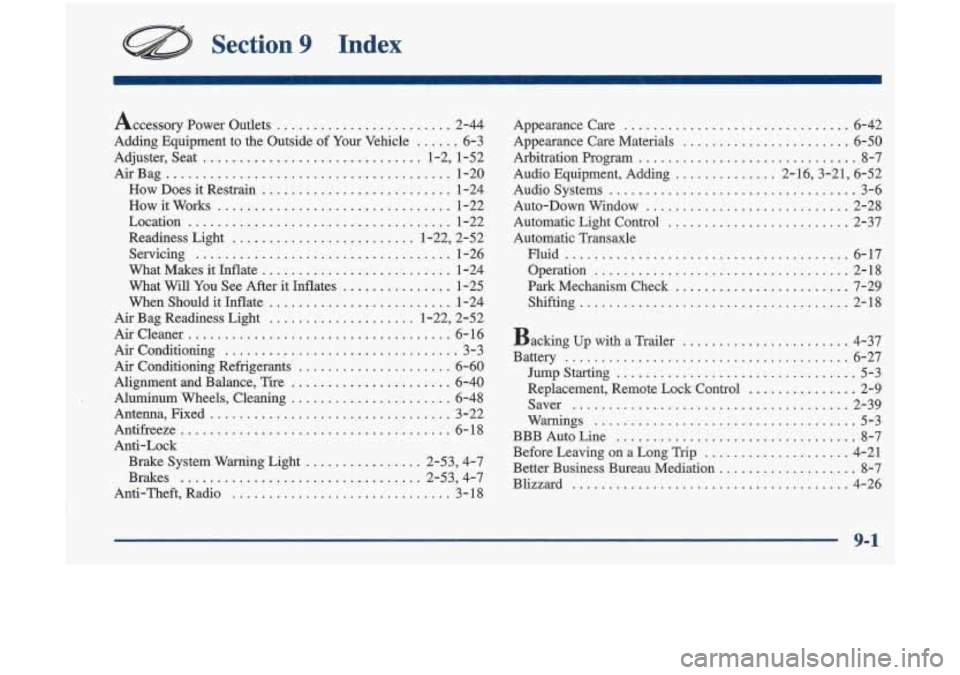
Section 9 Index
Accessory Power outlets ........................ 2-44
Adding Equipment to the Outside
of Your Vehicle ...... 6-3
Adjuster. Seat
.............................. 1.2. 1.52
AirBag
....................................... 1-20
How Does it Restrain .......................... 1-24
How it Works
................................ 1-22
Location
.................................... 1-22
Readiness Light
......................... 1.22. 2.52
Servicing
................................... 1-26
What Makes it Inflate
.......................... 1-24
What Will You See After it Inflates
............... 1-25
When Should it Inflate
......................... 1-24
Air Bag Readiness Light .................... 1.22. 2.52
Aircleaner
.................................... 6-16
Air Conditioning
................................. 3-3
Air Conditioning Refrigerants ..................... 6-60
Alignment and Balance. Tire
...................... 6-40
Aluminum Wheels. Cleaning
...................... 6-48
Antenna. Fixed
................................. 3-22
Antifreeze
..................................... 6-18
hti-Lock Brake System Warning Light
................ 2.53. 4.7
Brakes
................................. 2.53. 4.7
Anti.Theft. Radio
.............................. 3-18 Appearance Care
............................... 6-42
Appearance Care Materials
....................... 6-50
ArbitrationProg
ram .............................. 8-7
Audio Equipment, Adding
.............. 2-16,3-21, 6-52
Audio Systems
.................................. 3-6
Auto-Down Window
............................ 2-28
Automatic Light Control
......................... 2-37
Automatic Transaxle Fluid
....................................... 6-17
Operation
................................... 2-18
Park Mechanism Check ........................ 7-29
Shifting
..................................... 2-18
Backing up with
a Trailer ....................... 4-37
Battery
....................................... 6-27
Jump Starting
................................. 5-3
Replacement. Remote Lock Control
............... 2-9
Saver
...................................... 2-39
BBB Auto Line
................................. 8-7
Before Leaving on a Long Trip
.................... 4-21
Better Business Bureau Mediation
................... 8-7
Warnings .................................... 5-3
Blizzard ...................................... 4-26
9-1