fuel Oldsmobile Cutlass 1998 s Owner's Guide
[x] Cancel search | Manufacturer: OLDSMOBILE, Model Year: 1998, Model line: Cutlass, Model: Oldsmobile Cutlass 1998Pages: 348, PDF Size: 17.46 MB
Page 255 of 348
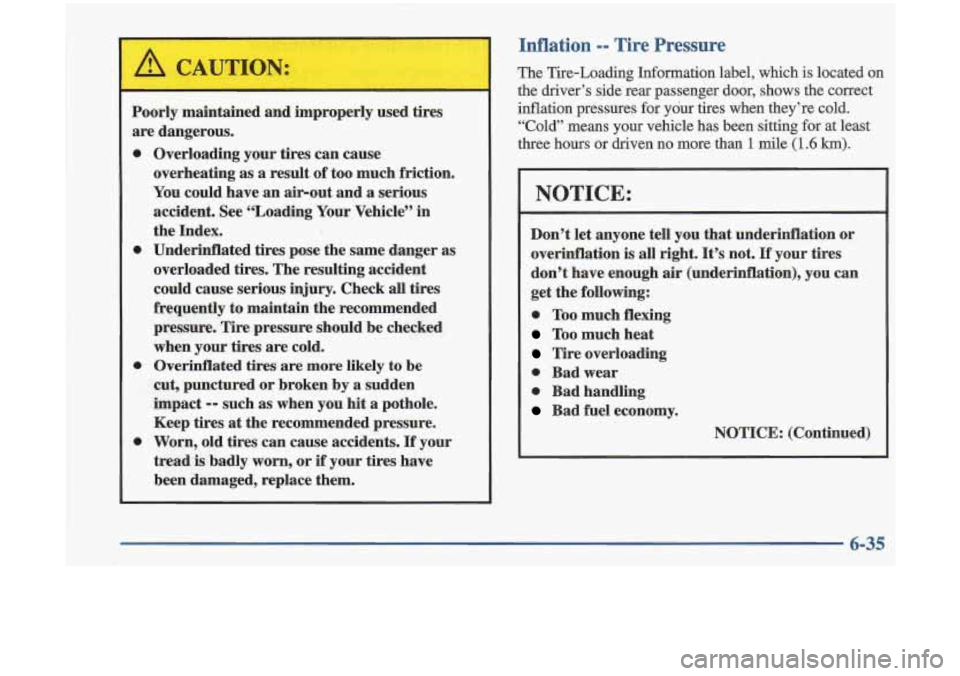
Poorly maintained and improperly used tires
are dangerous.
0
0
0
0
Overloading your tires can cause
overheating as a result of too much friction.
You could have an air-out and a serious
accident. See “Loading Your Vehicle” in
the Index.
Underinflated tires pose the same danger as
overloaded tires. The resulting accident
could cause serious mjury. Check all tires
frequently
to maintam the recommended
pressure. Tire pressure should be checked
when your tires are cold.
Overinflated tires are more likely
to be
cut, punctured or broken by
a sudden
impact
-- such as when you hit a pothole.
Keep tires at the recommended pressure.
Worn, old tires can cause accidents.
If your
tread is badly worn,
or if your tires have
been damaged, replace them.
Inflation -- Tire Pressure
The Tire-Loading Information label, which is located on
the driver’s side rear passenger door, shows the correct
inflation pressures for
your tires when they’re cold.
“Cold” means your vehicle has been sitting for at least
three hours or driven no more than
1 mile (1.6 km).
NOTICE:
Don’t let anyone tell you that underinflation or
overinflation
is all right. It’s not. If your tires
don’t have enough air (underinflation), you can
get the following:
0 Too much flexing
Too much heat
Tire overloading
0 Bad wear
0 Bad handling
Bad fuel economy.
NOTICE: (Continued)
6-35
I 1
Page 277 of 348
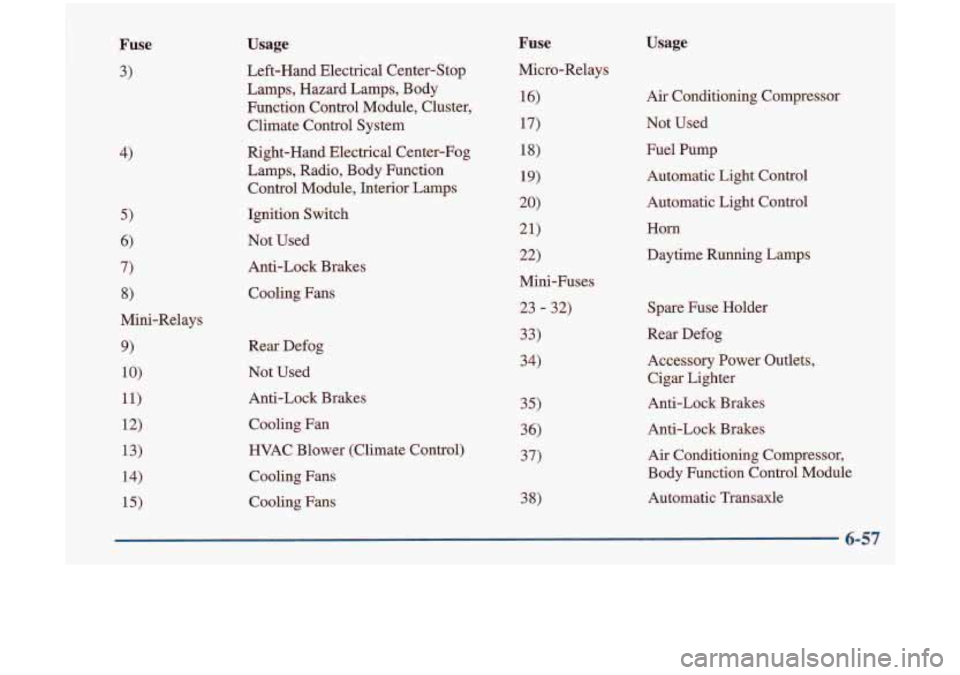
Fuse
3)
4)
Usage
Left-Hand Electrical Center-Stop
Lamps, Hazard Lamps, Body
Function Control Module, Cluster,
Climate Control System
Right-Hand Electrical Center-Fog
Lamps, Radio, Body Function Control Module, Interior Lamps
Ignition Switch
Not Used
Anti-Lock Brakes Cooling Fans
Rear Defog
Not Used
Anti-Lock Brakes Cooling Fan
WAC Blower (Climate Control)
Cooling Fans
Cooling Fans
35)
36)
37)
3
8)
Usage
Air Conditioning Compressor
Not Used Fuel Pump Automatic Light Control Automatic Light Control
Horn
Daytime Running Lamps
Spare Fuse Holder
Rear Defog
Accessory Power Outlets, Cigar Lighter
Anti-Lock Brakes
Anti-Lock Brakes
Air Conditioning Compressor,
Bodv Function Control Module
P-_. mmatic Transaxle
6-57
Page 278 of 348
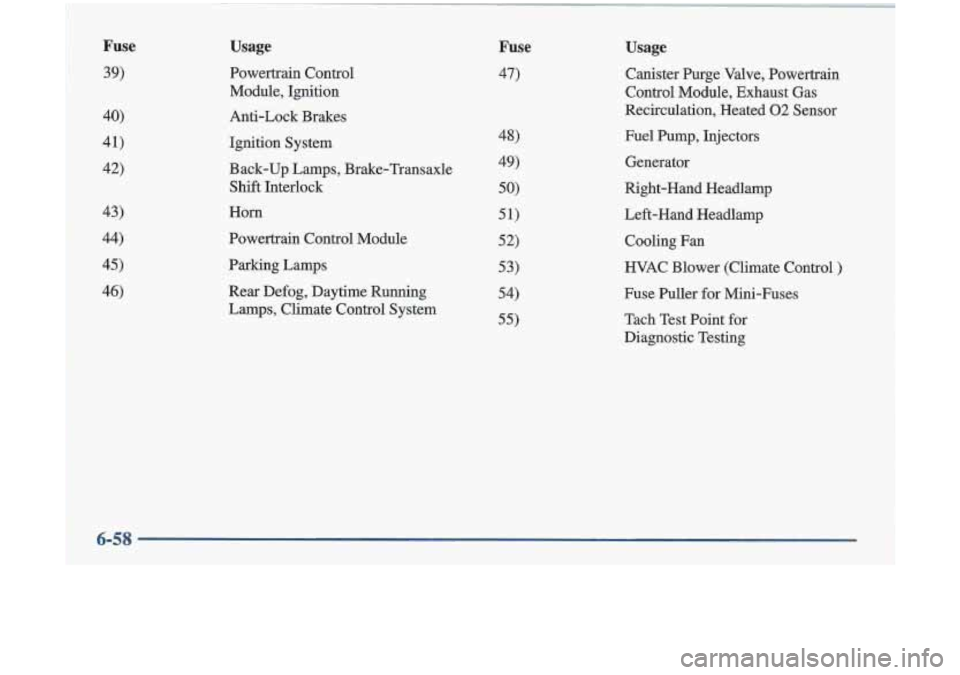
Fuse
39)
Usage
Powertrain Control Module, Ignition
Anti-Lock Brakes
Fuse
47)
Usage
Canister Purge Valve, Powertrain
Control Module, Exhaust Gas
Recirculation, Heated 02 Sensor
Ignition System
Back-up Lamps, Brake-Transaxle
Shift Interlock
Horn
Powertrain Control Module
Parking Lamps
Rear Defog, Daytime Running
Lamps, Climate Control System Fuel
Pump, Injectors
Generator
Right-Hand Headlamp
Left-Hand Headlamp
Cooling Fan
HVAC Blower (Climate Control
)
Fuse Puller for Mini-Fuses
Tach Test Point for
Diagnostic Testing
6-58
Page 279 of 348
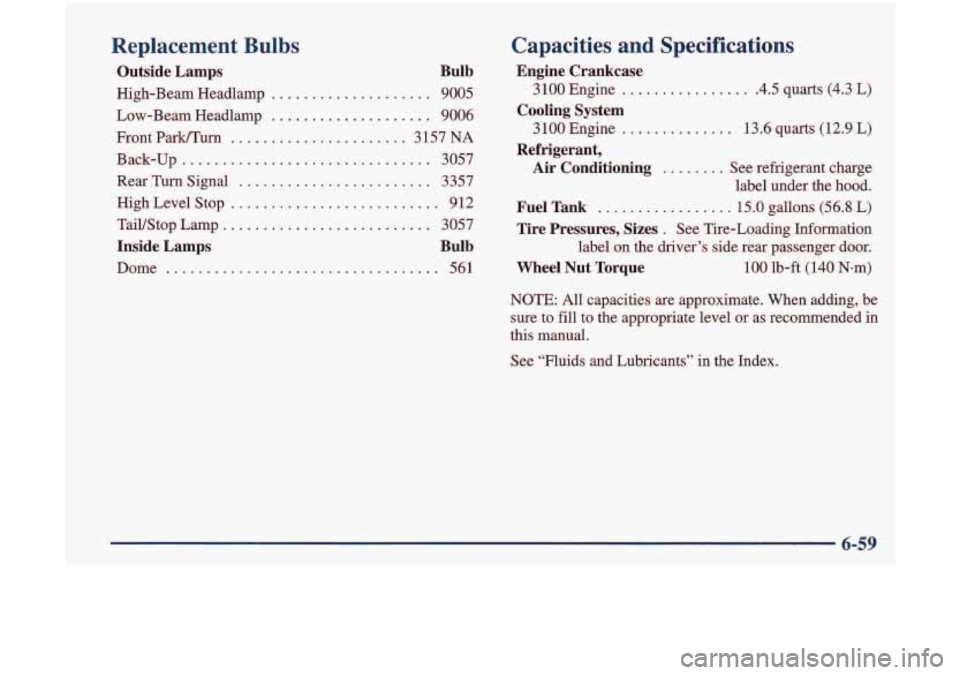
Replacement Bulbs
Outiide Lamps Bulb
High-Beam Headlamp .................... 9005
Low-Beam Headlamp
.................... 9006
Front Park/Turn
...................... 3 157 NA
Back-up
............................... 3057
Rear Turn Signal
........................ 3357
HighLevelStop
.......................... 912
TaiUStop Lamp
.......................... 3057
Inside Lamps Bulb
Dome .................................. 561
Capacities and Specifications
Engine Crankcase
Cooling System
Refrigerant,
3 100 Engine ................ .4.5 quarts (4.3 L)
3100 Engine
.............. 13.6 quarts (12.9 L)
Air Conditioning ........ See refrigerant charge
label under the hood.
Fuel Tank ................. 15.0 gallons (56.8 L)
Tire Pressures, Sizes . See Tire-Loading Information
label on the driver’s side rear passenger door.
Wheel Nut Torque 100 lb-ft (140 Nom)
NOTE: All capacities are approximate. When adding, be
sure to
fill to the appropriate level or as recommended in
this manual.
See “Fluids and Lubricants” in the Index.
6-59
Page 286 of 348

Part A: Scheduled Maintenance
Services
Using Your M ’,--lawe Schedule
We at General Motors want to help you keep your
vehicle in good working condition. But we don’t know
exactly how you’ll drive it. You may drive very short
distances only a few times a week. Or you may drive
long distances all the time in very hot, dusty weather.
You may use your vehicle in making deliveries. Or
you may drive it to work, to do errands
or in many
other ways.
Because of all the different ways people use their
vehicles, maintenance needs
vary. You may even need
more frequent checks and replacements than you’ll find
in the schedules in this section.
So please read this
section and note how you drive. If you have any
questions on how to keep your vehicle in good
condition, see your retailer.
This part tells you the maintenance services you should
have done and when you should schedule them. If you go to your retailer for your service needs, you’ll
know
that GM-trained and supported service people will
perform the work using genuine
GM parts. The proper fluids and lubricants to
use are listed in Part D.
Make sure whoever services your vehicle uses these. All
parts should be replaced and all necessary repairs done
before you
or anyone else drives the vehicle.
These schedules are for vehicles that:
carry passengers and cargo within recommended
limits. You will find these limits on your vehicle’s
Tire-Loading Information label. See “Loading Your
Vehicle” in the Index.
0 are driven on reasonable road surfaces within legal
driving limits.
0 use the recommended fuel. See “Fuel” in the Index.
Selecting the Right Schedule
First you’ll need to decide which of the two schedules is
right for your vehicle. Here’s how to decide which
schedule to follow:
7-4
Page 287 of 348
Maintenance Schedule
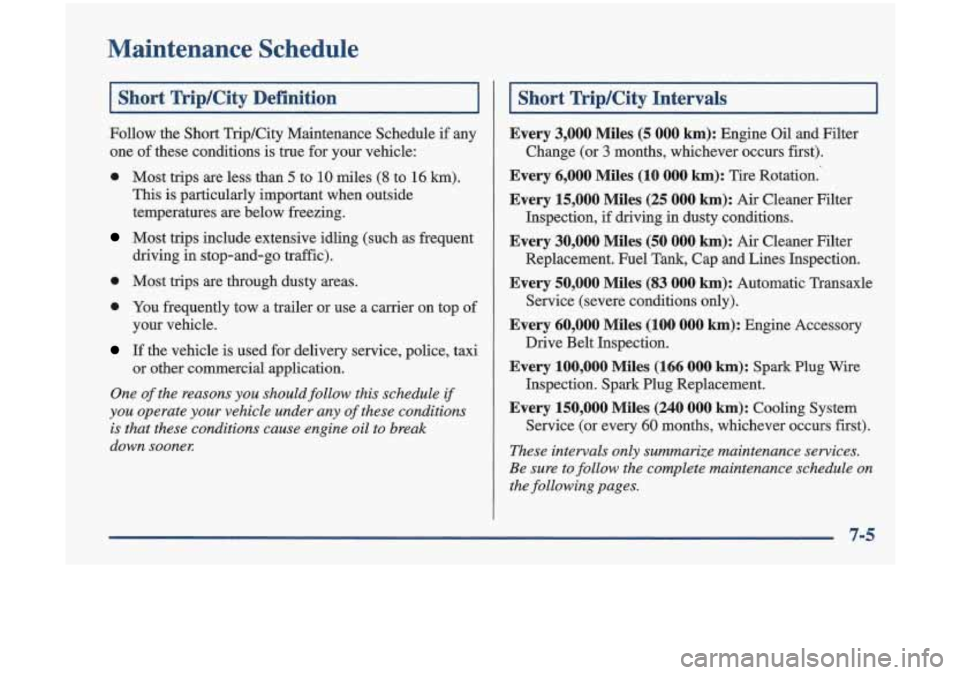
I Short TripKity Definition I
Follow the Short TripKity Maintenance Schedule if any
one of these conditions
is true for your vehicle:
0 Most trips are less than 5 to 10 miles (8 to 16 km).
This is particularly important when outside
temperatures are below freezing.
Most trips include extensive idling (such as fiequent
driving in stop-and-go traffic).
0 Most trips are through dusty areas.
0 You frequently tow a trailer or use a carrier on top of
your vehicle.
If the vehicle is used for delivery service, police, taxi
One of the reasons you should follow this schedule if
you operate your vehicle under any of these conditions
is that these conditions cause engine oil to break
down soonex
or other commercial application.
Short TripKity Intervals
Every 3,000 Miles (5 000 km): Engine Oil and Filter
Change
(or 3 months, whichever occurs first).
Every 6,000 Miles (10 000 km): Tire Rotation.
Every 15,000 Miles (25 000 km): Air Cleaner Filter
Inspection, if driving in dusty conditions.
Every 30,000 Miles (50 000 km): Air Cleaner Filter
Replacement. Fuel Tank, Cap and Lines Inspection.
Every 50,000 Miles (83 000 km): Automatic Transaxle
Service (severe conditions only).
Every 60,000 Miles (100 000 km): Engine Accessory
Drive Belt Inspection.
Every 100,000 Miles (166 000 km): Spark Plug Wire
Inspection. Spark Plug Replacement.
Every 150,000 Miles (240 000 km): Cooling System
Service (or every
60 months, whichever occurs first).
These intervals only summarize maintenance services.
Be sure to follow the complete maintenance schedule
on
the following pages.
7-5
Page 288 of 348
Maintenance Schedule
Long Trip/Hig;hway Definition I 1 i
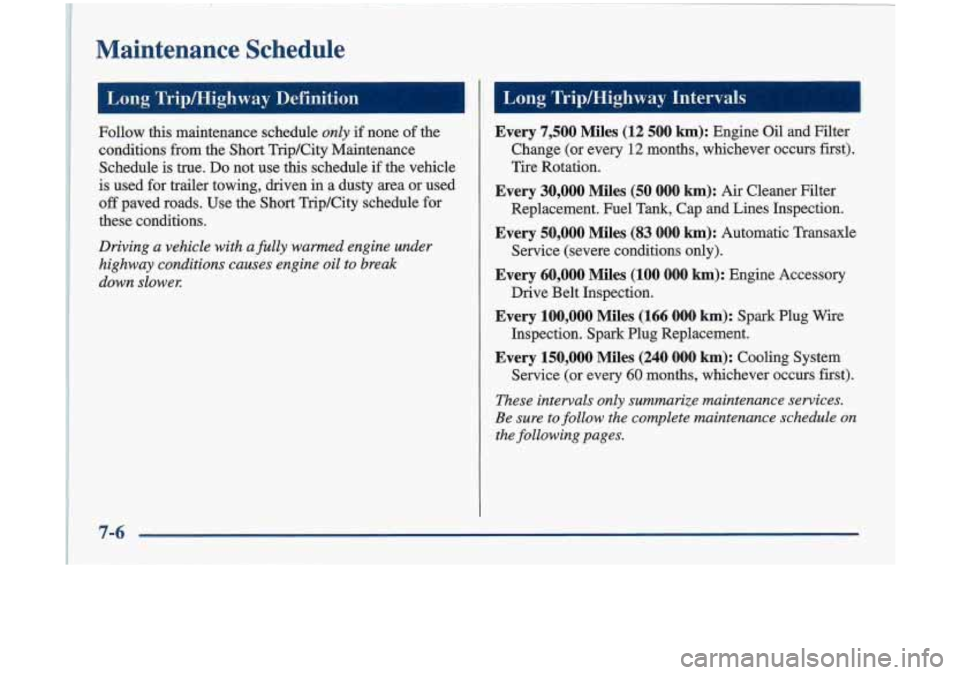
Follow this maintenance schedule only if none of the
conditions from the
Short TripKity Maintenance
Schedule is true. Do not use this schedule
if the vehicle
is used
for trailer towing, driven in a dusty area or used
off paved roads. Use the Short Trip/City schedule for
these conditions.
Driving a vehicle with a fully warmed engine under
highway conditions causes engirae oil
to break
down slower:
--
Every 7,500 Miles (12 500 km): Engine Oil and Filter
Change (or every
12 months, whichever occurs first).
Tire Rotation.
Every 30,000 Miles (50 000 km): Air Cleaner Filter
Replacement. Fuel
Tank, Cap and Lines Inspection.
Every 50,000 Miles (83 000 km): Automatic Transaxle
Service (severe conditions only).
Every 60,000 Miles (100 000 km): Engine Accessory
Drive Belt Inspection.
Every 100,000 Miles (166 000 km): Spark Plug Wire
Inspection. Spark Plug Replacement.
Every 150,000 Miles (240 000 km): Cooling System
Service (or every
60 months, whichever occurs first).
These intervals only summarize maintenance services.
Be sure to
follow the complete maintenance schedule on
the following pages.
7-6
Page 292 of 348
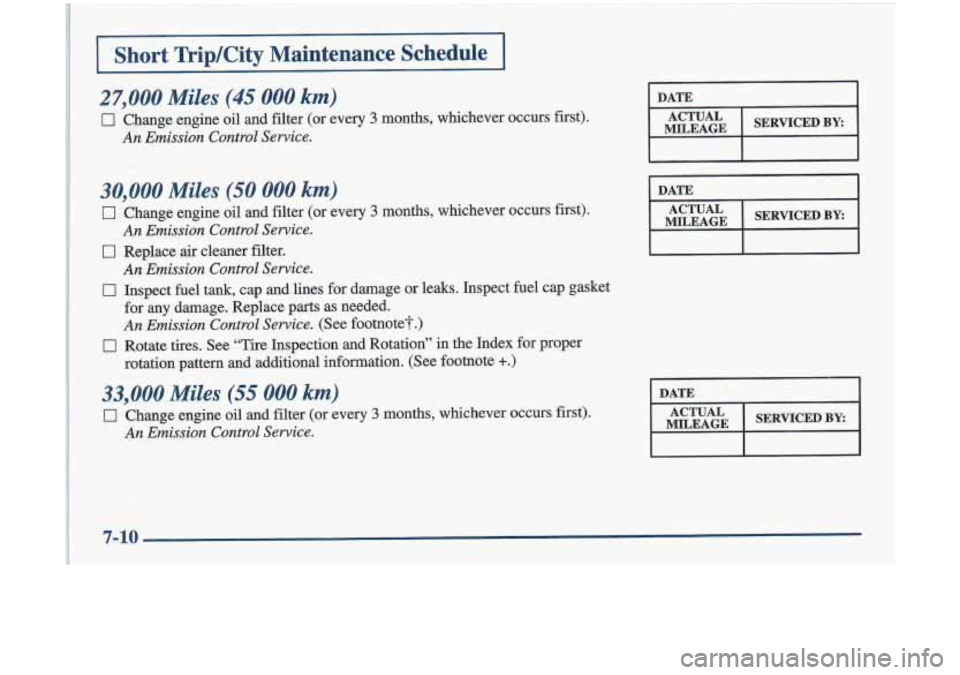
30,000 Miles (50 000 km)
0 Change engine oil and filter (or every 3 months, whichever occurs first).
Cl Replace air cleaner filter.
0 Inspect~fuel tank, cap and lines for darnage or leaks. Inspect fuel cap gasket
An Emission Control Service.
An Emission
Control Service.
for any damage. Replace parts as needed.
An-Emission Control Service. (See footnote?.)
rotation pattern and additional information. (See footnote
+.)
0 Rotate tires. See “Tire kspection and Rotation” in the Index for proper
33,000 Miles (55 000 km)
0 Change engine oil and filter (or every 3 months, whichever occurs first).
An Emission Control Service.
MILEAGE
DATE
I
MILEAGE
DATE
I
7-10
Page 295 of 348
I Short Trip/City Maintenance Schedule I
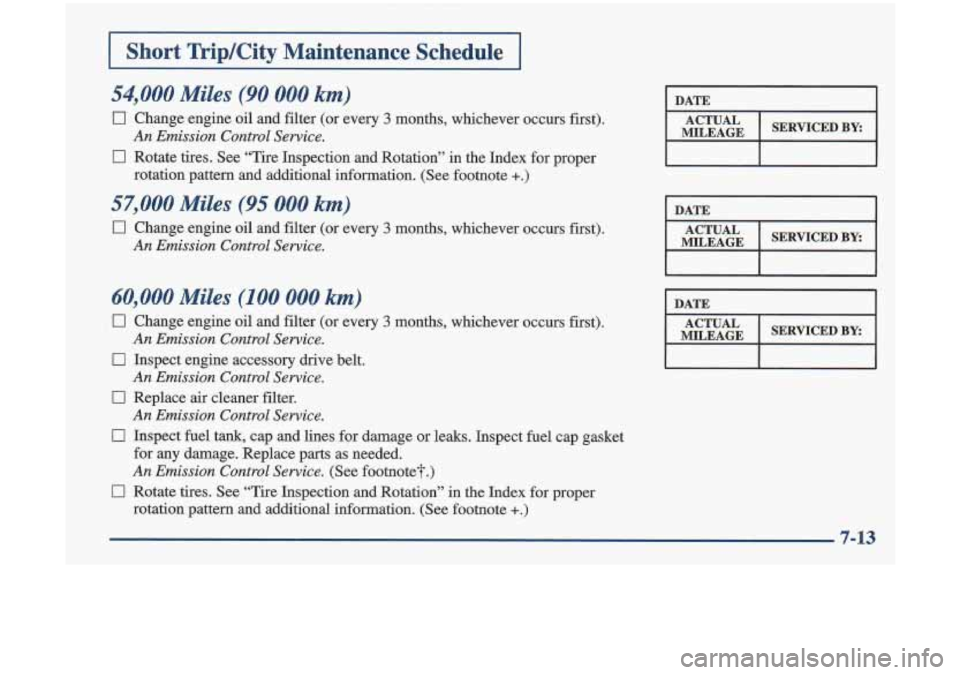
54,000 Miles (90 000 km)
0 Change engine oil and filter (or every 3 months, whichever o ~ ~ ~ ~ __ .
0 Rotate tires. See “Tire Inspection and Rotation” in the Index lV+. proper
..
An Emission Control Service.
rotation pattern and additional information. (See footnote +.)
57,000 Miles (95 000 km)
0 Change engine oil and filter (or every 3 months, whichever occurs first).
An Emission Control Service.
60,000 Miles (100 000 km)
17 Change engine oil and filter (or every 3 months, whichever occurs first).
0 Inspect engine accessory drive belt.
0 Replace air cleaner filter.
0 Inspect fuel tank, cap and lines for damage or leaks. Inspect fuel cap gasket
An Emission Control Service.
An Emission Control Service.
An Emission Control Service.
for any damage. Replace parts as needed.
An Emission Control Service. (See footnoteT.)
rotation pattern and additional information. (See footnote
+.)
0 Rotate tires. See “Tire Inspection and Rotation” in the Index for proper
DATE I
I MILEAGE ACTUAL I SERVICEDBY: I
I DATE I
MILEAGE
DATE
I
7-13
! I I
i
Page 298 of 348
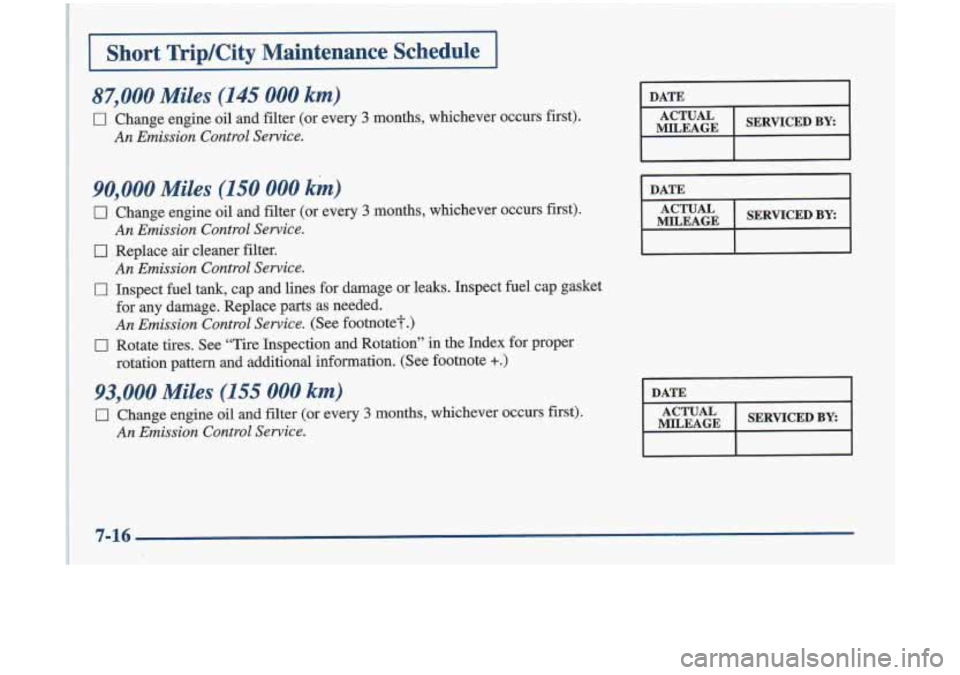
I I
90,000 Miles (150 000 km)
0 Change engine oil and filter (or every 3 months, whichever occurs first).
0 Replace air cleaner filter,
17 Inspect fuel tank, cap and lines for damage or leaks. Inspect fuel cap gasket
An Emission Control Service.
An Emission Control Service.
for any damage. Replace parts as needed.
An Emission Control Service. (See footnote"f)
rotation pattern and additional information. (See footnote
+.)
0 Rotate tires. See "Tire Inspection and Rotation" in the Index for proper
93,000 Miles (155 000 km)
0 Change engine oil and filter (or every 3 months, whichever occurs first).
An Emission Control Service.
I DATE I
MILEAGE
ACTUAL SERVICED BY:
DATE I
111 ACTUAL SERVICED BY:
DATE I
MILEAGE
7-16