light Oldsmobile Cutlass 1998 s Workshop Manual
[x] Cancel search | Manufacturer: OLDSMOBILE, Model Year: 1998, Model line: Cutlass, Model: Oldsmobile Cutlass 1998Pages: 348, PDF Size: 17.46 MB
Page 203 of 348
How to Add Coolant to the Coolant
Surge Tank
If you haven’t found a problem yet, but the coolant level
isn’t at
FULL COLD mark or slightly higher, add a
50/50 mixture of clean water (preferably distilled) and
DEX-COOL’ coolant at the coolant surge tank, but be
sure the cooling system, including the coolant surge tank
pressure cap,
is cool before you do it. (See “Engine
Coolant’’ in the Index for more infomation.)
I
Steam and scaldmg liquids from a hot cooling
system can blow out and burn you badly. They
are under pressure, and
if you turn the coolant
surge tank pressure cap
-- even a little -- they
can come out at high speed. Never
turn the cap
when the cooling system, including the coolant
surge tank pressure cap, is hot. Wait for the
cooling system and coolant surge
tank pressure
cap to cool
if you ever have to turn the
pressure cap.
5-17
Page 220 of 348

I NOTICE:
Spinning your wheels can destroy parts of your
vehicle as well as the tires. If you spin the wheels
too fast while shifting your transaxle back and
forth, you can destroy your transaxle.
Rocking Your Vehicle To Get It Out
First, turn your steering wheel left and right. That will
clear the area around your front wheels. Then shift back
and forth between REVERSE
(R) and a forward gear,
spinning the wheels
as little as possible. Release the
accelerator pedal while you shift, and press lightly on
the accelerator pedal when the transaxle is in gear. If
that doesn’t get you out after a few tries, you may need
to be towed out. If you do need to be towed out, see
“Towing Your Vehicle” in the Index.
~~
For information about using tire chains on your vehicle,
see “Tire Chains”
in the Index.
5-34
Page 231 of 348
Engine Oil
CHECK
OIL
If the CHECK OIL light
on the instrument panel
comes on, it means you
need to check your engine
oil level right away.
For more information, see “Check Oil Light” in the
Index.
You should check your engine oil level regularly;
this is an added reminder.
It’s a good idea to check your engine
oil every time you
get fuel.
In order to get an accurate reading, the oil must
be warm and the vehicle must be on level ground. The engine
yellow and
fi-ont
of the oil
dipstick is
located on the engine.
Turn off the engine and give the oil a few minutes to
drain back into the oil pan.
If you don’t, the oil dipstick
might not show the actual level.
Page 238 of 348
1 I
NOTICE:
We recommend you use only fluid labeled
DEXRON@-III, because fluid with that label is
made especially for your automatic transaxle.
Damage caused by fluid other than DEXRON-I11
is not covered by your new vehicle warranty.
Engine Coolant
The cooling s stem in your vehicle is filled with
DEX-COOL engine coolant. This coolant is designed
to remain in your vehicle for
5 years or 150,000 miles
(240 000 km) whichever occurs first, if you add only
DEX-COOL’ extended life coolant.
J
The following explains your cooling system and how
to add coolant when it is low. If you have a problem
with engine overheating,
see “Engine Overheating” in
the Index.
A 50/50 mixture of water and DEX-COOL@
coolant will:
0 Give freezing protection down to -34°F (-37°C).
0 Give boiling protection up to 265 OF (1 29 O C).
0 Protect against rust and corrosion.
0 Help keep the proper engine temperature.
0 Let the warning lights and gages work as
they should.
NOTICE:
When adding coolant, it is important that you use
only
DEX-COOL@ (silicate-free) coolant.
If coolant other than DEX-COOL is added to the
system, premature engine, heater core or
radiator corrosion may result. In addition, the
engine coolant will require change sooner
-- at
30,000 miles (50 000 km) or 24 months,
whichever occurs first. Damage caused by the use
of coolant other than DEX-COOL@
is not
covered by your new vehicle warranty.
6-18
Page 240 of 348
Checking Coolant
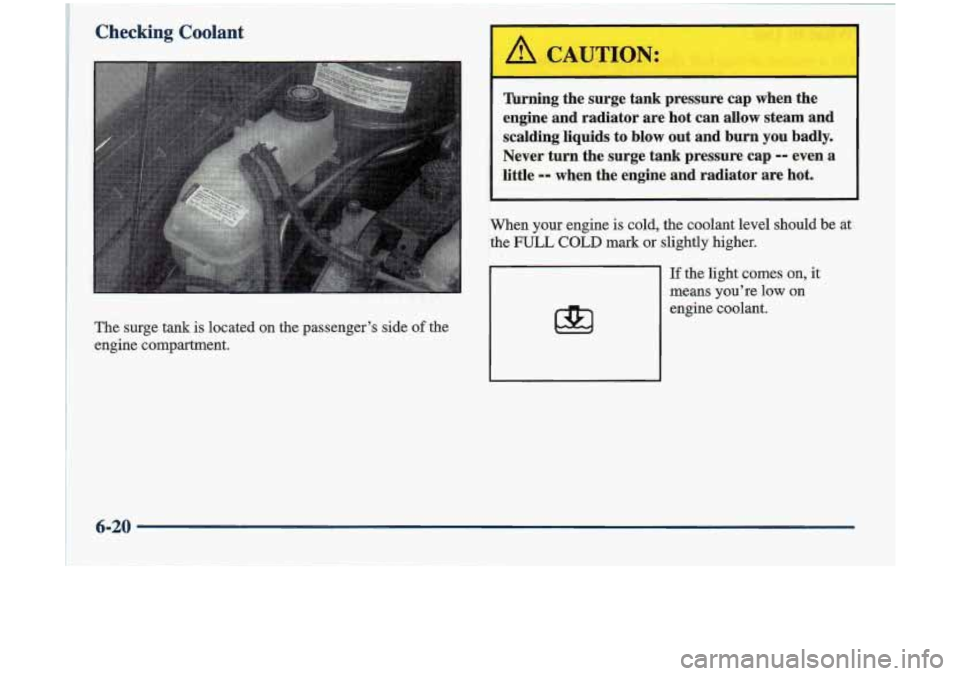
The surge tank is located on the passenger’s side of the
engine compartment.
Turning the surge tank pressure cap when the
engine and radiator are hot can allow steam and
scalding liquids to
blow out and burn you badly.
Never turn the surge
tank pressure cap -- even a
little
-- when the engine and radiator are hot.
When you engine is cold, the coolant level should be at
the
FULL COLD mark or slightly higher.
If the light comes on, it
means you’re
low on
engine coolant.
6-20
Page 245 of 348
BRAKE
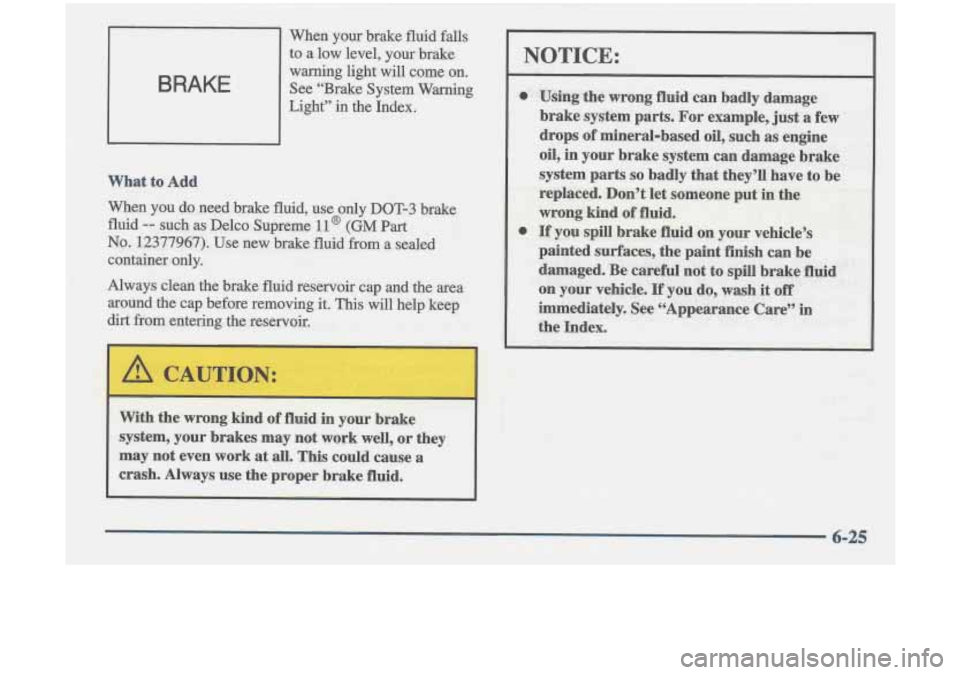
When your bmke fluid fa
to a low level, your brake
warning light will come on.
See ‘‘Brake System Wm
Light’9 in the hdex.
NOTICE:
0
0
Page 246 of 348
Brake Wear
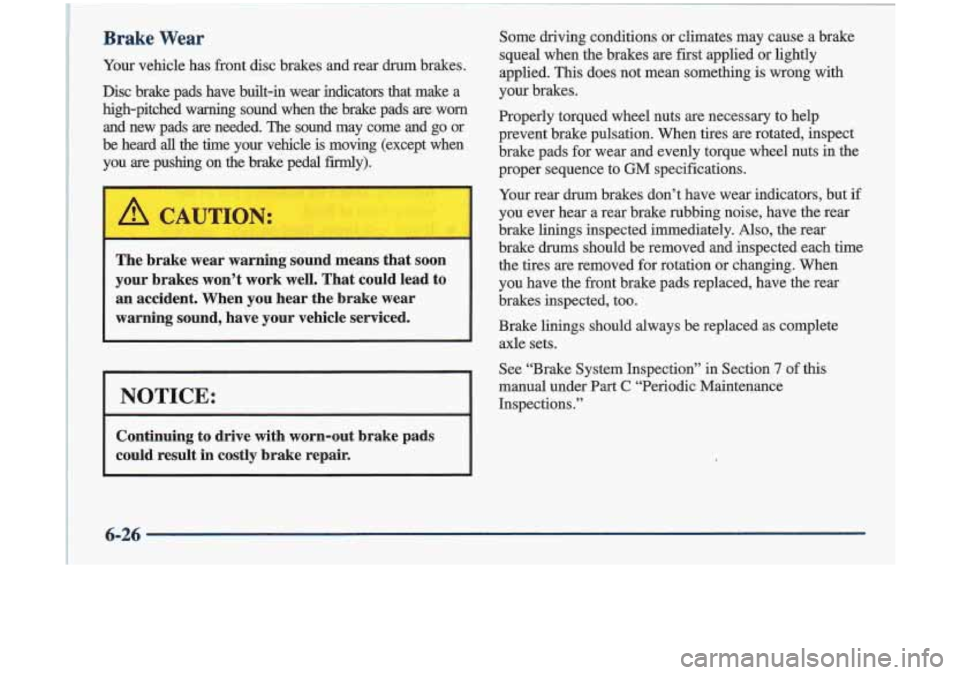
Your vehicle has front disc brakes and rear drum brakes.
Disc brake pads have built-in wear indicators that make a
high-pitched warning sound when the brake pads are
worn
and new pads are needed. The sound may come and go or
be heard
all the time your vehicle is moving (except when
you
are pushing on the brake pedal firmly).
The brake wear warning sound means that soon
your brakes won’t work well. That could lead
to
an accident. When you hear the brake wear
warning sound, have your vehicle serviced.
I NOTICE:
~~ ~ ~~
Continuing to drive with worn-out brake pads
could result
in costly brake repair.
Some driving conditions or climates may cause a brake
squeal when the brakes are first applied or lightly
applied. This does not mean something is wrong with
your brakes.
Properly torqued wheel nuts are necessary to help
prevent brake pulsation. When tires are rotated, inspect
brake pads for wear and evenly torque wheel nuts in the
proper sequence to GM specifications.
Your rear drum brakes don’t have wear indicators, but
if
you ever hear a rear brake rubbing noise, have the rear
brake linings inspected immediately. Also, the rear
brake drums should be removed and inspected each time the tires are removed for rotation or changing. When
you have the front brake pads replaced, have the rear
brakes inspected, too.
Brake linings should always be replaced as complete axle sets.
See “Brake System Inspection” in Section
7 of this
manual under Part
C “Periodic Maintenance
Inspections.”
6-26
Page 259 of 348
Uniform Tire Quality Grading
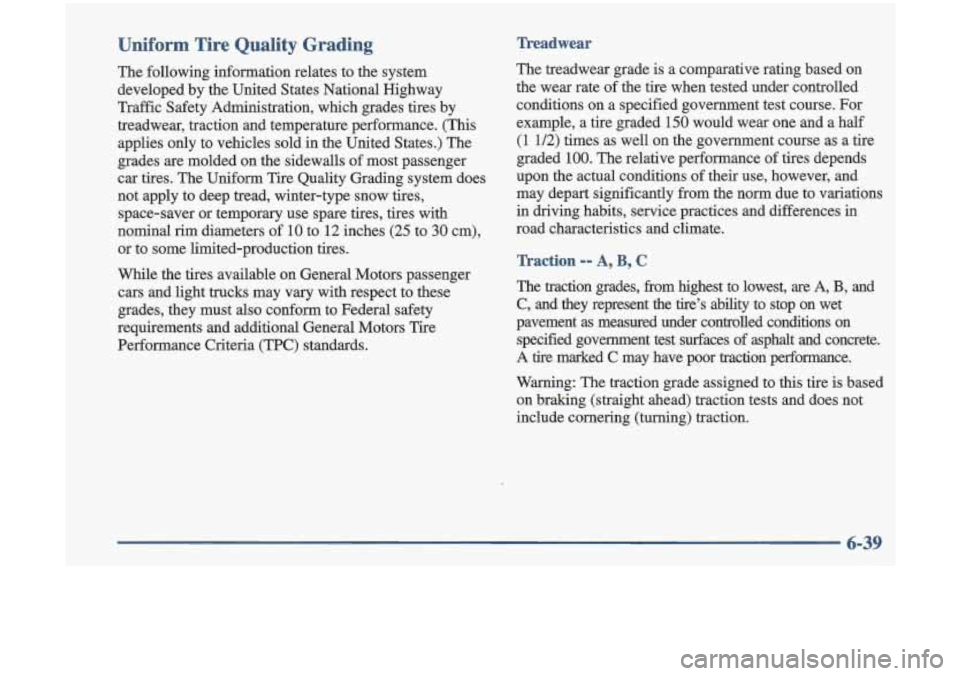
The following information relates to the system
developed by the United States National Highway
Traffic Safety Administration, which grades tires by
treadwear, traction and temperature performance.
(This
applies only to vehicles sold in the United States.) The
grades are molded on the sidewalls of most passenger
car tires. The Uniform Tire Quality Grading system does
not apply to deep tread, winter-type snow tires,
space-saver or temporary use spare tires, tires with
nominal rim diameters of
10 to 12 inches (25 to 30 cm),
or to some limited-production tires.
While the tires available on General Motors passenger cars and light trucks may vary with respect to these
grades, they must also conform to Federal safety
requirements and additional General Motors Tire
Pedomance Criteria (PC) standards.
Treadwear
The treadwear grade is a comparative rating based on
the wear rate of the tire when tested under controlled
conditions on a specified government test course. For
example, a tire graded 150 would wear one and a half
I I
(1 1/2) times as well on the government course as a tire ~
graded 100. The relative performance of tires depends 1
upon the actual conditions of their use, however, and
may depart significantly from the nom due to variations
in driving habits, service practices and differences in
road characteristics and climate. ! i
1
Traction -- A, B, C
The traction grades, fkom highest to lowest, are A, B, and
C, and they represent the tire’s ability to stop on wet
pavement
as measured mder controlled conditions on
specified government test surfaces of asphalt and concrete.
A tire marked C may have poor traction perfomce.
Warning: The traction grade assigned to this tire is based
on braking (straight ahead) traction tests and does not
include cornering (turning) traction.
Page 270 of 348
Appearance Care Materials Chart
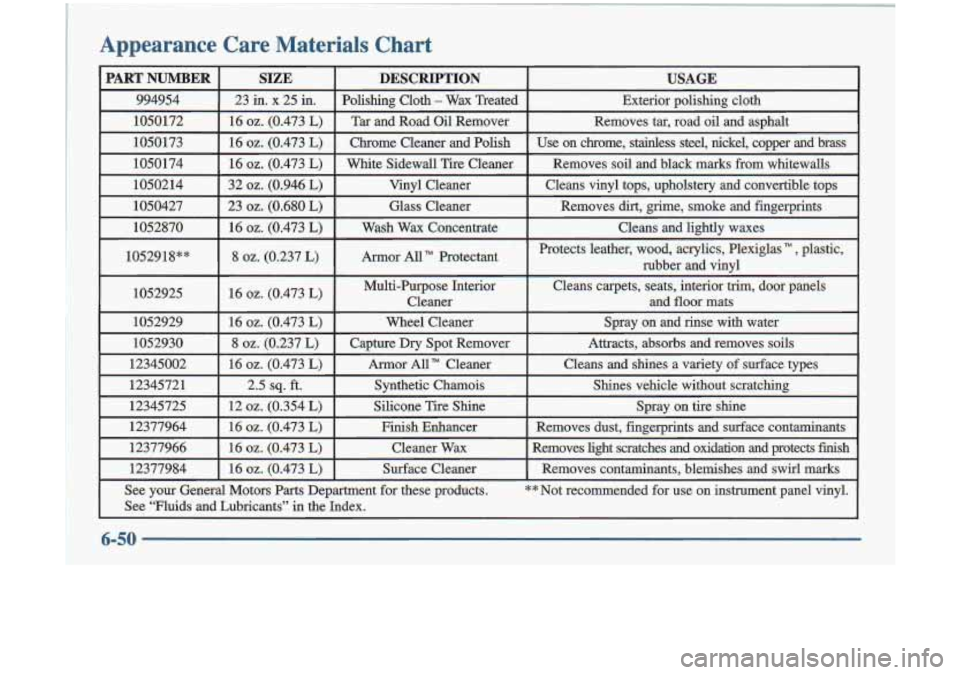
PART NUMBER SIZE DESCRIPTION USAGE
994954 23 in. x 25 in. Polishing Cloth - Wax Treated Exterior polishing cloth
1050172
16 oz. (0.473 L) Tar and Road Oil Remover Removes tat, road oil and asphalt
1050173
16 oz. (0.473 L) Chrome Cleaner and Polish Use on chrome, stainless steel, nickel, copper and brass
1050174 16
oz. (0.473 L) White Sidewall Tire Cleaner Removes soil and black marks from \
whitewalls
1050214 32
oz. (0.946 L)
Vinyl Cleaner
1050427 23
oz. (0.680 L)
Glass Cleaner
I 1052870 I 16 oz. (0.473 L) I Wash Wax Concentrate
I 1052918"" I 8 oz. (0.237 L) I Armor All" Protectant
1052925 16
oz. (0.473 L) Multi-Purpose Interior
Cleaner
1052929 16
oz. (0.473 L) Wheel Cleaner
1052930
8 oz. (0.237 L) Capture Dry Spot Remover
12345002 16
oz. (0.473 L)
Armor All" Cleaner
12345721 2.5
sq. ft. Synthetic Chamois
12345725 12
oz. (0.354 L)
Silicone Tire Shine
12377964 16
oz. (0.473 L)
Finish Enhancer
12377966 16
oz. (0.473 L) Cleaner Wax
12377984 16 oz. (0.473 L) Surface Cleaner
See your General Motors Parts Department for these products.
I See "Fluids and Lubricants" in the Index. Cleans vinyl tops, upholstery and convertible tops
Removes
dirt, grime, smoke and fingerprints
I Cleans and lightly waxes
~ ~~
Protects leather, wood, acrylics, Plexiglas " , plastic, -
rubber and vinyl I
Cleans carpets, seats, interior trim, door panels
and floor mats
I
Spray on and rinse with water
Attracts, absorbs and removes
soils
Cleans and shines a variety of surface types
Shines vehicle without scratching Spray on tire shine
Removes dust, fingerprints and surface contaminants
Removes light scratches and oxidation and protects &ish
Removes contaminants, blemishes and swirl marks
'* Not recommended for use on instrument panel vinyl.
6-50
Page 273 of 348

Fuses and Circuit Breakers
The wiring circuits in your vehicle are protected from
short circuits by a combination of fuses, circuit breakers
and fusible thermal
links in the wiring itself. This
greatly reduces the chance of fires caused by
electrical problems.
Look at the silver-colored band inside the fuse.
If the
band is broken or melted, replace the fuse. Be sure you
replace a bad fuse with a new one of the identical size
and rating.
If you ever have a problem on the road and don’t have a
spare- fuse, you can borrow one that has the same
amperage. Just pick a feature
of your vehicle that you
can get along without
-- like the radio or cigarette
lighter
-- and use its fuse, if it is the correct amperage.
Replace it as soon as you can. Also, there are spare fuses
in the left side instrument panel fuse block.
There are three fuse blocks in your vehicle: two
instmment panel fuse blocks and the engine
compartment fuse block.
Instrument Panel Fuse Block
The instrument panel fuse
blocks are located at each
end of the instrument panel.
To access the fuses, open
the fuse panel door by
To replace the door, insert the hooks at the front end
fiist, then push the door in to the instrument panel to
secure it.
Instrument Panel Fuse Block - Left
In the left instrument panel fuse block, there are spare
fuses and a fuse puller.
6-53