parking brake Oldsmobile Cutlass 1998 Owner's Manuals
[x] Cancel search | Manufacturer: OLDSMOBILE, Model Year: 1998, Model line: Cutlass, Model: Oldsmobile Cutlass 1998Pages: 348, PDF Size: 17.46 MB
Page 65 of 348

Section 2 Features and Controls
Here you can learn about the many standard and optional features on your vehicle, and inform\
ation on starting,
shifting and braking. Also explained are the instrument panel and the warning systems that tell you
if evewng is
working properly
-- and what to do if you have a problem.
2-2 2-4
2-6
2- 10
2- 12
2- 13
2-13
2- 14
2- 15
2- 16
2-18
2-22
2-23 2-25
2-26
Keys
Door Locks
Remote Lock Control
(If Equipped)
TrWnk
Theft Passlock'
New Vehicle "Break-In" Ignition Positions
Starting Your Engine
Engine Coolant Heater
(If Equipped)
Automatic Transaxle Operation
Parking Brake
Shifting
Into PARK (P)
Shifting Out of PARK (P)
Parking Over Things That Bum 2-26
2-27
2-28 2-28
2-29
2-29
2-36
2-38
2-40
2-4
1
2-45
2-46
2-48
2-50 Engine Exhaust
Running
Your Engine While You're Parked
Windows
Horn
Tilt Wheel
Turn Signal/Multifimction Lever
Exterior Lamps Interior Lamps
Mirrors Storage Compartments
Sunroof (If Equipped)
Instrument Panel Instrument Panel Cluster
Warning Lights, Gages and Indicators
2-1
Page 82 of 348
Automatic ’hansaxle Operation
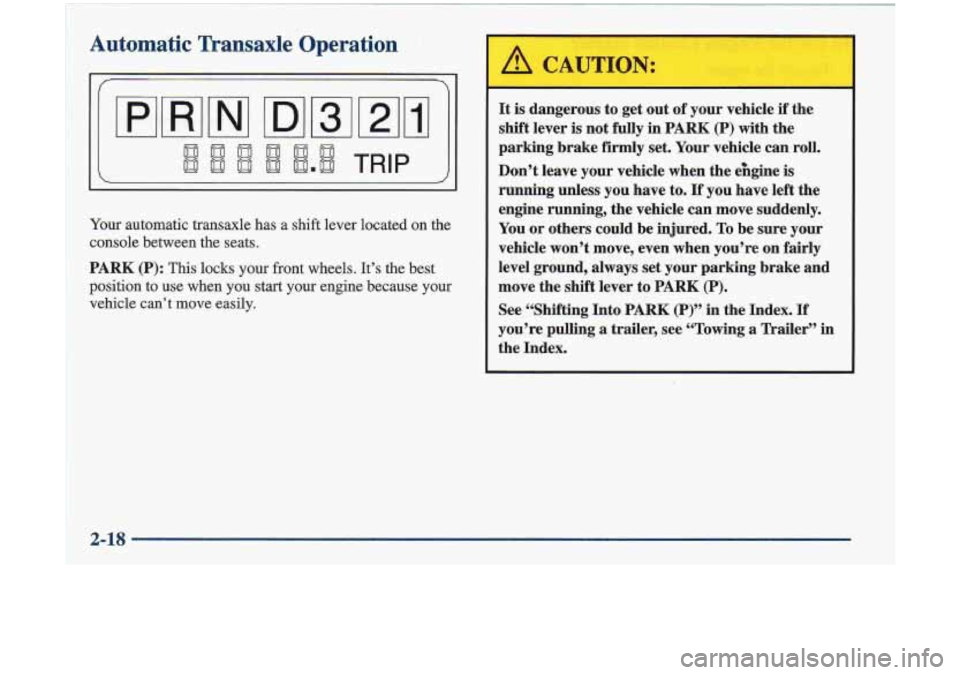
k Tour automatic transaxle has a shift lever located on the
console between the seats.
PARK (P): This locks your front wheels. It’s the best
position to use when you start your engine because your
vehicle can’t move easily.
It is dangerous to get out of your vehicle if the
shift lever is not fully in PARK (P) with the
parking brake firmly set. Your vehicle can roll.
Don’t leave your vehicle when the e&&e
is
running unless you have to. If you have left the
engine running, the vehicle can move suddenly.
You or others could be injured.
To be sure your
vehicle won’t move, even when you’re
on fairly
level ground, always set your parking brake and
move the shift lever to
PARK (P).
See “Shifting Into PARK (P)” in the Index. I€
you’re pulling a trailer, see “Towing a Trailer” in
the Index.
2-18
Page 86 of 348
Second-Gear Start
Your vehicle is equipped with a second-gear start
feature. Place the shift lever in SECOND
(2) gear to
provide more traction when you are starting on ice or
other slippery surfaces. The transaxle will be in
SECOND
(2) gear when the vehicle begins to move.
After starting in SECOND
(2) gear, place the shift lever
in THIRD
(3) or DRIVE (a).
This feature is for improved traction only when the road
surface is slippery
and is not intended for continuous use
or when the vehicle is stuck
in sand, mud, ice, snow
or gravel.
Parking Brake
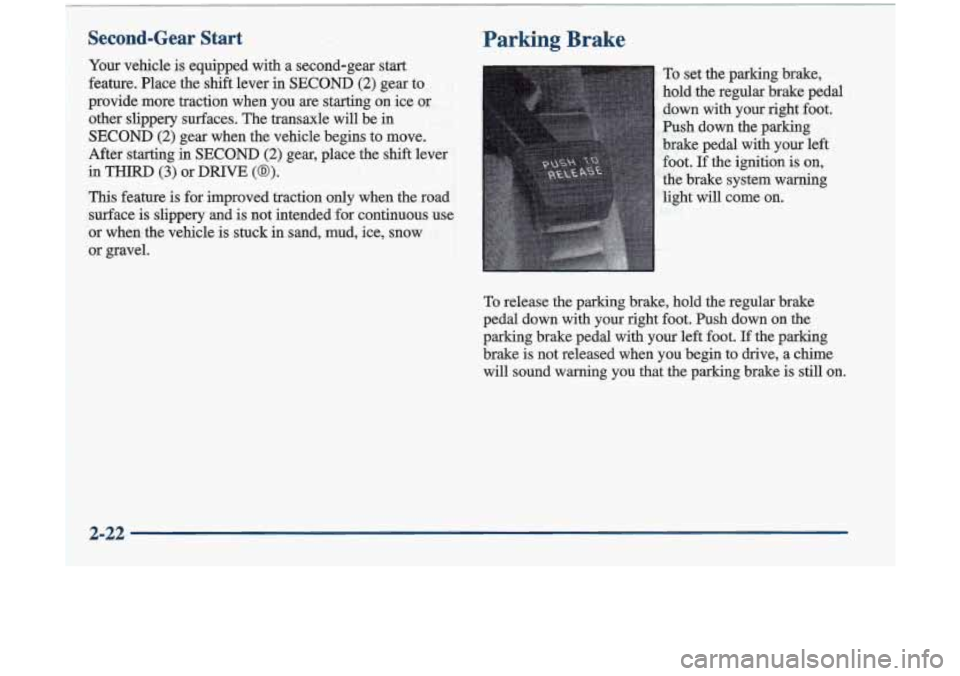
To set the parking brake,
hold the regular brake pedal
down with your right foot.
Push down the parking
brake pedal with your left foot.
If the ignition is on,
the brake system warning
light will come on.
To release the parking brake, hold the regular brake
pedal down with your right foot. Push down on the
parking brake pedal with your left foot.
If the parking
brake is not released when you begin to drive, a chime
will sound warning you that the parking brake is still on.
Page 87 of 348
NOTICE:
Driving with the parking brake on can cause
your rear brakes to overheat. You may have to replace them, and you could also damage other
parts
of your vehicle.
If you are towing a trailer and are parking on a hill, see
“Towing a Trailer”
in the Index. That section shows
what to do first to keep the trailer
fkom moving.
Shifting Into PARK (P)
L
1. Hold the brake pedal down with your right foot and
set the parking brake.
2-23
Page 88 of 348
Leaving Your Vehicle With the
.;Engine Running
I
~ , . .. . - ~~~ ~ ,.-‘.“~‘,’7 ,2-- .v7.! jT.-<--. , . ~ , -
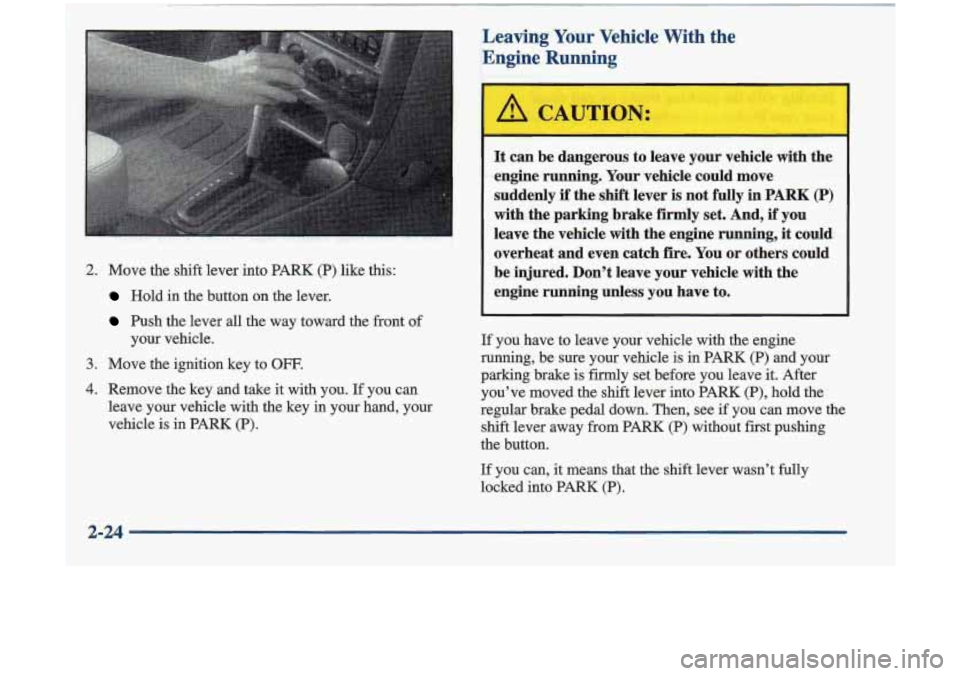
2. Move the shift lever into PARM (P) lilce this:
. . Hold jn the button on the lever.
Push the lever all the way toward the front of
your vehicle.
3. move the ignition key to OFF.
4. Remove the key and take it with you. If you can
leave your vehicle with the key in-your hand, your
veKcle
is in PARK (P).
It cm be dangerous to leave your vehicle with the
engine running. Your vehicle could move
suddenly if the shift lever
is not fully in PARK (P)
with the parking brake firmly set. And, if you
leave the vehicle
with the engine running, it could,
overheat and even catch fire. You
or others could
be.injured. Don’t leave your vehicle with the
engine
running unless you have to.
I
If you have to leave your vehicle with the engine
running, be sure your vehicle is in PARK (P) and your
parking brake is firmly set before
you leave it. After
you’ve moved the shift lever into
PARK (P), hold the
regular brake pedal down. Then, see
if you can move the
shift lever away from
PARK (P) without first pushing
the button.
If you can, it means that the shift lever wasn’t fully
locked into
PARK (p).
Page 89 of 348

Torque Lock
If you are parking on a hill and you don’t shift your
transaxle into
PARK (P) properly, the weight of the
vehicle may put too much force
on the parking pawl in
the transaxle.
You may find it difficult to pull the shift
lever out of PARK
(p). This is called “torque lock.” To
prevent torque lock, set the parking brake and then shift
into
PARK (P) properly before you leave the driver’s
seat.
To find out how, see “Shifting Into PARK (P)” in
the Index.
When you
are ready to drive, move the shift lever out of
PARK (P) before you release the parking brake.
If torque lock does occur, you may need to have another
vehicle push yours a
little uphill to take some of the
pressure from the parking pawl in the transaxle,
so you
can
pull the shift lever out of PARK (P).
Shifting Out of PARK (P)
Your Oldsmobile has a brake-transaxle shift interlock.
You have to apply your regular brake before you can
shift
from PARK (P) when the ignitian is in the RUN
position. See “Automatic Transaxle” in the Index.
If you cannot shift out of PARK (P), ease pressure on
the shift lever -- push the shift lever all the way into
PARK
(P) -- as you maintain brake application. Then
move the shift into the gear you wish. (Press the shift
lever button before moving the
shift lever.)
If you ever hold the brake pedal down but
still can’t
1. Turn the key to ACC.
2. Apply and hold the regular brake until the end of
3. Shift to NEUTRAL (N).
4. Turn the key to ON, to start the vehicle.
5. Shift to the drive gear you want.
6. Have the vehicle fixed as soon as you can.
shift out
of PARK
(P), try this:
Step 5.
Page 101 of 348
Daytime Running Lamps
Daytune Running Lamps (DRL) can make it easier for
others to see the front of your vehicle during the day.
DRL
can be helpful in many different driving
conditions, but they can be especially helpful in the
short periods after dawn and before sunset.
The
DRL system will make your low-beam headlamps
come on at a reduced brightness when:
The ignition is on,
The headlamp switch is in the OFF position or you
have turned
on your parking lamps
The light sensor detects daytime light,
0 The parking brake is released and
The shift lever is not in PARK (P).
When the DRL system is on, the taillamps, sidemarker,
parking lamps and instrument panel lights will not
be illuminated.
The
DRL system will remain off any time your vehicle
is in
PARK (P) or the parking brake is engaged.
As with any vehicle, you should turn on the regular
headlamp system when you need it.
Page 117 of 348
Anti-Lock Brake System Warning Light
Your brake system may not be working properly
if the brake system warning light is on. Driving
with the brake system warning light on can lead
to an accident. If the light is still on after you’ve pulled off the road and stopped carefully, have
the vehicle towed for service.
When the ignition is on, the brake system warning light
will also come on when you set your parking brake. The
light will stay on if your parking brake doesn’t release
fully.
If it stays on after your parking brake is fully
released, it means you have a brake problem. With the anti-lock brake
system, this light will come
on when you
turn your
ignition on or start your engine and it
will stay
on for three seconds.
That’s normal.
If the light stays on, turn the ignition to OFF. Or, if the
light comes on and the chime sounds when you’re
driving, stop as
soon as possible and turn the ignition
off. Then start the engine again to reset the system.
If
the light still stays on, or comes on again while you’re
driving, your vehicle needs service.
If the regular brake
system warning light isn’t on, you still have brakes,
but you don’t have anti-lock brakes.
If the regular
brake system warning light
is also on, you don’t have
anti-lock brakes and there’s a problem with your regular
brakes. See “Brake System Warning Light” earlier
in
this section.
The anti-lock brake system warning light should come
on briefly when you turn the ignition key to
ON. If the
light doesn’t come on then, have
it fixed so it will be
ready to warn you
if there is a problem.
2-53
Page 174 of 348
~~ ~ ~ ~~~~ ~ ~
~~~ ~ . ~~
-Run
your engine only as long as you must. This saves
fuel. When you run the engine, make it go a little faster
than just idle. That is, push the accelerator slightly. This
uses less fuel for the heat that you get and it keeps the
battery charged. You will need a well-charged battery to
restart the vehicle, and possibly for signaling later on
with your headlamps. Let the heater run for
a while.
' Then, shut the engine off and close the window almost
all the way to preserve the heat. Start the engine again and repeat this only when you feel really uncomfortable
from the cold. But do it as little as possible. Preserve the
fuel as long as you can. To help keep warm, you can get
' out of the vehicle and do some fairly vigorous exercises
.. every half hour or so until help comes.
Recreational Vehicle Towing
You can tow your vehicle behind another vehicle for use
at your'destination. Be sure to use the proper towing
equipment designed for recreational towing. Follow the
instructions for the towing equipment.
Towing Your Vehicle from the Front
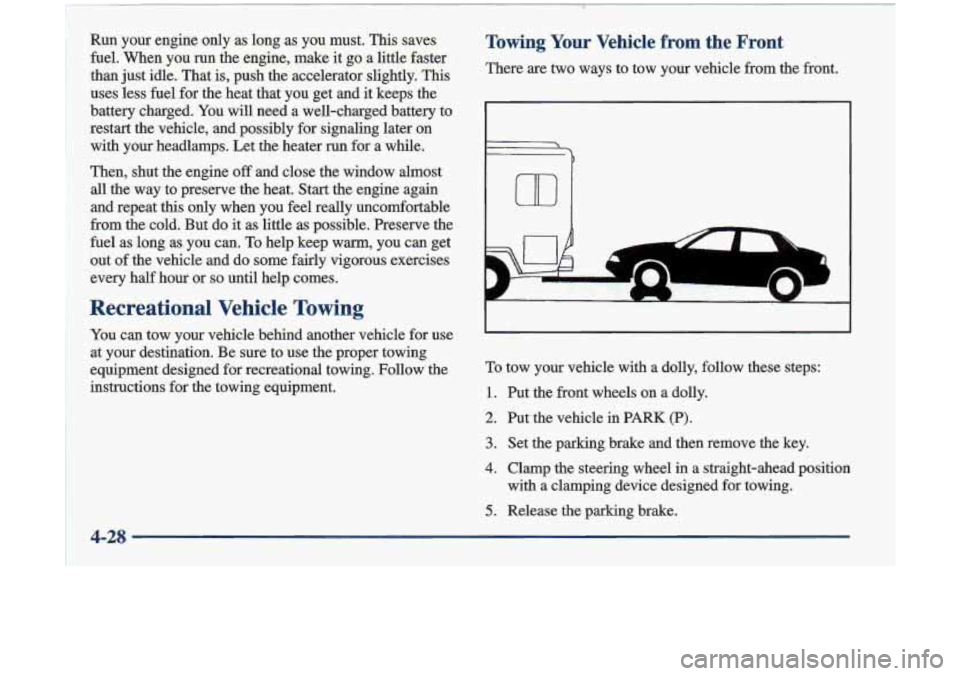
There are two ways to tow your vehicle from the front.
To tow your vehicle with a dolly, follow these steps:
1. Put the front wheels on a dolly.
2. Put the vehicle in PARK (P).
3. Set the parking brake and then remove the key.
4. Clamp the steering wheel in a straight-ahead position
with a clamping device designed for towing.
5. Release the parking brake.
Page 175 of 348
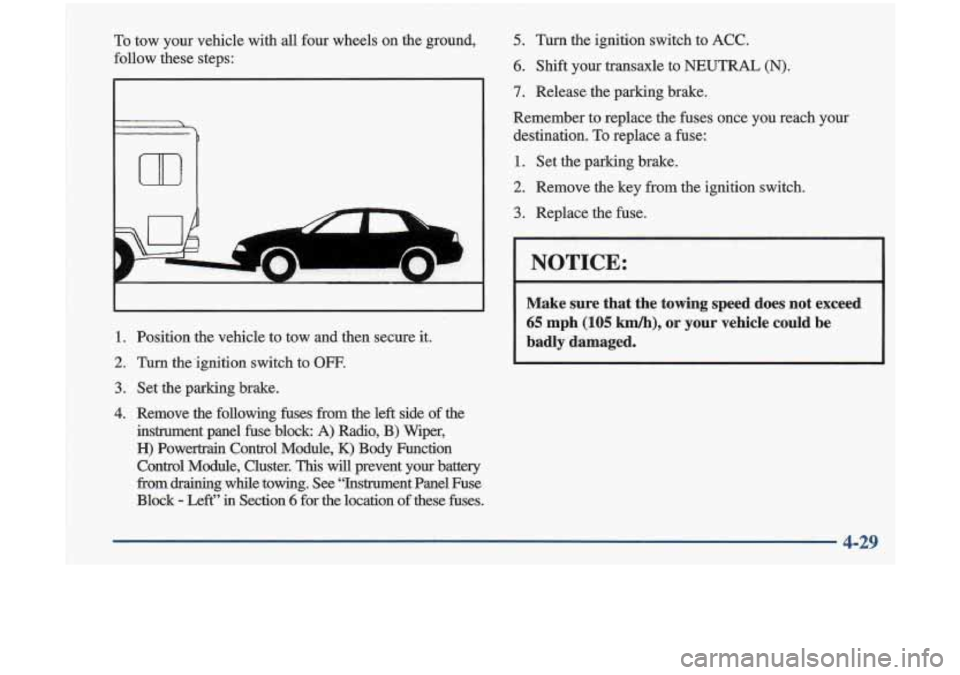
To tow your vehicle with all four wheels on the ground,
follow these steps:
m
A
1. Position the vehicle to tow and then secure it.
2. Turn &.ignition switch to OFF.
3. Set the parking brake.
4. Remove the following fuses from the left side of the
instrument panel fuse block A) Radio, B)
Wiper,
H) Powertrain Control Module, K) Body Function
Control Module, Cluster.
This will prevent your battery
from
draining while towing. See “Instrument Panel Fuse
Block
- Left” in Section 6 for the location of these fuses.
5. Turn the ignition switch to ACC.
6. Shift your transaxle to NEUTRAL (N).
7. Release the parking brake.
Remember to replace the fuses once you reach your
destination.
To replace a fuse:
1. Set the parhg brake.
2. Remove the key from the
3. Replace the fuse. ignition switch.
I NOTICE:
Make sure that the towing speed does not exceed
65 mph (105 km/h), or your vehicle could be
badly damaged.
4-29