brake Oldsmobile Cutlass Supreme 1993 s User Guide
[x] Cancel search | Manufacturer: OLDSMOBILE, Model Year: 1993, Model line: Cutlass Supreme, Model: Oldsmobile Cutlass Supreme 1993Pages: 340, PDF Size: 16.21 MB
Page 76 of 340
Features & Controh
74
To Get Out of Cruise Control
There are two ways to turn off the
cruise control:
Step lightly on the brake pedal; OR
Move the cruise switch to OFF.
To Erase Cruise Speed Memory
When you turn off the cruise control or
the ignition, your cruise control set
speed memory is erased.
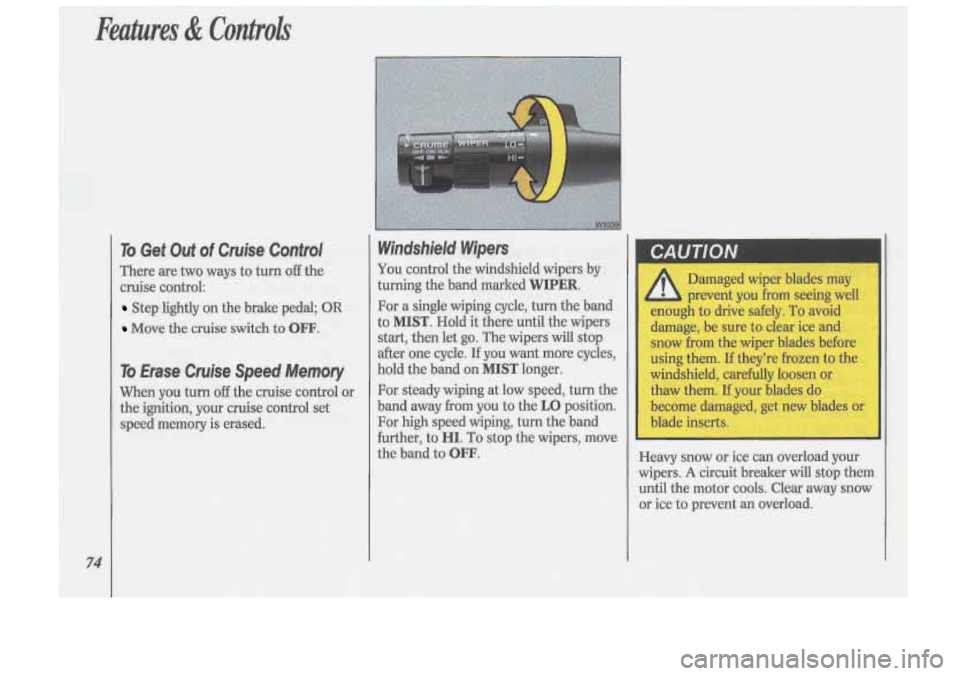
Windshield Wipers
You control the windshield wipers by
turning the band marked
WIPER.
For a single wiping cycle, turn the band
to
MIST. Hold it there until the wipers
start, then let go. The wipers will stop
after one cycle.
If you want more cycles,
hold the band on
MIST longer.
For steady wiping at low speed, turn the
band away
from you to the LO position.
For high speed wiping, turn the band
further, to
HI. To stop the wipers, move
the band to
OFF. Heavy snow or ice can overload your
wipers.
A circuit breaker will stop them
until the motor cools. Clear away snow
or ice to prevent an overload.
Page 80 of 340
Features & Controls
78
Daytime Running Lights (CONK)
At dusk, the exterior lights will come on
automatically and the low beams will
change to full brightness. At dawn, the
exterior lights will go out and the low
beams will change to the reduced
brightness of
DRL (if the headlight
switch is off).
Of course, you may still turn on the
headlights any time you need to.
To idle your vehicle with the DRL off,
set the parking brake while the ignition
is in the
Off or Lock position. Then
start the vehicle. The DRL will stay off
until you release the parking brake.
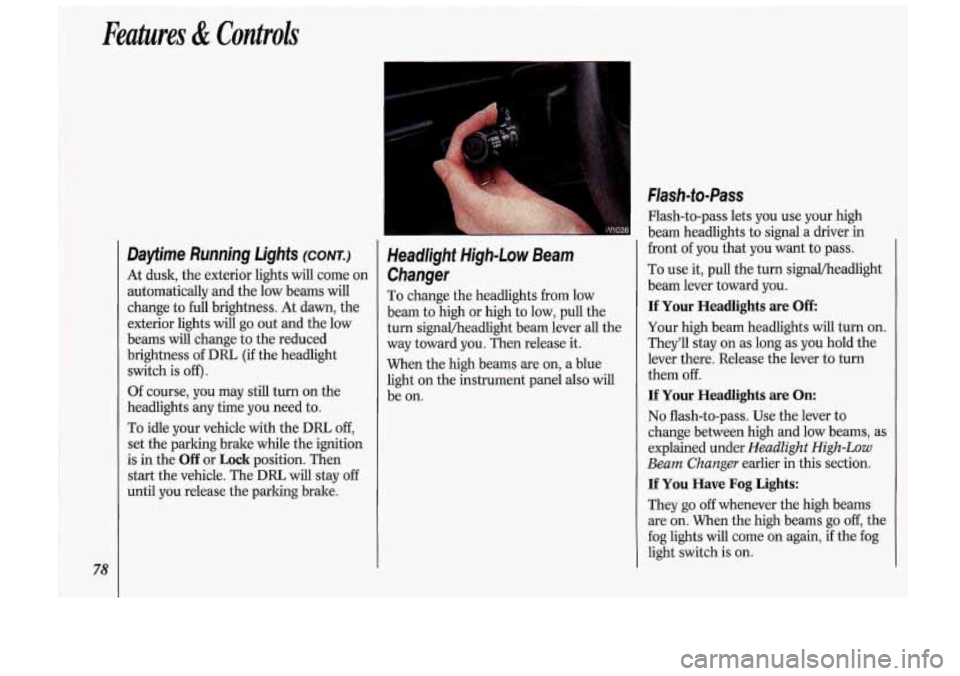
Headlight High-Low Beam
Changer
To change the headlights from low
beam to high or high to low, pull the
turn signal/headlight beam lever all the
way toward you. Then release it.
When the high beams are on,
a blue
light on the instrument panel also will
be on.
Flash-to- Pass
Flash-to-pass lets you use your high
beam headlights
to signal a driver in
front of you that you want to pass.
To use it, pull the turn signal/headlight
beam lever toward you.
If Your Headlights are Off
Your high beam headlights will turn on.
They'll stay on
as long as you hold the
lever there. Release the lever to turn
them off.
If Your Headlights are On:
No flash-to-pass. Use the lever to
change between high and low beams, as
explained under
Headlight High-Low
Beam Changer
earlier in this section.
If You Have Fog Lights:
They go off whenever the high beams
are on. When the high beams go
off, the
fog lights will come on again, if the fog
light switch is on.
Page 91 of 340
The Instrument Panel-
Your Information System
Your instrument panel is designed to let
you know
at a glance how your vehicle
is running. You’ll know how fast you’re
going, how much fuel you’re using, and
many other things you’ll need to drive
safely and economically.
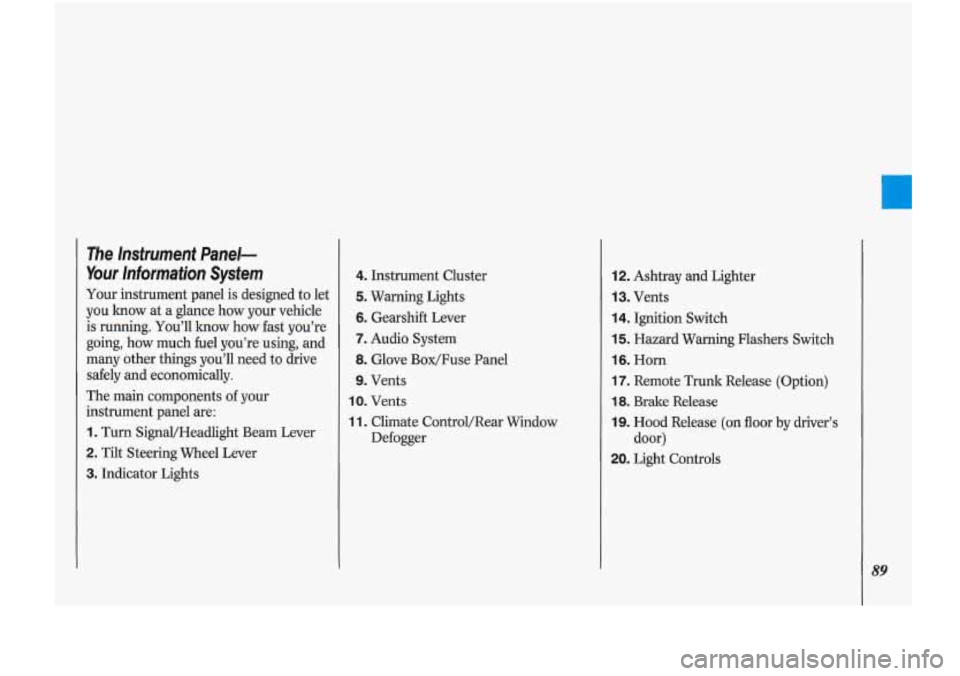
The main components of your
instrument panel are:
1. Turn Signal/Headlight Beam Lever
2. Tilt Steering Wheel Lever
3. Indicator Lights
4. Instrument Cluster
5. Warning Lights
6. Gearshift Lever
7. Audio System
8. Glove Box/Fuse Panel
9. Vents
IO. Vents
11. Climate ControVRear Window
Defogger
12. Ashtray and Lighter
13. Vents
14. Ignition Switch
15. Hazard Warning Flashers Switch
16. Horn
17. Remote Trunk Release (Option)
18. Brake Release
19. Hood Release (on floor by driver’s
20. Light Controls
door)
89
Page 100 of 340

\A1
Battery Warning Light
(EECTRONiC CLUSTER)
The charging system light will come on
briefly when you turn.
on the ignition as
a check to show you it
is working. Then
it
should go out. If it stays on, or comes
on
while you are driving, you may have
a problem with the electrical chaging
system. It could indicate that you have
a loose generator drive belt or another
eIectrical problem. Have it checked
right away. Driving while this light is
on
could drain your battery.
If you mu,st drive a short distance with
the light
on, be certain to turn off all
your accessories, such as the radio and
air conditioner.
Voltmeter (ANALOG CLOSER)
When the engine is running, the gage
shows the condition
of the charging
system. Readings between the red
warning zones indicate the
normal
operating range.
Readings in either red warning zone
indicate
a possible problem in the
electrical system. Have your vehicle
serviced immediately.
When your engine is not running, but
the ipition is on (in the
Run position),
the gage shows your battery‘s state
of
charge.
Brake System Warning Light
It
Your Oldsmobile’s hydraulic brake
system is divided .into
two parts. If one I
1
Page 101 of 340
brake is fully released, it means you
have a brake problem.
If the light comes
on while driving, pull
off the road and stop carefully. You may
notice that the pedal is harder to push.
Or, the pedal may go closer to the floor.
It may take longer to stop. If the light is
still on, have the vehicle towed for
service. (See the
Index under Towing
Your Oldsrnobile.)
CAUTION
Your brake system may not I
be working properly if the
brake warning light is on. Driving
with the brake warning light on can
lead to an accident. If the light is
still on after you’ve pulled
off the
road and stopped carefully, have
the vehicle towed for service.
Anti-Lock Brake System Warning
Light
(opTloN)
With anti-lock, this light will go on
when you start your engine and it will
stay on for three seconds. That’s
normal. If the light doesn’t come on,
have it fixed
so it will be ready to warn
you if there is a problem.
If the light stays on or comes on when
you’re driving, stop as soon as possible
and turn the key
off. Then start the
engine to reset the system.
If the light
still stays on, or comes
on again while
you’re driving, your Oldsmobile needs
service. Unless the regular brake system
warning light
is also on, you will still
have brakes, but not anti-lock brakes.
If
the regular brake system warning light
99
Page 102 of 340
100
Anti-Lock Brake System Warning Light
(CONT.)
is also on, see Brake System Warning
Light earlier in this section.
If the anti-lock brake system warning
light ever flashes, your anti-lock bralre system is still working but needs service
as soon as possible.
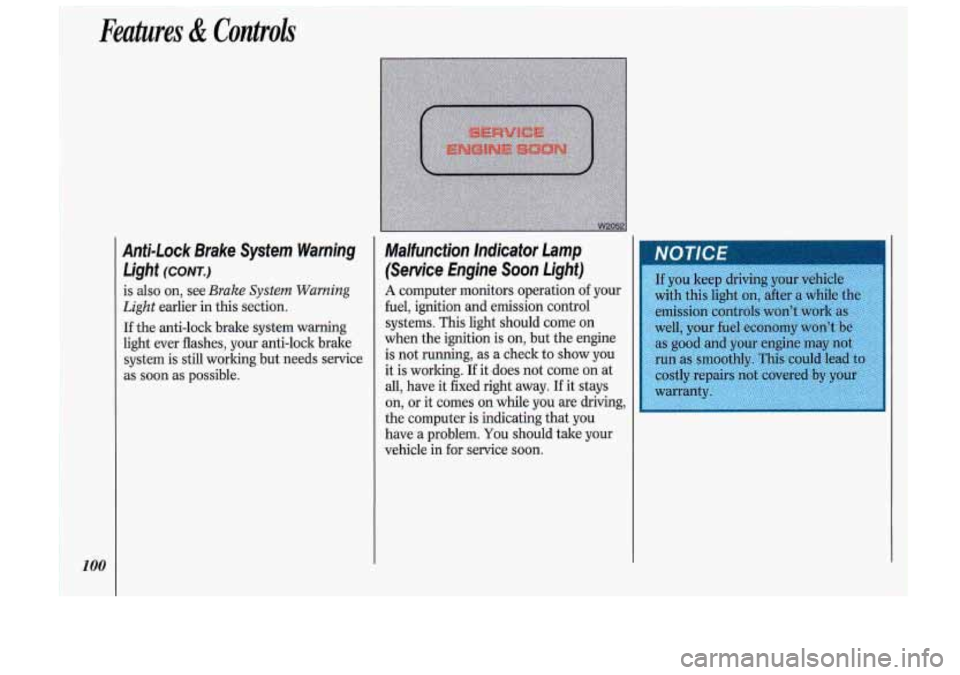
Malfunction lnelicator Lamp
(Service Engine Soon Light)
A computer monitors operation of your
fuel, ignition and emission control
.systems.
This light should come on
when the ignition is on, but the engine
is not running, as a check
to show you-
it is working. If it does not come on at
all, have it fixed right away. If it stays
on,
or it comes on while you are driving,
the computer is indicating that you
have
a problem. You should take your
vehicle in
for service soon.
Page 141 of 340
Part 4
Here you’ll find information about driving on different kinds of roads and
in varying weather conditions
. We’ve
also included many other useful tips
on driving
.
Your Driving and the Road
Road Signs ........................................................................\
....................................... 140
Defensive Driving
........................................................................\
............................ 144
Drunken Driving
........................................................................\
............................ 145
Control of a Vehicle
Braking
........................................................................\
......................................... 148
Anti-Lock Brakes ........................................................................\
......................... 149
Steering Tips
........................................................................\
................................ 154
Steering in Emergencies
........................................................................\
.............. 155
Driving at Night
........................................................................\
............................... 159
Driving in the Rain
........................................................................\
.......................... 161
Passing ........................................................................\
......................................... 156
Driving in Fog, Mist and Haze
........................................................................\
....... 164
City Drmng
........................................................................\
...................................... 165 ..
Freeway Driving ........................................................................\
............................. 166
Driving a Long Distance ........................................................................\
................ 168
Hill and Mountain Roads ........................................................................\
............... 170
Winter Driving
........................................................................\
................................ 173
Parking
on Hills ........................................................................\
.............................. 171
Towing a Trailer
........................................................................\
............................... 176 139
Page 146 of 340
Your Driving and the Road
Defensive Driving
, The best advice anyone can give about
144
driving is: Drive defensively.
Please start with a very important safety
device in your Oldsmobile: Buckle up.
(See the
Index under Safety Belts. )
Defensive driving really means “be
ready for anything.”
On city streets,
rural roads, or freeways, it means
“always expect the unexpected.’’
Assume that pedestrians or other
drivers are going to be careless and
make mistakes. Anticipate what they
might do. Be ready for their mistakes.
Expect children to dash out from
behind parked cars, often followed by
other children. Expect occupants in
parked cars to open doors into traffic.
Watch for movement in parked cars-
someone may be about to open a door. Expect
other drivers
t .o run st ,op signs
when you are on a through street. Be
ready to brake if necessary as you go
through intersections.
You may not
have to use the brake, but if you do, you
will be ready.
If you’re driving through a shopping
center parking lot where there are well-
marked lanes, directional arrows, and
designated parking areas, expect some
drivers to ignore all these markings and
dash straight toward one part
of the lot.
Pedestrians can be careless. Watch for
them. In general, you must give way to
pedestrians even if you know you have
the right of way.
Rear-end collisions are about the most
preventable of accidents. Yet they are
common. Allow enough following
distance. It’s the best defensive driving maneuver,
in both city and rural
driving. You never know when the
vehicle in front of you is going to brake
or turn suddenly.
Here’s a final bit of information about
defensive driving. The most dangerous
time for driving in the
U.S. is very early
on Sunday morning. In fact, GM
Research studies show that the most
and the least dangerous times for
driving, every week, fall
on the same
day. That day is Sunday. The most
dangerous time is Sunday from
3 a.m.
to
4 a.m. The safest time is Sunday from
10 a.m. to 11 a.m. Driving the same
distance
on a Sunday at 3 a.m. isn’t just
a little more dangerous than it is at
10
a.m. It’s about 134 times more
dangerous!
That leads to the next section.
Page 150 of 340
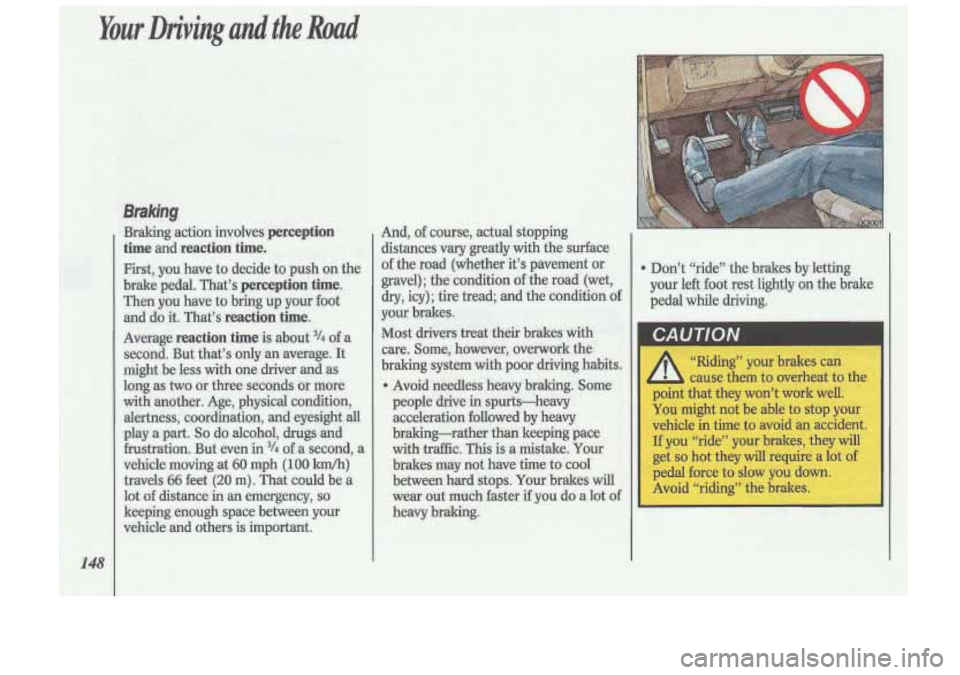
Tiding” your brakes can
cause them to overheat to the
point that they won’t work well.
You might not be able to stop your
vehicle in time
to avoid an accident.
If you “ride” your brakes, they will
get
so hot they will require a lot of
pedal force to slow you down.
Avoid “riding” the brakes.
Page 151 of 340
If you keep pace with the tr&c and
allow realistic following distances, you
will eliminate a lot of unnecessary
braking. That means better braking and
longer brake life.
If your engine ever stops while you’re
driving, brake normally but don’t
pump your brakes.
If you do, the
pedal may get harder to push down. If
your engine stops, you will still have
some power brake assist. But you will
use it when you brake. Once the
power assist is used up, it may take
longer to stop and the brake pedal will
be harder to push.
Anti-Lock Brakes (ABS) (OPTION)
If your Oldsmobile has this system, it
has an advanced electronic braking
system that
will help prevent skidding.
If you have an anti-lock brake system
(ABS), the brake pedal will say
so.