warning Oldsmobile Cutlass Supreme 1993 s User Guide
[x] Cancel search | Manufacturer: OLDSMOBILE, Model Year: 1993, Model line: Cutlass Supreme, Model: Oldsmobile Cutlass Supreme 1993Pages: 340, PDF Size: 16.21 MB
Page 100 of 340

\A1
Battery Warning Light
(EECTRONiC CLUSTER)
The charging system light will come on
briefly when you turn.
on the ignition as
a check to show you it
is working. Then
it
should go out. If it stays on, or comes
on
while you are driving, you may have
a problem with the electrical chaging
system. It could indicate that you have
a loose generator drive belt or another
eIectrical problem. Have it checked
right away. Driving while this light is
on
could drain your battery.
If you mu,st drive a short distance with
the light
on, be certain to turn off all
your accessories, such as the radio and
air conditioner.
Voltmeter (ANALOG CLOSER)
When the engine is running, the gage
shows the condition
of the charging
system. Readings between the red
warning zones indicate the
normal
operating range.
Readings in either red warning zone
indicate
a possible problem in the
electrical system. Have your vehicle
serviced immediately.
When your engine is not running, but
the ipition is on (in the
Run position),
the gage shows your battery‘s state
of
charge.
Brake System Warning Light
It
Your Oldsmobile’s hydraulic brake
system is divided .into
two parts. If one I
1
Page 101 of 340
brake is fully released, it means you
have a brake problem.
If the light comes
on while driving, pull
off the road and stop carefully. You may
notice that the pedal is harder to push.
Or, the pedal may go closer to the floor.
It may take longer to stop. If the light is
still on, have the vehicle towed for
service. (See the
Index under Towing
Your Oldsrnobile.)
CAUTION
Your brake system may not I
be working properly if the
brake warning light is on. Driving
with the brake warning light on can
lead to an accident. If the light is
still on after you’ve pulled
off the
road and stopped carefully, have
the vehicle towed for service.
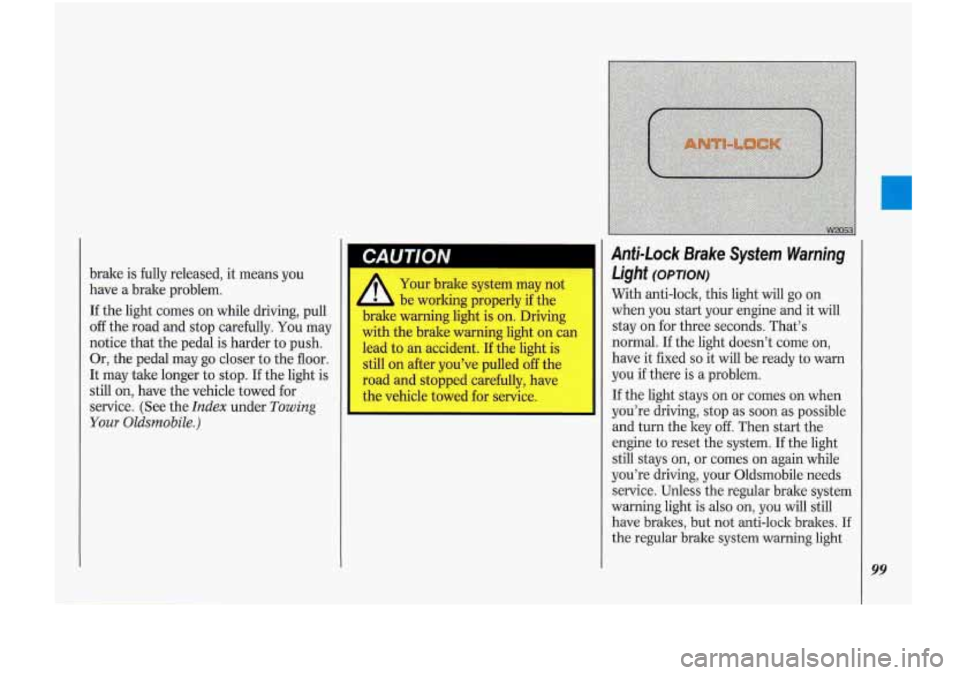
Anti-Lock Brake System Warning
Light
(opTloN)
With anti-lock, this light will go on
when you start your engine and it will
stay on for three seconds. That’s
normal. If the light doesn’t come on,
have it fixed
so it will be ready to warn
you if there is a problem.
If the light stays on or comes on when
you’re driving, stop as soon as possible
and turn the key
off. Then start the
engine to reset the system.
If the light
still stays on, or comes
on again while
you’re driving, your Oldsmobile needs
service. Unless the regular brake system
warning light
is also on, you will still
have brakes, but not anti-lock brakes.
If
the regular brake system warning light
99
Page 102 of 340
100
Anti-Lock Brake System Warning Light
(CONT.)
is also on, see Brake System Warning
Light earlier in this section.
If the anti-lock brake system warning
light ever flashes, your anti-lock bralre system is still working but needs service
as soon as possible.
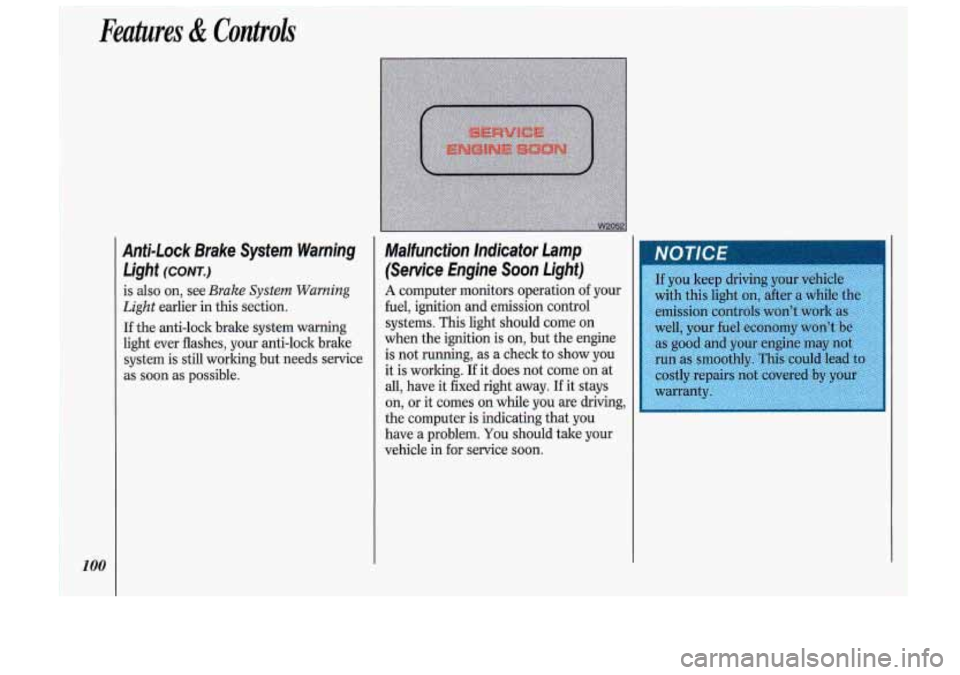
Malfunction lnelicator Lamp
(Service Engine Soon Light)
A computer monitors operation of your
fuel, ignition and emission control
.systems.
This light should come on
when the ignition is on, but the engine
is not running, as a check
to show you-
it is working. If it does not come on at
all, have it fixed right away. If it stays
on,
or it comes on while you are driving,
the computer is indicating that you
have
a problem. You should take your
vehicle in
for service soon.
Page 142 of 340
Your Driving and the Road
~
140
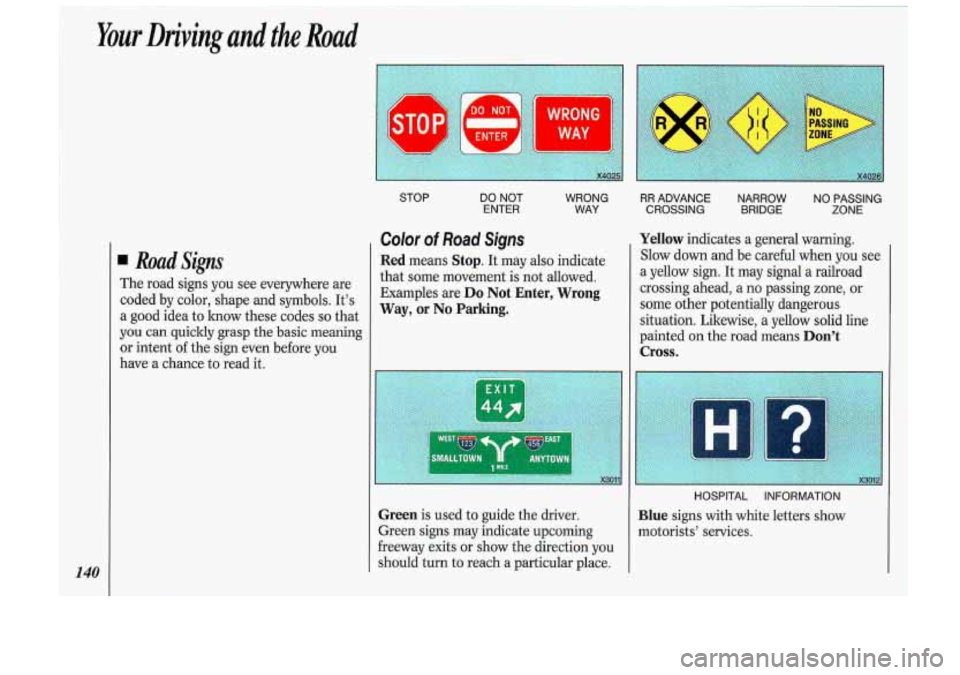
Road Signs
The road signs you see everywhere are
coded by color, shape and symbols. It's
a good idea to lmow these codes so that
you can quickly grasp the basic meaning
or intent of the sign even before you
have a chance to read it.
STOP
DO NOT
ENTER WRONG
WAY
Color of Road Signs
Red means Stop. It may also indicate
that some movement is not allowed.
Examples are
Do Not Enter, Wrong
Way,
or No Parking.
Green is used to guide the driver.
Green signs may indicate upcoming
freeway exits or show the direction you
should turn to reach a particular place.
RR ADVANCE NARROW NO PASSING
CROSSING BRIDGE ZONE
Yellow indicates a general warning.
Slow down and be careful when you see
a yellow sign. It may signal a railroad
crossing ahead, a no passing zone, or
some other potentially dangerous
situation. Likewise, a yellow solid line
painted on the road means
Don't
Cross.
Blue signs with white letters show
motorists' services.
Page 143 of 340
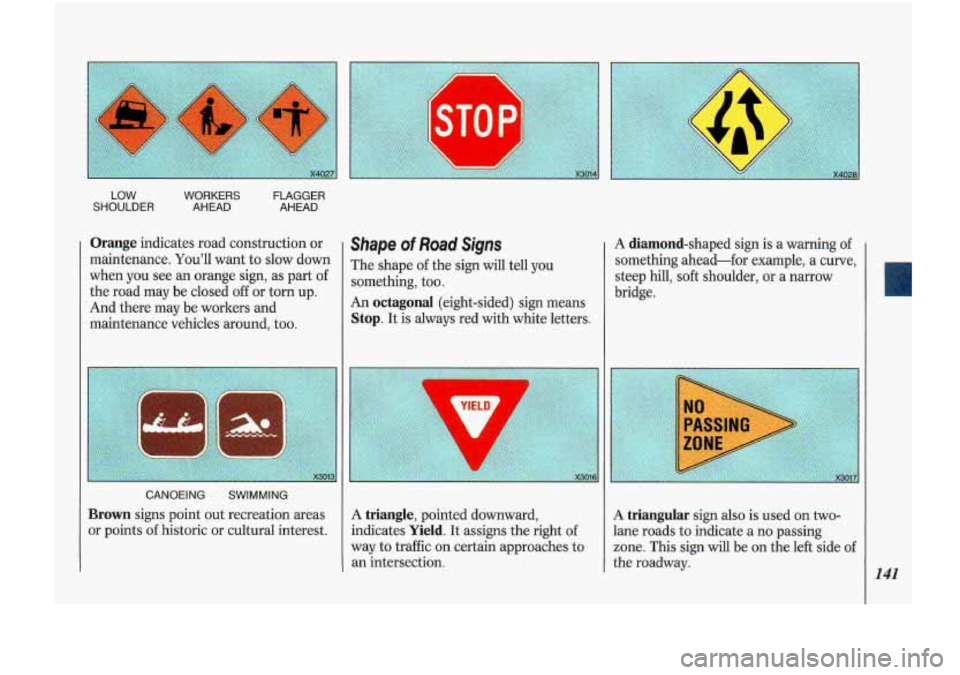
LOW WORKERS FLAGGER
SHOULDER AHEAD AHEAD
Orange indicates road construction or
maintenance. You’ll want to slow down
when you see
an orange sign, as part of
the road may be closed
off or torn up.
And there may be workers and
maintenance vehicles around, too.
II
II
Shape of Road Signs
The shape of the sign will tell you
something, too.
An octagonal (eight-sided) sign means
Stop. It is always red with white letters.
CAtuuttt\lG SWIMMING
3rown signs point out recreation areas
)r points of historic or cultural interest.
4 diamond-shaped sign is a warning of
something ahead-for example, a curve,
steep hill,
soft shoulder, or a narrow
xidge.
A triangle, pointed downward,
indicates Yield.
It assigns the right of
way to traffic on certain approaches to
an intersection.
1 triangular sign also is used on two-
ane roads to indicate
a no passing
!one. This sign will be on the left side of
:he roadway.
141
Page 152 of 340
Your Driving and the Road
150
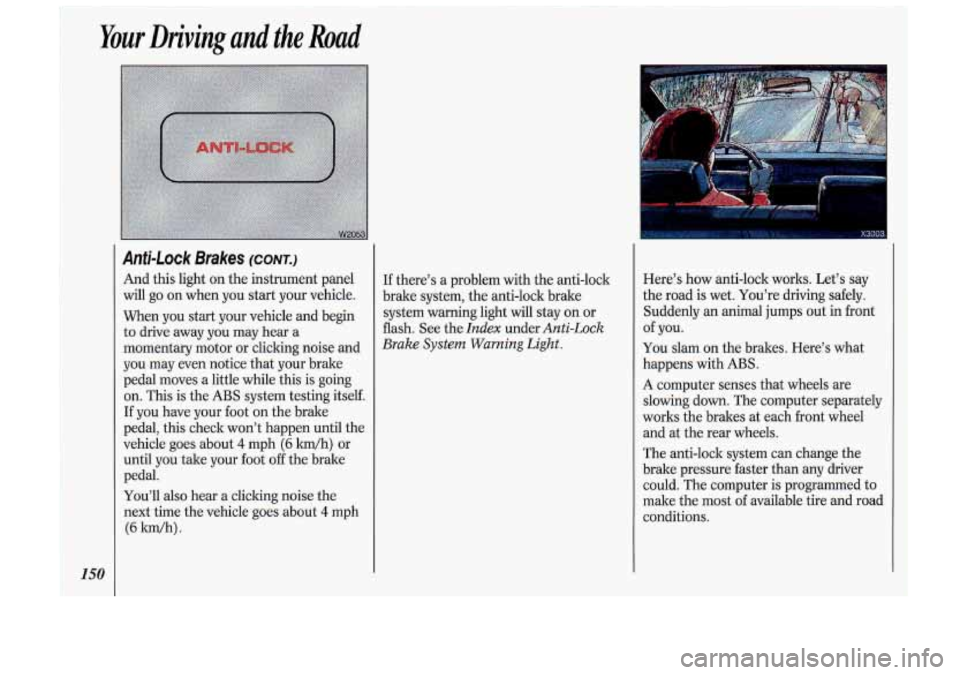
Anti-Lock Brakes (CONT.)
And this light on the instrument panel
will go on when you start your vehicle.
When you start your vehicle and begin
to drive away you may hear a
momentary motor or clicking noise and
you may even notice that your brake
pedal moves a little while this is going
on. This is the
ABS system testing itself.
If you have your foot on the brake
pedal, this check won’t happen until the
vehicle goes about
4 mph (6 lm/h) or
until you take your foot off the brake
pedal.
You’ll also hear a clicking noise the
next time the vehicle goes about
4 mph
(6 lun/h).
If there’s a problem with the anti-lock
brake system, the anti-lock brake
system warning light will stay on or
flash. See the
Index under Anti-Lock
Brake System Warning Light.
Here’s how anti-lock works. Let’s say
the road is wet. You’re driving safely.
Suddenly an animal jumps out in front
of you.
You slam on the brakes. Here’s what
happens with
ABS.
A computer senses that wheels are
slowing down. The computer separately
works the brakes at each front wheel
and at the rear wheels.
The anti-lock system can change the
brake pressure faster than any driver
could. The computer is programmed to
make the most of available tire and road
conditions.
Page 153 of 340
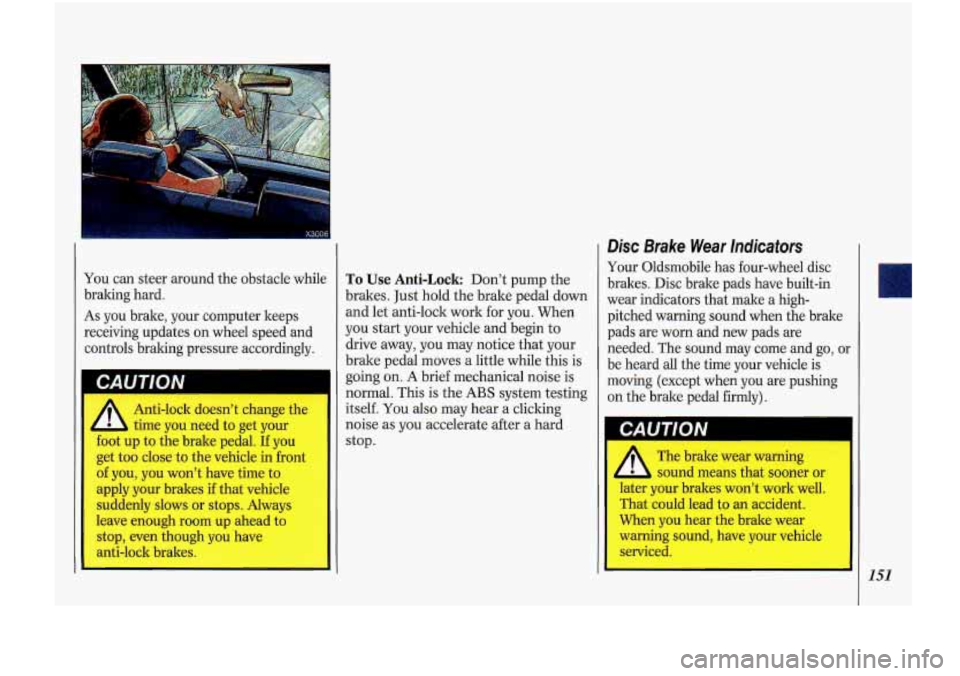
You can steer around the obstacle while
braking hard.
As you brake, your computer keeps
receiving updates on wheel speed and
controls braking pressure accordingly.
CAUTION
Anti-lock doesn’t change the
time you need to get your
foot up to the brake pedal.
If you
get too close to the vehicle in front
of you, you won’t have time to
apply your brakes if that vehicle
suddenly slows or stops. Always
leave enough room up ahead
to
stop, even though you have
anti-lock brakes.
To Use Anti-Lock: Don’t pump the
brakes. Just hold the brake pedal down
and let anti-lock work for you. When
you start your vehicle and begin to
drive away, you may notice that your
brake pedal moves a little while this is
going on. A brief mechanical noise is
normal. This is the
ABS system testing
itself.
You also may hear a clicking
noise as
you accelerate after a hard
stop.
Disc Brake Wear lndicafors
Your Oldsmobile has four-wheel disc
brakes. Disc brake pads have built-in
wear indicators that make a high-
pitched warning sound when the brake
pads are worn and new pads are
needed. The sound may come and go, or
be heard all the time your vehicle
is
moving (except when you are pushing
on the brake pedal firmly).
3
ne Ibr&eUrw walmhg
sound mans that sooner or
I later yaur hdes won’t work weU.
mt could llead to an accident.
hen you hear the brake wm
-l
1:
1
I 151
Page 161 of 340
cause the tires to slide. You may not
realize the surface is slippery until your
vehicle is skidding. Learn to recognize
warning clues-such as enough water,
ice or packed snow on the road to make
a “mirrored surface”-and slow down
when you have any doubt.
If you have the anti-lock braking
system, remember: It helps avoid only
the braking skid.
If you do not have
anti-lock, then in a braking skid (where
the wheels are no longer rolling),
release enough pressure on the brakes
to get the wheels rolling again. This
restores steering control. Push the
brake pedal down steadily when you
have to stop suddenly. As long as the
wheels are rolling, you will have
steering control. Steer the way you
want to go.
I .@ i 7“
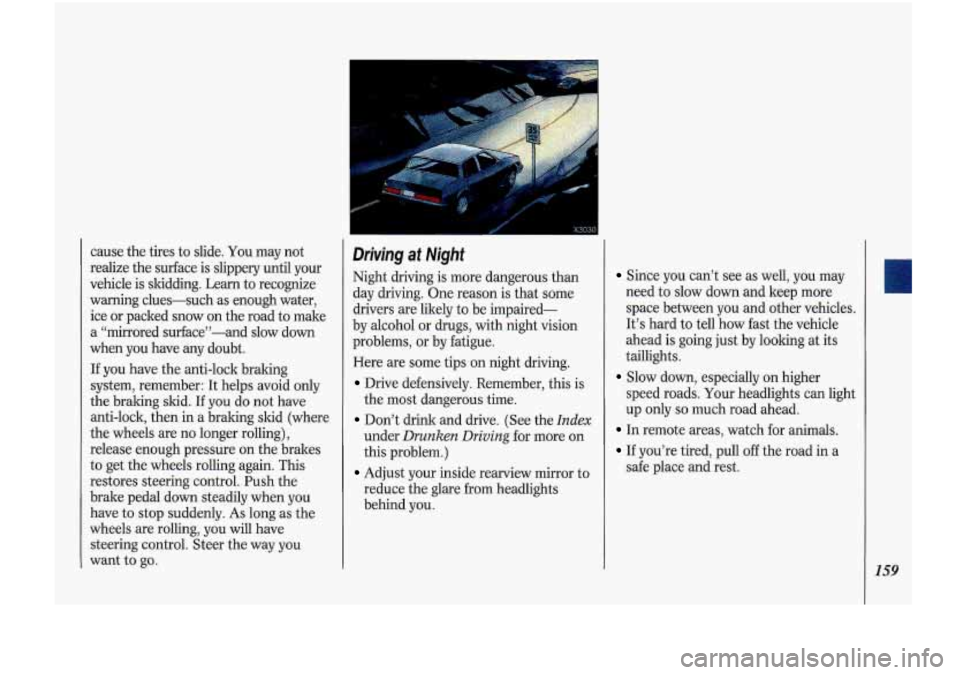
Driving at Night
Night driving is more dangerous than
day driving. One reason is that some
drivers are likely to be impaired-
by alcohol or drugs, with night vision
problems, or by fatigue.
Here are some tips on night driving.
Drive defensively. Remember, this is
the most dangerous time.
Don’t drink and drive. (See the Index
under Drunken Driving for more on
this problem.)
Adjust your inside rearview mirror to
reduce the glare from headlights
behind you.
Since you can’t see as well, you may
need to slow down and keep more
space between you and other vehicles.
It’s hard to tell how fast the vehicle
ahead is going just by looking at its
taillights.
speed roads. Your headlights can light
up only
so much road ahead.
Slow down, especially on higher
In remote areas, watch for animals.
If you’re tired, pull off the road in a
safe place and rest.
1
159
Page 189 of 340
Here you’ll find what to do about
some problems that can occur on the
road
.
Part 5
Problems on the Road
Hazard Warning Flashers ........................................................................\
............... 188
Jump Starting
........................................................................\
.................................. 189
Towing Your Oldsmobile
........................................................................\
............... 193
Engine Overheating
........................................................................\
........................ 197
If a Tire Goes Flat ........................................................................\
........................... 204
Changing a Flat Tire
........................................................................\
....................... 205
Compact Spare Tire ........................................................................\
........................ 211
If You’re Stuck: In Sand, Mud, Ice or Snow ......................................................... 212
187
Page 195 of 340
A
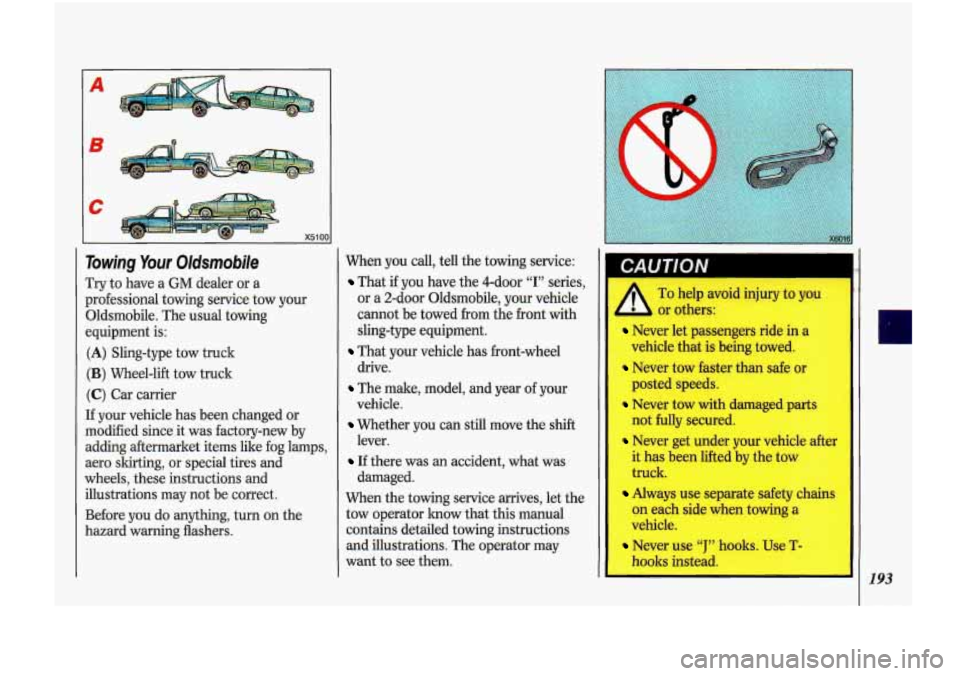
Towing Your Oldsmobile
Try to have a GM dealer or a
professional towing service tow your
Oldsmobile. The
usual towing
equipment
is:
(A) Sling-type tow truck
(B) Wheel-lift tow truck
(C) Car carrier
If your vehicle .has been changed or
modified since it was factory-new by
adding aftermarket items like fog lamps,
aero skirting, or special tires and
wheels, these instructions and
illustrations may not be correct.
Before you do anything, turn on the
hazard warning flashers. When
you
call, tell the towing service:
That if you have the 4-door “I” series,
or a 2-door Oldsmobile, your vehicle
cannot be towed
from the fiont with
sling-type equipment.
drive.
vehicle. lever.
damaged.
That your vehicle has front-wheel
The make, model, and year of your
Whether you can still move the shift
If there was an accident, what was
When the towing service arrives, let the
tow operator know that this manual
contains detailed towing instructions
and illustrations. The operator may
want to see them.
To help avoid injury to you
or others:
Never let passengers ride in a
vehicle that is being towed.
Never tow faster than safe or
posted speeds.
Never tow with damaged parts
not fully secured.
Never get under your vehicle after
it has been lifted by the tow
truck.
Always use separate safety chains
on each side when towing a
vehicle.
Never use “J” hooks. Use T-
I hnnks instead.
193