warning Oldsmobile Cutlass Supreme 1993 s Owner's Guide
[x] Cancel search | Manufacturer: OLDSMOBILE, Model Year: 1993, Model line: Cutlass Supreme, Model: Oldsmobile Cutlass Supreme 1993Pages: 340, PDF Size: 16.21 MB
Page 199 of 340
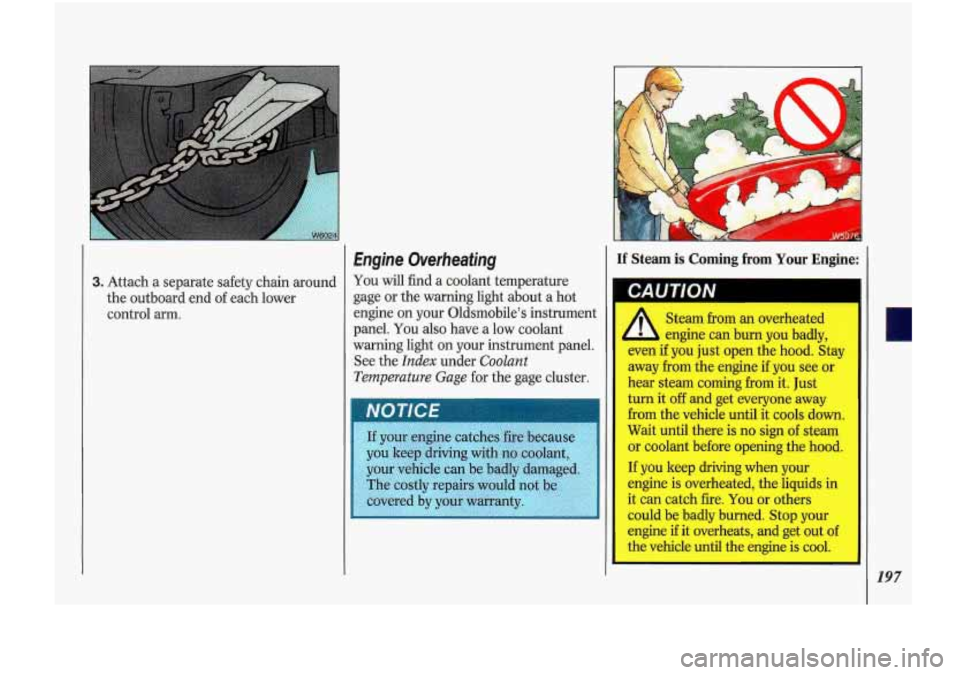
3. Attach a separate safety chain around
the outboard end of each lower
control
arm.
Engine Overheating
You will find a coolant temperature
gage or the warning light about a hot
engine
on your Oldsmobile’s instrument
panel.
You also have a low coolant
warning light on your instrument panel.
See the
Index under Coolant
Temperature Gage for the gage cluster.
r
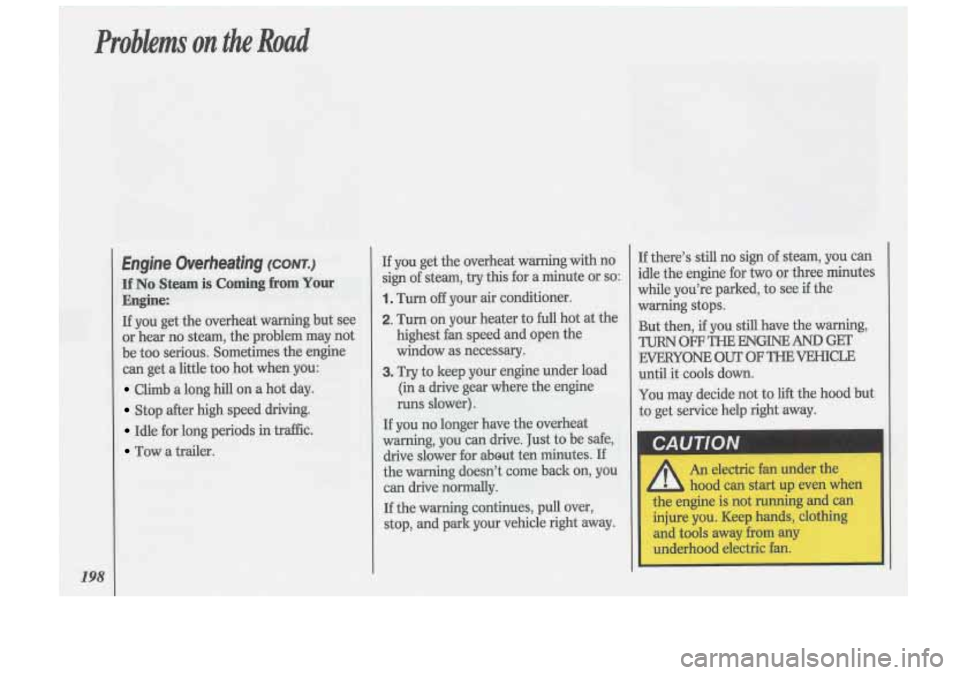
If Steam is Coming from Your Engine:
CAUTION
A
Steam from an overheated
engine can burn you badly,
even if you just open the hood. Stay
away
from the engine if you see or
hear steam coming
from it. Just
turn it off and get everyone away
from the vehicle until it cools down.
Wait until there is no sign of steam
or coolant before opening the hood.
If you keep driving when your
engine is overheated, the liquids in
it can catch fire.
You or others
could be badly burned. Stop your
engine if it overheats, and get out of
the vehicle until the engine is cool.
197
Page 200 of 340
Probkms on the Road
Engine Overheating (CONTJ
If No Steam is Coming from Your
Engine:
If you get the overheat warning but see
or hear no steam, the problem may not
be too serious. Sometimes the engine
can get a little too hot when you:
Climb a long hill on a hot day.
Stop after high speed driving.
Idle for long periods in traffic.
Tow a trailer.
198
If you get the overheat warning with no
sign of steam, try this for a minute or so:
1. Turn off your air conditioner.
2. Turn on your heater to full hot at the
highest fan speed and open the
window as necessary.
3. Try to keep your engine under load
(in
a drive gear where the engine
runs slower).
If you no longer have the overheat
warning, you can drive. Just to be safe,
drive slower for ab& ten minutes. If
the warning doesn't come back on, you
can drive normally.
If the warning continues, pull over,
stop, and, park your vehicle right away.
f there's still no sign of steam, you can
dle the engine for two or three minutes
vhile you're parked, to see if the
varning stops.
3ut then,
if you still have the warning,
KJRJNOFFTHEENGINEANDGET
WERYONE OUT OF THE VEHICLE
Inti1 it cools
down.
(ou may decide not to lift the hood but
o get service help right away.
Page 202 of 340
Problems on the Road
Adding only plain water to
your cooling system can be
dangerous. Plain water, or some
other liquid like alcohol, can boil
before the proper coolant mix will.
Your vehicle's coolant warning
system is set for the proper coolant
mix. With plain water or the wrong
mix, your engine could get too hot
but you wouldn't get the overheat
warning. Your engine could catch
fire and you or others could be
burned. Use a
50/50 mix of clean
water and a proper antifreeze.
I
200
You can be burned if you
spill coolant on hot engine
-I.& Coolant contains ethylene
pdrts are hot enough. Don't spill
ycol
and it will burn if the engine
I I coolant on a hot engine.
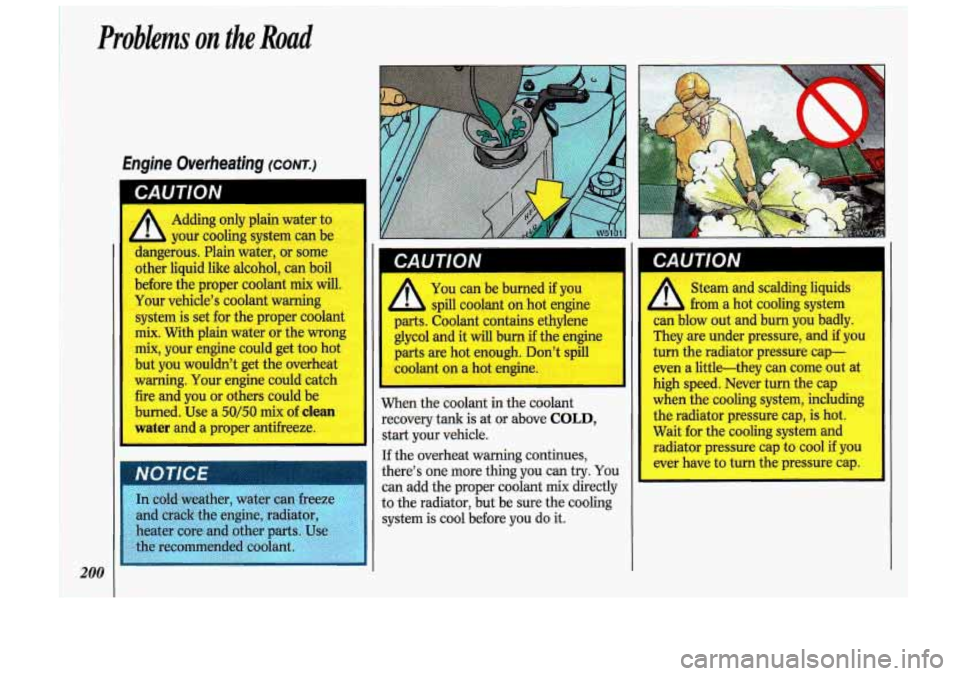
When the coolant
in the coolant
recovery tank is at or above
COLD,
start your vehicle.
If the overheat
warning continues,
there's one more
thing you can try. You
can add the proper coolant mix directly
to the radiator, but be sure the cooling
system
is cool before you do it.
1
1
can blow out and burn you badly.
They are under pressure, and
if you
turn the radiator pressure cap-
even a little-they can come out at
high speed. Never turn the cap
when the cooling system, including
the radiator pressure cap, is hot.
Wait for the cooling system and
radiator pressure cap to cool
if you
ever have to turn the pressure cap.
1
Page 207 of 340
Changing a Flat Tire
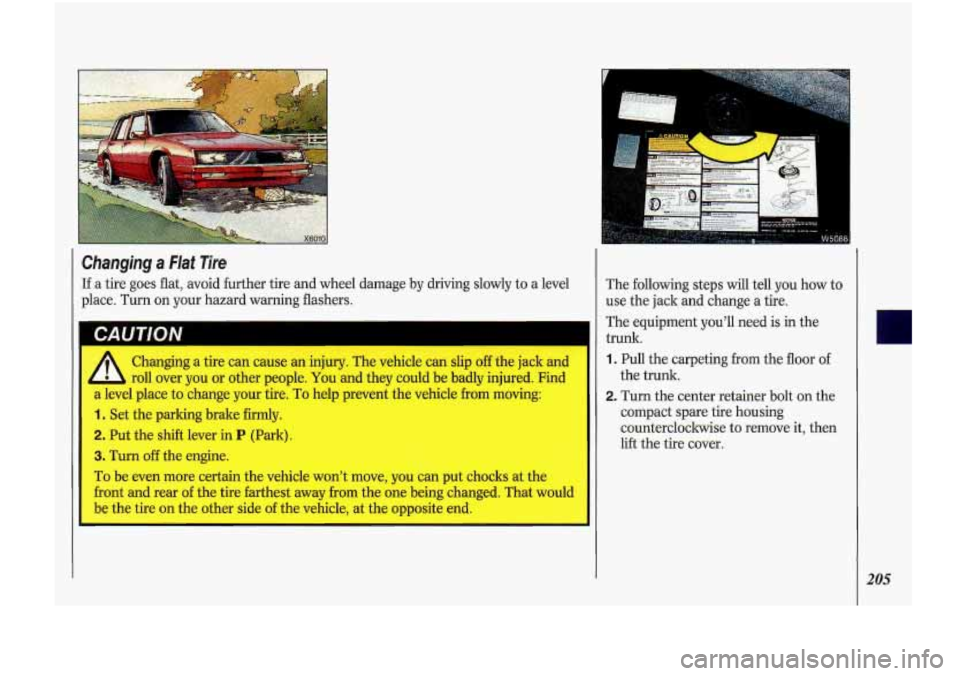
If a tire goes flat, avoid further tire and wheel damage by driving slowly to a level
place. Turn on
your hazard warning flashers.
1. Set the parking brake firmly.
2. Put the shift lever in P (Park).
3. Turn off the engine.
To be even more certain the vehicle won't move, you can put chocks at the
front and rear of the tire farthest away
from the one being changed. That would
! the tire on the other side of the vehicle. at the omosite end.
c& ..:
The following steps will tell you how to
use the jack and change a tire.
The equipment you'll need is
in the
trunk.
1. Pull the carpeting from the Boor of
the trunk.
2. Turn the center retainer bolt on the
compact spare tire housing
countercloclwise to remove it, then
lift
the^ tire cover.
205
Page 241 of 340
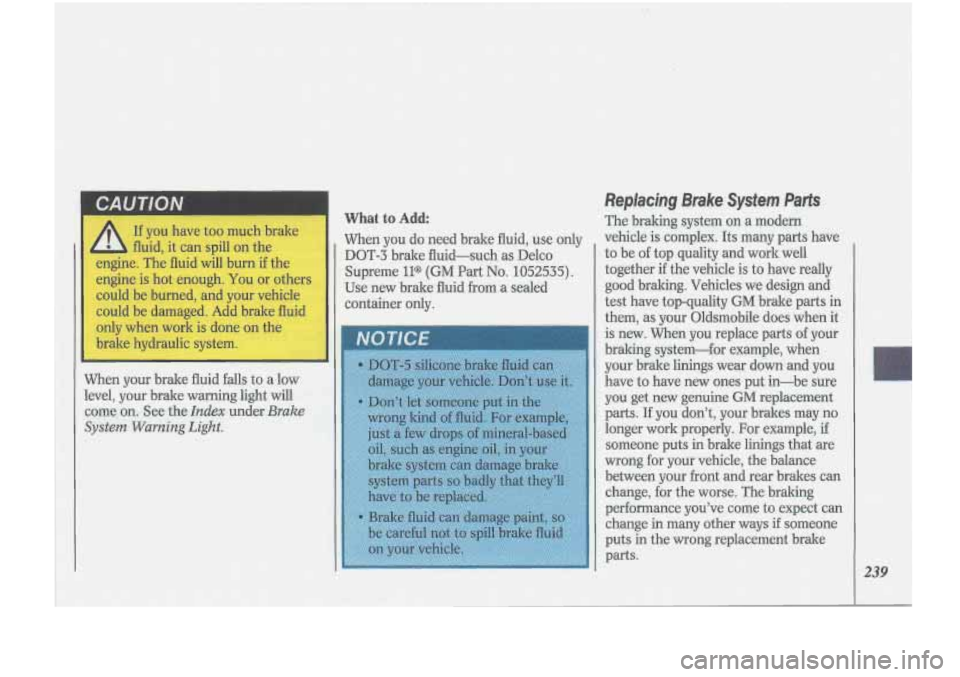
If you have too much brake
fluid, it can spill on the
engine. The fluid will burn
if the
engine is hot enough. You or others
could be burned, and your vehicle
could be damaged. Add brake fluid
only when work is done on the
brake hydraulic system.
? I
When your brake fluid falls to a low
level,
your brake warning light will
come on. See the Index under Brake
System Warning Light.
What to Add
When you do need brake fluid, use only
DOT-3 brake fluid-such as Deko
Supreme
11* (GM Part No. 1052535).
Use new brake fluid from a sealed
container
only.
Page 258 of 340
Sewice & Appearance Care
256
1 Uniform Tire Quality
Grading
The following information relates to the
system developed by the United States
National Highway Traffic Safety
Administration which grades tires by
treadwear, traction and temperature
performance. (This applies only to
vehicles sold in the United States.)
Treadwear
The treadwear grade is a comparative
rating based on the wear rate of the tire
when tested under controlled
conditions on a specified government
test course. For example, a tire graded
150 would wear one and a half (1%)
times as well on the government course
as a tire graded
100. The relative
performance of tires depends upon the actual
conditions
of their use, however,
and may depart significantly from the
norm due to variations
in driving habits,
service practices and dif€erences in road
characteristics and climate.
Traction-A, B, C
The traction grades, from highest to
lowest are:
A, B, and C. They represent
the tire’s ability to stop on wet
pavement as measured under controlled
conditions on specified government test
surfaces
of asphalt and concrete. A tire
marked
C may have poor traction
performance.
Warning: The traction grade assigned
to this tire is based on braking (straight-
ahead) traction tests and does not
include cornering (turning) traction.
Temperature-A, B, C
The temperature grades are A (the
highest),
B, and C, representing the
tire’s resistance to the generation of
heat and its ability to dissipate heat
when tested under controlled
conditions on a specified indoor
laboratory test wheel. Sustained high
temperature can cause the material of
the tire to degenerate and reduce tire
life, and excessive temperature can lead
to sudden tire failure. The grade
C
corresponds to a level of performance
which all passenger car tires must meet
under the Federal Motor Vehicle Safety
Standard No.
109. Grades B and A
represent higher levels of performance
on the laboratory test wheel than the
minimum required by law.
Page 259 of 340
Warning: The temperature grade for
this tire is established for a tire that is
properly inflated and not overloaded.
Excessive speed, underinflation, or
excessive loading, either separately
or
in combination, can cause heat
buildup and possible tire failure.
Those grades are molded on the
sidewalls of passenger car tires.
While the tires available as standard or
optional equipment on General Motors
vehicles may vary with respect to these
grades, all such tires meet General
Motors performance standards and
have been approved for use on General
Motors vehicles. All passenger type
(P Metric) tires must conform to
Federal safety requirements in addition
to these grades.
Wheel Alignment and
Tire Balance
The wheels on your vehicle were
aligned and balanced carefully at the
factory to give you the longest tire life
and best overall performance.
In most cases, you will not need to have
your wheels aligned again. However, if
you notice unusual tire wear
or your
vehicle pulling one way
or the other, the
alignment may need to be reset.
If you
notice your vehicle vibrating when
driving on a smooth road, your wheels
may need to be rebalanced.
Wheel Replacement
Replace any wheel that is bent, cracked
or badly rusted. If wheel nuts keep
coming loose, the wheel, wheel bolts,
and wheel nuts should be replaced. If
the wheel leaks air out, replace it
(except some aluminum wheels, which
can sometimes be repaired). See your
Oldsmobile dealer if any of these
conditions exist. Your dealer will know
the kind of wheel you need.
Each new wheel should have
the same
load carrying capacity, diameter, width,
offset, and be mounted the same way as
the one it replaces.
If you need to replace any of your
wheels, wheel bolts, or wheel nuts,
replace them only with new GM
original equipment parts. This way, you
will be sure to have the right wheel,
wheel bolts, and wheel nuts for your
Oldsmobile model.
257
Page 273 of 340
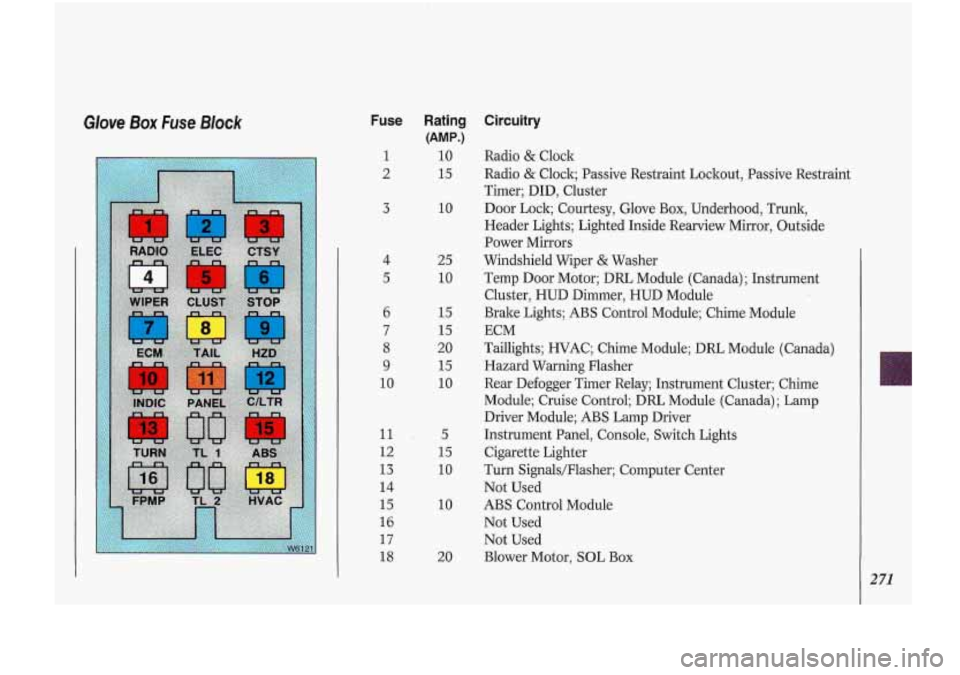
Glove Box Fuse Block Fuse
1
2
3
4
5
6
7
8
9
10
Rating
(AMP.)
10
15
10
25
10
15
15
20
15
10
11 - 5
12 15
13 10
14
15
16
17
18
10
20
Circuitry
Radio & Clock
Radio
& Clock; Passive Restraint Lockout, Passive Restraint
Timer; DID, Cluster
Door Lock; Courtesy, Glove Box, Underhood, Trunk,
Header Lights; Lighted Inside Rearview Mirror, Outside
Power Mirrors
Windshield Wiper
& Washer
Temp Door Motor; DRL Module (Canada)
; Instrument
Cluster, HUD Dimmer, HUD Module
Brake Lights; ABS Control Module; Chime Module
ECM
Taillights; HVAC; Chime Module; DRL Module (Canada)
Hazard Warning Flasher
Rear Defogger Timer Relay; Instrument Cluster; Chime
Module; Cruise Control;
DRL Module (Canada); Lamp
Driver Module; ABS Lamp Driver
Instrument Panel, Console, Switch Lights
Cigarette Lighter
Turn Signals/Flasher; Computer Center
Not Used
ABS Control Module
Not Used
Not Used Blower Motor, SOL Box
2 71
Page 304 of 340
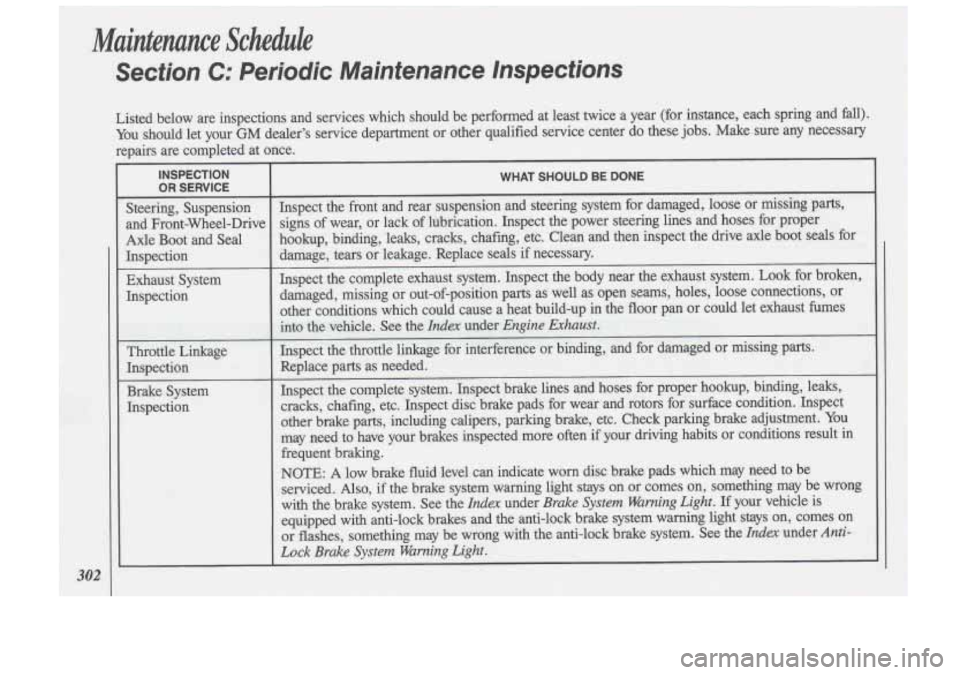
Maintenunce Schedule
Section C: Periodic Maintenance Inspections
Listed below are inspections and services which should be performed at least twice a year (for instance, each spring and fall).
You should let your GM dealer’s service department or other qualified service center do these jobs. Make sure any necessary
repairs
are completed at once.
302
INSPECTION
OR SERVICE
Steering, Suspension
and Front-Wheel-Drive
Axle Boot and Seal
Inspection
Exhaust System
Inspection
Throttle Linkage
Inspection
Brake System
Inspection
WHAT SHOULD BE DONE
Inspect the front and rear suspension and steering system for damaged, loose or missing parts,
signs of wear, or lack of lubrication. Inspect the power steering lines and hoses for proper
hookup, binding, leaks, cracks, chafing, etc. Clean and then inspect the drive axle boot seals for
damage, tears or leakage. Replace seals if necessary.
Inspect the complete exhaust system. Inspect the body near the exhaust system. Look for broken,
damaged, missing or out-of-position parts as well as open seams, holes, loose connections, or
other conditions which could cause a heat build-up in the floor
pan or could let exhaust fumes
into the vehicle. See the
Index under Engine Ekhaust.
Inspect the throttle linkage for interference or binding, and for damaged or missing parts.
Replace parts as needed.
Inspect the complete system. Inspect brake lines and hoses for proper hookup, binding, leaks,
cracks, chafing, etc. Inspect disc brake pads for wear and rotors for surface condition. Inspect
other brake parts, including calipers, parking brake, etc. Check\
parking brake adjustment. You
may need to have your brakes inspected more often if your driving habits or conditions result
in
frequent braking.
NOTE: A low brake fluid level can indicate worn disc brake pads whi\
ch may need to be
serviced. Also, if the brake system warning light stays on or comes on, something may be wrong
with the brake system. See the
Index under Brake System Warning Light. If your vehicle is
equipped with anti-lock brakes and the anti-lock brake system w\
arning light stays on, comes on
or flashes, something may be wrong with the anti-lock brake system. See the
Index under Anti-
Lock Brake System Warning Light.
Page 328 of 340
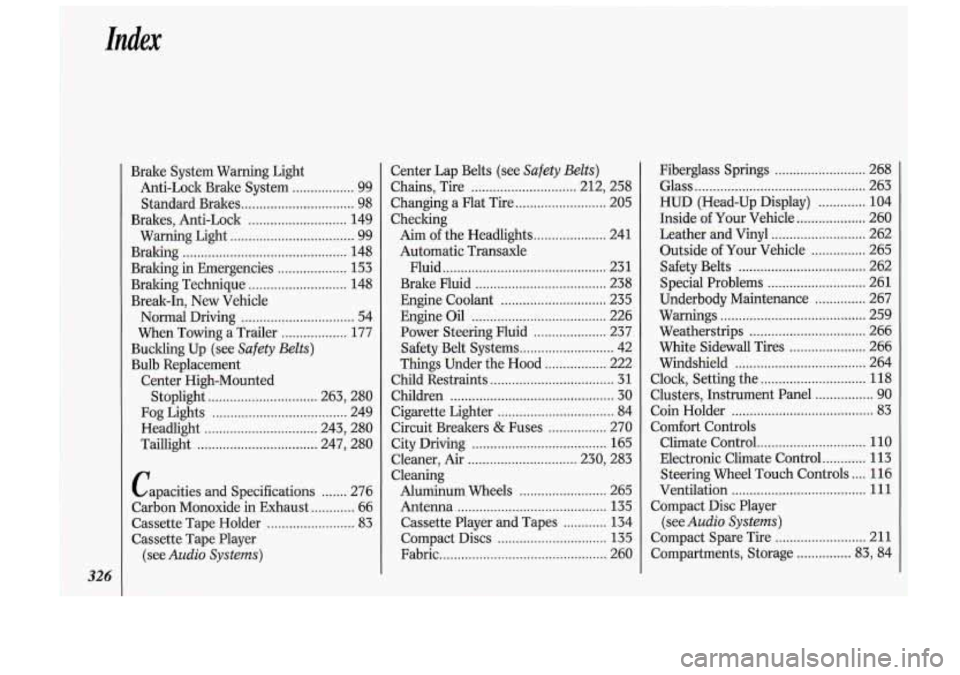
Index
326
Brake System Warning Light Anti-Lock Brake System
................. 99
Standard Brakes
............................... 98
Brakes. Anti-Lock
........................... 149
Warning Light
.................................. 99
Braking
in Emergencies ................... 153
Braking Technique ........................... 148
Break.Tn. New Vehicle
Normal Driving
............................... 54
When Towing a Trailer
.................. 177
Braking
............................................. 148
Buckling Up (see
Safety Belts)
Bulb Replacement
Center High-Mounted
Stoplight
.............................. 263. 280
Fog Lights
..................................... 249
Taillight
................................. 247. 280
Headlight
............................... 243. 280
Capacities and Specifications
....... 276
Carbon Monoxide
in Exhaust ............ 66
Cassette Tape Holder
........................ 83
Cassette Tape Player
(see
Audio Systems)
Center Lap Belts (see Safety Belts)
Chains. Tire ............................. 212. 258
Changing a Flat Tire
......................... 205
Checking Aim
of the Headlights .................... 241
Automatic Transaxle Fluid
............................................. 231
Brake Fluid
.................................... 238
Engine Coolant
............................. 235
Engine Oil
..................................... 226
Power Steering Fluid
.................... 237
Safety Belt Systems
.......................... 42
Things Under the Hood
................. 222
Child Restraints
.................................. 31
Children
............................................. 30
Cigarette Lighter
................................ 84
Circuit Breakers
& Fuses ................ 270
City Driving
..................................... 165
Cleaner, Air
.............................. 230, 283
Cleaning Aluminum Wheels
........................ 265
Antenna
......................................... 135
Cassette Player and Tapes
............ 134
Compact Discs
.............................. 135
Fabric .............................................. 260 Fiberglass Springs
......................... 268
Glass
............................................... 263
HUD (Head-Up Display)
............. 104
Inside
of Your Vehicle ................... 260
Leather and Vinyl
.......................... 262
Outside
of Your Vehicle ............... 265
Safety Belts
................................... 262
Special Problems
........................... 261
Underbody Maintenance
.............. 267
Warnings
........................................ 259
Weatherstrips
................................ 266
White Sidewall Tires
..................... 266
Windshield
.................................... 264
Clock, Setting the
............................. 118
Clusters. Instrument Panel ................ 90
Coin Holder ....................................... 83
Comfort Controls
Climate Control
.............................. 110
Electronic Climate Control
............ 113
Steering Wheel Touch Controls
.... 116
Ventilation ..................................... 111
Compact Disc Player
(see
Audio Systems)
Compact Spare Tire ......................... 211
Compartments, Storage
............... 83, 84