check engine light Oldsmobile Cutlass Supreme 1993 Owner's Manuals
[x] Cancel search | Manufacturer: OLDSMOBILE, Model Year: 1993, Model line: Cutlass Supreme, Model: Oldsmobile Cutlass Supreme 1993Pages: 340, PDF Size: 16.21 MB
Page 100 of 340

\A1
Battery Warning Light
(EECTRONiC CLUSTER)
The charging system light will come on
briefly when you turn.
on the ignition as
a check to show you it
is working. Then
it
should go out. If it stays on, or comes
on
while you are driving, you may have
a problem with the electrical chaging
system. It could indicate that you have
a loose generator drive belt or another
eIectrical problem. Have it checked
right away. Driving while this light is
on
could drain your battery.
If you mu,st drive a short distance with
the light
on, be certain to turn off all
your accessories, such as the radio and
air conditioner.
Voltmeter (ANALOG CLOSER)
When the engine is running, the gage
shows the condition
of the charging
system. Readings between the red
warning zones indicate the
normal
operating range.
Readings in either red warning zone
indicate
a possible problem in the
electrical system. Have your vehicle
serviced immediately.
When your engine is not running, but
the ipition is on (in the
Run position),
the gage shows your battery‘s state
of
charge.
Brake System Warning Light
It
Your Oldsmobile’s hydraulic brake
system is divided .into
two parts. If one I
1
Page 102 of 340
100
Anti-Lock Brake System Warning Light
(CONT.)
is also on, see Brake System Warning
Light earlier in this section.
If the anti-lock brake system warning
light ever flashes, your anti-lock bralre system is still working but needs service
as soon as possible.
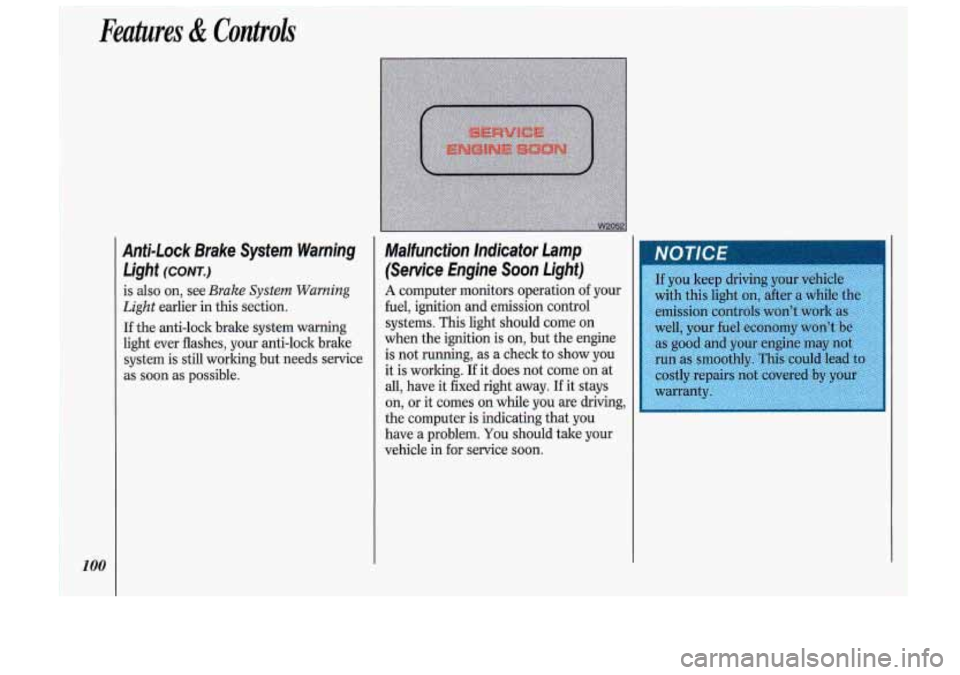
Malfunction lnelicator Lamp
(Service Engine Soon Light)
A computer monitors operation of your
fuel, ignition and emission control
.systems.
This light should come on
when the ignition is on, but the engine
is not running, as a check
to show you-
it is working. If it does not come on at
all, have it fixed right away. If it stays
on,
or it comes on while you are driving,
the computer is indicating that you
have
a problem. You should take your
vehicle in
for service soon.
Page 170 of 340
Your Driving and the Road
Driving a Long Distance
Although most long trips today are
made on freeways, there are still many
made on regular highways.
Long-distance driving on freeways and
regular highways is the same
in some
ways. The trip has to be planned and
the vehicle prepared, you drive at
higher-than-city speeds, and there
are
longer turns behind the wheel. You’ll
enjoy your trip more if you and your
vehicle are in good shape. Here are
some tips for a successful long trip.
Before Leaving on a Long Trip
Make sure you’re ready. Try to be well
rested. If you must start when you’re
not fresh-such as after a day’s work
don’t plan to make too many miles that
first part of the journey. Wear
comfortable clothing and shoes you can
easily drive in.
Is your vehicle ready for a long trip? If
you keep it serviced and maintained, it’s
ready to go. If it needs service, have it
done before starting out. Of course,
you’ll find experienced and able service
experts in Oldsmobile dealerships all
across North America. They’ll be ready
and willing to help if you need it. Here are
some things you can check
before a trip:
Windshield Washer Fluid: Is the
reservoir
full? Are all windows clean
inside and outside?
shape? Have you checked
all levels?
the lenses clean?
safe, trouble-free trip. Is the tread
good enough for long-distance
driving?
Are the tires all inflated to
the recommended pressure?
Weather Forecasts: What’s the
weather outlook along your route?
Should you delay your trip a short
time to avoid a major storm system?
Maps: Do you have up-to-date maps?
Wiper Blades: Are they in good
Fuel, Engine Oil, Other Fluids:
Lights: Are they all working? Are
Tires: They are vitally important to a
Page 184 of 340
Your Driving and the Road
Driving with a Trailer (CONT.)
Making Turns
When you’re turning with a trailer,
make wider turns than normal.
Do this
so your trailer won’t strike soft
shoulders, curbs, road signs, trees, or
other objects. Avoid jerky or sudden
maneuvers. Signal well in advance.
Turn Signals When Towing a Trailer
When you tow a trailer, your vehicle has
to have
a different turn signal flasher
and extra wiring. The green arrows
on
your instrument panel will flash
whenever you signal a turn or lane
change. Properly hooked up, the trailer
lights will also flash, telling other
drivers you’re about to turn, change
lanes or stop. When towing a
trailer, the green arrows
on your instrument panel will flash for
turns even if the bulbs on the trailer are
burned out. Thus, you may think
drivers behind you are seeing your
signal when they are not. It’s important
to check occasionally to be sure the
trailer bulbs are still working.
Driving On Grades
Reduce speed and shift to a lower gear
before you start down a long or steep
downgrade.
If you don’t shift down, you
might have to use your brakes
so much
that they would get hot and
no longer
work well.
On a long uphill grade, shift down and
reduce your speed to around
45 mph
(70 lm/h) to reduce the possibility of
engine and transaxle overheating.
If you are towing a trailer and you have
an automatic transaxle with Overdrive,
you may want to drive in
D instead of
(or, as you need to, a lower gear).
Page 193 of 340
Using a match near a batteq
can cause battery gas to
explode. People have been hurt
doing this, and some have been
blinded. Use a flashlight if you need
more light.
Be sure the battery has enough
water.
You don’t need to add water to the
Delco Freedoms battery installed in
every new
GM vehicle. But if a
battery has filler caps, be sure the
right amount
of fluid is there. If it is
low, add water to take care of that
first. If you don’t, explosive gas
could be present.
Battery fluid contains acid that can
burn you. Don’t get it
on you. If
you accidentally get it in your eyes
or
on your skin, flush the place
with water and get medical help
immediately.
I
5. Check that the jumper cables don’t
have loose or missing insulation.
If
they do, you could get a shock. The
vehicles could be damaged, too.
Before you connect the cables, here are
some things you should
know. Positive
(+) will go to positive (+) and negative
(-) will go to negative (-) or a metal
engine part. Don’t connect
(+) to (-) or
you’ll get
a short that would damage the
battery and maybe other parts, too.
I I
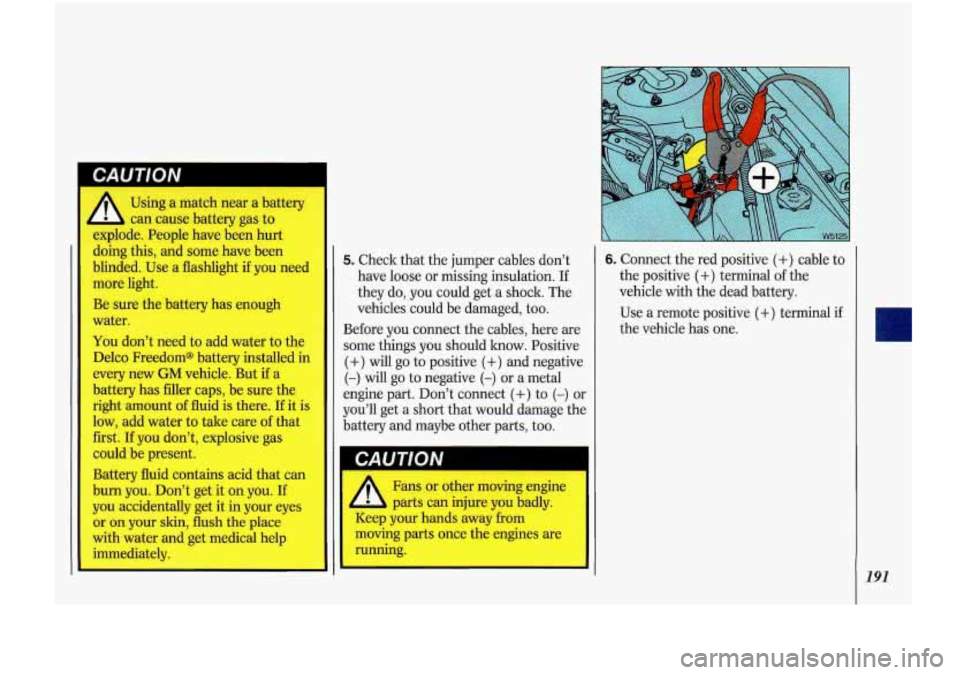
6. Connect the red positive (+) cable to
the positive
(+) terminal of the
vehicle with the dead battery.
Use a remote positive
(+) terminal if
the vehicle has one.
191
Page 228 of 340
226
Sewice & Appearance Care
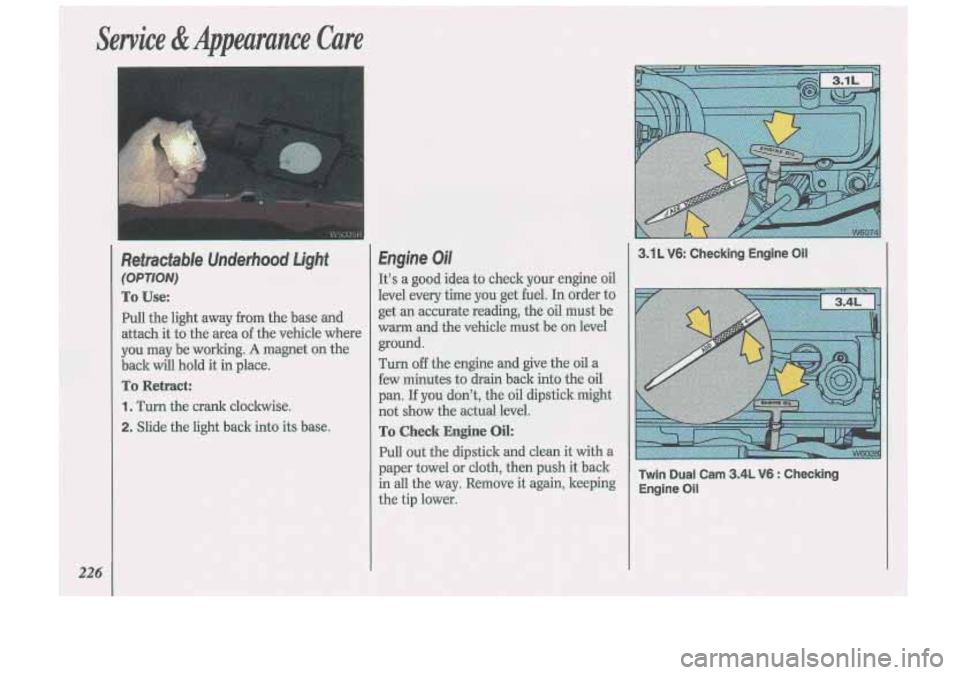
Retractable Underhood Light
(OPTION)
To Use:
Pull the light away from the base and
attach it to the area
of the vehicle where
you
may be working. A magnet on the
back will hold it in place.
To Retract:
1. Turn the crank clockwise.
2. Slide the light back into its base.
Engine Oil
It’s a good idea to check your engine oil
level every time you get fuel. In order to
get
an accurate reading, the oil must be
warm and the vehicle must be
on level
ground.
Turn off the engine and give the oil a
few minutes to drain back into the oil
pan. If you don’t, the oil dipstick might
not show the actual level.
To Check Engine Oil:
Pull out the dipstick and clean it with a
paper towel or cloth, then push it back
in all the way. Remove it again, keeping
the tip lower.
3.1 L V6: Checking Engine Oil
Twin
Dual Cam 3.4L V6 : Checking
Engine
Oil
Page 237 of 340
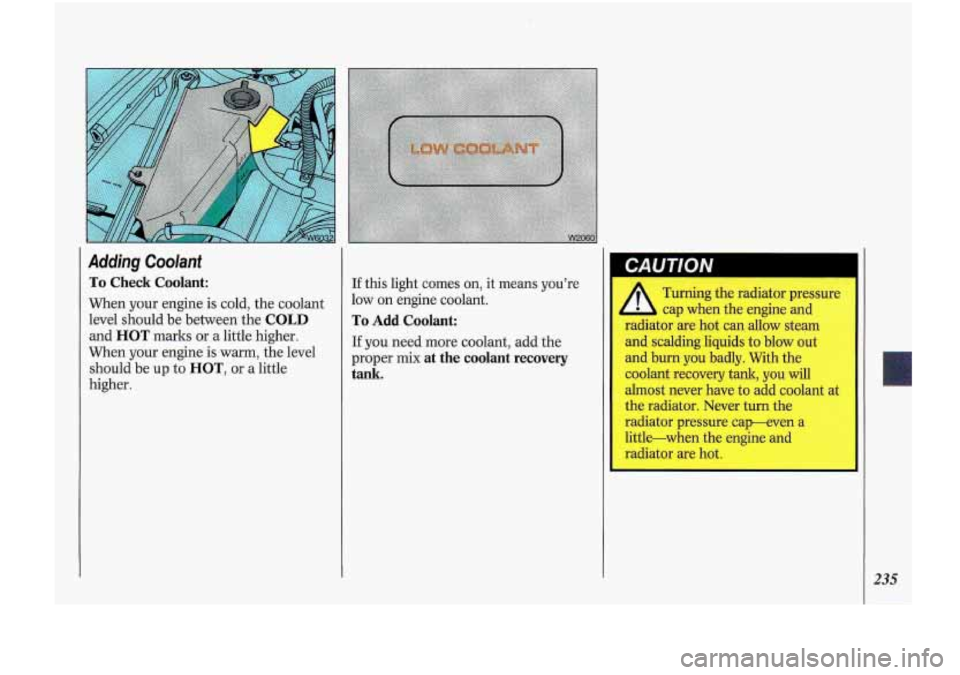
Adding Coolant
To Check Coolant:
When your engine is cold, the coolant
level should be between
the COLD
and HOT marks or a little higher.
When your
engine is warm, the level
should be u.p to HOT, or a little
higher.
If this light comes on, it means you’re
low
on engine coolant.
To Add Coolant:
If you need more coolant, add the
proper
mix at the coolant recovery
tank.
Turning the radiator pressure I
cap when the engine and
radiator are hot can allow steam
and scalding liquids to blow out
and burn you badly. With the
coolant recovery tank, you will
almost never have to add coolant at
the radiator. Never turn the
radiator pressure cap-even a
little-when the engine and
radia
I are hot.
I I
n
Page 304 of 340
Maintenunce Schedule
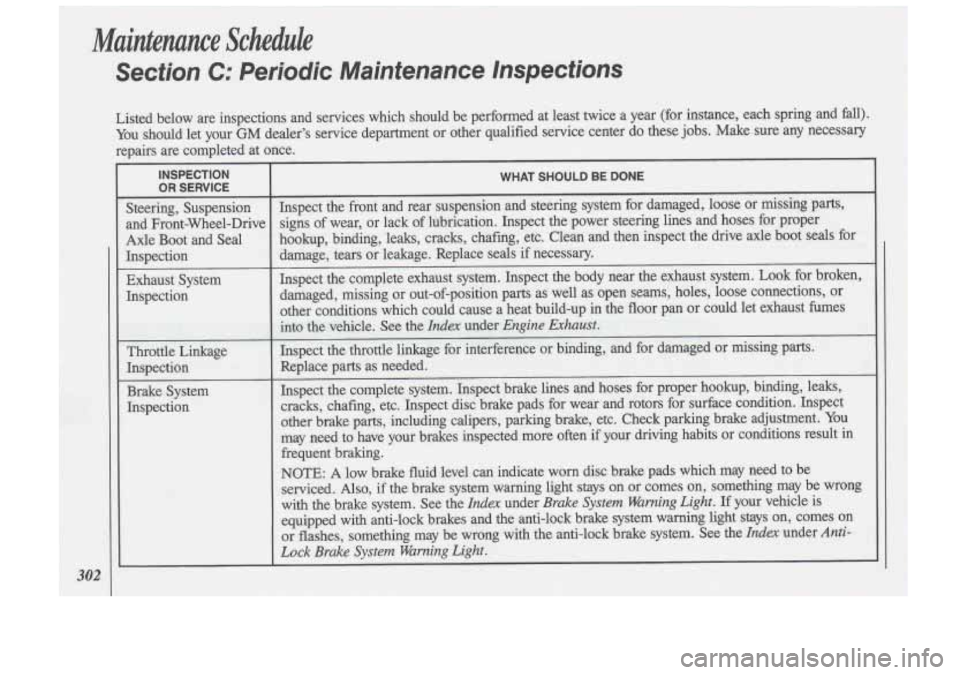
Section C: Periodic Maintenance Inspections
Listed below are inspections and services which should be performed at least twice a year (for instance, each spring and fall).
You should let your GM dealer’s service department or other qualified service center do these jobs. Make sure any necessary
repairs
are completed at once.
302
INSPECTION
OR SERVICE
Steering, Suspension
and Front-Wheel-Drive
Axle Boot and Seal
Inspection
Exhaust System
Inspection
Throttle Linkage
Inspection
Brake System
Inspection
WHAT SHOULD BE DONE
Inspect the front and rear suspension and steering system for damaged, loose or missing parts,
signs of wear, or lack of lubrication. Inspect the power steering lines and hoses for proper
hookup, binding, leaks, cracks, chafing, etc. Clean and then inspect the drive axle boot seals for
damage, tears or leakage. Replace seals if necessary.
Inspect the complete exhaust system. Inspect the body near the exhaust system. Look for broken,
damaged, missing or out-of-position parts as well as open seams, holes, loose connections, or
other conditions which could cause a heat build-up in the floor
pan or could let exhaust fumes
into the vehicle. See the
Index under Engine Ekhaust.
Inspect the throttle linkage for interference or binding, and for damaged or missing parts.
Replace parts as needed.
Inspect the complete system. Inspect brake lines and hoses for proper hookup, binding, leaks,
cracks, chafing, etc. Inspect disc brake pads for wear and rotors for surface condition. Inspect
other brake parts, including calipers, parking brake, etc. Check\
parking brake adjustment. You
may need to have your brakes inspected more often if your driving habits or conditions result
in
frequent braking.
NOTE: A low brake fluid level can indicate worn disc brake pads whi\
ch may need to be
serviced. Also, if the brake system warning light stays on or comes on, something may be wrong
with the brake system. See the
Index under Brake System Warning Light. If your vehicle is
equipped with anti-lock brakes and the anti-lock brake system w\
arning light stays on, comes on
or flashes, something may be wrong with the anti-lock brake system. See the
Index under Anti-
Lock Brake System Warning Light.
Page 328 of 340
Index
326
Brake System Warning Light Anti-Lock Brake System
................. 99
Standard Brakes
............................... 98
Brakes. Anti-Lock
........................... 149
Warning Light
.................................. 99
Braking
in Emergencies ................... 153
Braking Technique ........................... 148
Break.Tn. New Vehicle
Normal Driving
............................... 54
When Towing a Trailer
.................. 177
Braking
............................................. 148
Buckling Up (see
Safety Belts)
Bulb Replacement
Center High-Mounted
Stoplight
.............................. 263. 280
Fog Lights
..................................... 249
Taillight
................................. 247. 280
Headlight
............................... 243. 280
Capacities and Specifications
....... 276
Carbon Monoxide
in Exhaust ............ 66
Cassette Tape Holder
........................ 83
Cassette Tape Player
(see
Audio Systems)
Center Lap Belts (see Safety Belts)
Chains. Tire ............................. 212. 258
Changing a Flat Tire
......................... 205
Checking Aim
of the Headlights .................... 241
Automatic Transaxle Fluid
............................................. 231
Brake Fluid
.................................... 238
Engine Coolant
............................. 235
Engine Oil
..................................... 226
Power Steering Fluid
.................... 237
Safety Belt Systems
.......................... 42
Things Under the Hood
................. 222
Child Restraints
.................................. 31
Children
............................................. 30
Cigarette Lighter
................................ 84
Circuit Breakers
& Fuses ................ 270
City Driving
..................................... 165
Cleaner, Air
.............................. 230, 283
Cleaning Aluminum Wheels
........................ 265
Antenna
......................................... 135
Cassette Player and Tapes
............ 134
Compact Discs
.............................. 135
Fabric .............................................. 260 Fiberglass Springs
......................... 268
Glass
............................................... 263
HUD (Head-Up Display)
............. 104
Inside
of Your Vehicle ................... 260
Leather and Vinyl
.......................... 262
Outside
of Your Vehicle ............... 265
Safety Belts
................................... 262
Special Problems
........................... 261
Underbody Maintenance
.............. 267
Warnings
........................................ 259
Weatherstrips
................................ 266
White Sidewall Tires
..................... 266
Windshield
.................................... 264
Clock, Setting the
............................. 118
Clusters. Instrument Panel ................ 90
Coin Holder ....................................... 83
Comfort Controls
Climate Control
.............................. 110
Electronic Climate Control
............ 113
Steering Wheel Touch Controls
.... 116
Ventilation ..................................... 111
Compact Disc Player
(see
Audio Systems)
Compact Spare Tire ......................... 211
Compartments, Storage
............... 83, 84
Page 329 of 340
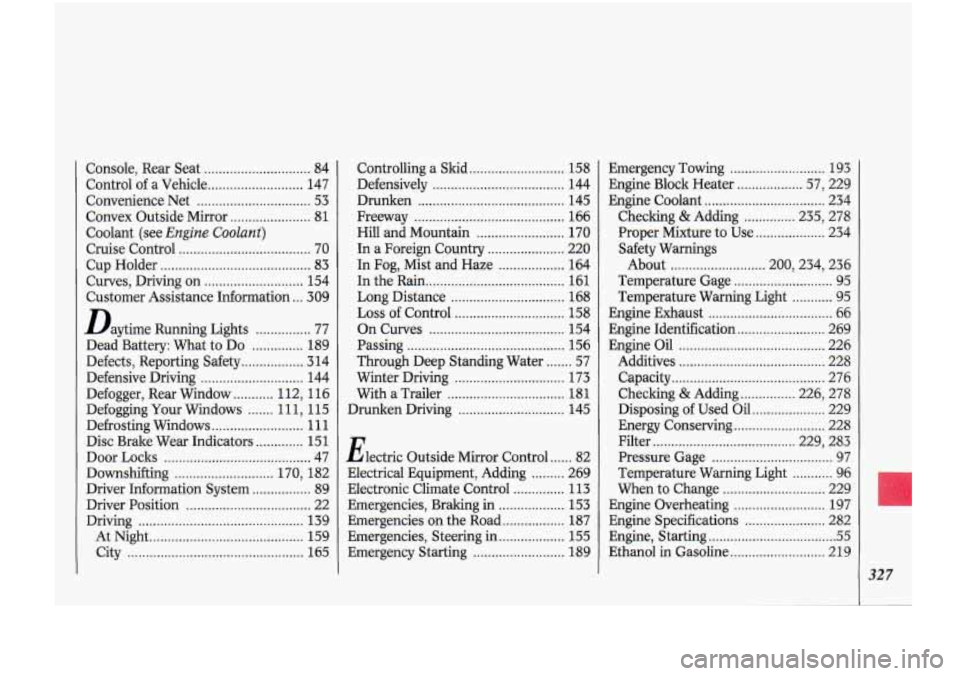
Console. Rear Seat ............................. 84
Control of
a Vehicle .......................... 147
Convenience Net
............................... 53
Convex Outside Mirror
...................... 81
Coolant (see Engine Coolant)
Cruise Control .................................... 70
Cup Holder
......................................... 83
Curves. Driving on ........................... 154
Customer Assistance Information
... 309
Daytime Running Lights
............... 77
Dead Battery: What to Do
.............. 189
Defects, Reporting Safety
................. 314
Defensive Driving
............................ 144
Defogger, Rear Window
........... 112, 116
Defrosting Windows
......................... 11 1
Disc Brake Wear Indicators ............. 151
Door Locks ........................................ 47
Defogging Your Windows
....... 11 1, 115
Downshifting
........................... 170, 182
Driver Information System
................ 89
Driver Position
.................................. 22
Driving
............................................. 139
At Night
.......................................... 159
City
................................................ 165 Controlling a Skid
.......................... 158
Defensively .................................... 144
Drunken
........................................ 145
Freeway
......................................... 166
Hill and Mountain
........................ 170
In a Foreign Country
..................... 220
In Fog. Mist and Haze
.................. 164
In the Rain
...................................... 161
Long Distance
............................... 168
Loss of Control
.............................. 158
On Curves ..................................... 154
Passing
........................................... 156
Through Deep Standing Water
....... 57
Winter Driving
.............................. 173
With
a Trailer ................................ 181
Drunken Driving ............................. 145
Electric Outside Mirror Control
...... 82
Electrical Equipment. Adding
......... 269
Electronic Climate Control
.............. 1 13
Emergencies. Braking in
.................. 153
Emergencies on the Road ................. 187
Emergencies. Steering in
.................. 155
Emergency Starting ......................... 189 Emergency Towing
.......................... 193
Engine Block Heater
.................. 57. 229
Engine Coolant
................................. 234
Checking
& Adding .............. 235. 278
Proper Mixture to Use
................... 234
Safety Warnings
Temperature Gage
........................... 95
Temperature Warning Light
........... 95
Engine Exhaust
.................................. 66
Engine Identification
........................ 269
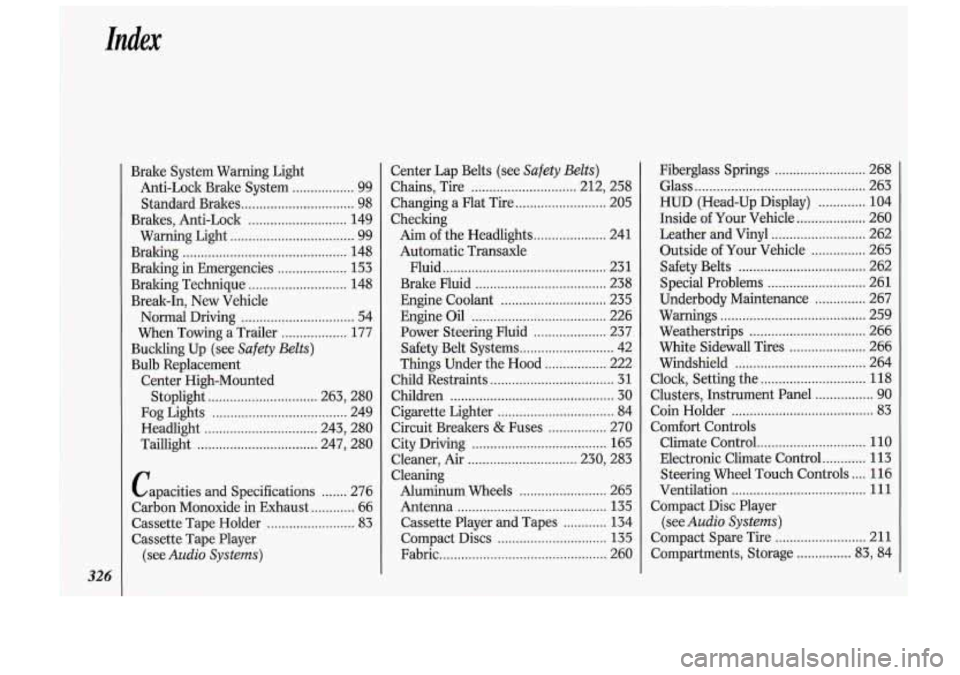
Engine Oil
........................................ 226
Additives
........................................ 228
Capacity
.......................................... 276
Checking
& Adding ............... 226, 278
Energy Conserving
......................... 228
Filter
....................................... 229, 283
Temperature Warning Light
........... 96
Engine Overheating
......................... 197
Engine Specifications
...................... 282
Engine, Starting
................................... 55
Ethanol in Gasoline .......................... 219
About
.......................... 200. 234. 236
Disposing of Used Oil
.................... 229
Pressure Gage
................................. 97
When to Change
............................ 229
327