headlight Oldsmobile Cutlass Supreme 1993 Owner's Manuals
[x] Cancel search | Manufacturer: OLDSMOBILE, Model Year: 1993, Model line: Cutlass Supreme, Model: Oldsmobile Cutlass Supreme 1993Pages: 340, PDF Size: 16.21 MB
Page 11 of 340
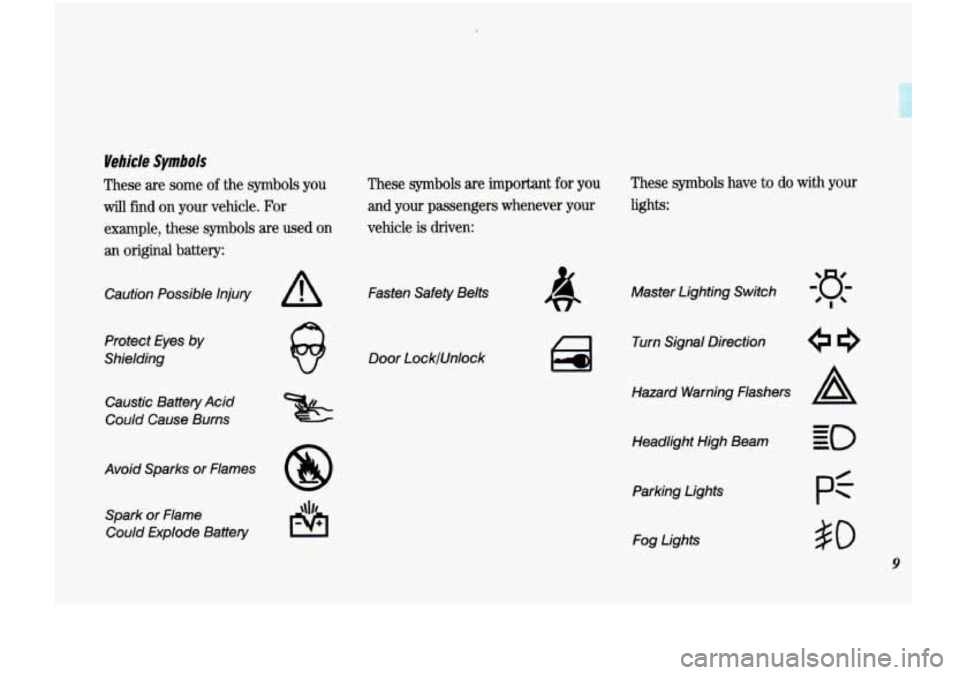
Vehicle Symbols
These are some of the symbols you
will find on your vehicle. For
example, these
symbols are used on
an original battery:
Caution Possible Injury A
Protect Eyes by
Shielding
Caustic Battery Acid
Could Cause Burns
Avoid Sparks or Flames
8
Spark or Flame Could Explode Battery
These symbols are important for you
and your passengers whenever your
vehicle
is driven:
Fasten Safety Belts
Door LocklUnlock
These symbols have to do with your
lights:
Master Lighting Switch
Turn Signal Direction
Hazard Warning Flashers
A
Headlight High Beam Parking Lights Fog Lights
pf
#O
9
Page 71 of 340
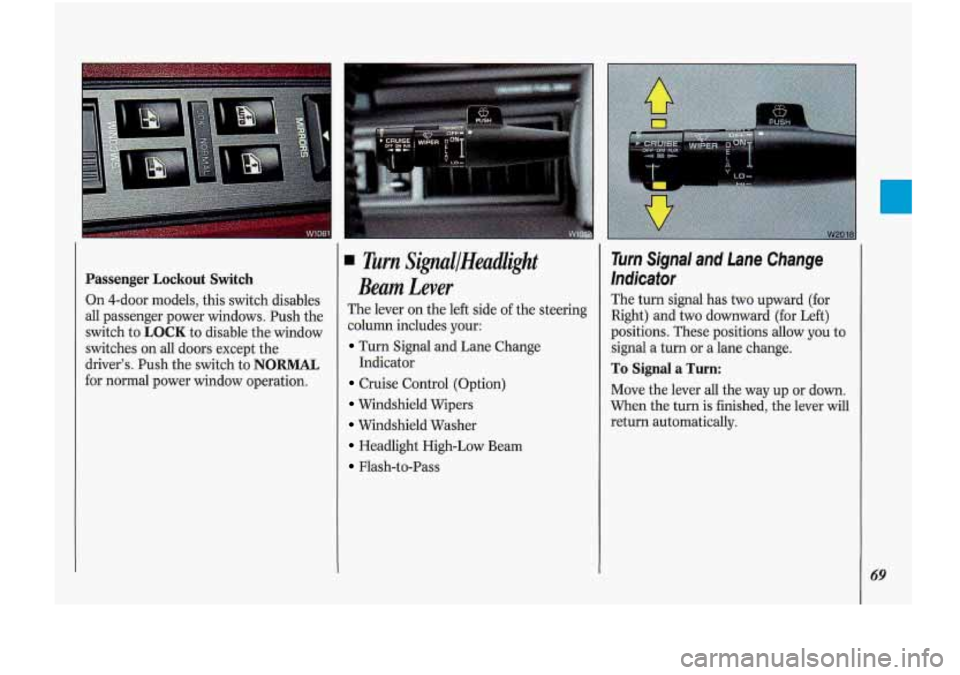
Passenger Lockout Switch
On 4-door models, this switch disables
all passenger power windows. Push the
switch to
LOCK to disable the window
switches on all doors except the
driver’s. Push the switch to
NORMAL
for normal power window operation.
Turn SiflallHeadlight
Beam Lever
The lever on the left side of the steering
column includes your:
Turn Signal and Lane Change
Cruise Control (Option)
Windshield Wipers
Windshield Washer
Headlight High-Low Beam
Flash-to-Pass Indicator
Turn Signal and Lane Change
Indicator
The turn signal has two upward (for
Right) and
two downward (for Left)
positions. These positions allow you to
signal a turn or a lane change.
To Signal a Turn:
Move the lever all the way up or down.
When the turn
is finished, the lever will
return automatically.
69
Page 78 of 340
Features & Controls
76
Windshield Washer (CONT.)
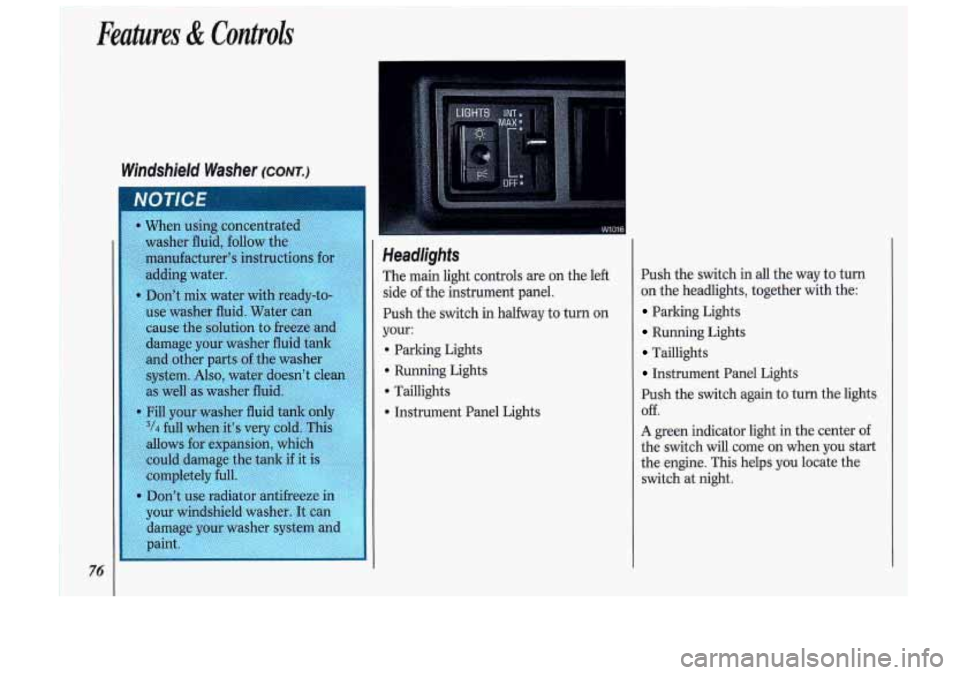
Push the switch in all the wa
on the headlights, together u
Parking Lights
Running Lights
Taillights
Instrument Panel Lights
1y to turn
rith the:
Push the switch again to turn the lights
Off.
A green indicator light in the center of
the switch will come on when you start
the engine. This helps you locate the
switch at night.
Page 80 of 340
Features & Controls
78
Daytime Running Lights (CONK)
At dusk, the exterior lights will come on
automatically and the low beams will
change to full brightness. At dawn, the
exterior lights will go out and the low
beams will change to the reduced
brightness of
DRL (if the headlight
switch is off).
Of course, you may still turn on the
headlights any time you need to.
To idle your vehicle with the DRL off,
set the parking brake while the ignition
is in the
Off or Lock position. Then
start the vehicle. The DRL will stay off
until you release the parking brake.
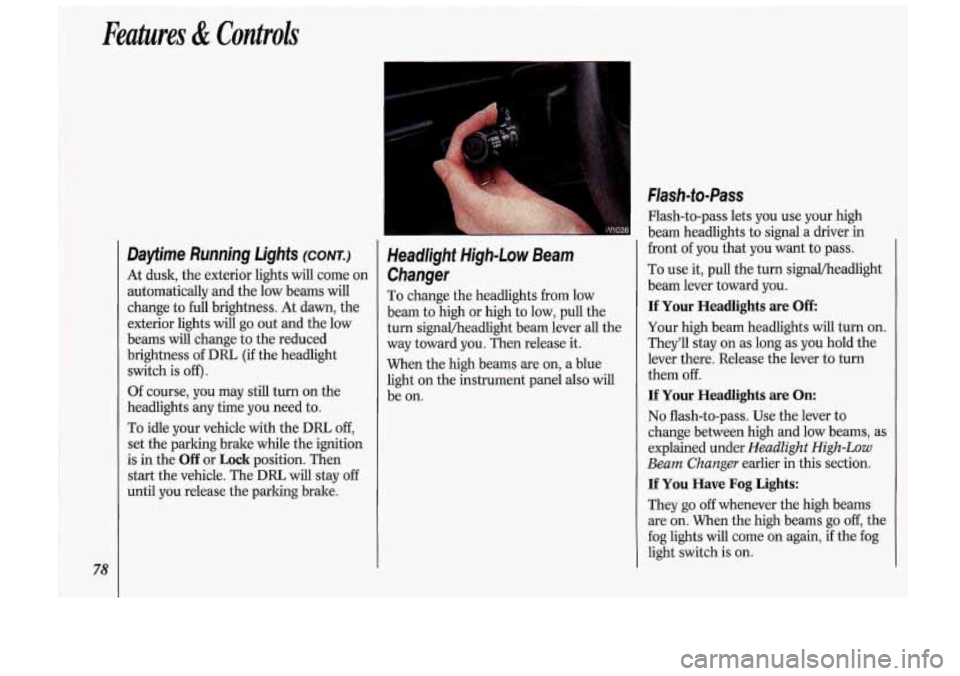
Headlight High-Low Beam
Changer
To change the headlights from low
beam to high or high to low, pull the
turn signal/headlight beam lever all the
way toward you. Then release it.
When the high beams are on,
a blue
light on the instrument panel also will
be on.
Flash-to- Pass
Flash-to-pass lets you use your high
beam headlights
to signal a driver in
front of you that you want to pass.
To use it, pull the turn signal/headlight
beam lever toward you.
If Your Headlights are Off
Your high beam headlights will turn on.
They'll stay on
as long as you hold the
lever there. Release the lever to turn
them off.
If Your Headlights are On:
No flash-to-pass. Use the lever to
change between high and low beams, as
explained under
Headlight High-Low
Beam Changer
earlier in this section.
If You Have Fog Lights:
They go off whenever the high beams
are on. When the high beams go
off, the
fog lights will come on again, if the fog
light switch is on.
Page 81 of 340
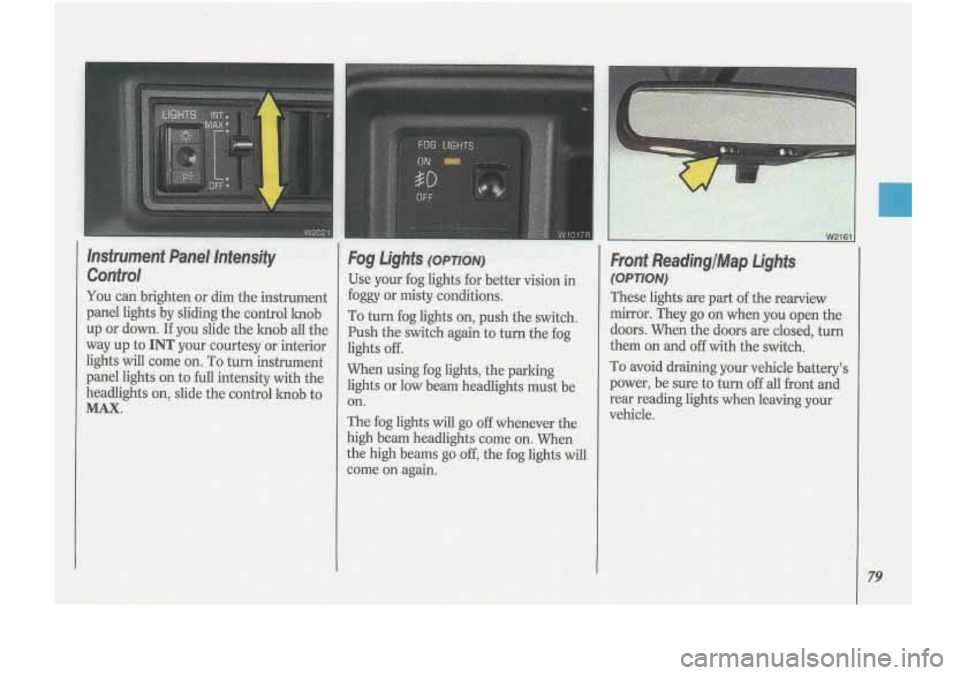
Insfrum~e~t Panel hfensity
Control
You can brighten or dim the instrument
panel lights by sliding the control hob
up or down. If you slide the hob all the
way up to
INT your courtesy or interior
lights
will come on. To turn instrument
panel lights on to
full intensity with the
headlights on, slide the control hob
to
MAX.
Fog (OPTION)
Use your fog lights for better vi'sion in
foggy or misty conditions.
To turn fog lights on, push the switch.
Push the-switch again to turn the fog
lights off.
When using fog lights, the parlung
lights or low beam headlights must be on.
The fog lights will go
off whenever the
high beam headlights come on. When
the high beams go
off, the fog lights will^
come on again.
Front ReadinglMap Ljghfs
(OPTION)
These lights are part of the rearview
mirror. They go on when you open the
doors. When the doors are closed, turn
them on
and off with the switch.
To avoid draining your vehicle battery's
power, be sure
to turn off all front and
rear reading lights-when leaving your
vehicle.
79
Page 91 of 340
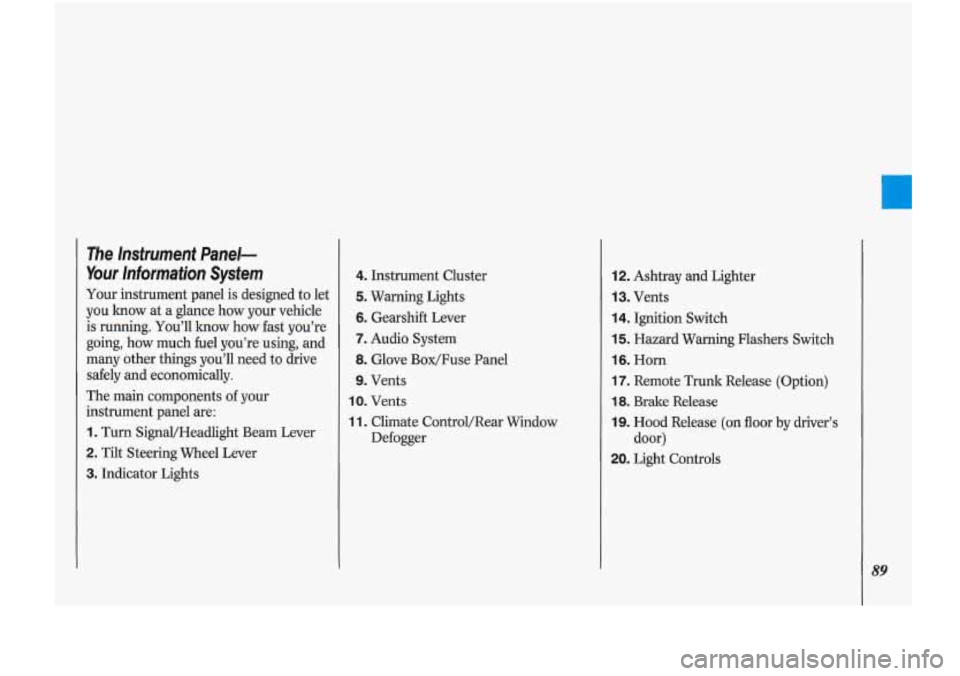
The Instrument Panel-
Your Information System
Your instrument panel is designed to let
you know
at a glance how your vehicle
is running. You’ll know how fast you’re
going, how much fuel you’re using, and
many other things you’ll need to drive
safely and economically.
The main components of your
instrument panel are:
1. Turn Signal/Headlight Beam Lever
2. Tilt Steering Wheel Lever
3. Indicator Lights
4. Instrument Cluster
5. Warning Lights
6. Gearshift Lever
7. Audio System
8. Glove Box/Fuse Panel
9. Vents
IO. Vents
11. Climate ControVRear Window
Defogger
12. Ashtray and Lighter
13. Vents
14. Ignition Switch
15. Hazard Warning Flashers Switch
16. Horn
17. Remote Trunk Release (Option)
18. Brake Release
19. Hood Release (on floor by driver’s
20. Light Controls
door)
89
Page 104 of 340
102
Although the HUD irinage apper
to be near the front
of the vehicl
do not, use it as a parking aid. T1
HUD was not designed For that
rpose.
If you try to use it that
way, such as in a parltirig lot, yo
may misjudge distance
ct run
:o somethin!
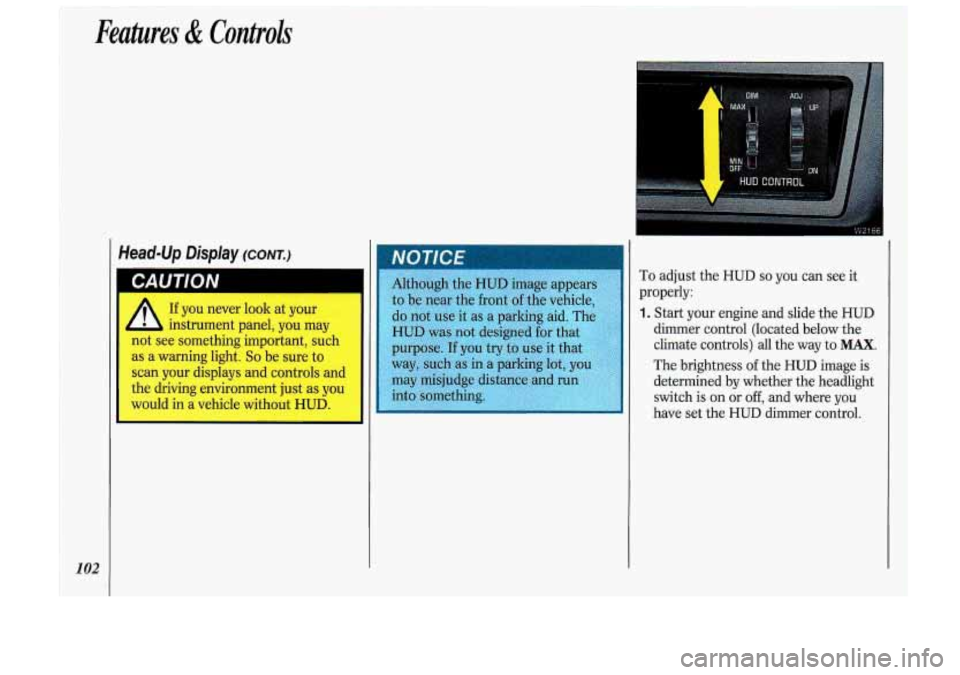
To adjust the HUD so you can see it
properly:
1. Start your engine and slide the HUD
dimmer control (located below the
climate controls) all the way to
MAX.
The brightness of the HUD image is
determined
by whether the headlight
switch is on or
off, and where you
have set the HUD dimmer control.
Page 105 of 340
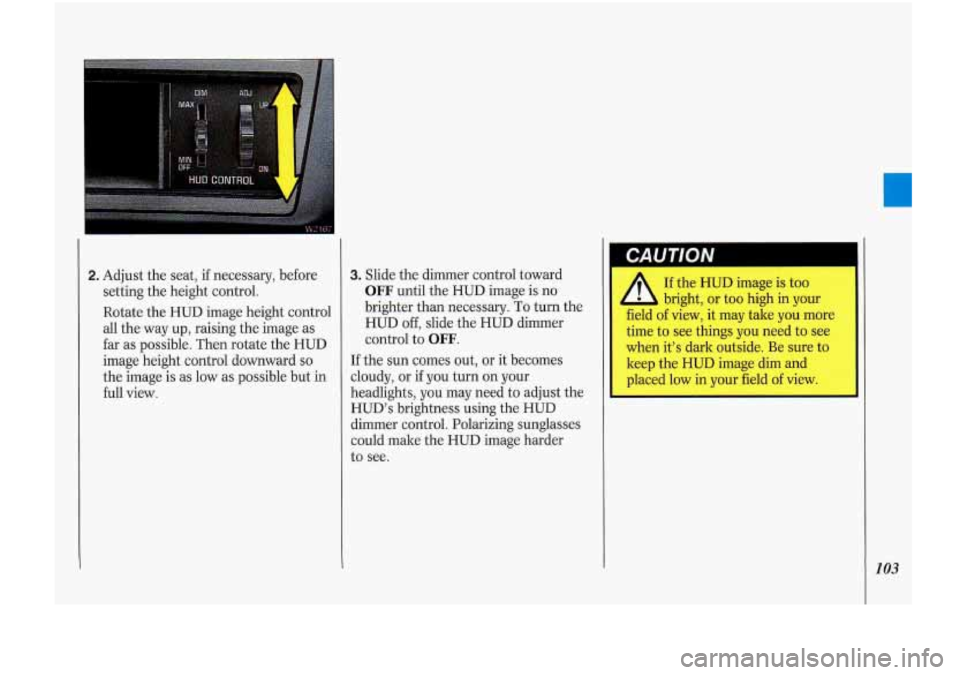
2. Adjust the seat, if necessary, before
setting the height control.
Rotate the HUD image height control
all the way up, raising the image as
far as possible. Then rotate the HUD
image height control downward
so
the image is as low as possible but in
full view.
3. Slide the dimmer control toward
OFF until the HUD image is no
brighter than necessary.
To turn the
HUD off, slide the HUD dimmer
control to
OFF.
If the sun comes out, or it becomes
cloudy, or
if you turn on your
headlights, you may need
to adjust the
HUD's brightness using the HUD
dimmer control. Polarizing sunglasses
could make the HUD image harder
to see.
I I
CAUTION I
A
If the HUD image is too
bright, or too high
in your
field of view, it may take you more
time to see things you need to see
when it's dark outside. Be sure to
I
keep the HUD image dim and
I placed low in your field of view.
203
Page 161 of 340
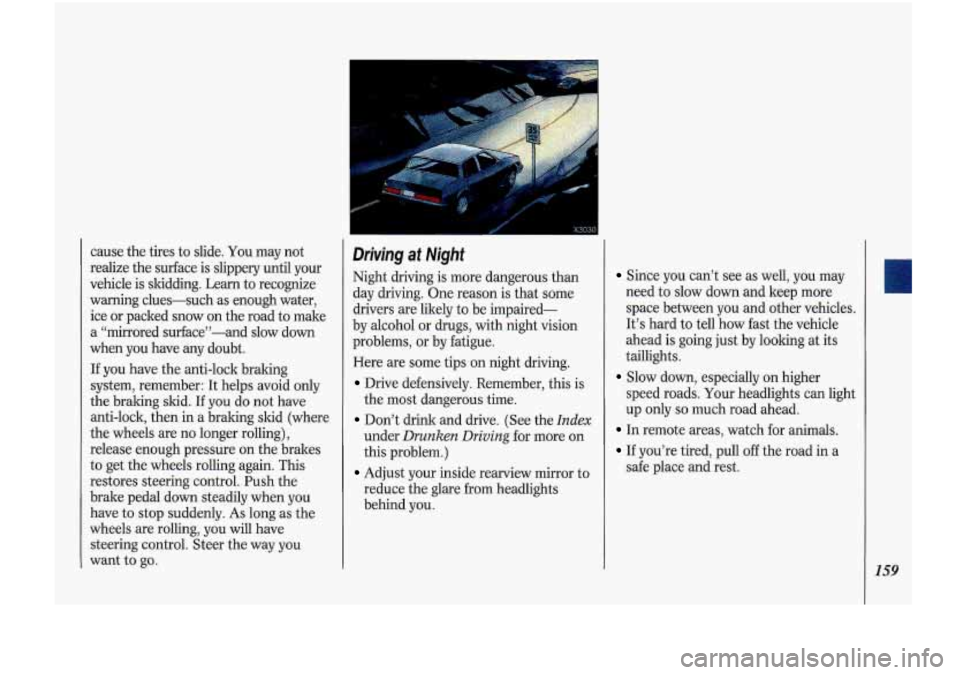
cause the tires to slide. You may not
realize the surface is slippery until your
vehicle is skidding. Learn to recognize
warning clues-such as enough water,
ice or packed snow on the road to make
a “mirrored surface”-and slow down
when you have any doubt.
If you have the anti-lock braking
system, remember: It helps avoid only
the braking skid.
If you do not have
anti-lock, then in a braking skid (where
the wheels are no longer rolling),
release enough pressure on the brakes
to get the wheels rolling again. This
restores steering control. Push the
brake pedal down steadily when you
have to stop suddenly. As long as the
wheels are rolling, you will have
steering control. Steer the way you
want to go.
I .@ i 7“
Driving at Night
Night driving is more dangerous than
day driving. One reason is that some
drivers are likely to be impaired-
by alcohol or drugs, with night vision
problems, or by fatigue.
Here are some tips on night driving.
Drive defensively. Remember, this is
the most dangerous time.
Don’t drink and drive. (See the Index
under Drunken Driving for more on
this problem.)
Adjust your inside rearview mirror to
reduce the glare from headlights
behind you.
Since you can’t see as well, you may
need to slow down and keep more
space between you and other vehicles.
It’s hard to tell how fast the vehicle
ahead is going just by looking at its
taillights.
speed roads. Your headlights can light
up only
so much road ahead.
Slow down, especially on higher
In remote areas, watch for animals.
If you’re tired, pull off the road in a
safe place and rest.
1
159
Page 162 of 340
Your Driving and the Road
140
Night Vision
No one can see as well at night as in the
daytime. But as we get older these
differences increase.
A 50-year-old
driver may require at least twice as
much light to see the same thing at
night as a 20-year-old.
What you do in the daytime can also
affect your night vision. For example, if
you spend the day in bright sunshine
you are wise to wear sunglasses. Your
eyes will have less trouble adjusting to
night.
But if you’re driving, don’t wear
sunglasses at night. They may cut down
on glare from headlights, but they
also
make a lot of things invisible that
should remain visible-such as parked
cars, obstacles, pedestrians, or even
trains blocking railway crossings. You
may want to put
on your sunglasses
after you have pulled into a brightly- lighted service
or refreshment area.
Eyes shielded
from that glare may
adjust more quickly to darkness back
on the road. But be sure to remove your
sunglasses before you leave the service
area.
You
can be temporarily blinded by
approaching lights. It
can take a second
or two, or even several seconds, for
your eyes to readjust to the dark. When
you are faced with severe glare (as from
a driver who doesn’t lower the high
beams, or a vehicle with misaimed
headlights), slow down a little. Avoid
staring directly into the approaching
lights. If there is a line of opposing
traffic, make occasional glances over the
line of headlights
to make certain that
one of the vehicles isn’t starting to
move into your lane. Once you are past
the bright lights, give your eyes time to
readjust before resuming speed.
High Beams
If the vehicle approaching you has its
high beams
on, signal by flicking yours
to high and then back to low beam. This
is the usual signal to lower the
headlight beams. If the other driver still
doesn’t lower the beams, resist the
temptation to put your high beams
on.
This only makes two half-blinded
drivers.
On a freeway, use your high beams only
in remote areas where you won’t impair
approaching drivers. In some places,
like cities, using high beams is illegal.
When you follow another vehicle on a
freeway or highway, use low beams.
True, most vehicles now have day-night
mirrors that enable the driver to reduce
glare. But outside mirrors are not of this
type and high beams from behind can
bother the driver ahead.