towing Oldsmobile Cutlass Supreme 1993 Owner's Manuals
[x] Cancel search | Manufacturer: OLDSMOBILE, Model Year: 1993, Model line: Cutlass Supreme, Model: Oldsmobile Cutlass Supreme 1993Pages: 340, PDF Size: 16.21 MB
Page 61 of 340
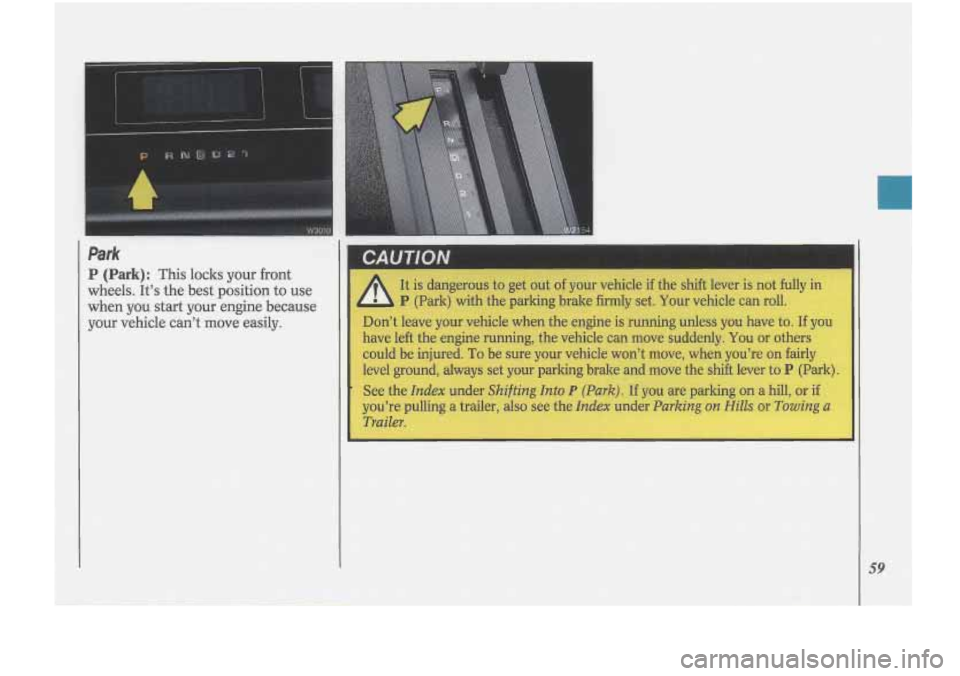
Park
P (Park): This loclcs your front
wheels. It’s the best position
to use
when you start your engine because
your vehicle can’t move easily.
A
I It is dangerous to get out of your vehicle if the shift lever is not fully in
P (Park) with the parking brake firmly set. Your vehicle can roll.
Don’t leave your vehicle when the engine
is running unless you have to. If you
have left the engine running, the vehicle can move suddenly. You or others
could be injured.
To be sure your vehicle won’t move, when you’re on fairly
level ground, always set your parking brake and move the shift lever to
P (Park).
See the
Index under Shifting Into P (Park). If you are parking on a hill, or if
you’re pulling a trailer, also see the
Index under Parking on Hills or Towing a I
Trailer. I
59
Page 64 of 340
Features & ControIs
62
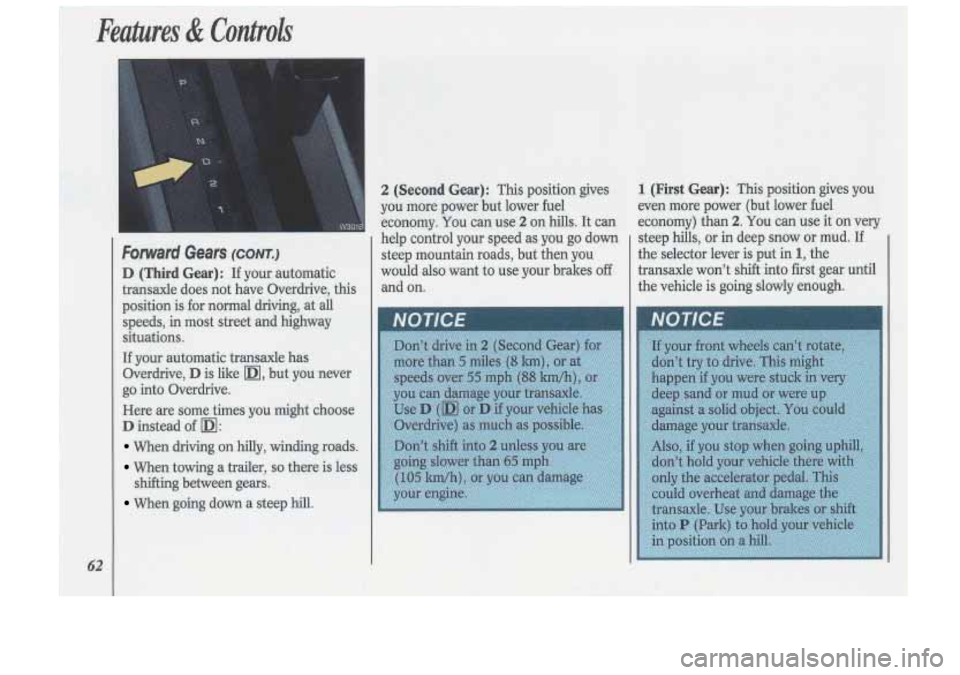
Forward Gears (CONT.)
D (Third Gear): If your automatic
transaxle does not have Overdrive, this
position is for normal driving, at all
speeds, in most street and highway
situations.
If your automatic transaxle has
Overdrive,
D is like m, but you never
go into Overdrive.
Here are some times you might choose
D instead of m:
When driving on hilly, winding roads.
When towing a trailer, so there is less
When going down a steep hill.
shifting between gears.
2 (Second Gear): This
position gives
you more power but lower fuel
economy.
You can use 2 on hills. It can
help control your speed as you go down
steep mountain roads, but then you
would also want to use your brakes
off
and on.
1 (First Gear): This position gives you
even more power (but lower fuel
economy) than
2. You can use it on very
steep hills, or in deep snow or mud.
If
the selector lever is put in 1, the
transaxle won’t shift into first gear until
the vehicle
is going slowly enough.
Page 65 of 340
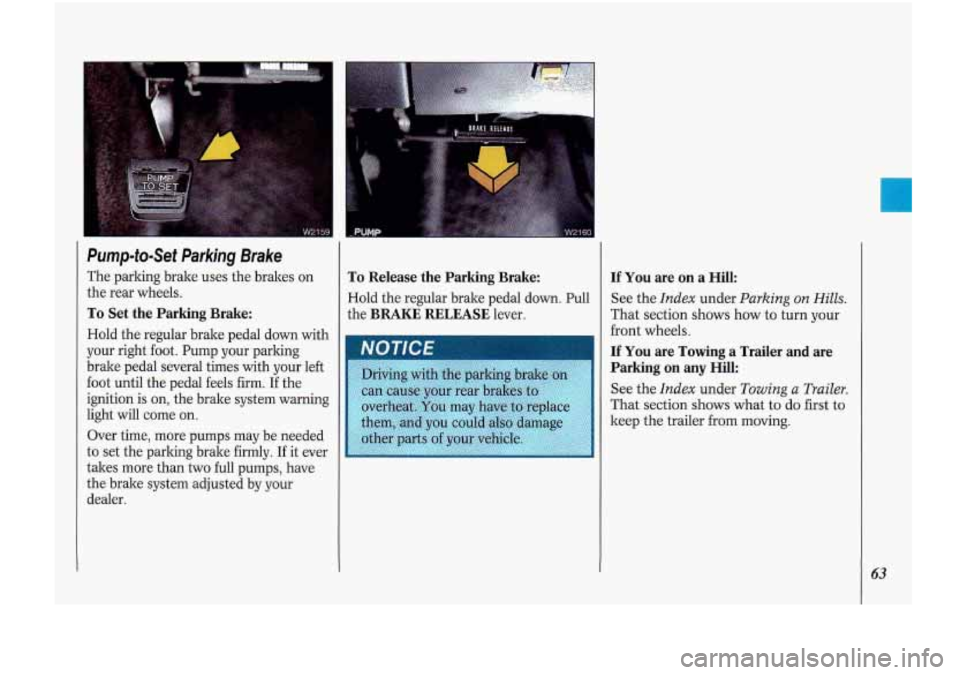
Pump-to-Set Parking Brake
The parking brake uses the brakes on
the rear wheels.
To Set the Parking Brake:
Hold the regular bralte pedal down with
your right foot. Pump your parking
brake pedal several times with your left
foot until the pedal feels firm. If the
ignition is
on, the brake system warning
light will come on.
Over time, more pumps may be needed
to set the parlung brake firmly. If it ever
takes more than two full pumps, have
the brake system adjusted by your
dealer.
..
To Release the Parking Brake:
Hold the regular brake pedal down. Pull
the
BRAKE RELEASE lever.
If You are on a Hill:
See the Index under Parking on Hills.
That section shows how to turn your
front wheels.
If You are Towing a Trailer and are
Parking on any Hill:
See the Index under Towing a Trailer.
That section shows what to do first to
keep the trailer from moving.
63
Page 66 of 340
Features & Controli
64
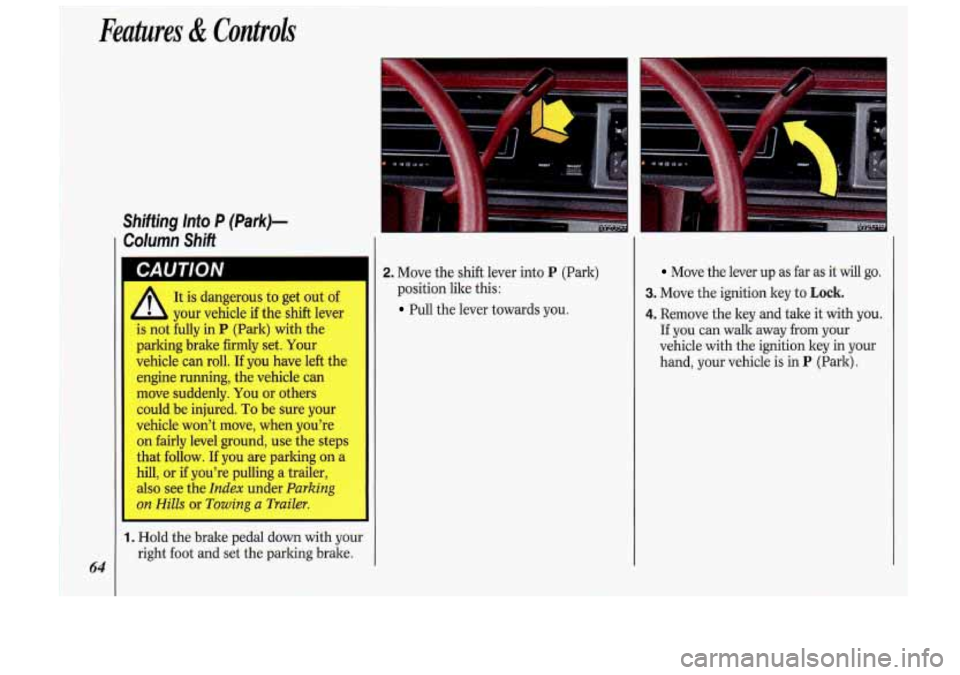
Shifting lnto P (Park)-
Column Shift
It is dangerous to get out of
your vehicle if the shift lever
is not fully in
P (Park) with the
parking brake firmly set. Your
vehicle can roll. If you have left the
engine running, the vehicle can
move suddenly.
You or others
could be injured.
To be sure your
vehicle won't move, when you're
on fairly level ground, use the steps
that follow.
If you are parking on a
hill, or if you're pulling a trailer,
also see the
Index under Parking
on Hills or Towing a Trailer.
1. Hold the brake pedal down with your
right foot and set the parking brake.
'." ' I
2. Move the shift lever into P (Park)
position like this:
Pull the lever towards you.
Move the lever up as far as it will go.
3. Move the ignition key to Lock.
4. Remove the key and tale it with you.
If you can walk away from your
vehicle with the ignition key in your
hand, your vehicle
is in P (Park).
Page 67 of 340
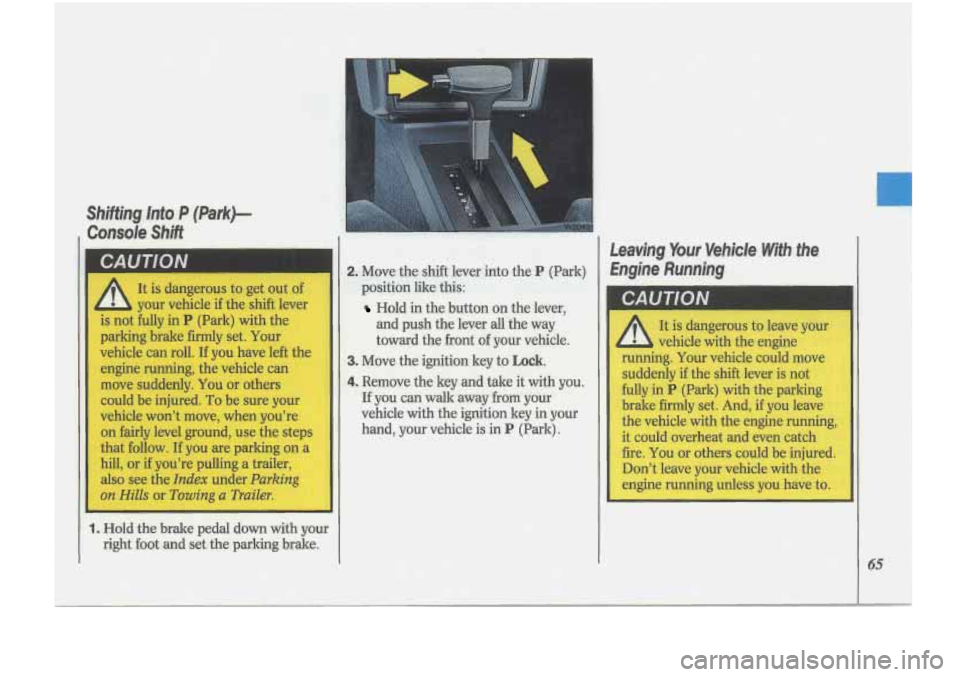
Shjfthg ‘Into P (Park)-
Console
Shift
A
It is dangerous to get out of
your vehicle
if the shift lever
is not fully
in P (Park) with the
parking brake firmly set. Your
vehicle can roll. If you have left the
engine running, the vehicle can
move suddenly. You or others
could be injured.
To be sure your
vehicle won’t move, when you’re
on fairly level ground, use the steps
that follow. If you are parking
on a
hill, or
if you’re pulling a trailer,
also see the
Index under Parking
on Hills or Towing a Trailer.
1. Hold the brake pedal down with your
right foot
and set the parking brake.
2. Move the shift lever into the P (Park)
position like this-:.
Hold in the button on the lever,
and push the lever
all the way
toward the front of your vehicle.
3. Move the ignition key to Lock.
4. Remove the key and take it with you.
If you can wallc away from your
vehicle with the ignition key
in your
hand, your vehicle is in
P (Park).
Leaving Yo,ur Vehicle Wfih the
Engine Running
I
Page 69 of 340
CAUTION --
A
Idling the engine with the air system control OFF could allow dangerous
exhaust into your vehicle (see the earlier CAUTION under
Engine
Zxhaust).
Also, idling in a closed-in place can let deadly carbon monoxide (GO) into your
vehicle even if the fan switch is at the highest setting. One place this can
happen is a garage. Exhaust-with CO-can come in easily.
NEVER park in a
garage with the engine running.
Another closed-in place can be a blizzard. (See the
Index under Blizzard.)
It can be dangerous to get out of your vehicle if the shift lever is not fully in
P (Park) with the parking brake firmly set. Your vehicle can roll. Don't leave
your vehicle when the engine is running unless you have to. If you've left the
engine running, the vehicle can move suddenly. You or others could be injured.
To be sure your vehicle won't move, even when you're on fairly level ground,
always set your parking brake and move the shift lever to
P (Park).
If you are parking on a hill, or if you're pulling
a trailer, also see the Index
under Parking on Hills or Towing a Trailer.
Page 101 of 340
brake is fully released, it means you
have a brake problem.
If the light comes
on while driving, pull
off the road and stop carefully. You may
notice that the pedal is harder to push.
Or, the pedal may go closer to the floor.
It may take longer to stop. If the light is
still on, have the vehicle towed for
service. (See the
Index under Towing
Your Oldsrnobile.)
CAUTION
Your brake system may not I
be working properly if the
brake warning light is on. Driving
with the brake warning light on can
lead to an accident. If the light is
still on after you’ve pulled
off the
road and stopped carefully, have
the vehicle towed for service.
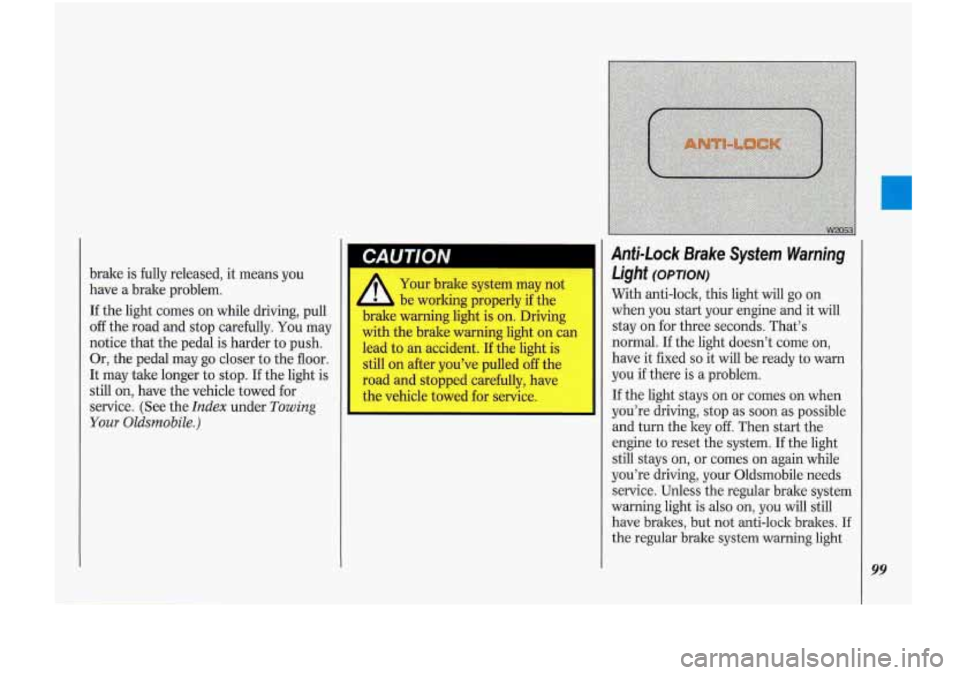
Anti-Lock Brake System Warning
Light
(opTloN)
With anti-lock, this light will go on
when you start your engine and it will
stay on for three seconds. That’s
normal. If the light doesn’t come on,
have it fixed
so it will be ready to warn
you if there is a problem.
If the light stays on or comes on when
you’re driving, stop as soon as possible
and turn the key
off. Then start the
engine to reset the system.
If the light
still stays on, or comes
on again while
you’re driving, your Oldsmobile needs
service. Unless the regular brake system
warning light
is also on, you will still
have brakes, but not anti-lock brakes.
If
the regular brake system warning light
99
Page 141 of 340
Part 4
Here you’ll find information about driving on different kinds of roads and
in varying weather conditions
. We’ve
also included many other useful tips
on driving
.
Your Driving and the Road
Road Signs ........................................................................\
....................................... 140
Defensive Driving
........................................................................\
............................ 144
Drunken Driving
........................................................................\
............................ 145
Control of a Vehicle
Braking
........................................................................\
......................................... 148
Anti-Lock Brakes ........................................................................\
......................... 149
Steering Tips
........................................................................\
................................ 154
Steering in Emergencies
........................................................................\
.............. 155
Driving at Night
........................................................................\
............................... 159
Driving in the Rain
........................................................................\
.......................... 161
Passing ........................................................................\
......................................... 156
Driving in Fog, Mist and Haze
........................................................................\
....... 164
City Drmng
........................................................................\
...................................... 165 ..
Freeway Driving ........................................................................\
............................. 166
Driving a Long Distance ........................................................................\
................ 168
Hill and Mountain Roads ........................................................................\
............... 170
Winter Driving
........................................................................\
................................ 173
Parking
on Hills ........................................................................\
.............................. 171
Towing a Trailer
........................................................................\
............................... 176 139
Page 184 of 340
Your Driving and the Road
Driving with a Trailer (CONT.)
Making Turns
When you’re turning with a trailer,
make wider turns than normal.
Do this
so your trailer won’t strike soft
shoulders, curbs, road signs, trees, or
other objects. Avoid jerky or sudden
maneuvers. Signal well in advance.
Turn Signals When Towing a Trailer
When you tow a trailer, your vehicle has
to have
a different turn signal flasher
and extra wiring. The green arrows
on
your instrument panel will flash
whenever you signal a turn or lane
change. Properly hooked up, the trailer
lights will also flash, telling other
drivers you’re about to turn, change
lanes or stop. When towing a
trailer, the green arrows
on your instrument panel will flash for
turns even if the bulbs on the trailer are
burned out. Thus, you may think
drivers behind you are seeing your
signal when they are not. It’s important
to check occasionally to be sure the
trailer bulbs are still working.
Driving On Grades
Reduce speed and shift to a lower gear
before you start down a long or steep
downgrade.
If you don’t shift down, you
might have to use your brakes
so much
that they would get hot and
no longer
work well.
On a long uphill grade, shift down and
reduce your speed to around
45 mph
(70 lm/h) to reduce the possibility of
engine and transaxle overheating.
If you are towing a trailer and you have
an automatic transaxle with Overdrive,
you may want to drive in
D instead of
(or, as you need to, a lower gear).
Page 189 of 340
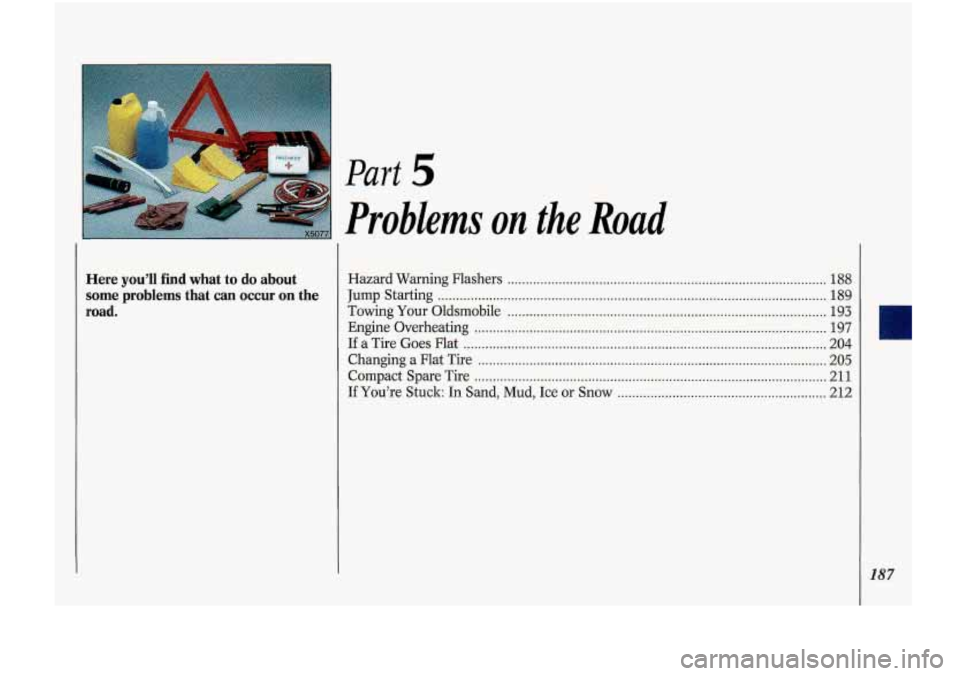
Here you’ll find what to do about
some problems that can occur on the
road
.
Part 5
Problems on the Road
Hazard Warning Flashers ........................................................................\
............... 188
Jump Starting
........................................................................\
.................................. 189
Towing Your Oldsmobile
........................................................................\
............... 193
Engine Overheating
........................................................................\
........................ 197
If a Tire Goes Flat ........................................................................\
........................... 204
Changing a Flat Tire
........................................................................\
....................... 205
Compact Spare Tire ........................................................................\
........................ 211
If You’re Stuck: In Sand, Mud, Ice or Snow ......................................................... 212
187