change time Oldsmobile Cutlass Supreme 1994 s User Guide
[x] Cancel search | Manufacturer: OLDSMOBILE, Model Year: 1994, Model line: Cutlass Supreme, Model: Oldsmobile Cutlass Supreme 1994Pages: 276, PDF Size: 14.73 MB
Page 136 of 276
Your Driving and the Road
134
steering, acceleration, or braking
(including engine bralting by shifting to
a lower gear). Any sudden changes
could cause the tires to slide. You may
not realize the surface is slippery until
your vehicle is skidding. Learn to
recognize warning clues
- such as
enough water, ice or packed snow on
the road to make a “mirrored surface”
- and slow down when you have any
doubt.
Remember: Any anti-lock braking system (ABS) helps avoid only the
braking skid.
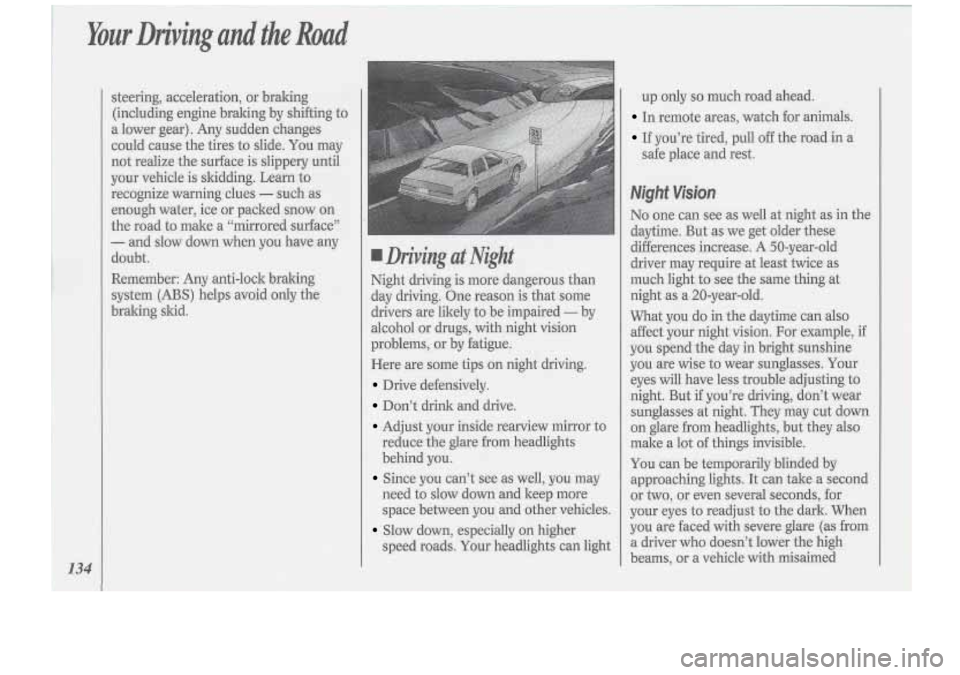
Driving at Night
Night driving is more dangerous than
day driving. One reason is that some
drivers are likely to be impaired
- by
alcohol or drugs, with night vision
problems, or by fatigue.
Here are some tips on night driving.
Drive defensively.
Don’t drink and drive.
Adjust your inside rearview mirror to
reduce the glare from headlights
behind you.
Since you can’t see as well, you may
need to slow down and keep more
space between you and other vehicles.
speed roads. Your headlights can light
Slow down, especially on higher up
only
so much road ahead.
In remote areas, watch for animals.
If you’re tired, pull off the road in a
safe place and rest.
Night Vision
No one can see as well at night as in the
daytime. But as we get older these
differences increase. A 50-year-old
driver may require at least twice as
much light to see the same thing at
night as
a 20-year-old.
What you do in the daytime can also
affect your night vision. For example,
if
you spend the day in bright sunshine
you are wise to wear sunglasses. Your
eyes will have less trouble adjusting to
night. But if you’re driving, don’t wear
sunglasses at night. They may cut down
on glare from headlights, but they also
make a lot of things invisible.
You can be temporarily blinded by
approaching lights. It can take a second
or two, or even several seconds, for
your eyes to readjust to the dark. When
you are faced with severe glare (as from
a driver who doesn’t lower the high
beams, or a vehicle with misaimed
i
Page 167 of 276
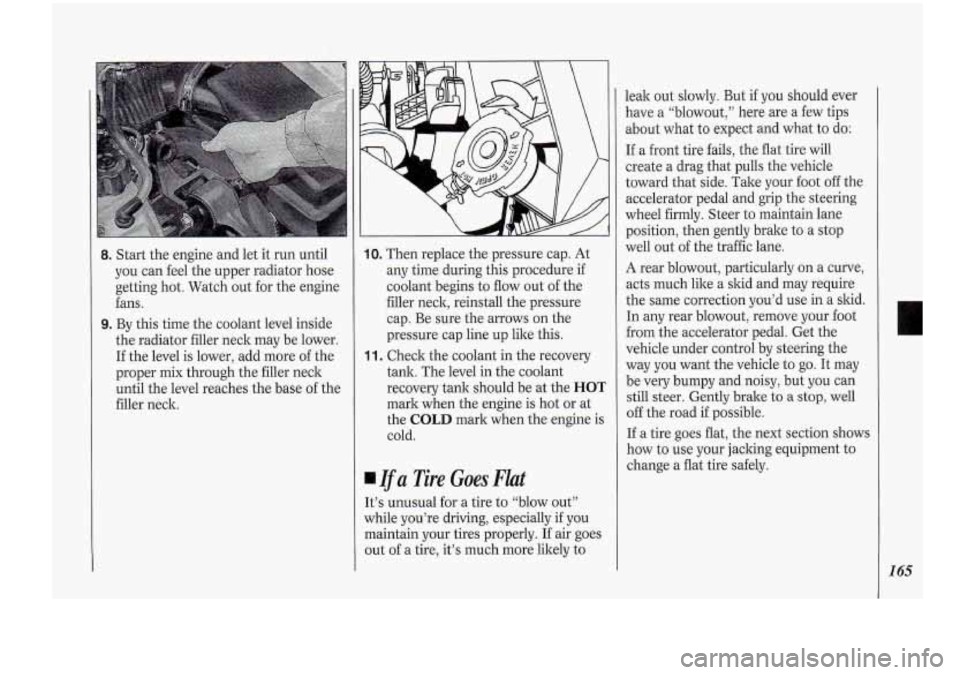
8. Start the engine and let it run until
you can feel the upper radiator hose
getting hot. Watch out for the engine
fans.
9. By this time the coolant level inside
the radiator filler neck may be lower.
If the level is lower, add more of the
proper mix through the filler neck
until the level reaches the base of the
filler neck.
10. Then replace the pressure cap. At
any time during this procedure if
coolant begins to flow out of the
filler neck, reinstall the pressure
cap. Be sure the arrows on the
pressure cap.line up like this.
11. Check the coolant in the recovery
tank. The level in the coolant
recovery tanlc should be at the
HOT
mark when the engine is hot or at
the
COLD mark when the engine is
cold.
Ifa Tire Goes Flat
It’s unusual for a tire to “blow out”
while you’re driving, especially
if you
maintain your tires properly. If air goes
out of a tire, it’s much more likely to
leak out slowly. But if you should ever
have
a “blowout,” here are a few tips
about what to expect and what to
do:
If a front tire fails, the flat tire will
create a drag that pulls the vehicle
toward that side. Take your foot off the
accelerator pedal and grip the steering
wheel firmly. Steer to maintain lane
position, then gently brake to a stop
well out of the traffic lane.
A rear blowout, particularly on a curve,
acts much like a slid and may require
the same correction you’d use
in a skid.
In any rear blowout, remove your foot
from the accelerator pedal. Get the
vehicle under control by steering the
way you want the vehicle to go. It may
be very bumpy and noisy, but you can
still steer. Gently brake to a stop, well
off the road if possible.
If a tire goes flat, the next section shows
how to use your jacking equipment to
change a flat tire safely.
165
Page 188 of 276
1
Service & Appearance Care
186
(-18°C) or above. These numbers on an
oil container show its viscosity, or
thickness. Do not use other viscosity
oils,
such as SAE 1OW-40 or SAE 20W-50.
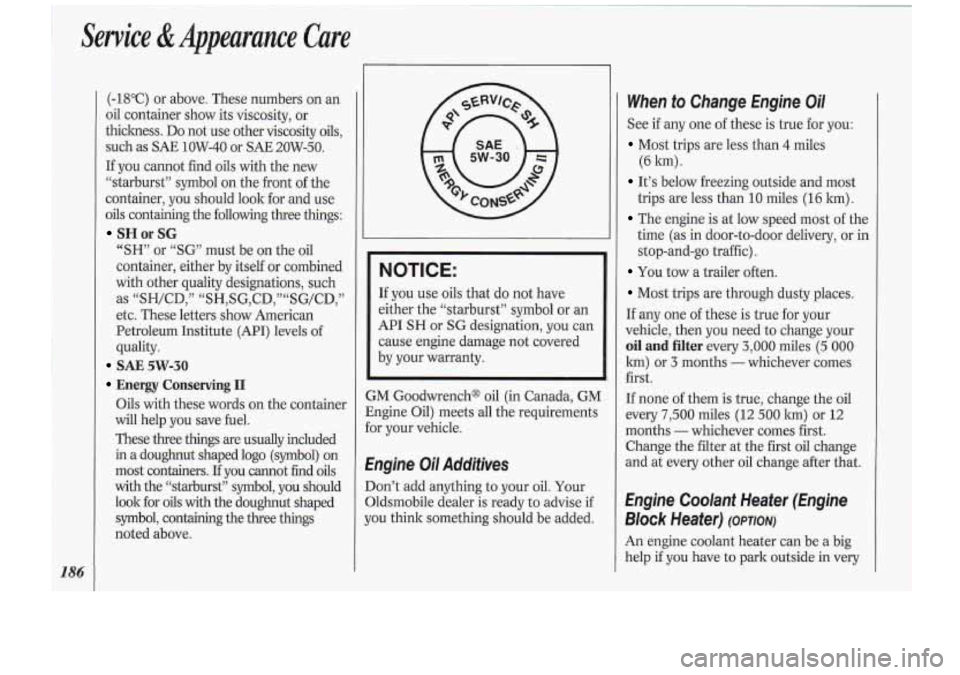
If you cannot find oils with the new
“starburst” symbol on the front of the
container, you should look for and use
oils containing the following three things:
SH or SG
“SH” or “SG” must be on the oil
container, either by itself or combined
with other quality designations, such
as “SH/CD,” “SH,SG,CD,”“SG/CD,”
etc. These letters show American
Petroleum Institute (API) levels of
quality.
SAE 5W-30
Energy Conserving I1
Oils with these words on the container
will help you save fuel.
These three things are usually included in
a doughnut shaped logo (symbol) on
most containers. If you cannot find
oils
with the “starburst” symbol, you should
look for oils with the doughnut shaped
symbol, containing the three things
noted above.
NOTICE:
If you use oils that do not have
either the “starburst” symbol or an
API
SH or SG designation, you can
cause engine damage not covered
by your warranty.
GM Goodwrench* oil (in Canada, GM
Engine Oil) meets all the requirements
for your vehicle.
Engine Oil Additives
Don’t add anything to your oil. Your
Oldsmobile dealer is ready to advise if
you think something should be added.
When to Change Engine Oil
See if any one of these is true for you:
Most trips are less than 4 miles
(6 km)
.
It’s below freezing outside and most
trips are less than 10 miles (16 ltm).
The engine is at low speed most of the
time (as in door-to-door delivery, or in
stop-and-go traffic).
You tow a trailer often.
Most trips are through dusty places.
If any one of these is true for your
vehicle, then you need to change your
oil and filter every 3,000 miles (5 000
km) or 3 months - whichever comes
-first.
If none of them is true, change the oil
every
7,500 miles (12 500 lm) or 12
months -whichever comes first.
Change the filter at the first
oil change
and at every other oil change after that.
Engine Coolant Heater (Engine
Block Heater) (omoN)
An engine coolant heater can be a big
help if you have to
park outside in very
Page 190 of 276
Service & Appearance Care
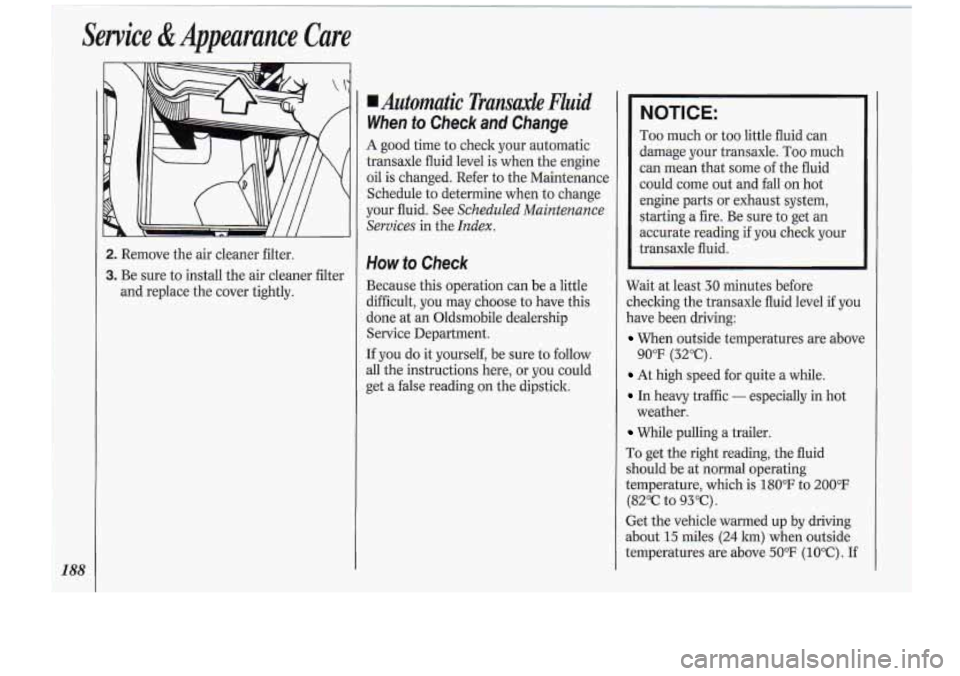
2. Remove the air cleaner filter.
3. Be sure to install the air cleaner filter
and replace the cover tightly.
Automatic Transaxk Fluid
When fo Check and Change
A good time to check your automatic
transaxle fluid level is when the engine
oil is changed. Refer to the Maintenance
Schedule to determine when to change
your fluid. See
Scheduled Maintenance
Services
in the Index.
How to Check
Because this operation can be a little
difficult, you may choose to have this
done at an Oldsmobile dealership
Service Department.
If you do it yourself, be sure to follow
all the instructions here, or
you could
get
a false reading on the dipstick.
NOTICE:
Too much or too.little fluid can
damage your transaxle.
Too much
can mean that some of the fluid
could come out and fall
on hot
engine parts
or exhaust system,
starting a
fire. Be sure to get an
accurate reading if you check your
transaxle fluid.
Wait at least
30 minutes before
checking the transaxle fluid level
if you
have been driving:
When outside temperatures are above
At high speed for quite a while.
In heavy traffic - especially in hot
90°F (32°C).
weather.
While pulling a trailer.
To get the right reading, the fluid
should be at
normal operating
temperature, which is 18O"F-to
2OOpF
(82°C to 93T).
Get the vehicle warmed up by driving
about
15 miles (24 lun) 'when outside
temperatures are above
50°F (10°C). If
Page 197 of 276
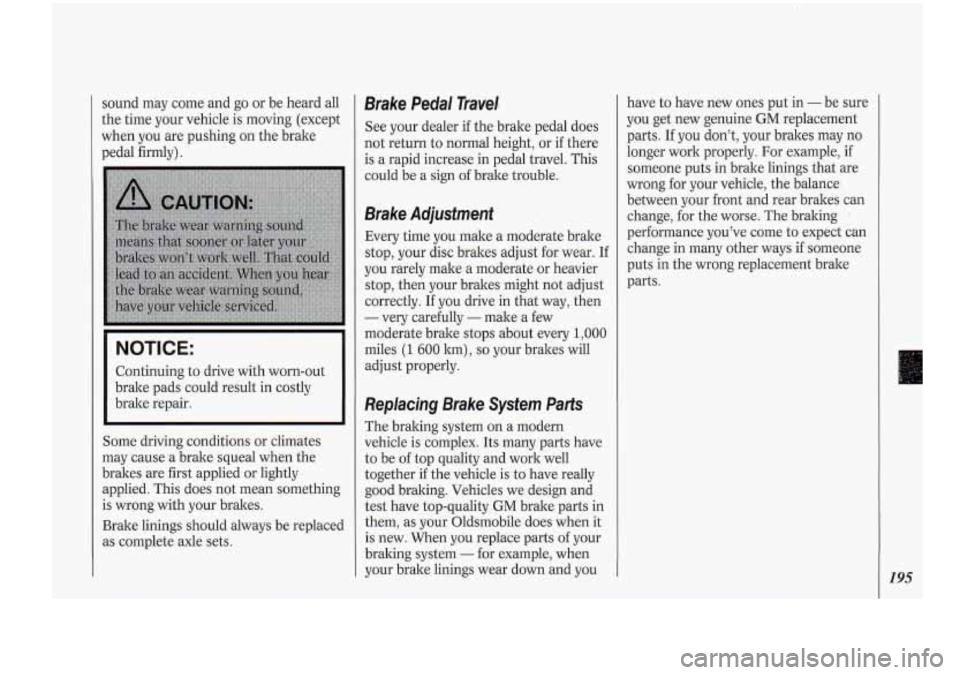
sound may come and go or be heard all
the time your vehicle is moving (except
when you are pushing
on. the brake
pedal firmly).
NOTICE:
Continuing to drive with worn-out
brake pads could result in costly
brake repair.
Some driving conditions or climates
may cause a brake squeal when the
brakes are first applied or lightly
applied. This does not mean something
is wrong with your brakes.
Brake linings should always be replaced
as complete axle sets.
Brake Pedal Travel-
See your dealer if the brake pedal does
not return to normal height, or if there
is a rapid increase in pedal travel. This
could be a sign
of brake trouble.
Brake Adjustment
Every time you male a moderate brake
stop, your disc brakes adjust for wear. If
you rarely make a mo.derate or heavier
stop, then your brakes might not adjust
correctly.
If you drive in that way, then
- very carefully - make a few
moderate brake stops about every
1,000
miles (1 600 km) , so your brakes will
adjust properly.
Replacing Brake System Parts
The braking system on a modern
vehicle is complex. Its many parts have
to be of top quality and work well
together
if the vehicle is to have really
good braking. Vehicles we design and
test have top-quality
GM brake parts in
them, as your Oldsmobile does when it
is new. When you replace parts of your
braking system
- for example, when
your brake linings wear down and you have
to have new ones put in
- be sure
you get new genuine
GM replacement
parts.
If you don’t, your brakes may no
longer work properly. For example, if
someone puts.in brake linings that are
wrong for your vehicle, the balance
between your front and rear brakes can
change, for the worse; The braking
performance you’ve come to expect can
change in many other ways if someone
puts in the wrong replacement brake
parts.
195
Page 256 of 276
Customer Assistance Infomation
254
Oldsmobile. If this mediation is
unsuccessful, an informal hearing will
be scheduled where eligible customers
may present their case to an impartial
third-party arbitrator.
The arbitrator will make a decision
which you may accept or reject. If you
accept the decision, GM
will be bound
by that decision. The entire dispute
resolution procedure should ordinarily
take about
forty days from the time you
file a claim until a decision is made.
Some state laws may require you to use
this program before filing a claim with a
state-run arbitration program or in the
courts. For further information, contact
the BBB or the Oldsmobile Customer
Assistance Center at 1-800-442-6537.
"This program may not be available in all
states, depending
on state law. Canadian
owners refer to
your Warranty and Owner
Assistance information booklet. General
Motors reserves the right to change
eligibility limitations and/or to discontinue
its participation in this program.
I REPORTIA /G SAFETl
'DEFECTS
TO
THE UNITED STATES
GOVBNMENT
If you believe that your vehicle has a
defect which could cause a crash or
could cause injury or death, you should
immediately inform the National
Highway Traffic Safety Administration
(NHTSA), in addition to notifying
General Motors.
If NHTSA receives similar complaints,
it may open an investigation, and if it
finds that a safety defect exists in a
group
of vehicles, it may order a recall
and remedy campaign. However,
NHTSA cannot become involved in
individual problems between you, your
dealer,
or General Motors.
To contact NHTSA, you may either call
the Auto Safety Hotline toll-free at
1-800-424-9393 (or 366-0123 in the
Washington, D.C. area)
01: write to:
NHTSA
U. S. Department of Transpartation
Washington, D.C. 20590
Yc IU can a1 so obtain other information
about motor vehicle safetv from
the
Hotline.
I REPORTING SAFETYDEFECTS
TO THE
CANADL4N
GOI%RN..NT
If you live in Canada, and you believe
that your vehicle has a safety defect,
you should immediately notify
Transport Canada, inaddition to
notifying General Motors of Canada
Limited. You may write
to:
Transport Canada
Box 8880
Ottawa, Ontario I-ClG 3J2.
I REPORTING SAFETYDEFECTS
TO GENEMIMOTORS
In addition to notlfylng NHTSA (or
Transport Canada) in a situation like this,
we certainly hope you'll notify
us. Please
call us at 1-800-442-6537, or write:
Oldsmobile Customer Assistance
Network
P.O. Box 30095
Lansing,
MI 48909