brake light Oldsmobile Cutlass Supreme 1994 Owner's Manuals
[x] Cancel search | Manufacturer: OLDSMOBILE, Model Year: 1994, Model line: Cutlass Supreme, Model: Oldsmobile Cutlass Supreme 1994Pages: 276, PDF Size: 14.73 MB
Page 12 of 276
How to Use this Manual
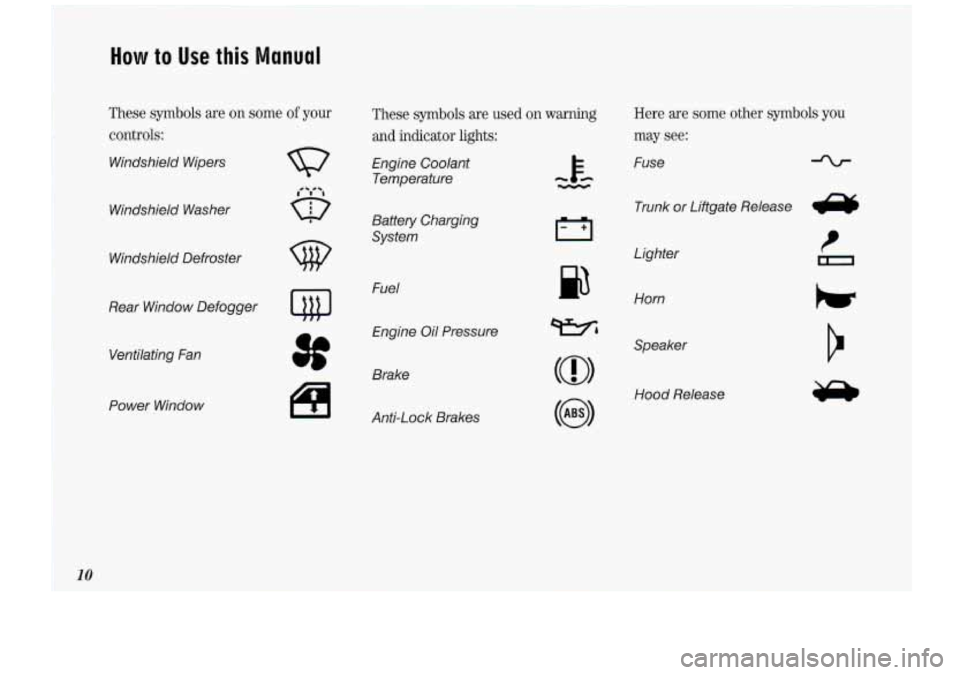
These symbols are on some of your
controls:
Windshield Wipers
Windshield Washer
Windshield Defroster
Rear Window Defogger
Ventilating Fan
Power Window
w
3f
1+1
These symbols are used on warning
and indicator lights:
Engine Coolant
Temperature
Battery Charging
System
Fuel Engine Oil Pressure
Anti-Lock Brakes
Here are some other symbols you
may see:
Fuse
Trunk
or Liftgate Release e
I
n Lighter
Horn
Speaker
Hood Release
#
10
Page 51 of 276
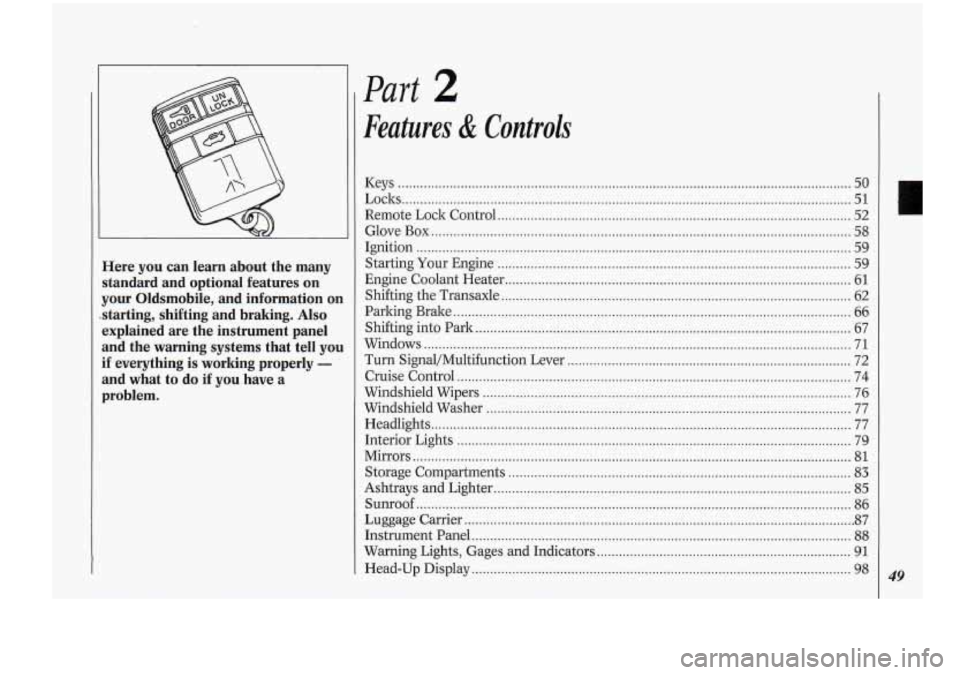
Here you can learn about the many
standard and optional features on
your Oldsmobile. and information on
starting. shifting and braking
. Also
explained are the instrument panel
and the warning systems that tell you
if everything is working properly -
and what to do if you have a
problem .
Part 2
Features & Controls
Keys ........................................................................\
............................
Loclts ........................................................................\
...........................
....
....
...
...
...
...
...
...
....
...
........ 50
........ 51
Remote Lock Control ........................................................................\
........................ 52
Glove Box ........................................................................\
.......................................... 58
Ignition
........................................................................\
.............................................. 59
Starting Your Engine
........................................................................\
........................ 59
Engine Coolant Heater
........................................................................\
....................... 61
Shifting the Transaxle
........................................................................\
....................... 62
Parking Brake
........................................................................\
.................................... 66
Shifting into Park
........................................................................\
.............................. 67
Windows
........................................................................\
............................................ 71
Turn Signal/Multifunction Lever
........................................................................\
..... 72
Cruise Control
........................................................................\
................................... 74
Windshield Wipers
........................................................................\
............................. 76
Windshield Washer
........................................................................\
........................... 77
Headlights
........................................................................\
.......................................... 77
Interior Lights
........................................................................\
................................... 79
Mirrors ........................................................................\
............................................... 81
Storage Compartments ........................................................................\
..................... 83
Ashtrays and Lighter ........................................................................\
......................... 85
Sunroof ........................................................................\
.............................................. 86
Luggage Carrier
........................................................................\
.................................. 87
Instrument Panel
........................................................................\
............................... 88
Warning Lights, Gages and Indicators ..................................................................... 91
Head-Up Display ........................................................................\
............................... 98 49
Page 68 of 276
Features & Controls
NOTICE:
Don’t drive in 2 (Second Gear) for
more than
5 miles (8 km) , or at
speeds over
55 mph (88 kwh), or
you can damage your transaxle.
Use
D or 3 as much as possible.
Don’t
shift into 2 unless you are
going slower than
65 mph (105
krn/h), or you can damage your
engine.
1 (First Gear): This position gives you
even more power (but lower fuel
economy) than
2. You can use it on
very steep hills, or in deep snow
or
mud. If the shift lever is put in 1, the
transaxle won’t shift into first gear until
the vehicle is going slowly enough.
NOTICE:
If your front wheels can’t rotate,
don’t
try to drive. This might
happen if you were stuck in very
deep sand or mud or were up
against a solid object. You could
damage your transaxle.
Also, if you stop when going uphill,
don’t hold your vehicle there with
only the accelerator pedal. This
could overheat and damage the
transaxle. Use your brakes or shift
into
P (Park) to hold. your vehicle.
in position on a hill.
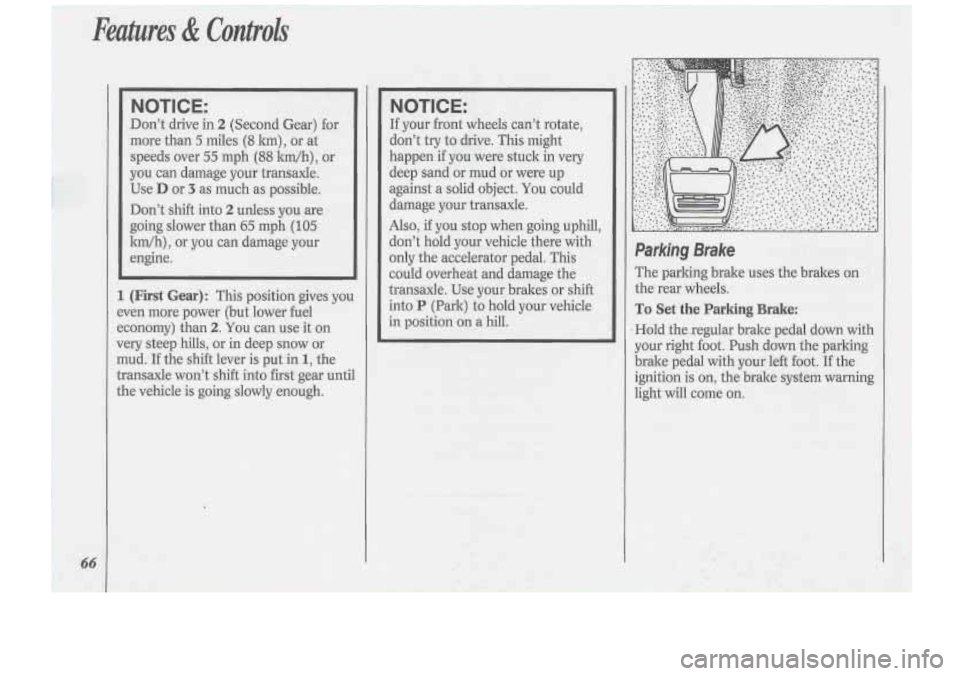
Parking Brake
The parking brake uses the brakes on
.the rear wheels.
To Set the Parking Brake:
Hold thexegular brake pedal down with
your right .foot. Push down the parking
brake pedal with your left foot. If the
ignition is
on, the brake system warning
light will come on.
Page 78 of 276
/1 Features & Controk
76
down. Of course, applying the brake
takes you .out of cruise control. Many
drivers find this to be too much trouble
and don’t use cruise control on steep
hills
*
To Get Out of Cruise Control
There are two ways to turn off the
cruise control:
Step lightly on the brake pedal; OR
Move the cruise switch to OFF.
To Erase Cruise Speed Memory
When you turn off the cruise control or
the ignition, or shift into
P (Park), your
cruise control set speed memory is
erased.
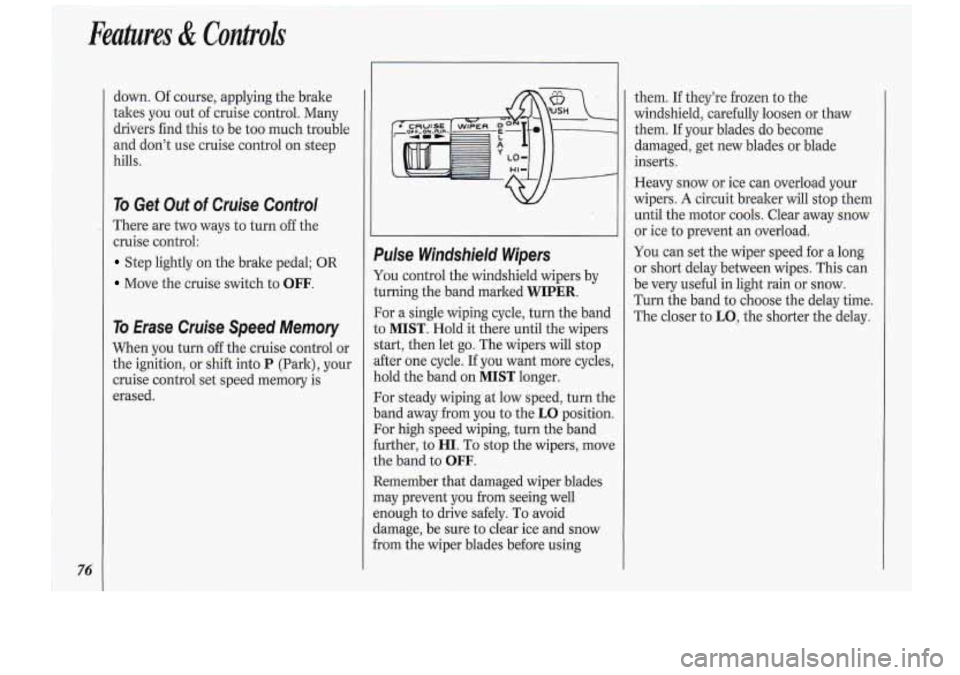
Pulse Windshield. Wipers
You control the windshield wipers by
turning the band marked
WIPER.
For a single wiping cycle, turn the band
to
MIST. Hold it there until the wipers
start, then let go. The wipers will stop
after one cycle. If you want more cycles,
hold the band on
MIST longer.
For steady wiping at low speed, turn the
band away from you to the
LO position.
For high-speed wiping, turn the band
further, to
HI. To stop the wipers, move
the band to
OFF.
Remember that damaged wiper blades
may prevent you from seeing well
enough to drive safely. To avoid
damage, be sure to clear ice and snow
from the wiper blades before using them.
If they’re
frozen to.the
windshield, carefully loosen or thaw
them.
If your blades do become
damaged, get new blades or blade
inserts.
Heavy snow or ice can overload your
wipers.
A circuit breaker will stop them
until the motor cools. Clear away snow
or ice to prevent an overload.
You can set the wiper speed for a long
or short delay between wipes. This can
be very useful
in light rain or snow.
Turn the band to choose the delay time.
The closer to
LO, the shorter the delay.
Page 80 of 276
78
1
1
I
I
I
1
1
4 ,I
i
I
1
-1
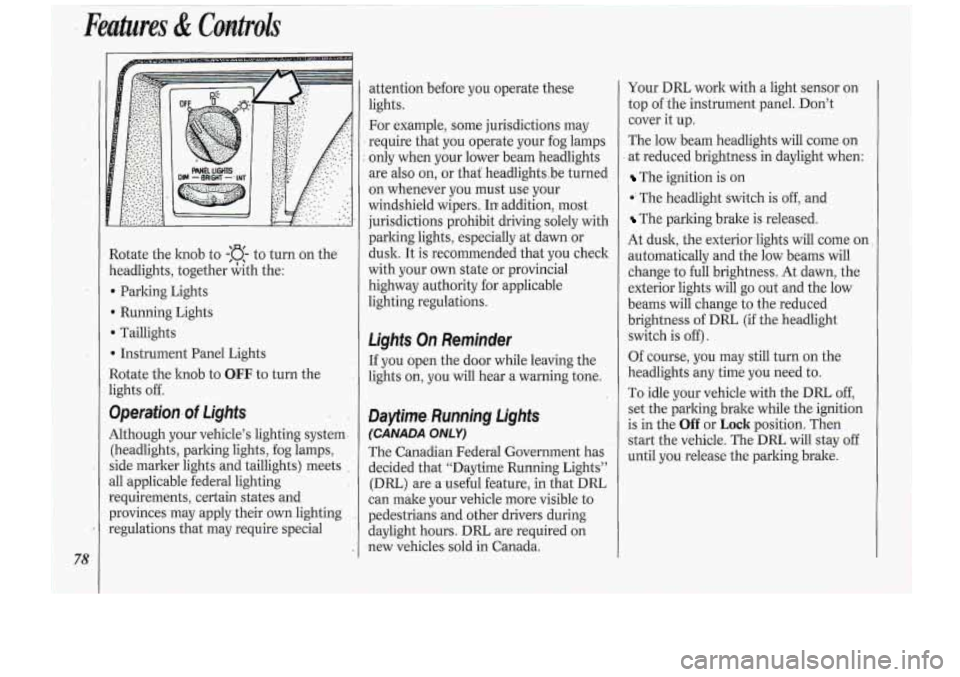
Rotate the knob to -:a- to turn on the
zeadlights, together &th the:
b Parking Lights
Running Lights
D ‘Taillights
b Instrument Panel Lights
3otate the hob to
OEF. to turn the
ights off.
9perafion.of Lights
Although your vehicle’s lighting system-
(headlights, parlung lights, fog lamps,
side marker lights and taillights) meets
311 applicable federal lighting
requirements, certain states and
provinces may apply thek own lighting
:egulations that may require special attention
before
you op~erate these
lights.
For example, some jurisdictions may
require that you operate your fog lamps
only when your lower beam headlights
are
also on, or that‘ headlightsbe turned
on whenever you must .use your
windshield wipers. In addition, mo.st
jurisdictions prohibit driving solely with
parking lights, especially at dawn or
dusk. It
is recommended that you check
with your
own state or provincial
highway authority for applicable
lighting regulations.
Ligk On Reminder
If you open the door while leaving the
lights on, you will hear a warning tone.
Daytinre. Rurmjng DgMs
(CANADA ONLY)
.The Canadian Federal Government has
decided that “Daytime Running Lights”
(DRL) are a useful feature, in that DRL
can make your vehicle more visible to
pedestrians and other drivers during
daylight hours.
DRL are required on
.new vehicles sold in Canada. Your
DIU work
with a light sensor on
top
of the instrument panel. Don’t
cover it up.
The low :beam headlights will come on
at reduced brightness in daylight when:
The ignition is on
*‘ The head,light switch is off, and
‘The parking brake is released.
At dusk, the exteriorlights will come on
automatically and the low beams will
change
to full brightness. At dawn, the
exterior lights will go out and the low
beams will change
to the reduced
brightness of
DRL (if the headlight
switch is
off).
Of course, you may still turn on the
headlights any time you need to.
To idle your vehicle with the DRL,
off,
set the parling brake while the ignition
is in the
Off or Loch position. Then
start the vehicle. The DRL will stay off
until
you: release the parking brake.
Page 91 of 276
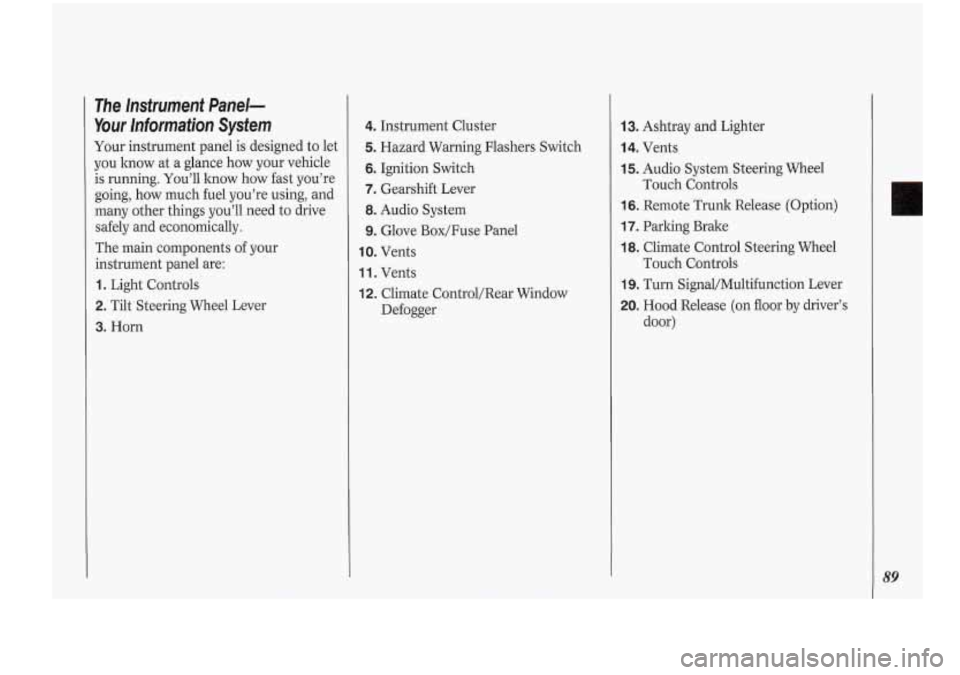
3. Horn
The Instrument Panel-
Your Information System
Your instrument panel is designed to let
you lmow at a glance how your vehicle
is running. You’ll how how fast you’re
going,
how much fuel you’re using, and
.many other things you’ll need to drive
safely and economically.
The main components
of your
instrument panel are:
1. Light Controls
2. Tilt Steering Wheel Lever
4. Instrument Cluster
5. Hazard Warning Flashers Switch
6. Ignition Switch
7. Gearshift Lever
8. Audio System
9. Glove Box/Fuse Panel
IO. Vents
1 1. Vents
12. Climate Control/Rear Window
Defogger
13. Ashtray and Lighter
14. Vents
15. Audio System Steering Wheel
16. Remote Trunk Release (Option)
17. Parking Brake
18. Climate Control Steering Wheel
19. Turn Signal/Multifunction Lever
20. Hood Release (on floor by driver’s
Touch Controls
Touch Controls
door)
Page 98 of 276
Features & Controh
96
s
BRAKE (a)(@)
1
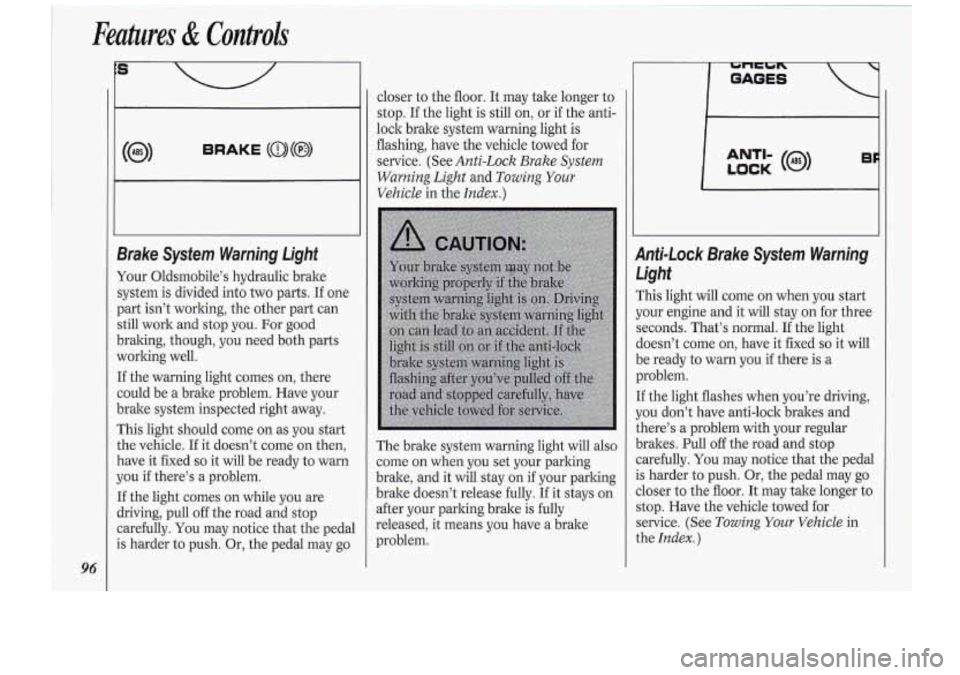
closer to the floor. It may take lang-er-to
stop. Ifthe light
is 'still -on, or-if.the anti-
lock brake system warning light is
flashing, have the vehicle towed .far
service. (See Anti-Lock Brake System
WarningLight
.and Towilzg .Your
Vehicle inthe Index.)
Page 99 of 276
If the anti-lock brake system warning
light stays on longer than normal after
you’ve started your engine, turn the
ignition
off. Or, if the light comes on
and stays on when you’re driving, stop
as soon as possible and turn the ignition
off. Then start the,engine again to reset
the system. If the light still stays on, or
comes on again while you’re driving,
your Oldsmobile needs service. If the
light
is on but not flashing and the
regular brake system warning light isn’t
on, you still have brakes, but you don’t
have anti-lock brakes.
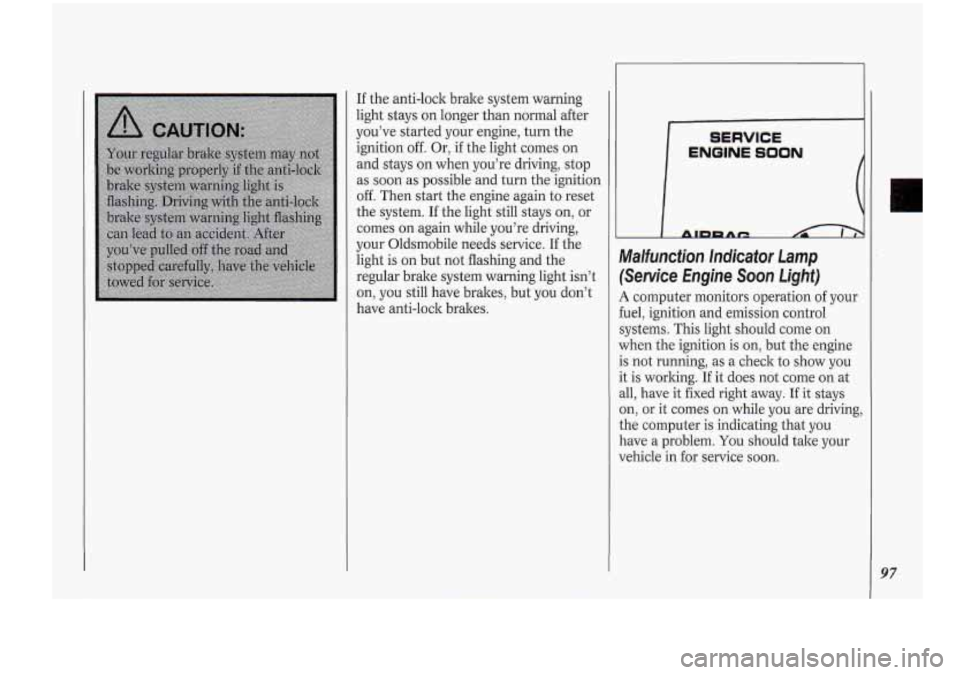
SERVICE
ENGINE SOON
Malfunction. Indicator Lamp
(Service Engine Soon Light)
A computer monitors operation of your
fuel, ignition and emission control
systems. This light should come on
when the ignition is on, but the engine
is not running, as a check to show you
it is working.
If it does not come on at
all, have it fixed right away. If it stays
on, or it comes on while you are driving,
the computer is indicating that you
have a problem.
You should take your
vehicle in for service soon.
97
Page 138 of 276
I Your Driving and the Road
136
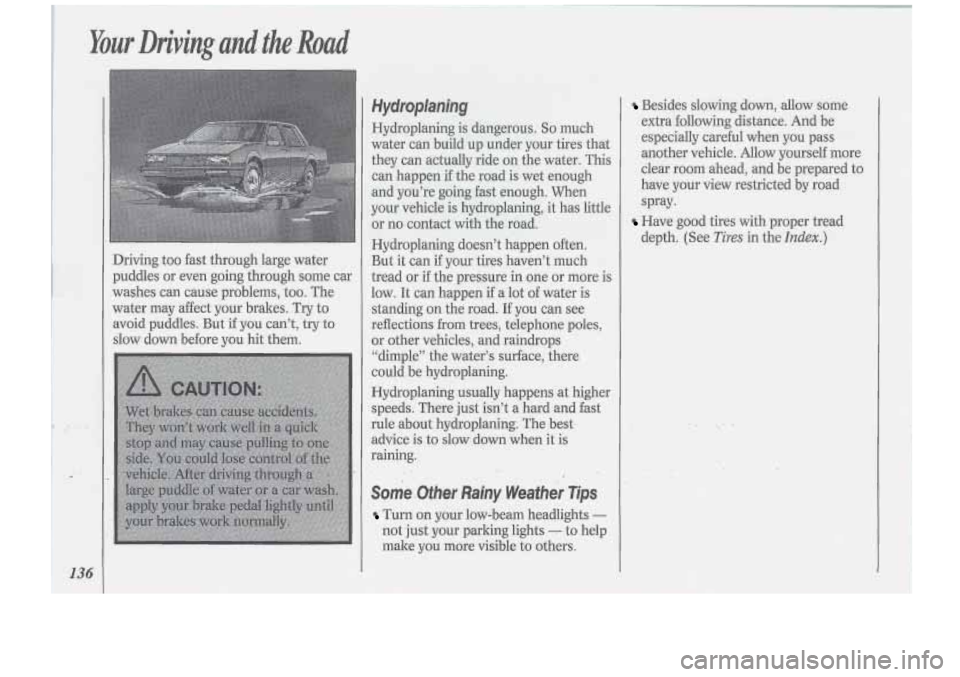
Driving too fast through large water
puddles or even going through some car
washes can cause problems, too. The
water may affect your brakes. Try to
avoid puddles.
But if you can’t, try to
slow down before you hit them.
Hydroplaning
Hydroplaning is dangerous. So much
water can build up under your tires that
they can actually ride
on the water. This
can happen if the road is wet enough
and you’re going fast enough. When
your vehicle is hydroplaning, it has little
or no contact with the road.
Hydroplaning doesn’t happen often.
But it can
if your tires haven’t much
tread or
if the pressure in one or more is
low. It can happen if a lot of water is
standing on the road. If you can see
reflections from trees, telephone poles,
or other vehicles, and raindrops
“dimple” the water’s surface, there
could be hydroplaning.
Hydroplaning usually happens at higher
speeds. There
just isn’t a hard and fast
rule about hydroplaning; The best
advice is to slow down when it is
raining.
Some .Other Rainy Weather Tips
Turn on your low-beam headlights -
not just your parlcing lights - to help
make you more visible to others.
Besides slowing down, allow some
extra following distance. And be
especially careful when you pass
another vehicle. Allow yourself more
clear room ahead, and be prepared to
have your view restricted by road
spray.
Have good tires with proper tread
depth. (See
Tires in the Index.)
Page 148 of 276
Your Driving and the Road
146
Safety Chains
You should always attach chains
between your vehicle and your trailer.
Cross the safety chains under the
tongue of the trailer
so that the tongue
will not drop to the road if it becomes
separated from the hitch. Instructions
about safety chains may be provided by
the hitch manufacturer or by the trailer
manufacturer. Follow the
manufacturer’s recommendation for
attaching safety chains. Always leave
just enough slack
so you can turn with
your rig. And, never allow safety chains
to drag
on the ground.
Trailer Brakes
Because you have anti-lock brakes,
don’t try to tap into your vehicle’s brake
system at all.
If you do, both brake
systems won’t work well or
at all.
Driving with a Trailer
Towing a trailer requires a certain
amount of experience. Before setting
out for the open road, you’ll want to get
to laow your rig. Acquaint yourself with
the feel
of handling and braking
with the added weight of the trailer.
And always keep in mind that the
vehicle you are driving is now a good
deal longer and not nearly
so responsive
as your vehicle is by itself.
Before you start, check the trailer hitch
and platform, safety chains, electrical
connector, lights, tires and mirror
adjustment.
If the trailer has electric
brakes, start your vehicle and trailer
moving and then apply the trailer brake
controller by hand to be sure the brakes
are working. This lets you check your
electrical connection at the same time.
During your trip, check occasionally to
be sure that the load is secure, and that
the lights and any trailer brakes are still
working.
Following Distance
Stay at least twice as far behind the
vehicle ahead as you would when
driving your vehicle without a trailer.
This can help you avoid situations that
require heavy braking and sudden
turns.
Passing
You’ll need more passing distance up
ahead when you’re towing a trailer.
And, because you’re a good deal longer,
you’ll need to go much farther beyond
the passed vehicle before you can return
to your lane.
Backing Up
Hold the bottom of the steering wheel
with one hand. Then, to move the
trailer to the left, just move that hand to
the left. To move the trailer to the right,
move your hand
to the right. Always
back up slowly and,
if possible, have
someone guide you.
Making Turns
When you’re turning with a trailer,
make wider turns than normal. Do this
so your trailer won’t strike soft
shoulders, curbs, road signs, trees, or
other objects. Avoid jerky or sudden
maneuvers. Signal well in advance.