tow Oldsmobile Cutlass Supreme 1994 s Owner's Guide
[x] Cancel search | Manufacturer: OLDSMOBILE, Model Year: 1994, Model line: Cutlass Supreme, Model: Oldsmobile Cutlass Supreme 1994Pages: 276, PDF Size: 14.73 MB
Page 158 of 276
Problems on the Road
156
J
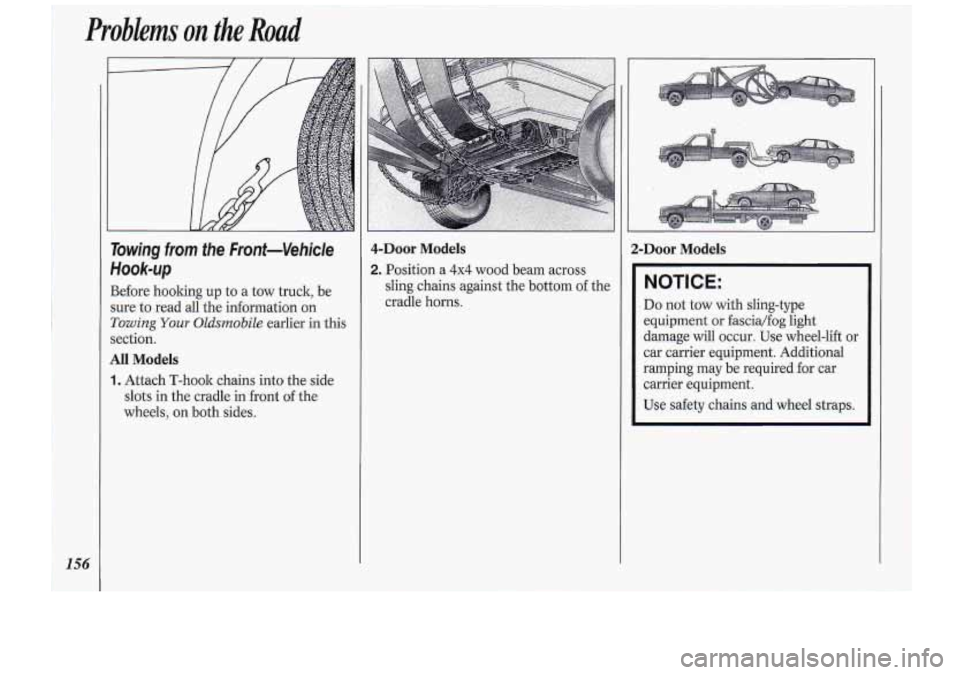
rowing from the Front-Vehicle
Hook-up
Before hooking up to a tow truck, be
sure to read all the information on
rowing Your Oldsmobile earlier in this
section.
Qll Models
1. Attach T-hook chains into the side
slots in the cradle in front of the
wheels, on both sides.
4-Door Models
2. Position a 4x4 wood beam across
sling chains against the bottom of the
cradle horns.
.Door Models
NOTICE:
Do not tow with sling-type
equipment
or fascia/fog light
damage will occur. Use wheel-lift or
car carrier equipment. Additional
ramping may be required for car
carrier equipment.
Use safety chains and wheel straps.
Page 159 of 276
NOTICE:
Towing a vehicle over rough
surfaces could damage
a vehicle.
Damage can occur
from vehicle to
ground or vehicle to wheel-lift
equipment.
To help avoid damage,
install a towing dolly and raise
vehicle until adequate clearance is
obtained between the ground
and/or wheel-lift equipment.
Do not attach winch cables or
J-
hooks to suspension components
when using car carrier equipment.
Always use T-hooks inserted in the
T-hook slots.
AN Models
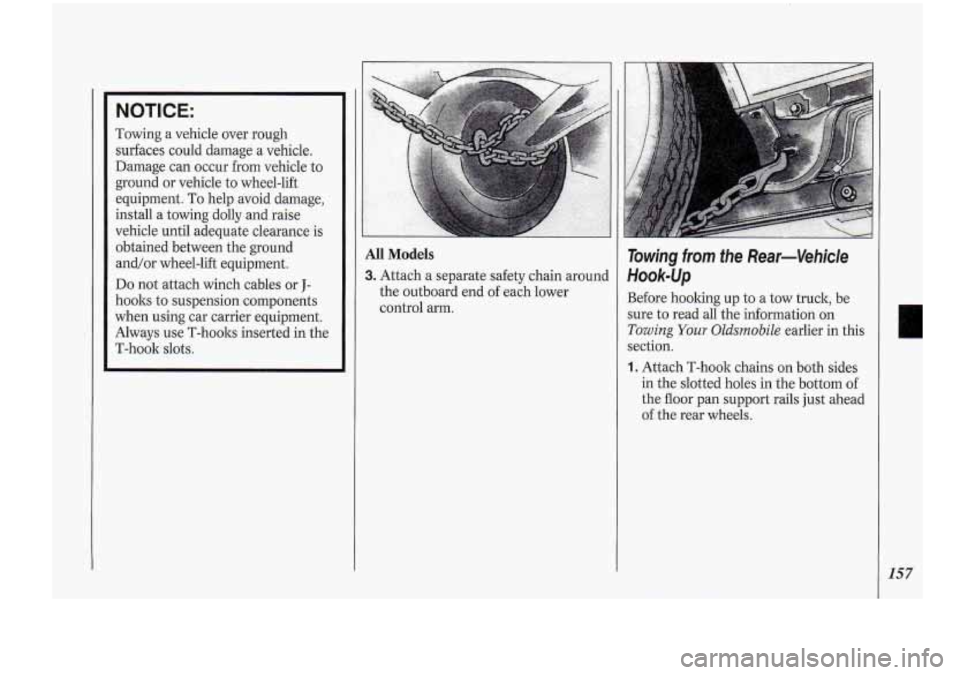
3. Attach a separate safety chain around
the outboard end
of each lower
control arm.
157
Page 167 of 276
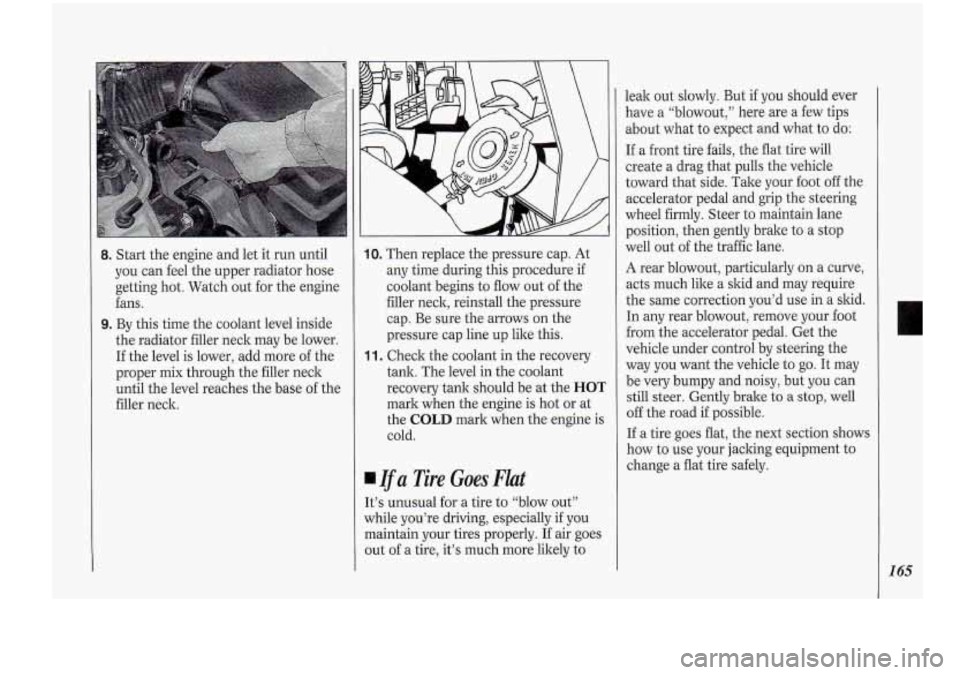
8. Start the engine and let it run until
you can feel the upper radiator hose
getting hot. Watch out for the engine
fans.
9. By this time the coolant level inside
the radiator filler neck may be lower.
If the level is lower, add more of the
proper mix through the filler neck
until the level reaches the base of the
filler neck.
10. Then replace the pressure cap. At
any time during this procedure if
coolant begins to flow out of the
filler neck, reinstall the pressure
cap. Be sure the arrows on the
pressure cap.line up like this.
11. Check the coolant in the recovery
tank. The level in the coolant
recovery tanlc should be at the
HOT
mark when the engine is hot or at
the
COLD mark when the engine is
cold.
Ifa Tire Goes Flat
It’s unusual for a tire to “blow out”
while you’re driving, especially
if you
maintain your tires properly. If air goes
out of a tire, it’s much more likely to
leak out slowly. But if you should ever
have
a “blowout,” here are a few tips
about what to expect and what to
do:
If a front tire fails, the flat tire will
create a drag that pulls the vehicle
toward that side. Take your foot off the
accelerator pedal and grip the steering
wheel firmly. Steer to maintain lane
position, then gently brake to a stop
well out of the traffic lane.
A rear blowout, particularly on a curve,
acts much like a slid and may require
the same correction you’d use
in a skid.
In any rear blowout, remove your foot
from the accelerator pedal. Get the
vehicle under control by steering the
way you want the vehicle to go. It may
be very bumpy and noisy, but you can
still steer. Gently brake to a stop, well
off the road if possible.
If a tire goes flat, the next section shows
how to use your jacking equipment to
change a flat tire safely.
165
Page 172 of 276
Probkms on the Road
1 70
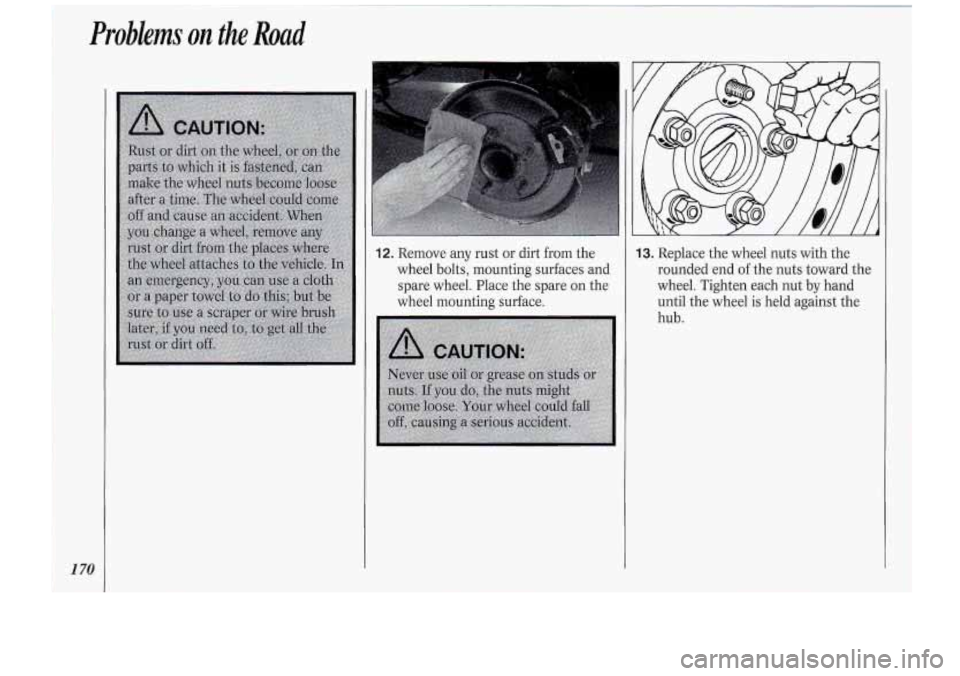
12. Remove any rust or dirt from the
wheel bolts, mounting surfaces and
spare wheel. Place the spare on the
wheel mounting surface. 13. Replace the wheel nuts with the
rounded end
of the nuts toward the
wheel. Tighten each nut by hand
until the wheel is held against the
hub.
Page 186 of 276
Service & Appearance Care
Engine Oil
If the LOW OIL LEVEL light on the
instrument panel comes
on, it means
you need to check your engine oil level
right away. For more information, see
Low Oil Level Light in the Index. You
should check your engine oil level
regularly; this is an added reminder.
It’s a good idea to check your engine .oil
:
every time you get fuel. In order to get
an accurate reading, the oil must be
warm and the vehicle must be on level
ground.
Turn
off the engine and give the 0il.a
few minutes to drain back into the
oil
pan. If you don’t, the oil dipstick might
not show the actual level.
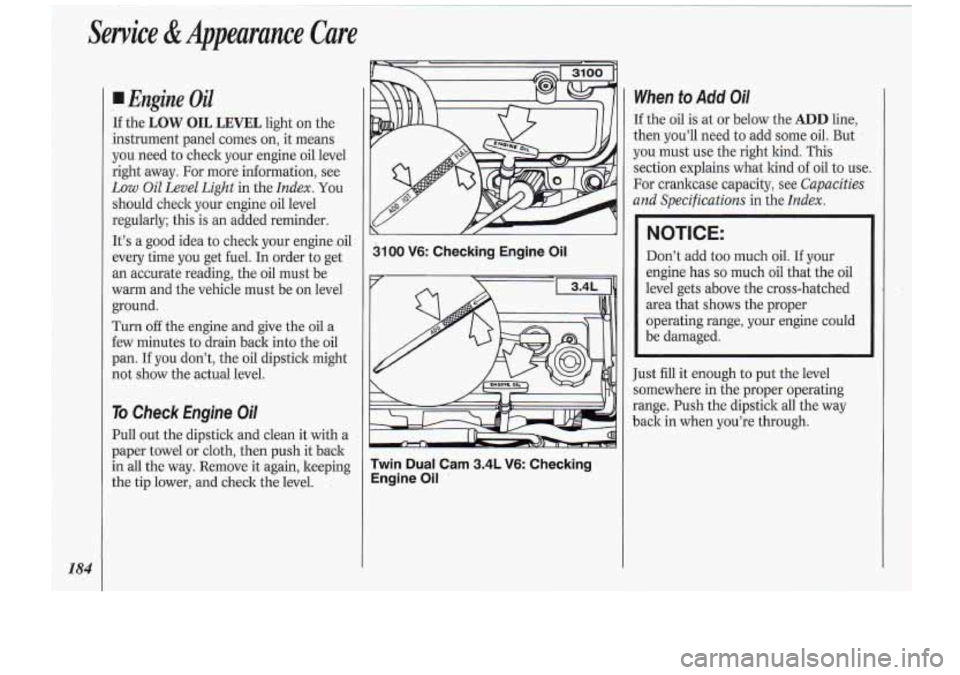
To Check Engine Oil
Pull out the dipstick and clean it with-a
paper towel or cloth, then push it bzck
in all the way. Remove it again, keeping
the tip lower, and check the level.
3100 V6: Checking Engine Oil
Twin
Dual Cam 3.4L V6: Checking
Engine Oil
’
When to Add Oil
If the oil is at or below the ADD line,
then you’ll need to add some
oil. But
you must use the right kind. This
section explains what kind
of oil to use.
For crankcase capacity, see
Capacities
and Specifications
in the Index.
NOTICE:
Don’t add too much oil. If your
engine has
so much oil that the oil
level gets above the cross-hatched
area that shows the proper
operating range, your engine could
be damaged.
Just fill it enough to put the level
somewhere in the proper operating
range. Push the dipstick all the way
back in when you’re through.
Page 188 of 276
1
Service & Appearance Care
186
(-18°C) or above. These numbers on an
oil container show its viscosity, or
thickness. Do not use other viscosity
oils,
such as SAE 1OW-40 or SAE 20W-50.
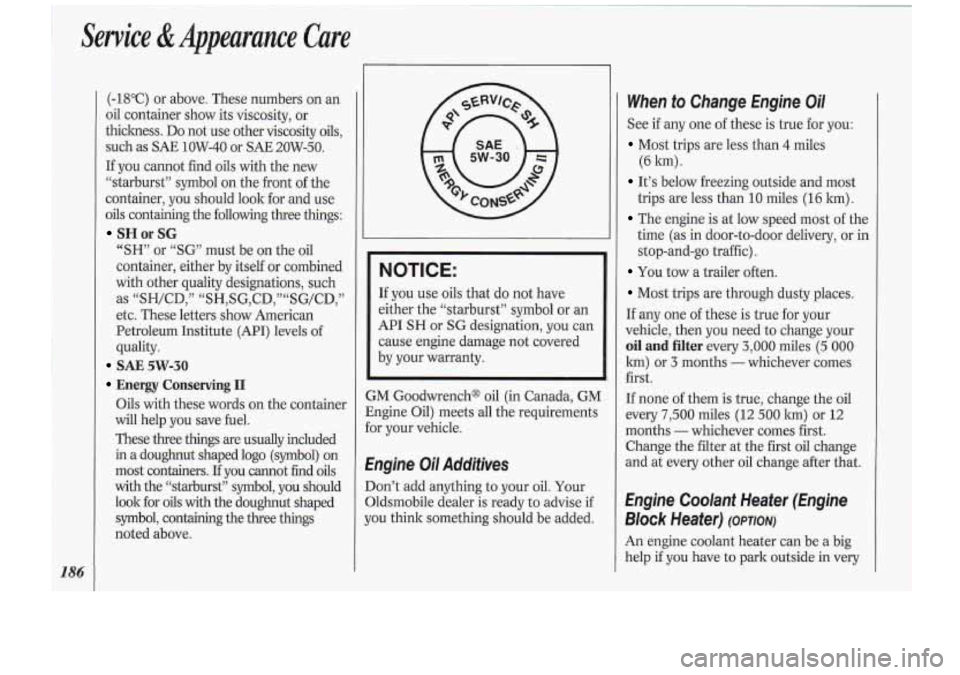
If you cannot find oils with the new
“starburst” symbol on the front of the
container, you should look for and use
oils containing the following three things:
SH or SG
“SH” or “SG” must be on the oil
container, either by itself or combined
with other quality designations, such
as “SH/CD,” “SH,SG,CD,”“SG/CD,”
etc. These letters show American
Petroleum Institute (API) levels of
quality.
SAE 5W-30
Energy Conserving I1
Oils with these words on the container
will help you save fuel.
These three things are usually included in
a doughnut shaped logo (symbol) on
most containers. If you cannot find
oils
with the “starburst” symbol, you should
look for oils with the doughnut shaped
symbol, containing the three things
noted above.
NOTICE:
If you use oils that do not have
either the “starburst” symbol or an
API
SH or SG designation, you can
cause engine damage not covered
by your warranty.
GM Goodwrench* oil (in Canada, GM
Engine Oil) meets all the requirements
for your vehicle.
Engine Oil Additives
Don’t add anything to your oil. Your
Oldsmobile dealer is ready to advise if
you think something should be added.
When to Change Engine Oil
See if any one of these is true for you:
Most trips are less than 4 miles
(6 km)
.
It’s below freezing outside and most
trips are less than 10 miles (16 ltm).
The engine is at low speed most of the
time (as in door-to-door delivery, or in
stop-and-go traffic).
You tow a trailer often.
Most trips are through dusty places.
If any one of these is true for your
vehicle, then you need to change your
oil and filter every 3,000 miles (5 000
km) or 3 months - whichever comes
-first.
If none of them is true, change the oil
every
7,500 miles (12 500 lm) or 12
months -whichever comes first.
Change the filter at the first
oil change
and at every other oil change after that.
Engine Coolant Heater (Engine
Block Heater) (omoN)
An engine coolant heater can be a big
help if you have to
park outside in very
Page 215 of 276
Rinse the section with a clean, wet
0 Wipe off what's left with a slightly
Then dry it immediately with a blow
sponge.
damp
paper: towel
or clsth.
dryer or a heat lamp.
.NOTICE:
Ek careful with a hair dryer or heat
lamp. You could scorch the fabric.
Wipe with a.clean cloth.
Using: SolvenbType Cleaner on
Fabric
First, see if you have to use solvent-type
dearrer at
all; Some spots and stains
.will clean
off. better with just water and
mild soap.
If you need to use a solvent:
0 Gently scrape excess soil 'from the
trim material with ,a clean,
dull knife
or scraper.
Use very little cleaner,
light pressure and clean cloths
(pre€erably cheesecloth). Cleaning
should start at the outside
of the
Page 239 of 276
inspections that your Oldsmobile
dealer’s service department or another
qualified service center should perform.
“Section D: Recommended Fluids
&
Lubricants” lists some products GM
recommends to help keep your vehicle
properly maintained. These products, or
their equivalents, should be used
whether you do the work yourself or
have it done.
“Section
E: Maintenance Record”
provides a place for you to record the
maintenance performed on your vehicle.
Whenever any maintenance is
performed, be sure to write it down in
this section. This will.help you
determine when your next maintenance
should be done. In addition, it
is a good
idea to keep your maintenance receipts.
They may be needed to qual@ your
vehicle for warranty repairs.
Section A: Scheduled
Maintenance Services
Using Your Maintenance
Schedule
This section tells you the maintenance
services you should have done and when
you should schedule them. Your
Oldsmobile dealer knows your vehicle
best and wants you to be happy with it.
If you go to your dealer for your service
needs, you’ll how that GM-trained and
supported service people will perform
the work using genuine GM parts.
These schedules are for vehicles that:
carry passengers and cargo within
recommended limits. You will find
these limits on your vehicle’s Tire-
Loading Information label. See
Loading Your Vehicle in the Index.
are driven on reasonable road
surfaces within legal driving limits.
use the recommended unleaded fuel.
See
Fuel in the .Index.
Selecting fhe Right Schedule
First you’ll need to decide which of the
two schedules is right for your vehicle.
Here’s how
to decide which schedule to
follow:
Schedule I
Is any one of these true for your
vehicle?
Most trips are less than 4 miles (6 lm).
Most trips are less than 10 miles (16
lun) when outside temperatures are
below freezing.
The engine is at low speed most of the
time (as in door-to-door delivery, or in
stop-and-go traffic).
You operate your vehicle in dusty
areas.
You tow a trailer. (With some models,
you should never tow a trailer. See
Towing a Trailer in the Index.)
If any one (or more) of these is true for
your driving, follow Schedule
I.
Schedule I1
Follow Schedule I1 only if none of’the
above conditions is true.
L
237
Page 240 of 276
Maintenance Schedule
238
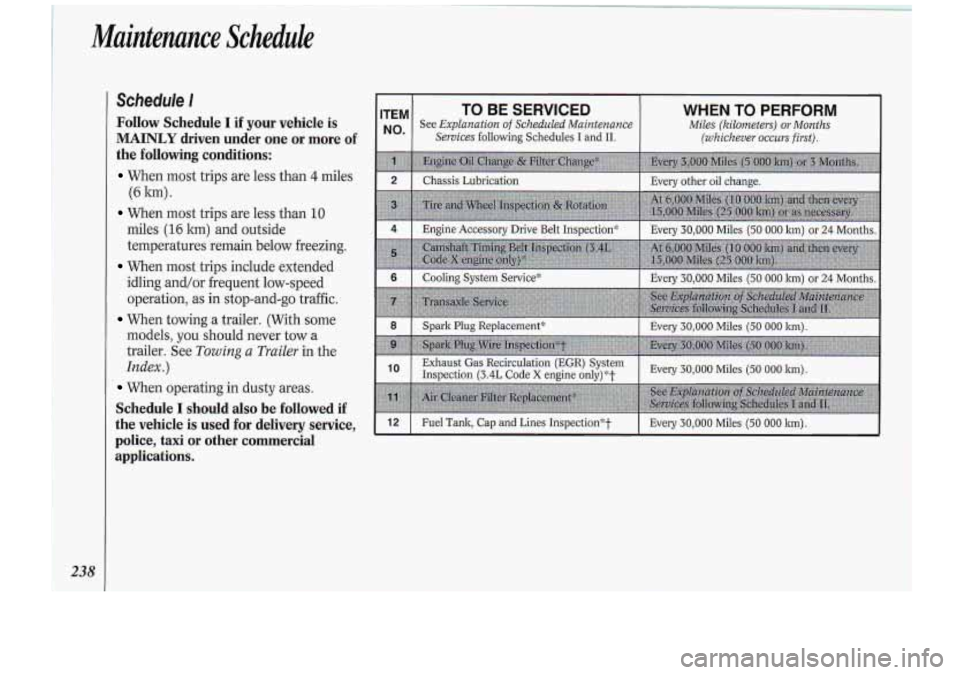
Schedule l
Follow Schedule I if your vehicle is
MAINLY driven under one or more of
the following conditions:
When most trips are less than 4 miles
When most trips are less than 10
(6 lun) .
miles (16 ltm) and outside
temperatures remain below freezing.
When most trips include extended
idling and/or frequent low-speed
operation, as in stop-and-go traffic.
When towing a trailer. (With some
models, you should never tow a
trailer. See
Towing a Trailer in the
Index.)
When operating in dusty areas.
Schedule I should also be followed if
the vehicle is used for delivery service,
police,
taxi or other commercial
applications.
ITEM TO BE SERVICED
Nom See Explanation of Scheduled Maintenance
Services
following Schedules I and 11.
WHEN TO PERFORM
Miles (kilometers) or Months
(whichever occurs first).
I 2 I Chassis Lubrication I Every other oil change. I
I 4 I Engine Accessory Drive Belt Inspection* I Every 30,000 Miles (50 000 lun) or 24 Months. I
I 6 I Cooling System Service" I Every 30,000 Miles (50 000 lun) or 24 Months. I
I
8 I Spark Plug Replacement* I Every 30,000 Miles (50 000 km). I
I 12 I Fuel Tanlc, Cap and Lines Inspection*+ I Every 30,000 Miles (50 000 lun).
~
I
I
Page 245 of 276
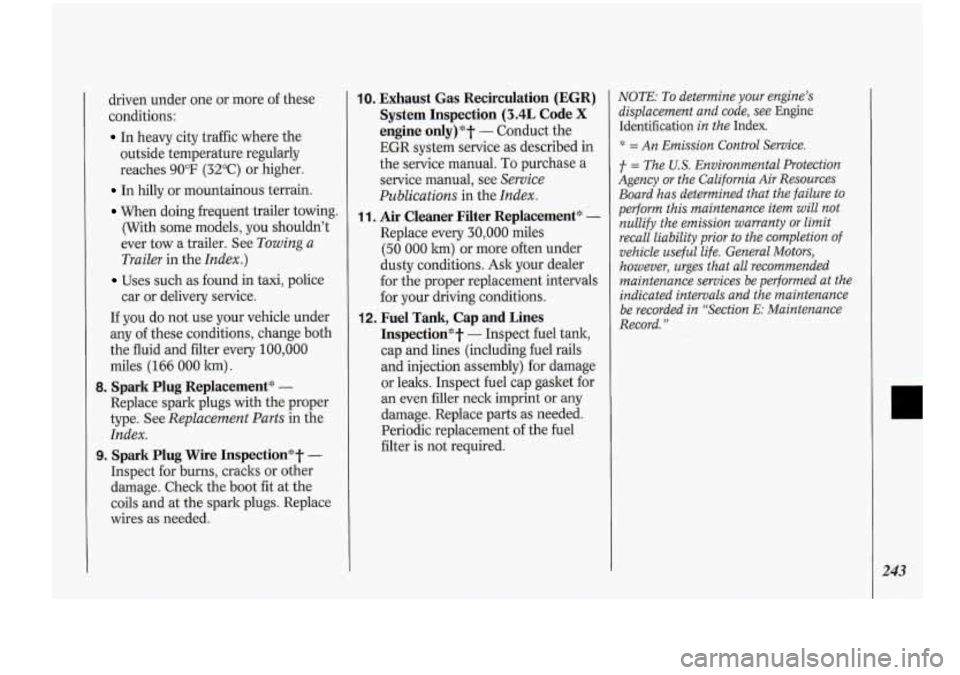
driven under one or more of these
c.onditions:
In heavy city traffic where the
outside temperature: regularly
reaches
90°F (32°C) or higher.
In hilly or mountainous terrain.
When doing frequent trailer towing.
(With some models, you shouldn’t
ever tow
a trailer. See Towing a
Trailer
in the Index.)
Uses such as.found in taxi, police
car or delivery service.
If-you do not use your vehicle under
any of these conditions, change both
the fluid and filter every
100,000
miles (166 000 km) .
Replace spark plugs with the proper
type. See
Replacement-Parts in the
Index.
9. Spark Plug Wire Inspection*T -
Inspect for burns, .cracks or other
damage. Check the boot fit at the
coils and at the spark plugs. Replace
wires as needed.
8. Spark PIug~Replacement* -
-10. Exhaust Gas Recirculation (EGR)
System Inspection
(3.4L Code X
engine only)*? - Conduct the
EGR system service-as described in
the service manual.
To purchase a
service manual, see Service
Publications
in the Index.
1 1. Air Cleaner Filter Replacementgc -
Replace every 30,000 miles
(50 000 lun) or more often under
dusty conditions. Ask your dealer
for the proper replacement intervals
for your driving conditions.
12. Fuel Tank, Cap and Lines
Inspectiong‘t
- Inspect fuel tank,
cap and lines (including fuel rails
and injection assembly). for damage
or leaks. Inspect fuel cap gasket for
an even filler neck imprint or any
damage. Replace parts as needed.
Periodic replacement of the fuel
filter is not required.
NOTE: To determine your engine’s
displacement and code, see
Engine
Identification
in the Index.
* = An Emission Control Service.
f = The U.S. Environmental Protection
Agency
or the California Air Resources
Board has determined that the failure to
perform this maintenance item will not
nullify the emission warranty
or limit
recall liability prior to the completion of
vehicle
useful life. General Motors,
however, urges that all recommended
maintenance services be performed at the
indicated intervals and the maintenance
be recorded in “Section
E: Maintenance
Record.”
243