engine Oldsmobile Cutlass Supreme 1995 s Workshop Manual
[x] Cancel search | Manufacturer: OLDSMOBILE, Model Year: 1995, Model line: Cutlass Supreme, Model: Oldsmobile Cutlass Supreme 1995Pages: 340, PDF Size: 16.68 MB
Page 220 of 340
NOTICE:
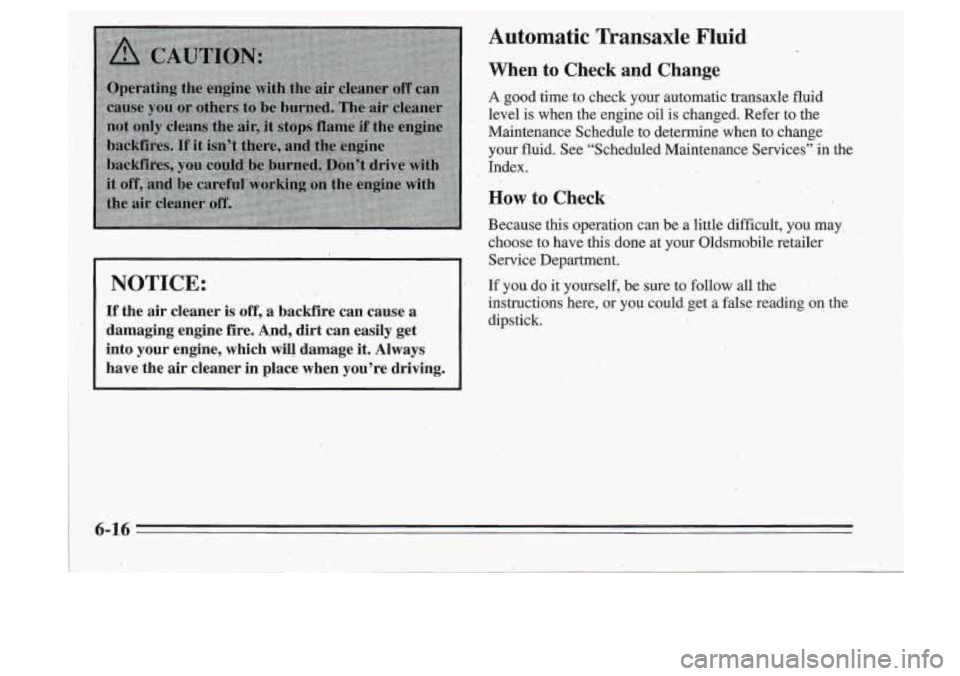
If the air cleaner is off, a backfire can cause a
damaging engine fire. And, dirt can easily ,get
into your engine, which will damage it. Always
have the air cleaner in place when you’re driving.
Automatic Transaxle Fluid
When to Check and Change
A good time to check your automatic transaxle fluid
level is when the engine oil is changed. Refer to the
Maintenance Schedule to determine when to change
your fluid. See “Scheduled Maintenance Services’’ in the
Index.
How to Check
Because this operation can be a little difficult, you may
choose to have this done at your Oldsmobile retailer
Service Department.
If yon do it yourself, be sure to follow all the
instructions here,
or you could get a false reading on the
dipstick.
Page 221 of 340
NOTICE:
Too much or too little fluid can damage your
transaxle.
Too much can mean that some of the
fluid could come
out and fall on hot engine parts
or exhaust system parts, starting a fire. Be sure to
get an accurate reading if
you check your
transaxle fluid.
Wait at least 30 minutes before, checking the transaxle
fluid level
if you have been driving:
When outside temperatures are above 90°F (32°C).
0 At high speed for quite a while.
In heavy traffic -- especially in hot weather.
a ' While pulling a trailer.
To get the right reading; the fluid should be at normal
operating temperature, which is 180°F to 200°F (82°C
to 93°C).
Get the vehicle warmed up by driving about 15 miles
(24
km) when outside temperatures are above 50°F
(10°C). If it's colder than 50°F (lO"C), you may have
to drive longer.
To check the fluid level
0
0
0
0
Park your vehicle on a level place. Keep the engine
running.
With the parking brake applied,.place the shift lever
in PARK
(P). J
With your foot on the brake pedal, move the shift
lever through each gear range, pausing for about
three seconds in each range. Then, position the shik:
lever in
PAkK (P).
Let the engine-run at idle for three to five minutes.
6-17
Page 222 of 340
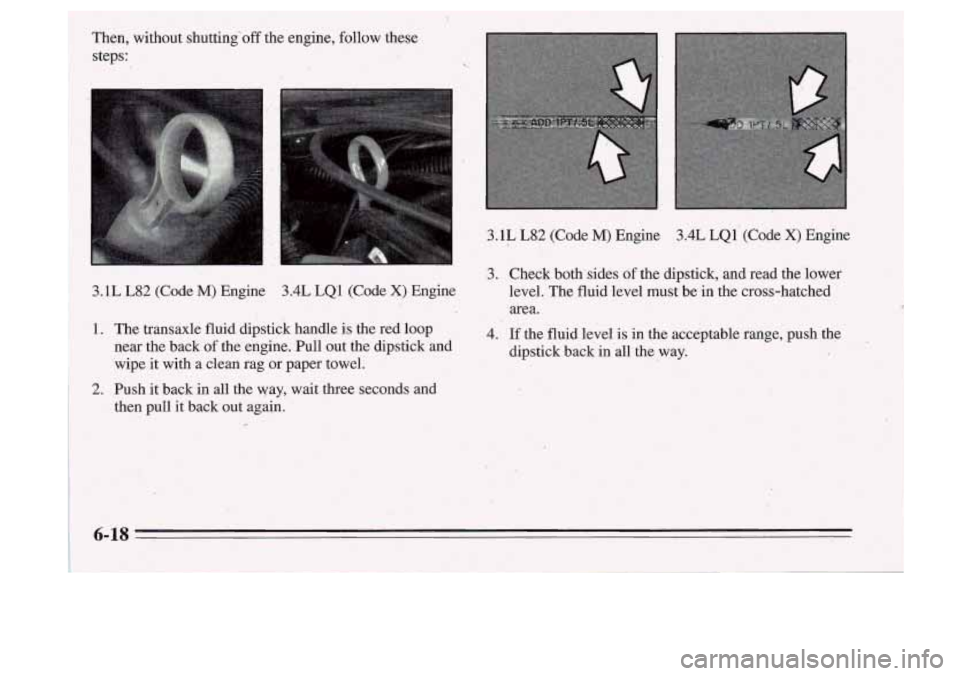
3.1L L82 (Code M) Engine 3.4L LQ1 (Code X) Engine
3. Check both'sides of the dipstick, and read the lower
level. The fluid level must be:in the cross-hatched
area.
1. The transaxle fluid dipstick handle is the red loop 4. If the fluid level is in the acceptable range, push the
near the back
of the engine. Pull out the dipstick and dipstick back in all the way.
'wipe it with a clean rag or paper towel.
then pull it back out again.
2. Push
it back
in all the yay, wait three seconds and
Page 224 of 340
NOTICE:
~f you use an improper coolant mix, your engine
could overheat and be badly damaged. The repair cost wouldn’t be covered by your
warranty. Too much water in the mix can freeze
and crack the engine, radiator, heater core and
other parts.
..
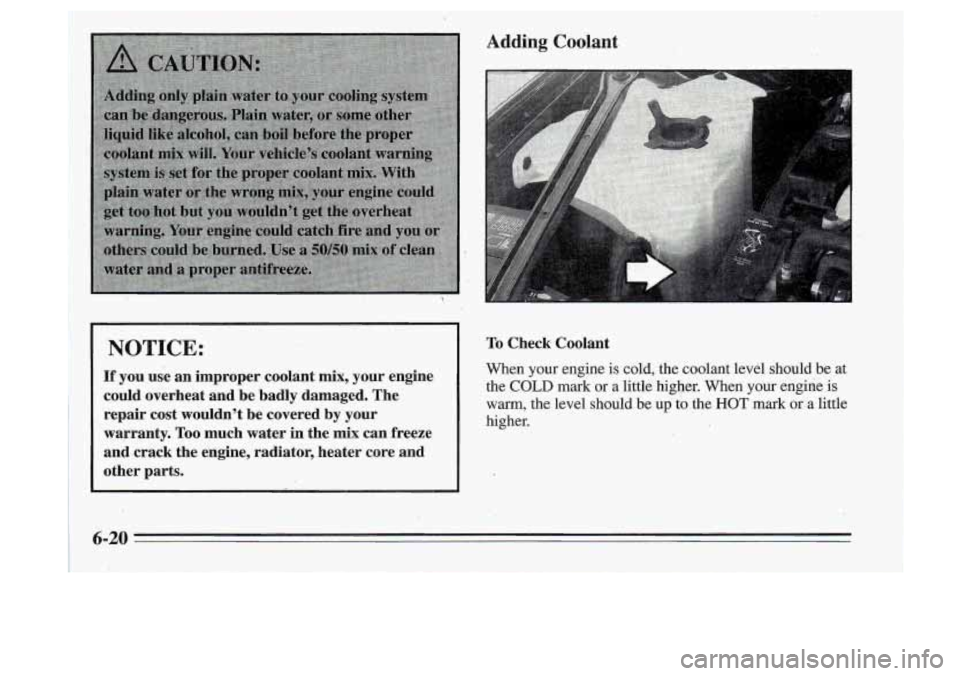
To Check Coolant
When your engine is cold, the coolant level should be at
the
COLD mark or a little higher. When your engine is
warm, the level should be up to the HOT mark or a little
higher.
4-20
Page 225 of 340
/ LOW
il
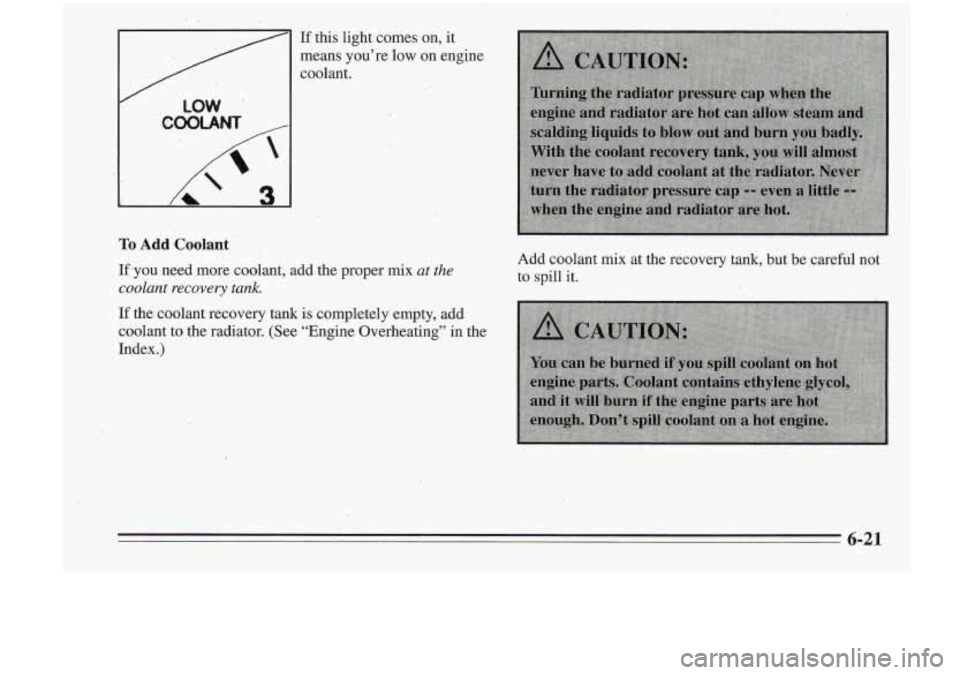
If this 1ight.comes on, it
means you’re low on engine
coolant.
To Add Coolant
Ifjyou need more coolant, add the proper mix at the
coolant recovery tank.
If the coolant recovery tank is completely empty, add
coolant to the radiator. (See “Ennine Overheating” in the
Index.) Add coolant
mix at
the recovery tqk, but be ,careful not
to spill it.
6-21
Page 227 of 340
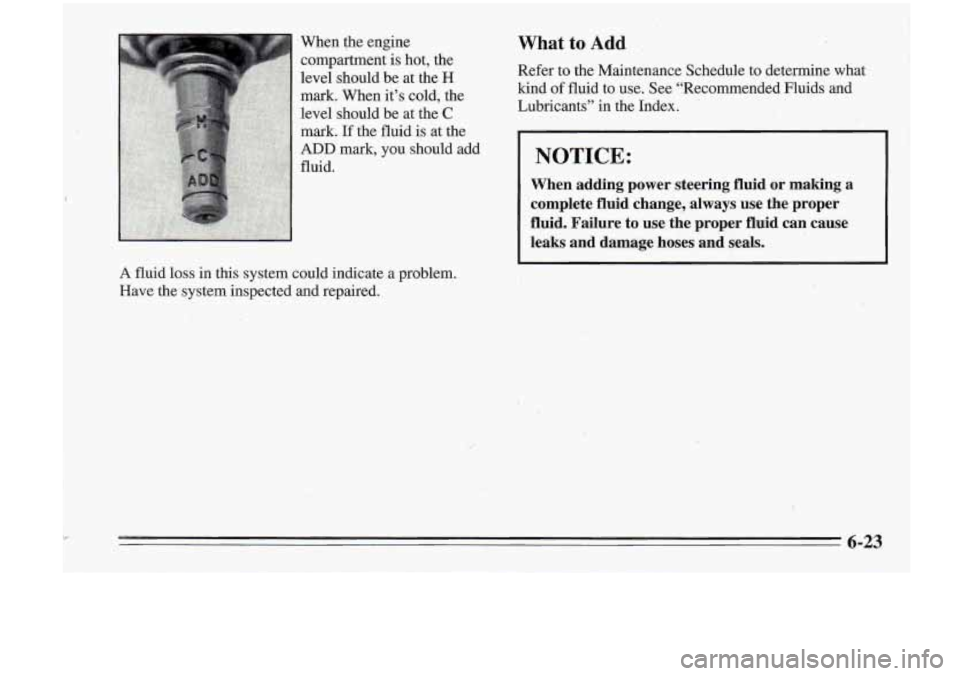
When the engine
compartment is hot, the
level should be at the
H
mark. When it’s cold, the
level should be at the
C
What to Add
Refer to the Maintenance Schedule to determine what
kind of fluid to use. See “Recommended Fluids and
Lubricants” in the Index.
mark.
If the fluid is at the I
NOTICE:
When adding power steering fluid or making a
complete fluid change, always use the proper
fluid. Failure to use the proper fluid can cause
leaks and damage hoses and seals.
A fluid loss in this system could indicate a problem.
Have the system inspected and repaired.
6-23
Page 259 of 340
Underbody Maintenance
Chemicals used for ice and snow.removal and dust
control can collect on the underbody.
If these .are not
removed, accelerated coirosion (rust) can occur on the
underbody
parts such as fuel lines, frame, floor pan, and
exhaust system even though they have corrosion
protection.
At least every spring, flush these materials from the
underbody with plain water. Clean any areas where mud
and other debris can collect. Dirt packed in closed areas
of the frame should be loosened before being flushed.
Your retailer
or an underbody vehicle -washing system
can do this for you.
Fiberglass Springs
I
NOTICE: 1
Don’t use corrosive or acidic cleaning agents,
engine degreasers, aluminum cleaning agents or
other harsh solvents to clean fiberglass springs;
they’ll damage the springs.
Chemical Paint Spotting
Some weather and atmospheric conditions can create
a chemical fallout. Airborne pollutants can fall upon
and attack painted surfaces on,your vehicle. This
damage can take two
forms: blotchy, ringlet-shaped
discolorations, and small irregular dark spots etched
into the paint surface.
Although
no defect in the paint job causes this,
Oldsmobile will repair, at no charge to the owner, the
surfaces of new vehicles damaged by this fallout
condition within
12 months or 12,000 miles (20 000 h)
of purchase, whichever comes first.
6-55
Page 261 of 340
I.
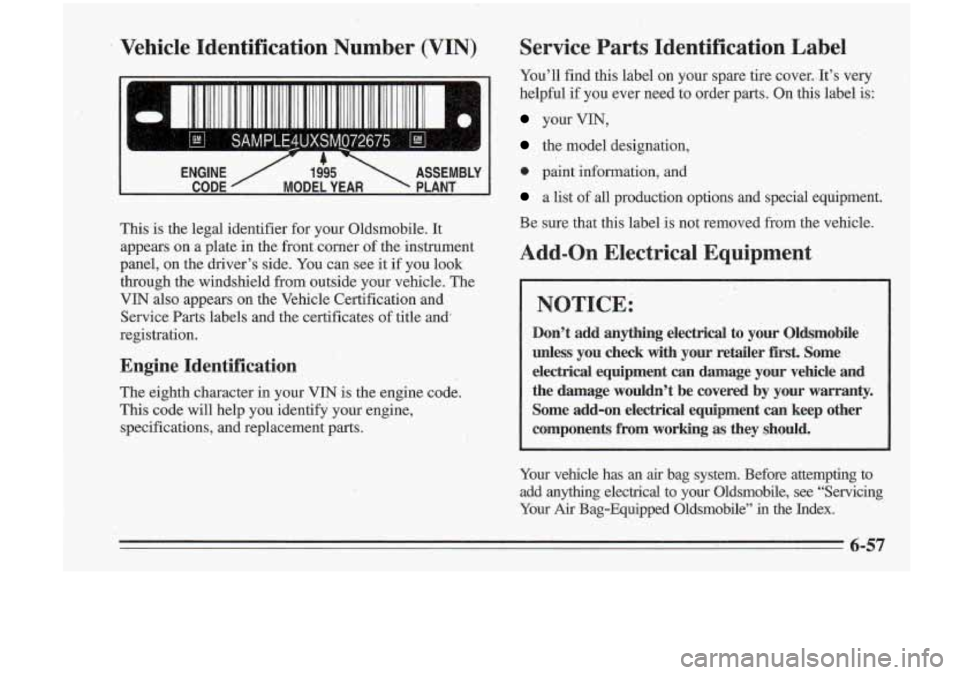
Vehicle Identification Number (VIN)
I
U I
ENGINE / 1.&5 ASSEMBLY
CODE MODEL YEAR PLANT
This is the legal identifier for your Oldsmobile. It
appears on a plate in the front corner of the instrument
panel,
on the driver’s side. You can see it if you look
through the windshield from outside your vehicle. The
VIN also appears on the’vehicle Certification and
Service
Parts labels and the certificates of title and’
registration.
Engine Identification
The eighth character in your VIN is the engine code.
This code will help you identify your engine,
specifications, and replacement parts.
Service Parts Identification Label
You’ll find this label on your spare tire cover. I It’s very
helpful if you ever need
to order parts. On this label is:
your VIN,
the model designation,
9 paint information, and
a list of all production options and special equipment.
Be sure that this label
is not removed from the vehicle.
Add-on Electrical Equipment
NOTICE:
Don’t add anything electrical to your Oldsmobile
unless you check with your, retailer
first. Some
electrical equipment can damage your vehicle and
the damage wouldn’t be covered by your warranty. Some add-on electrical eqtiipment can keep other
components from working
as they should.
Your vehicle has an air bag system. Before attempting to
add anythng electrical to your Oldsmobile, see “Servicing
Your
Air Bag-Equipped Oldsmobile” in the Index.
Page 271 of 340
1 Section 7 Maintenance Schedule
I
IMPORTANT:
KEEP ENGINE OIL
AT THE PROPER
LEVEL AND CHANGE AS
RECOMMENDED
This section covers the $ naintenml ce required for yoiir
Oldsmobile. Your vehicle,needs these services to retain its
safety, dependability .and emission control performar ,
Introduction
Your Vehicle and the Environment
Proper vehicle maintenance not only helps to keep your
vehicle in good working condition, but also helps the
environment. All recommended maintenance procedures
are important. Improper vehicle maintenance or the
removal of important components can significantly
affect the quality 'of the air we breathe. Improper fluid
levels or even the wrong tire inflation can increase the
level of emissions from your vehicle.
TO help protect our
environment, and to help keep your vehicle ingood
condition, please maintain your vehicle properly.
Have you purchased the GM Protection -Plan? The Plan
supplements
your new vehicle warranties. See your
Oldsmobile retailer for details.
7-1
Page 274 of 340
,i
Maintenance Schedule
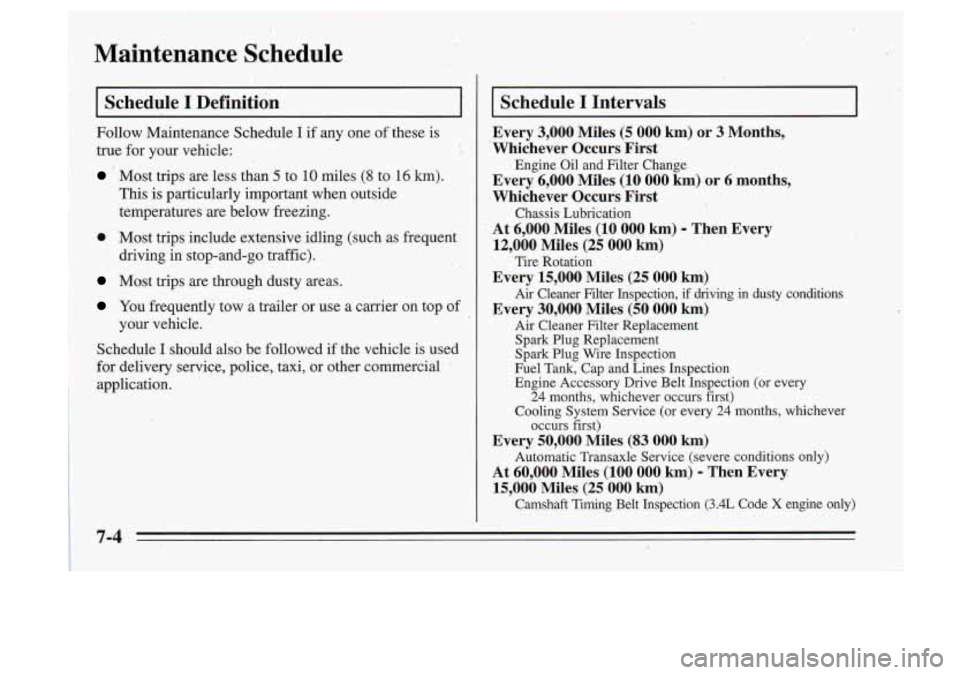
Schedule I Definition
Follow Maintenance Schedule I if any one of these is
true for your vehicle:
' Most tripsare less than 5 to 10 miles (8 to 16 km).
This 'is particularly important when outside
temperatures are below freezing.
0 'Most trips include extensive idling (such as frequent
driving in stop-and-go traffic).
Most trips are through dusty areas.
You frequently tow a trailer or use a carrier on top of
Schedule
I should also be followed if the vehicle is used
for delivery service, police, taxi, or other commercial
application. your vehicle.
I Schedule I Intervals
Every 3,000 Miles (5 000 b) or 3 Months,
'Whichever Occurs First
Every
6,000 Miles (10 000 km) or 6 months,
Whichever Occurs First
Chassis Lubrication
At-6,000 Miles (10 000 km) - Then Every
12,000 Miles (25 000 km)
Every 15,000 Miles (25 000 km).
Every 30,000 Miles (50 000 km),
Engine Oil and Filter Change
I
Tire Rotation
Air Cleaner Filter Inspection, if driving in dusty conditic
Air Cleaner Filter Replacement Spark Plug Replacement
Spark Plug Wire Inspection
Fuel Tank, Cap and Lines Inspection
Engine Accessory Drive Belt Inspection (or every 24 months, whichever occurs
first)
ms
Cooling System Service (or every
24 months, whichever
occurs first)
Every 50,000 Miles (83 000 km)
At 60,000 Miles (100 000 km) - Then Every.
15,600 Miles (25 000 km)
Autdmatic Transaxle Service (severe conditions only)
Camshaft Timing Belt Inspection (3.4L Code
X engine only)
7-4
!