engine Oldsmobile Cutlass Supreme 1995 s User Guide
[x] Cancel search | Manufacturer: OLDSMOBILE, Model Year: 1995, Model line: Cutlass Supreme, Model: Oldsmobile Cutlass Supreme 1995Pages: 340, PDF Size: 16.68 MB
Page 81 of 340
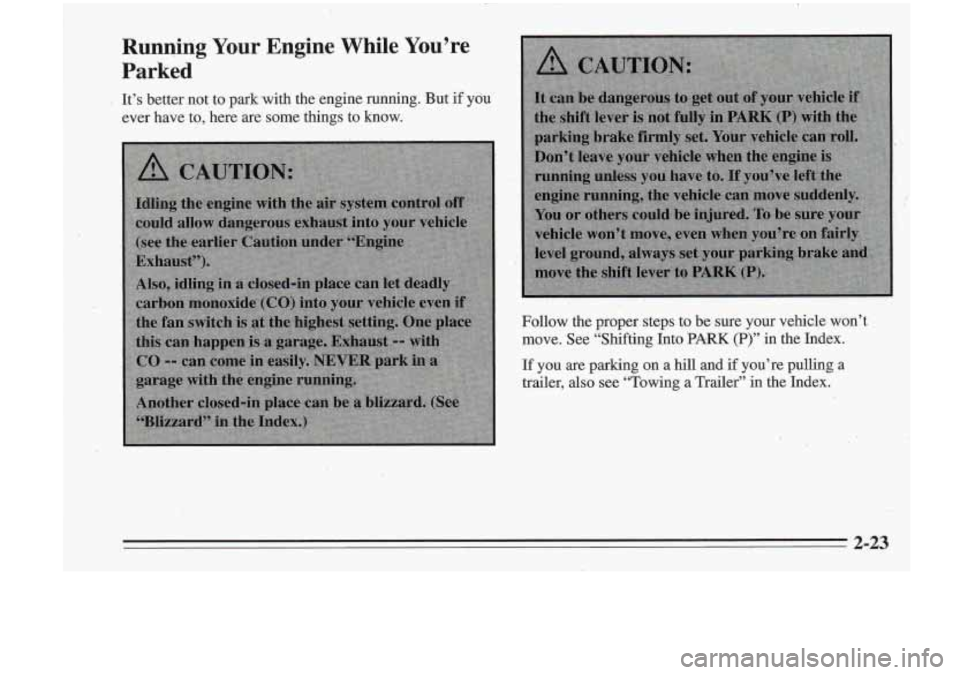
Running Your Engine While You’re
Parked
It’s better not to park ‘with the engine running. But if you
ever have to, here are some things to know.
2-23
Page 102 of 340
!
!
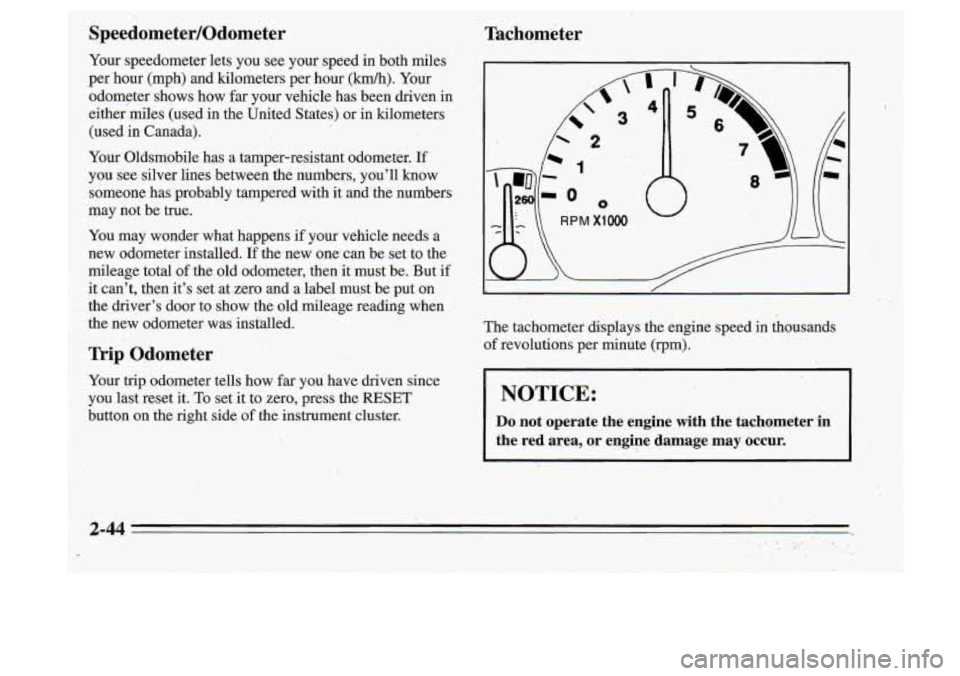
Tachometer
The tachometer displays the engine speed in thousands
of revolutiotts per minute (rpm).
NOTICE:
Do not operate the engine with the tachometer in
the red area, or engine damage may occur.
1. '
2-44 < ., ., . .I .,. , ...
.-
Page 103 of 340
Warning Lights, Gages and Indicators
This part describes the warning lights and,gages that
may be
on your vehicle. The pictures will help you
locate them.
Warning lights and gages can signal that something
is
wrong before it becomFs serious enough to cause an
expensive repair or replacement. Paying attention to
your warning.lights and gages could also save you or
others from injury.
Warning lights come on when there may be or is a
problem with one of your vehicle’s functions.
As you
will see in the details on the next few pages, some
warning lights come on briefly when you start the
engine just to let you know they’re working.
If you are
‘familiar with this section, you should not be alarmed
when this happens.
Gages can indicate when there may be or is a problem
with one-of your vehicle’s functions. Often gages and
warning lights work together to let you know when
there’s a problem with your vehicle.
When one
of the warning lights comes on and stays on
when you are driving, or when one of the gages shows
there may be a problem, check the section that
tells you
what to do about
it. Please follow this manual’s advice.
Waiting to do repairs can be costly
-- and even dangerous.
So please
get to know your warning lights
and gages. They’re
a big help.
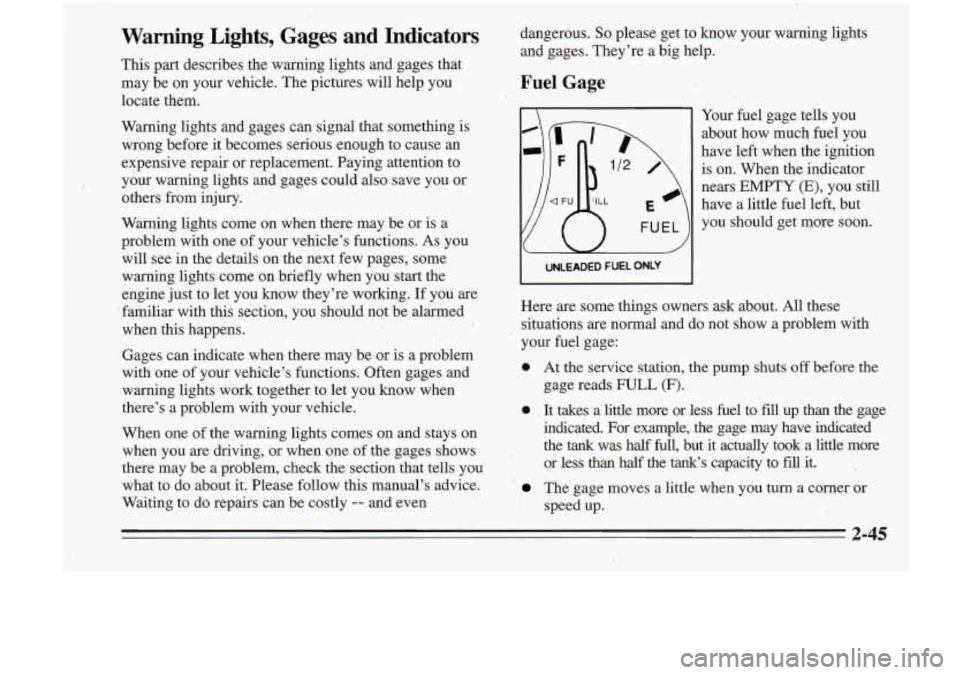
Fuel Gage
Your fuel gage tells you
about how much fuel
YOU
have left when the ignition
is on. When the indicator
nears
EMPTY (E), you still
have
a little fuel left, but
you should get more soon.
UNLEADED FUEL ONLY I
I
Here are some things owners ask about. All these
situations are normal and do not show a problem with
your fuel gage:
0 At the service station, the pump shuts off before the
gage reads
FULL (F).
0 . It takes a little more or less fuel to fill up than the gage
indicated. For example, the gage may have indicated
the
tank was half full, but it actually took a little more
or less
than half the tank‘s capacity to fill it.
The gage moves a little when you turn a corner or
speed up.
2-45
Page 108 of 340
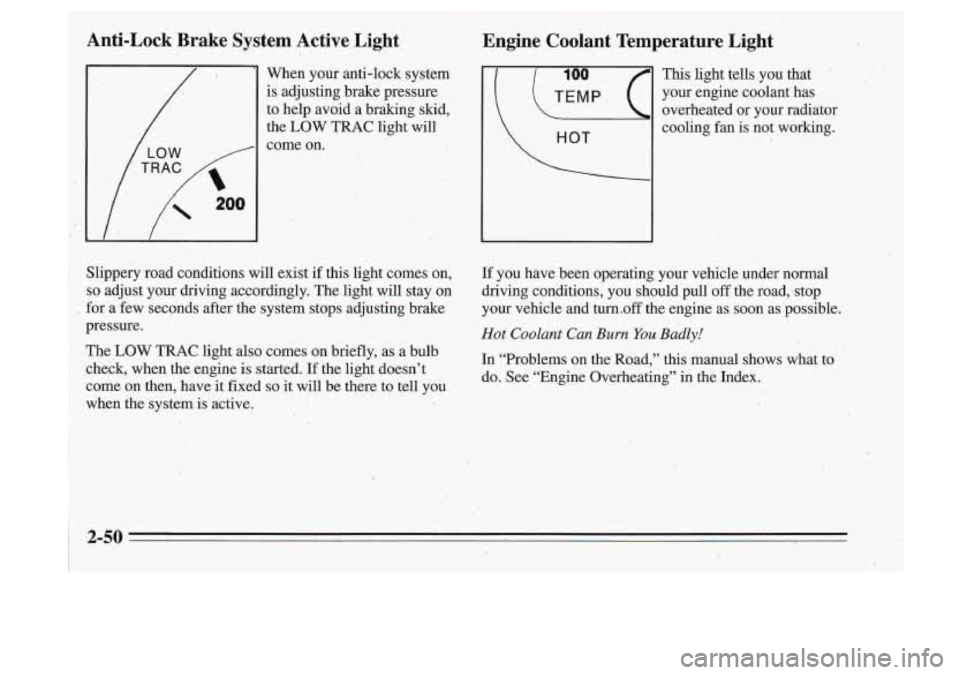
Anti-Lock Brake System Active Light
When your anti-lock system
is adjusting brake pressure
to help avoid a braking skid,
the LOW TRAC light will
come on.
Slippery road conditions will exist if this light comes on,
so adjust your driving accordingly. The light will stay on
for a few seconds after the system stops adjusting brake
pressure.
The LOW TRAC light also comes on briefly, as a bulb
check, when the engine is started. If the light doesn’t
come on then, have it fixed
so it will be there to tell you
when the system is active.
‘ This light tells.you that
your engine coolant has
, overheated or your radiator
cooling fan is not working.
If you have been operating your vehicle under normal
driving conditions, you should pull
off the road;stop’
your vehicle and turn.off the engine as soon as possible.
Hot Coolant Can Burn You Badly!
In “Problems on the~Road,” this manual shows what to
do. See “Engine Overheating”
in the Index.
2-50
Page 109 of 340
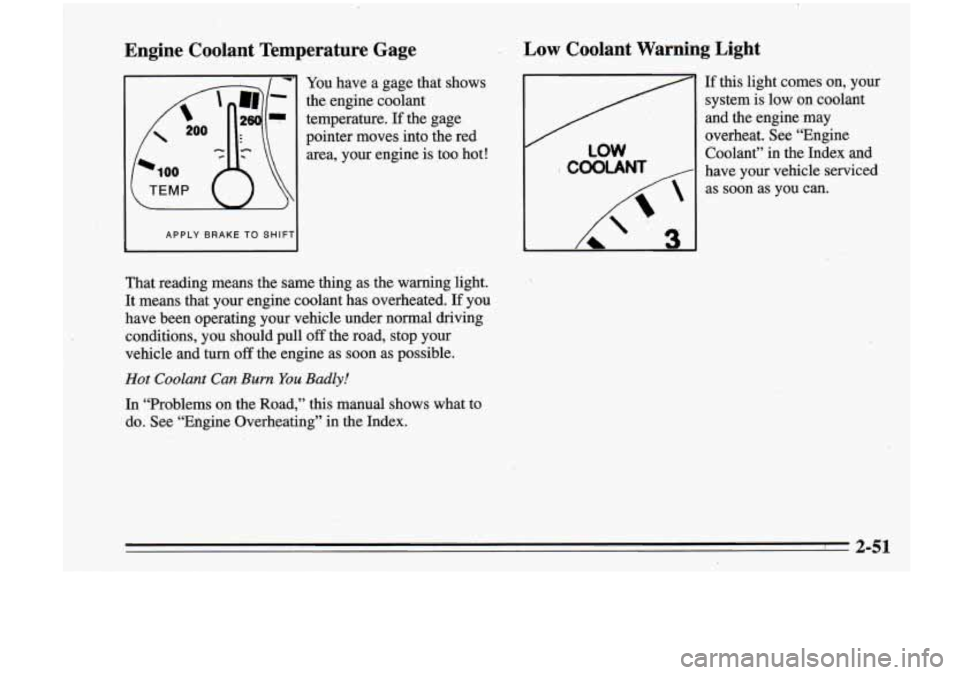
Engine Coolant Temperature Gage
APPLY BRAKE TO SHIF1
You have a gage that shows
the engine coolant
temperature.
If the gage
pointer moves into the red
area, your engine is too hot!
Low Coolant Warning Light
If this light comes on, your
system is low on coolant
and the engine may
overheat. See “Engine
Coolsint” in the Index and
have your vehicle serviced
as soon as you can.
i COOLANT
That reading means the same thing as the warning light.
It means that your engine coolant has overheated. If you
have been operating your vehicle under normal driving
conditions, you should pull
off the road, stop your
vehicle and turn
off the engine as soon as possible.
Hot Coolant Can Burn You Badly!
In “Problems on the Road,” this manual shows what to
do. See “Ennine Overheatine” in the Index.
Page 110 of 340
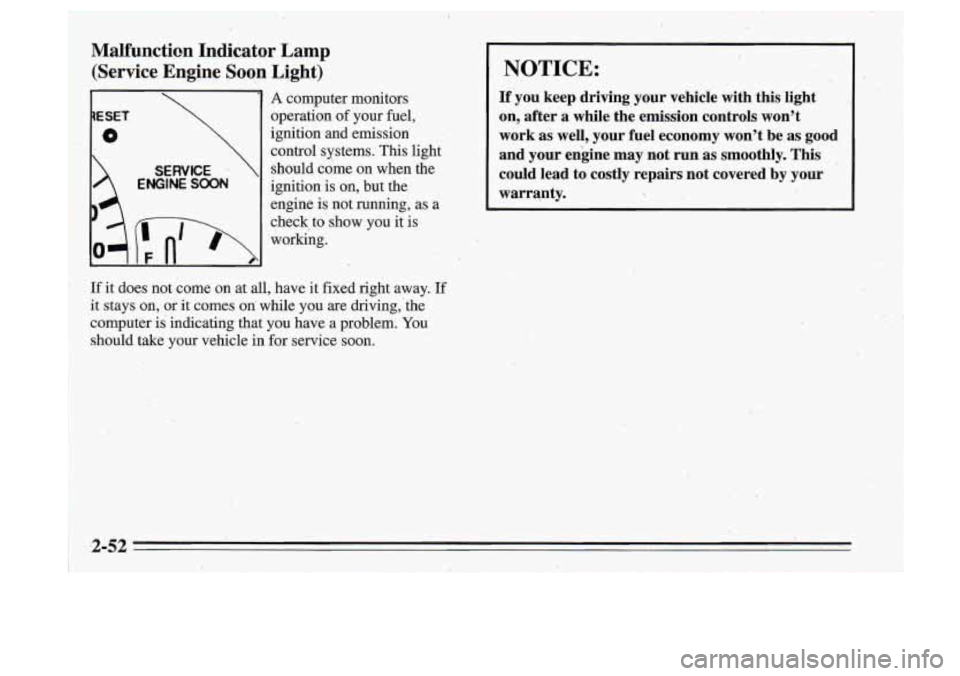
~ Malfunction Indicator Lamp
(Service Engine Soon Light)
1ESET
0
SERVICE
ENGINE SOON
1 A computer monitors
operation of your fuel,
ignition and emission control systems. This light
should come on when the
ignition
is on, but the
engine
is not running, as a
check, to'show you it is
working.
If it does not come
on at all, have it fixed right away. If
it stays on, or it comes on while you are driving,'the
computer is indicating that
you have a problem. You
should take your vehicle in for service soon.
,I.
NOTICE:
If you keep driving your vehicle with this light
on, after a while the emission controls won't
work as well, your fuel economy won't
be as good
and your en'gine may not run as smoothly. This
could lead to costly repairs not covered by your
warranty.
Page 112 of 340
.(I
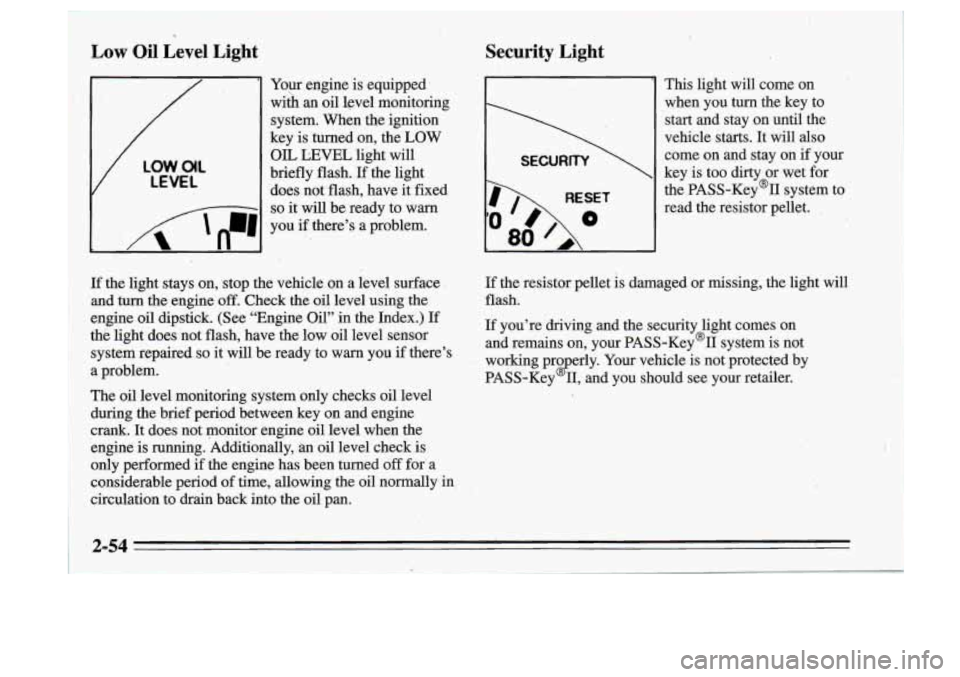
Low Oil Level Light
Your engine is equipped’
wiih
an oil level monitoring
system. When the ignition
key is turned on, the
LOW
V
LOW.O(L
LEVEL
OIL LEVEL light will
briefly flash.
If the light
‘does not flash, have it fixed
I 8 - -1 so it will be ready to warn
I n
I ‘A ‘n-1 , .
you if there’s a problem.
- ..
Security Light
I
RESET
80
This light will come on
when you
turn the key to
start and stay on until the
vehicle starts.
It will also
come on and stay on if your
key is too dirty or wet for
the PASS-Key% system to
read the resistor pellet.
,
If the light stays on,, stop the vehicle on a level surface
and turn the engine
off. Check the oil level using the
engine oil dipstick. (See “Engine Oil” in the Index.) If
thti light does not flash, have
the low oil level sensor
system repaired
so it will be ready to warn you if there’s
a problem.
The
oil level monitoring system only checks oil level
during the brief period between key on and engine
crank. It does not monitor engine oil level when the
engine is running. Additionally,
an oil level check.is
only performed if the engine has been turned
off for- a
considerable period
of time, allowing the oil normally in
circulation to drkn back into the oil pan.
If the resistor pellet is damaged or missing, the light will
flash.
If you’re driving and the security light comes on
and remains on, your PASS-Key’II system is not
working pro erly. Your vehicle is not protected by
PASS-Key
2 11, and you should see your retailer.
2-54
t
Page 114 of 340
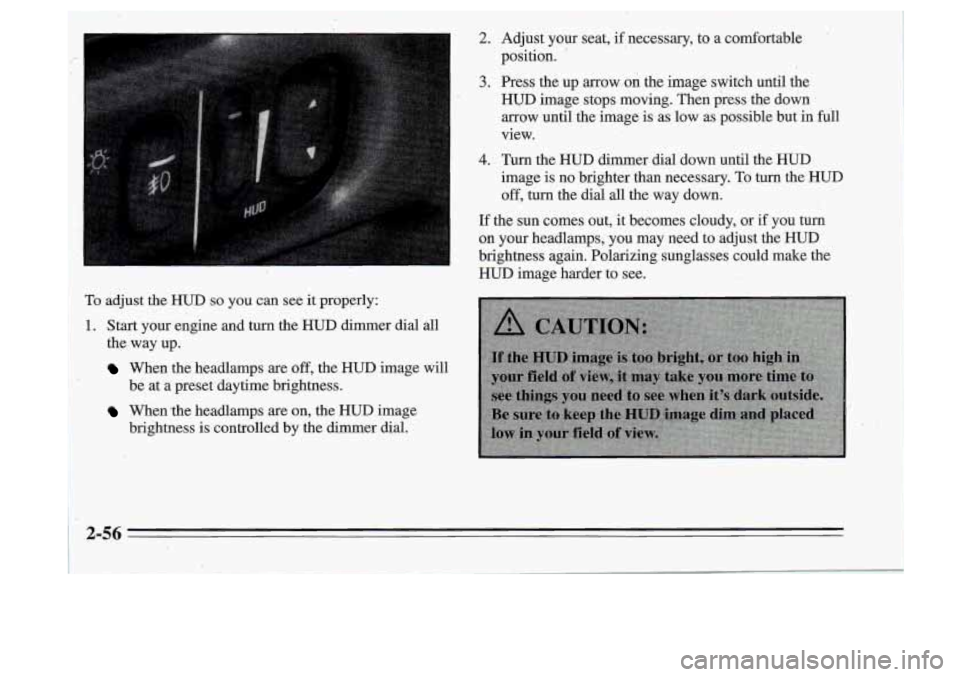
To adjust the HUD so you can see it properly:
1~. Start your engine and turn the HUD dimer dial all
I the, way up.
When the headlamps are off, the HUD image will
When the headlamps are on, the HUD image
be at
a preset daytime brightness.
brightness
is controlled by the dimmer dial.
2. Adjust your seat, if necessary, to a comfortable
position.
'
3. Press the up arrow on the image switch until the
HUD image stops moving. Then press the down
arrow until the image is as low as possible but in full
view.
4. Turn the HUD dimmer dial down until the HUD
image is no brighter than necessary. To turn the HUD
off, turn the dial all the way down.
If the sun comes out, it becomes cloudy, or if you turn
on your headlamps, you may need to adjust the HUD
brightness again. Polarizing sunglasses could make the
HUD image harder to see.
2-56
Page 119 of 340
Air Conditioning
On very hot days, open the windows long enough to let
hot inside air escape. This reduces the time the
compressor has to run, which should help fuel economy.
For quick cool-down on very hot days, use
MAX with
the temperature knob all the way in the blue area. If this
setting is used. for long periods of time, the air in your
vehicle may become too dry.
For normal cooling on hot days, use
VENT with the
temperature knob
in the blue area and the NC'button
pushed
in. The system will bring in outside air and cool it.
On cool but sunny days, the sun may warm your upper
body, but your lower body may not be warm enough.
You can use BI-LEVEL with the,terhperature
knob in
the middle and the
A/C button pushed in. The system
will bring
in outside air and direct it to your upper body,
while sending slightly warmed
air to your lower body.
You may notice this temperature difference more at
. '
some times than others.
J
Heating
On cold days use FLOOR with the temperature knob all
the way
in the red area. The system will bring in outside
air, heat it and send it to the floor ducts.
If your vehicle has an engine coolant heatkr, you can use
it to help your system provide warm air faster when it's
cold outside
(0" F (-1 8 O C) or lower). An engine coolant-
heater
warms the coolant your engine and heating
system use to provide heat. See "Engine Coolant
Heater" in the Index.
Ventilation
For mild outside temperatures when little heating or
cooling is needed, use
VENT to direct outside air through
your vehicle. Your vehicle also has the flow-through
ventilation system described later in this section.
Defogging and Defrosting Windows
Your system' has two settings for clearing the front and
side windows. To defrost the windows'quickly, use
DEFROST with the temperature knob all the way in the
red area. To warrn passengers while keeping the
windows' clean, use
QEFOG.
3-3
Page 122 of 340
Automatic Control
For the most efficient operation, you ,should.set the
system temperature and press the knob. The system will
select the best fan speed and air flow, settings to keep
you comfortable. The air conditioning compressor will
run
if the outside temperature is above 40°F (4.5 ” C).
YOU may notice
a delay of three to four minutes before
the fan comes on.
Manual Control
If you prefer to manually control the heating, cooling
and ventilation
in your vehicle, push UPPER, BI-LEV,
LOWER, DEFOG or
DEE AUTO will go off the
display. Set the system to the temperature and fan
speed you want. The system will try to maintain the
temperature you set using the mode you select. The
following suggestions will help the system run more
efficiently in manual mode.
Air Conditioning
On very hot days, open the windows long enough to
let hot inside
air escape. This reduces the time the
compressor has to run, which should help fuel economy.
For quick cool-down on very hot days, use RECIRC. If
this setting is used for long periods
of time, the air in
your vehicle may become too dry. For normal cooling on hot days, use UPPER with the
A/C button pushed
in. The system will.bring in outside
air and cool it.
On
cool but .sunny days, the sun may warm your upper ,
body, but your lower body may not be warm enough. You
can use BI-LEV with the A/C’ button pushed in.’
The system will bring in outside air and direct it to your
upper body, while sending slightly warmed air to your
lower body. You may notice this temperature difference
more at some times than.others.
Heating
On cold days use LOWER. The system will bring in
outside air, heat it and send it to the floor ducts.
If your vehicle has an engine coolant heater, you, can use
it to help your system provide warm air faster when it’s
cold outside
(0°F (-18°C) or lower). An engine coolant
heater warms the‘coolant your engine and heating
system use to provide heat. See “Engine Coolant
Heater” in the Index.
Ventilation
For mild outside temperatures when little heating or
cooling is needed, use-UPPER to direct outside air through
your vehicle.
Your vehicle also has the flow-through
ventilation system described later in
this section.
3-6
-