tow Oldsmobile Cutlass Supreme 1996 s Owner's Guide
[x] Cancel search | Manufacturer: OLDSMOBILE, Model Year: 1996, Model line: Cutlass Supreme, Model: Oldsmobile Cutlass Supreme 1996Pages: 356, PDF Size: 18.48 MB
Page 193 of 356
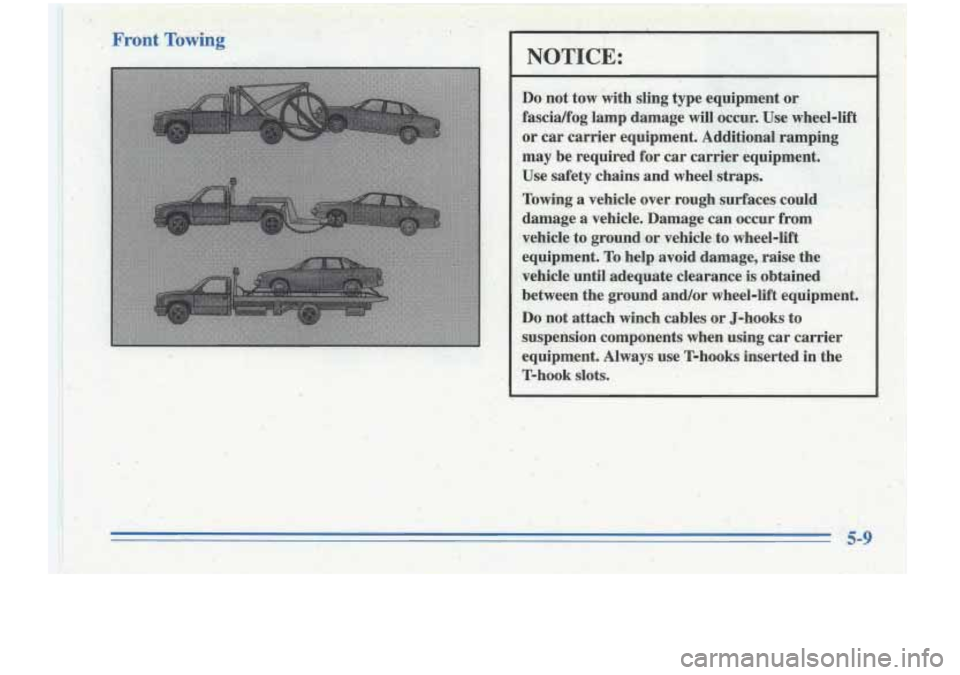
NOTICE:
Do not tow 'ivith sling type equipment or
fascidfog lamp damage
will oceur. Use wheel-lEt
or car carrier equipment. Additional ramping
may be required for
car carrier equipment.
Use safety chains and wheehtraps.
. '
Towing a vehicle over rough surfaces could .
damage a vehicle. Damage can occur from
vehicle
to ground or vehicle to wheel-lift
equipment.
To helg .avoid damage, raise the
vehi.cle until adequate clearance is obtained
between the ground and/or wheel-lift equipment.
Do not attach winch cables or J-hooks to
suspension components when using car carrier
equipment. Always use T-hooks inserted in the
T-hook
slots.
Page 195 of 356
Rear Towing
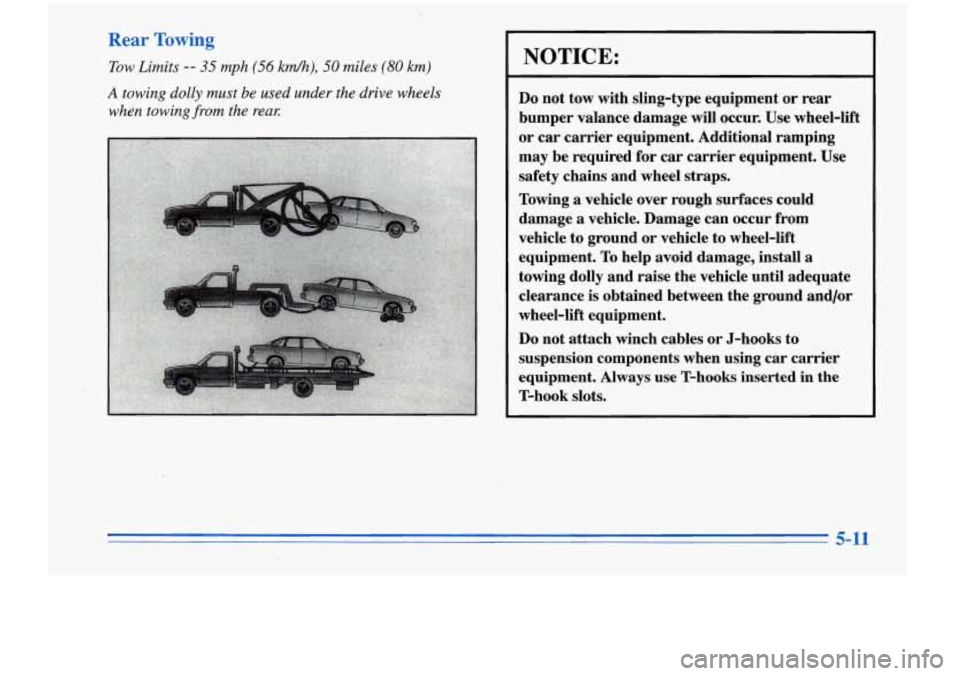
Tow Limits -- 35 mph (56 kdj, 50 miles (80 km)
A towing dolly must be used under the drive wheels
when towing from the rea7:
NOTICE:
Do not tow with sling-type equipment or rear
bumper valance damage will occur. Use wheel-lift
or car carrier equipment. Additional ramping
may be required for car carrier equipment.
Use
safety chains and wheel straps.
Towing
a vehicle over rough surfaces could
damage
a vehicle. Damage can occur from
vehicle to ground or vehicle to wheel-lift
equipment. To help avoid damage, install
a
towing dolly and raise the vehicle until adequate
clearance
is obtained between the ground and/or
wheel-lift equipment.
Do not attach winch cables or J-hooks to
suspension components when using car carrier
equipment. Always use T-hooks inserted in the
T-hook slots.
5-11
Page 198 of 356
If No Steam,Is Coming From Your Engine If you no longer have the overheat warning, you can
If you get the overheat waning but
see or hear no
the engine can get a little too hot when you: drive. Just
to be safe, drive slower for about 10 minutes.
If the warning doesn’t come back on, you can
~ steam, the problem may not be too serious. Sometimes drive normally.
I Y Y
’ Climb a long hill on a hot day.
Stop after high-speed driving.
Idle for long periods in traffic.
Tow a trailer.
If you get the overheat warning with no sign of steam,
try this for a minute or
so: ,.
1. Turn off your air conditioner. If
the warning continues, pull over, stop, and park your
vehicle right away.
If there’s still no sign
of steam, you can idle the engine
for two or three minutes while you’re parked, to see if
the warning stops. But then, if you still have the
1
warning, turn off the engine and get everyone out of the
vehicle
until it cools down.
You may decide not to lift the hood but to get service
help right away.
2. Turn on your heater to full hot at the highest fan
speed and open the window
as necessary.
3. If you’re in a traffic jam, shift to NEUTRAL (N);
otherwise, shift to the highest gear while
driving
-- AUTOMATIC OVERDRIVE (@)
or THIRD (3).
5-14
Page 207 of 356
If a Tire Goes Flat
It’s unusual for a tire to “blow out” while you’re driving,
especially
if you maintain your tires properly. If air goes
out of a tire, it’s much more likely to leak out slowly.
But if you should ever have a “blowout,” here are a few
tips about what to expect and what
to do:
If a front tire fails, the flat tire will create a drag that
pulls the vehicle toward that side. Take your foot
off the
accelerator pedal and grip the steering wheel firmly.
Steer to maintain lane position, and then gently brake to
a stop well out of the traffic lane.
A rear blowout, particularly on a curve, acts much like a
skid and may require the same correction you’d use in a
skid. In any rear blowout, remove your foot from the
accelerator pedal. Get the vehicle under control by
steering the way you want the vehicle to go. It may be
very bumpy and noisy, but you can still steer. Gently
brake to a stop
-- well off the road if possible.
If a tire goes flat, the next part shows how to use your
jacking equipment to change a flat tire safely.
Changing a Flat Tire
If a tire goes flat, avoid further tire and wheel damage
by driving slowly to a level place. Turn on your hazard
warning flashers.
Changing a tire can cause an injury. The vehicle
can slip
off the jack and roll over you or other
people. You and they could be badly injured.
Find
a level place to change your tire. To help
prevent the vehicle from moving:
1. Set the parking brake firmly.
2. Put the shift lever in PARK (P).
3. Turn off the engine.
To be even more certain the vehicle won’t move,
you can put blocks at the front and rear
of the
tire farthest away from the one being changed.
That would be the tire on the other side of the
vehicle,
at the opposite end.
5-23
Page 212 of 356
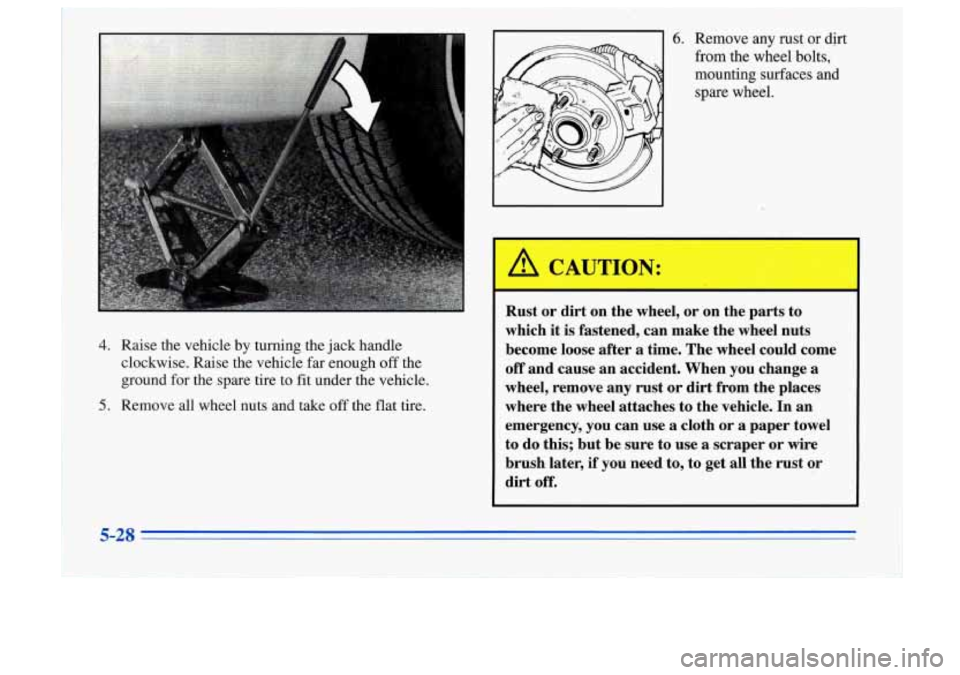
4. Raise the vehicle by turning the jack handle
clockwise. Raise the vehicle far enough
off the
ground for the spare tire to fit under the vehicle.
5. Remove all wheel nuts and take off the flat tire.
6. Remove any rust or dirt
from the wheel bolts,
mounting surfaces and
spare wheel.
J
Rust or dirt on the wheel, or on the parts to
which it is fastened, can make the wheel nuts
become loose after
a time. The wheel could come
off and cause an accident. When you change a
wheel, remove any rust or dirt from the places
where the wheel attaches to the vehicle. In an
emergency, you can use
a cloth or a paper towel
to do this; but be sure to use
a scraper or wire
brush later, if you need to, to get all the rust or
dirt off.
Page 213 of 356
Never use oil or grease on studs or nuts. If you
do, the nuts might come loose. Your wheel could
fall
off, causing a serious accident.
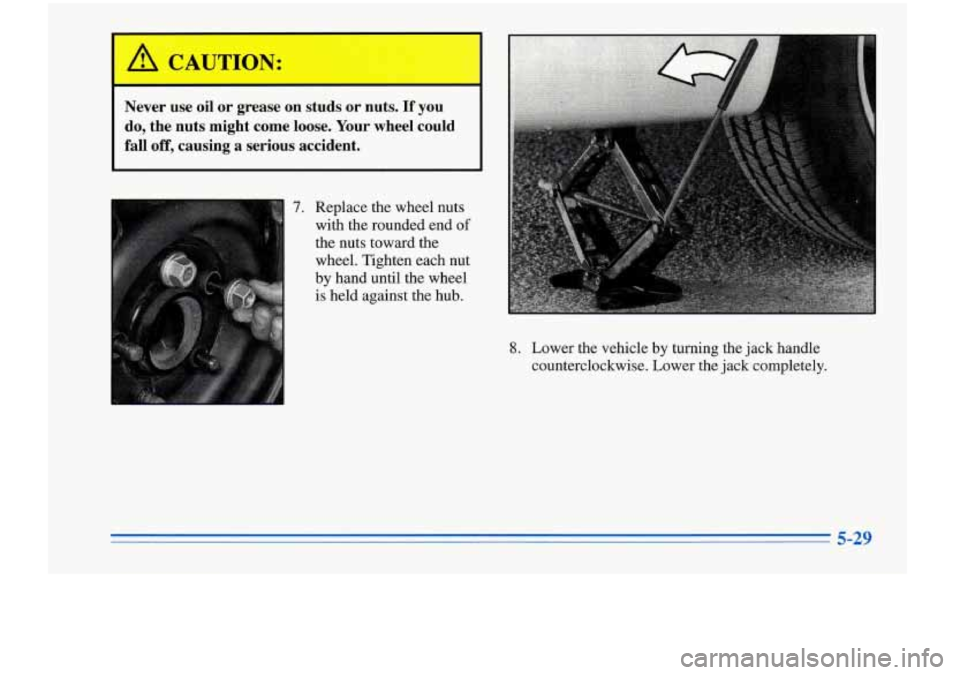
I 7. Replace the wheel nuts with the rounded end
of
the nuts toward the
wheel. Tighten each nut
by hand until the wheel
is held against the hub.
8. Lower the vehicle by turning the jack handle
counterclockwise. Lower the jack completely.
5-29
Page 218 of 356
If You’re Stuck: In Sand, Mud,
Ice or
Snow
What you don’t want to do when your vehicle is stuck is
to spin your wheels too fast. The method known as
“rocking” can help you get out when you’re stuck, but
you must use caution.
If you let your tires spin
at high speed, they can
.explode, and you or others could be injured.
And, the transaxle or other parts of the vehicle
can overheat. That could cause an engine
compartment fire or othen damage. When you’re
stuck, spin the wheels as little as possible. Don’t
spin the wheels above
35 mph (55 km/h) as shown
on the speedometer.
NOTICE:
Spinning your wheels can destroy parts of your
vehicle as well as the tires.
If you spin the wheels
too fast while shifting your transaxle back and
forth, you can destroy your transaxle.
For information about using tire chains
on your vehicle,
see “Tire Chains” in the Index.
Rocking Your Vehicle to Get it Out
First, turn your steering wheel left and right. That will
clear the area around your front wheels. Then shift back
and forth between REVERSE (R) and a forward gear,
spinning the wheels as little as possible. Release the
accelerator pedal while you shift, and press lightly
on
the accelerator pedal when the transaxle is in gear. If
that doesn’t get you out after a few tries, you may need
to be towed out. If you do need to be towed
out, see
“Towing Your Vehicle” in the Index.
5-34
Page 231 of 356
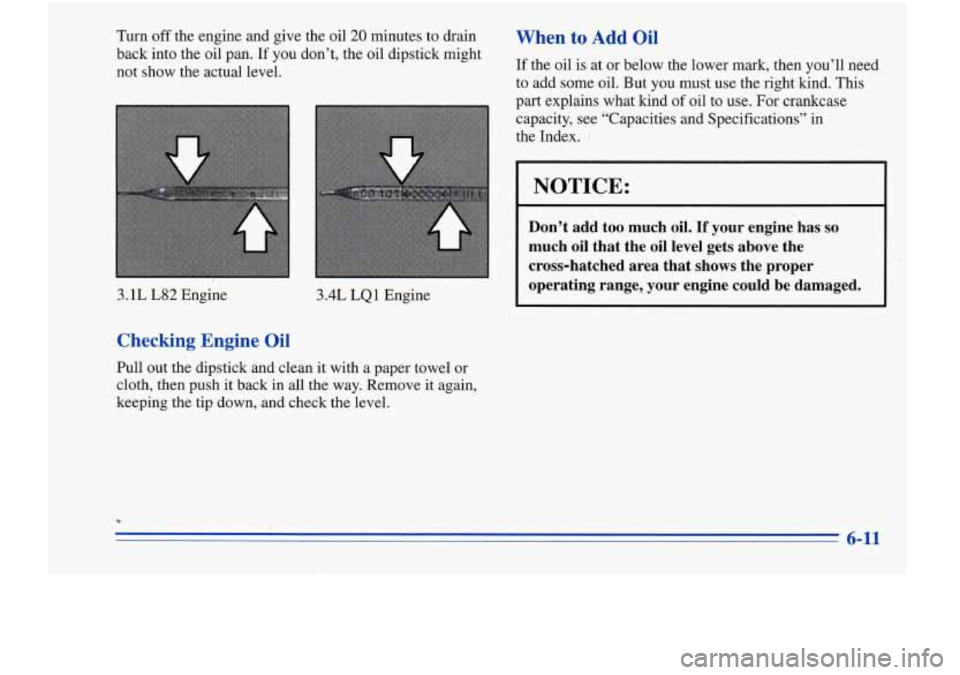
Turn off the engine and give the oil 20 minutes to drain
back into the oil pan. If
you don’t, the oil dipstick might
not show the actual level.
3.1 L L82 Engine 3.4L LQ 1 Engine
Checking Engine Oil
Pull out the dipstick and clean it with a paper towel or
cloth, then push it back in all the way. Remove it again,
keeping the tip down, and check the level.
When to Add Oil
If the oil ist at or below the lower mark, then you’ll need
to add some oil. But you must use the right kind. This
part explains what kind of oil, to use.
For crankcase
capacity, see “Capacities and Specifications” in
the Index.
1
I NOTICE:
Don’t add too much oil. If your engine has so
much oil that the oil level gets above the
cross-hatched area’that shows the proper
operating range, your engine could be damaged.
*
6-11
Page 235 of 356
Engine Oil Additives
Don’t add anytkng to your oil. Your Oldsmobile retailer is
ready ‘to advise if you
think something should be added.
When to Change Engine Oil
See if any one of these is true for you:
0
0
0
0
0
Most trips are less than 5 to 10 miles (8 to 16 km).
This is particularly important when outside
temperatures are below freezing.
Most trips include extensive idling (such as frequent
driving in stop-and-go traffic).
Most trips are through dusty areas.
You frequently tow a trailer or use a carrier on top of
your vehicle.
,’
The vehicle is used for delivery service, police, taxi
or other commercial application.
Driving under these conditions causes engine oil to
break down sooner. If any one of these is true for your
vehicle, then you need to change your oil and filter
every 3,000 miles (5 000 km) or 3 months -- whichever
occurs first. If
none of them is true, change the oil and filter every
7,500 miles (12 500 km) or 12 months -- whichever
occurs first. Driving a vehicle with a fully warmed
engine under highway conditions causes engine oil
to
break down slower.
What to Do with Used Oil
Did you know that used engine oil contains certain
e€ements that may be unhealthy for your skin and could
even cause cancer? Don’t let used oil stay on your skin
for very long. Clean your ’skin and nails with soap and
water, or a good hand cleaner. Wash or properly throw
away clothing or rags containing used engine oil. (See
the manufacturer’s warnings about the use and disposal
of oil products.)
Used oil can be a real threat to the environment. If you
change your own oil, be sure to
drain all free-flowing oil
from the filter before disposal. Don’t ever dispose of oil
by putting
it in the trash, pouring it on the ground, into
sewers,
or into streams or bodies of water. Instead,
recycle
it by taking it to a place that collects used oil. If
you have a problem properly disposing of your used oil,
ask your retailer, a service station or a local recycling
center for help.
6-15
Page 237 of 356
I
Operating the.engine wi4.h the air cleaner oi’fcan
cause you or .others to be burned. The
air cleaner
not only cleans the
air, it stops flame if the engine
backfires. Hit isn’t there, and the engine
backfires, you could
be burned. Don’t drive with
it off, and be careful working on the engine with
the
air cleaner off.
NOTICE:
If the air cleaner is off, a backfii can cause a
damaging engine fire. And, dirt can easily get
into
your engine, which will damage it. Always
have the
air cleaner in place when you’re driving.
-1 -. .. ..
Automatk Transaxle’ Fluid
When to Check and Change
A good time to check your automaticdransaxle fiui,d
level is when the engine
oil is changed.
Change both the fluid and. filter ,every
30,000 miles
(83 000 km) if the, vehicle is mainly ‘driven under one or
more of these conditions:
’
In heavy city traffic where the outside temperature
regularly reaches
90 OF (32 O C) or higher;.
In hilly or mountainous terrain.
When doing frequent trailer towing.
Uses such as found in :taxi, polide or delivery service. ,.,
If you do not use your vehicle under any of these
conditions, the fluid and filter
.. do not require changing.
See “Scheduled Maintenance Services” in the Index.
I