coolant level Oldsmobile Cutlass Supreme 1996 Owner's Manuals
[x] Cancel search | Manufacturer: OLDSMOBILE, Model Year: 1996, Model line: Cutlass Supreme, Model: Oldsmobile Cutlass Supreme 1996Pages: 356, PDF Size: 18.48 MB
Page 121 of 356
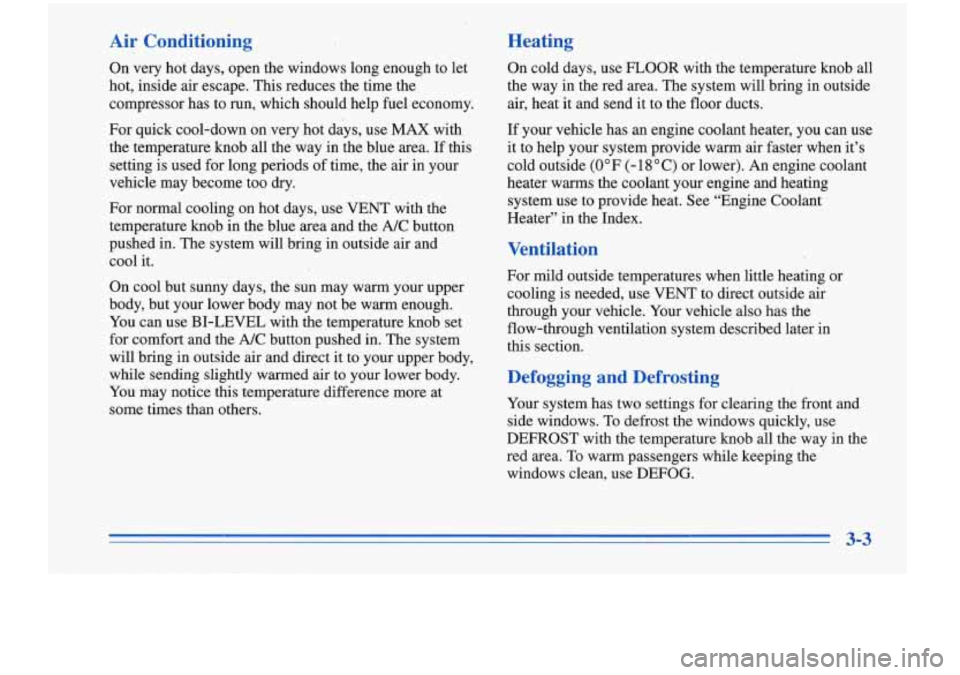
Air Conditioning
On very hot days, open the windows long enough to’let
hot, inside air escape. This reduces the time the
compressor has to run, which should help fuel economy.
For quick cool-down on very hot days, use
MAX with
the temperature knob all
the way in the blue area. If this
setting is used for long periods of time, the air in your
vehicle may become too
dry.
For normal cooling on hot days, use VENT with the
temperature knob in the blue area and the A/C button
pushed in. The system will bring in outside air and
cool it.
On cool but sunny days, the sun may warm your upper
body, but your lower body may not be warm enough.
You can use BI-LEVEL with the temperature knob set
for comfort and the A/C button pushed in. The system
will bring in outside air and direct it to your upper body,
while sending slightly warmed air
to your lower body.
You may notice this temperature difference more at
some times than others.
Heating
On cold days, use FLOOR with the temperature knob all
the way in the red area. The system will bring in outside
air, heat it and send it to the floor ducts.
If your vehicle has an engine coolant heater, you can use
it to help your system provide warm air faster when it’s
cold outside (0°F (-18°C) or lower). An engine coolant
heater warms the coolant your engine and heating
system use to provide heat. See “Engine Coolant
Heater” in the Index.
Ventilation
For mild outside temperatures when little heating or
cooling is needed, use VENT to direct outside air
through your vehicle. Your vehicle also has the
flow-through ventilation system described later in
this section.
Defogging and Defrosting
Your system has two settings for clearing the front and
side windows. To defrost the windows quickly, use
DEFROST with the temperature knob all the way in the
red area. To warm passengers while keeping the
windows clean, use DEFOG.
3-3
Page 200 of 356
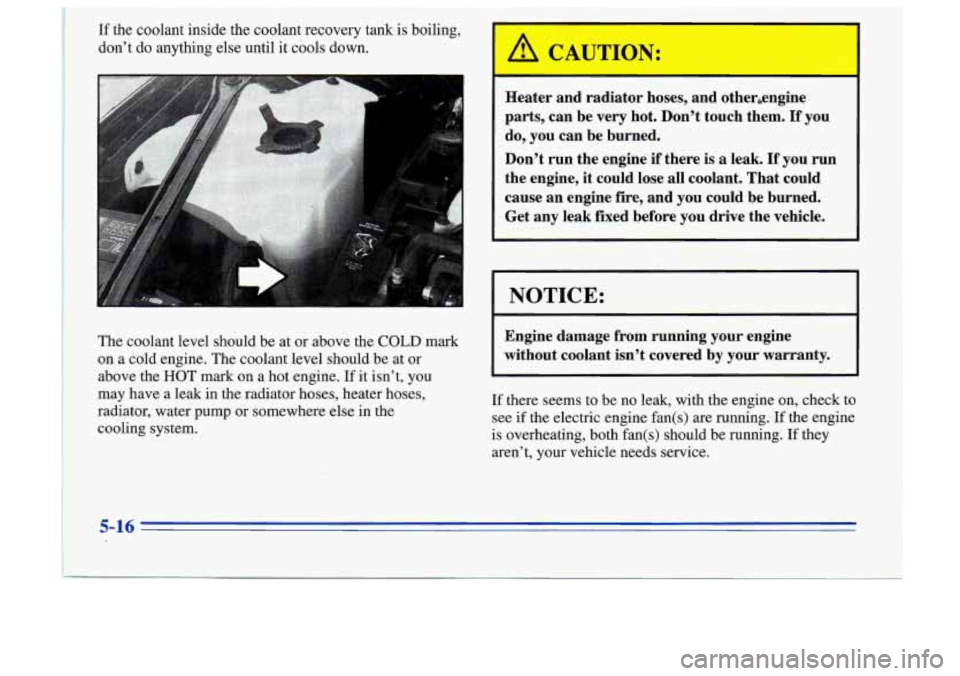
j If the coolant inside the coolant recovery tank is boiling,
don’t do anything
else until it cools down.
.. - ”r -+
Heater and radiator hoses, and otherengine
parts, can be very hot. Don’t touch them.
If you
do, you can be burned.
Don’t run the engine
if there is a leak. If you run
the engine,
it could lose all coolant. That could
cause an engine fiie,
and you could be burned.
Get any leak fixed before you drive the vehicle.
’
I NOTICE:
The coolant level should be at or above the COLD mark
on a cold engine. The coolant level should be at or
above the HOT mark on a hot engine. If it isn’t, you
may have a leak in the radiator hoses, heater hoses,
radiator, water pump or somewhere else in the cooling system.
r
Engine damage from running your engine
without coolant isn’t covered by your warranty.
If there seems to be no leak, with the engine on, check to
see if the electric engine fan(s) are running. If the engine
is overheating, both fan@) should be running; If they
aren’t, your vehicle needs service.
5-16
Page 201 of 356
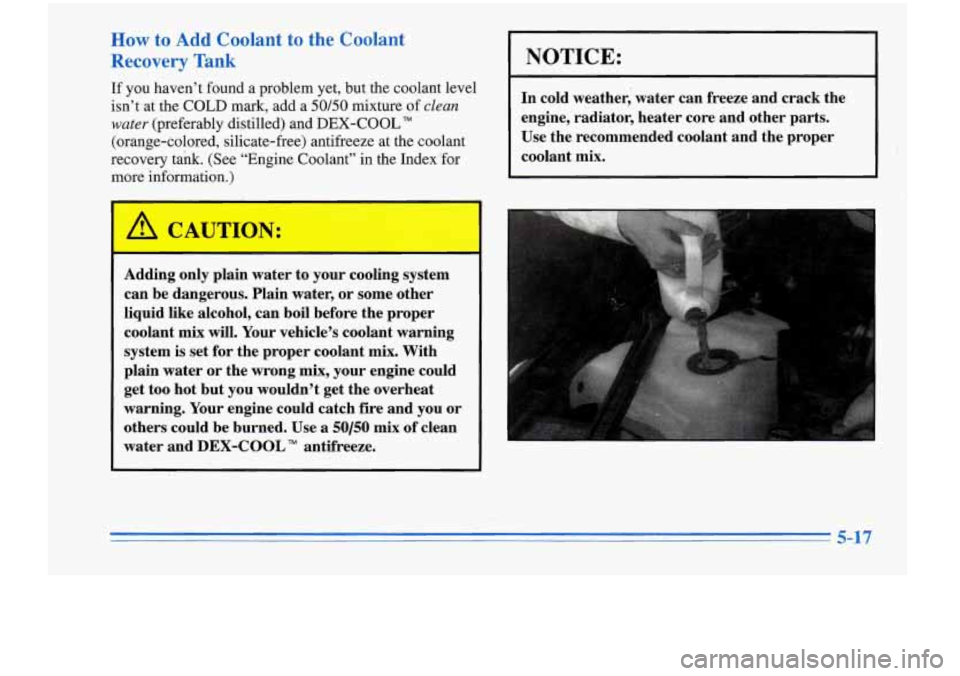
How to Add Coolant to the Coolant
Recovery Tank
If you haven’t found a problem yet, but the coolant level
isn’t at the COLD mark, add a
50/50 mixture of clean
water
(preferably distilled) and DEX-COOL
(orange-colored, silicate-free) antifreeze at the coolant
recovery
tad. (See “Engine Coolant” in the Index ’for
more information.)
I
A CAUTION:
- -
Adding only plain water to your cooling system
can be dangerous. Plain water, or some other
liquid like alcohol, can boil before the proper
coolant mix will. Your vehicle’s coolant warning
system
is set for the proper coolant mix. With
plain water or the wrong, mix, your engine could
get too hot but you wouldn’t get the overheat
warning. Your engine could catch fire and you
or
others could be burned. Use a 50/50 mix of clean
water and
DEX-COOL antifreeze.
NOTICE:
In cold weather, water can freeze and crack the
engine, radiator, heater core and other parts.
Use the recommended coolant and the proper
coolant mix.
5-17
Page 206 of 356
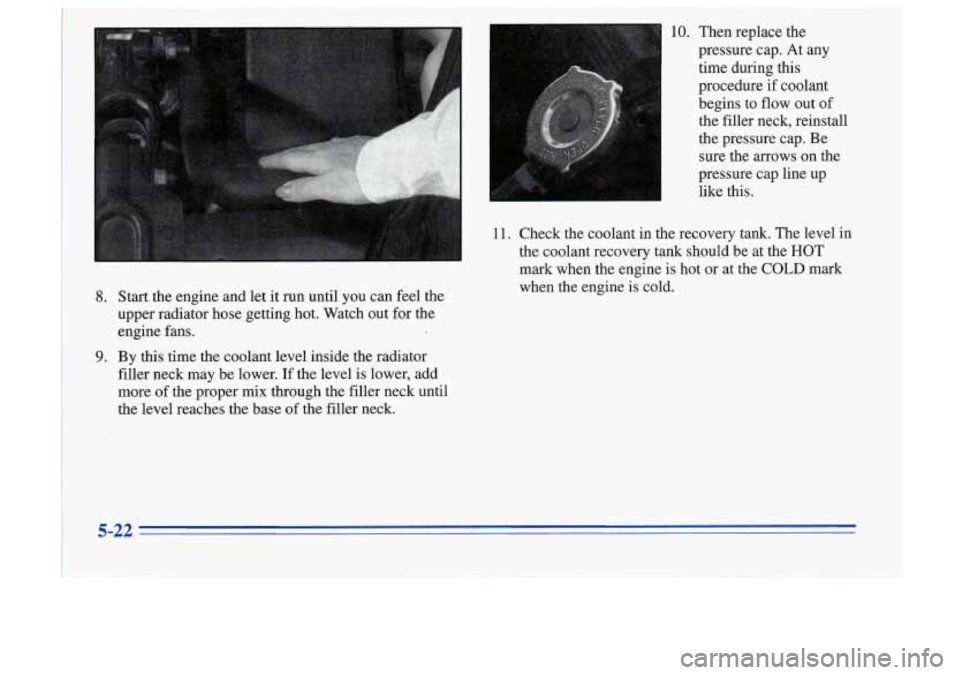
8. Start the engine and let it run until you can feel the
upper radiator hose getting hot. Watch out for the
engine fans.
filler neck may be lower. If the level is lower, add
.more of the proper
mix through the filler neck until
the level reaches the base of the filler neck.
9. By this time the coolant level inside the radiator
10. Then replace the
pressure cap. At any
time during this
procedure if coolant
begins to flow out
of
the filler neck, reinstall
the pressure cap. Be
sure the arrows on the
pressure cap line up
like this.
11. Check the coolant in the recovery tank. The level in
the coolant recovery tank should be at the HOT
mark when the engine is hot or at the
COLD mark
when the engine is cold.
5-22
Page 240 of 356
How ,to Add Fluid Engine Coolant
I
Refer to the Maintenance Schedule to determine what
Fluids and Lubricants” in the Index.
If the fluid level is low, add only enough of the proper
fluid to bring the level into the cross-hatched area on
the dipstick.
~ kind of transaxle fluid to use. See “Recommended ,
1. Pull out the dipstick.
.2. Using a long-neck funnel, add enough fluid at the
dipstick hole to bring it to the proper level.
It doesn’t take much fluid, generally less than a pint
(0.5 L). Don’t ove@ZZ. We recommend you use only
fluid labeled DEXRON@-111, ‘because fluid with that
label is made especially for your automatic transaxle.
Damage caused by fluid other than DEXRON-I11 is
not covered by your new vehicle warranty.
After adding fluid, recheck the fluid level as
described under “How to Check.”
0 When the correct fluid level is obtained, push the
dipstick back in all the way.
6-20
The cooling system in your vehicle is filled with new
DEX-COOL
TM (orange-colored, silicate-free) engine
coolant. This coolant is designed to remain
in your
vehicle for
5 years or 100,000 miles (166 000 km),
whichever occurs first.
The following explains your cooling system and how to
add coolant when it is low. If you have a problem with
engine overheating or if you need to add coolant to your
radiator, see “Engine Overheating” in the Index.
A
50/50 mixture of water and the proper.coolant for
your Oldsmobile will:
0 Give freezing protection down to -34°F (-37°C).
0 Give boiling protection up to 265 OF ( 129 O C).
0 Protect against rust and corrosion.
0 Help keep the proper engine temperature.
0 Let the warning lights and gages work as
they should.
Page 242 of 356
NOTICE:
If you use.an improper coolant mix, your engine-
could overheat and be badly damaged. The
.
repair cost wouldn't be covered by your
warranty.
Too much water in the mix can freeze
and crack' the engine, radiator, heater core and
other parts.
..
If you have to add coolant more than four times a year,
,have your retailer check your cooling system.
' ,.
NOTICE:
If you use the proper coolant, you don't have to
add extra inhibitors or additives which claim to
improve the system. These can be harmful.
.. , ,', . . , .,
L
I,
. -1 I ' .. .. . *. .. .,
.
,.
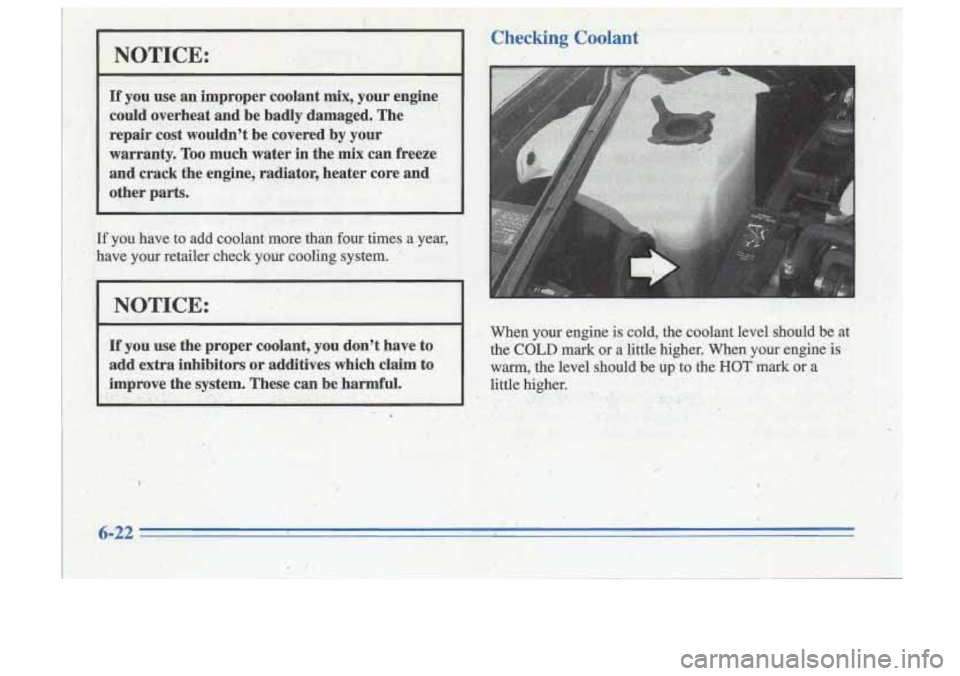
Chec'-'ng Coolant
When your engine is cold, the coolant level should be at
the
COLD mark or a little higher. When your engine. is
warm, the level should be up' to the HOT mark or, a
little higher.
/I .
Page 326 of 356
Part B: Owner Checks and Services
Listed below are owner checks and services which
should be performed at the intervals specified to help
ensure the safety, dependability and emission control
performance of your vehicle.
Be sure any necessary repairs are completed at once.
Whenever any fluids or lubricants are added to your
vehicle, make sure they are the proper ones, as shown
in Part
D.
At Each Fuel Fill
I
It is important for you or a service station attendant to
perform these underhood checks at each fuel
fill.
Engine Oil Level Check
Check the engine oil level and add the proper oil if
necessary. See “Engine Oil” in the Index for
further details.
Engine Coolant Level Check
Check the engine coolant level and add the proper
coolant mix if necessary. See “Engine Coolant” in the
Index for further details.
Windshield Washer Fluid Level Check
Check the windshield washer fluid level in the
windshield washer tank and add the proper fluid
if
necessary. See “Windshield Washer Fiuid”,in the Index
for further details.
At Least Once a Month
Tire Inflation Check
Make sure tires are inflated to the correct pressures. See
“Tires” in the Index for further details.
Cassette Deck Service
Clean cassette deck. Cleaning should be done every
50 hours of tape play. See “Audio Systems” in the Index
for further details.
Power Antenna Service
Clean power antenna mast. See “Audio Systems” in the
Index for further details.
7-36
Page 349 of 356
Hill and Mountain Roads ......................... 4-21
Hitches. Trailer
................................. 4-32
Hood Checking Things Under
......................... 6-7
Release
...................................... 6-7
Ho~
......................................... 2-25
Hydroplaning
.................................. 4- 17
Ignition Positions
.............................. 2. 10
Illuminated Entry
............................... 2-34
Inflation. Tire
.................................. 6-42
Inside Daymight Rearview Mirror
.................. 2-36
Inspections
Brakesystem
................................. 7-40
Exhaust Systems
............................. 7-40
Front-Wheel-Drive Axle Boot
.................. 7-40
Front-Wheel-Drive Axle Seal
................... 7-40
Radiator and Heater Hose
...................... 7-40
Steering
.................................... 7-40
Suspension
.................................. 7-40
Throttle Linkage
.............................. 7-40
Instrumentpanel
............................... 2-42
Brightness Control
............................ 2-33
Cluster
..................................... 2-43
FuseBlock
.................................. 6-61
Interior Lamps
................................. 2-33
Jack, Tire
.................................... 5-23
Jump Starting
.................................... 5-2
Cleaning
.................................... 6-53 Key
Lock Cylinders Service
..................... 7-37
Key Reminder Warning
.......................... 2-11
Keys
.......................................... 2-1
Labels
....................................... 4-27
Certification
................................. 4-27
Service Parts Identification
..................... 6-59
Tire-Loading Information
...................... 4-27
Vehicle Identification Number
................... 6-59
Courtesy
..................................... 2-33
Dome
.I .................................... 2-35
Interior
..................................... 2-33
OnReminder
................................ 2-32
Latches, Seatback
................................ 1-5
Leaving Your Vehicle
............................. 2-4
Leaving Your Vehicle with the Engine Running
....... 2-21
Lighter
....................................... 2-39
Lights Air Bag Readiness
....................... 1-20.2-46
Anti-Lock Brake System Active
............. 2-49, 4-8
Anti-Lock Brake System Warning
............ 2-48, 4-6
Brake System Warning
......................... 2-47
Charging System
............................. 2-46
Engine Coolant Temperature
.................... 2-49
Interior
..................................... 2-33
Low Coolant Warning
......................... 2-50
LowFuel
................................... 2-56
LowOilLevel
............................... 2-55
Oilwarning
................................. 2-53
Safety Belt Reminder
...................... 1-7, 2-45
Security
.................................... 2-55
Service Engine
Soon .......................... 2-51
Lamps
........................................ 2-32
9-5
Page 350 of 356
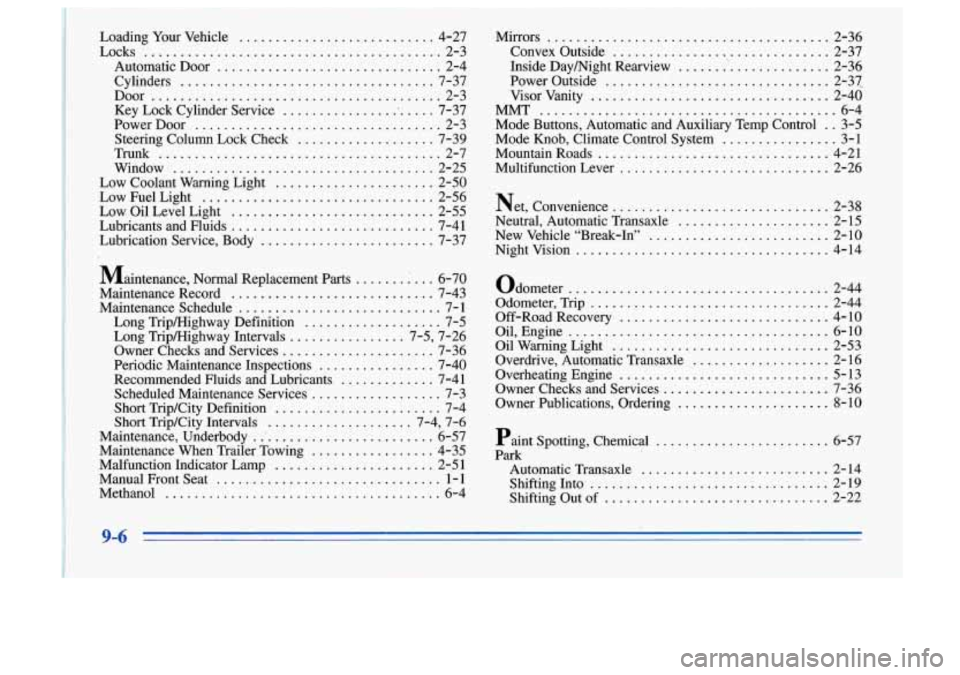
I Loading Your Vehicle- ........................... 4-27
Locks .......................................... 2-3
Automatic Door ................................ 2-4
Cylihders ................................... 7-37
DCJDT ......................................... 2-3
Key Lock Cylinder Service ...................... 7-37
POWU Door .................................. 2-3
Steering
. Column Lock Check ................... 7-39
Trunk ....................................... 2-7
Window .................................... 2-25
Low Coolant Warning Light
...................... 2-50
Low Fuel Light .................................. 2-56
LOW Oil Level Light .............................. 2-55
Lubricants and HrJids ............................ 7-41
Lubrication Service,
Body ........................ 7-37
M~EO~S ......................................... 2-36
Convex Outside .............................. 2-37
Inside Day/Night Rearview ...................... 2-36
Power Outside ................................. .. 2-37,
Visor Vanity
................................. 2-40
"I' ......................................... 6-4
Mode Buttons. Automatic and Awriliary Temp Control . . 3-5
Mode
Knob, Climate Control System ................ 3-1
MountainRoads ................................. 4-21
Multifunction Lever
............................. 2-26
Net. Convenience .............................. 2-38
Neutral. Automatic Transaxle
..................... 2-15
New Vehicle "Break-In" .......................... 2-10
Nightvision ................................... 4-14
Maintenance. Normal Replacement parts
....... .' ... 6-70
Maintenance Record
............................ 7-43
Maintenanceschedule
............................ 7-1
Long TripMghway Definition
................... 7-5
Long Tripmighway Intervals
................ 7.5. 7.26
Owner Checks and Services
..................... 7-36
Periodic Maintenance Inspections
................ 7-40
Recommended Fluids and Lubricants
............. 7-41
Scheduled Maintenance Services'
.................. 7-3
Short Trip/Citv Definition
....................... 7-4 Odometer
................
Odometer. Trip .............
Off-Road Recovery .........
Oil. Engine ................
Oil
Waffling Light ..........
Overdrive. Automatic Transaxle
Overheating Engine .........
Owner Checks and SerVices ...
Owner Publications. Ordering .
.................... 2.44,
.................... 2-44
.................... 4-1Q
.................... 6-10
.................... 2-53
...................... 2-16
.................... 5-13
.................... 7-36
.................... 8-10
Short Tr$CiG Intervals
.................... 7.4. 7.6
Maintenance. Underbody
.. '. ...................... 6-57 Paint spotting. chemical
Maintenance When Trailer Towing 4-35
Park 6-57
Malfunction Indicator .Lamp
....................... 2-5 1 Automatic Transaxle ........................... 2-14 ManualFrontSeat ............................... 1-1
Methanol
...................................... 6-4 ShifIing-Out of .. ............................ 2-22
........................ .................
Shifting Into ................................. 2.- 13
9-6