night vision Oldsmobile Cutlass Supreme 1996 Owner's Manuals
[x] Cancel search | Manufacturer: OLDSMOBILE, Model Year: 1996, Model line: Cutlass Supreme, Model: Oldsmobile Cutlass Supreme 1996Pages: 356, PDF Size: 18.48 MB
Page 161 of 356
A cornering skid and an acceleration skid are best
handled by easing your foot
off the accelerator pedal.
If your vehicle starts to slide, ease your foot off the
accelerator pedal and quickly steer the way you want the
vehicle to go. If you start steering quickly enough, your
vehicle may straighten out. Always be ready for a
second skid if it occurs.
Of course, traction is reduced when water, snow, ice,
gravel or other material is on the road. For safety, you’ll
want to slow down and adjust your driving to these
conditions. It is important to slow down on slippery
surfaces because stopping distance will be longer and
vehicle control more limited.
While driving on a surface with reduced traction, try
your best to avoid sudden steering, acceleration or
braking (including engine braking by shifting to a lower
gear). Any sudden changes could cause the tires to slide.
You may not realize the surface is slippery until your
vehicle is skidding. Learn to recognize warning
clues
-- such as enough water, ice or packed snow
on the road to make a “mirrored surface”
-- and slow
down when you have any doubt.
Remember: Any anti-lock brake system
(ABS) helps
avoid only the braking skid.
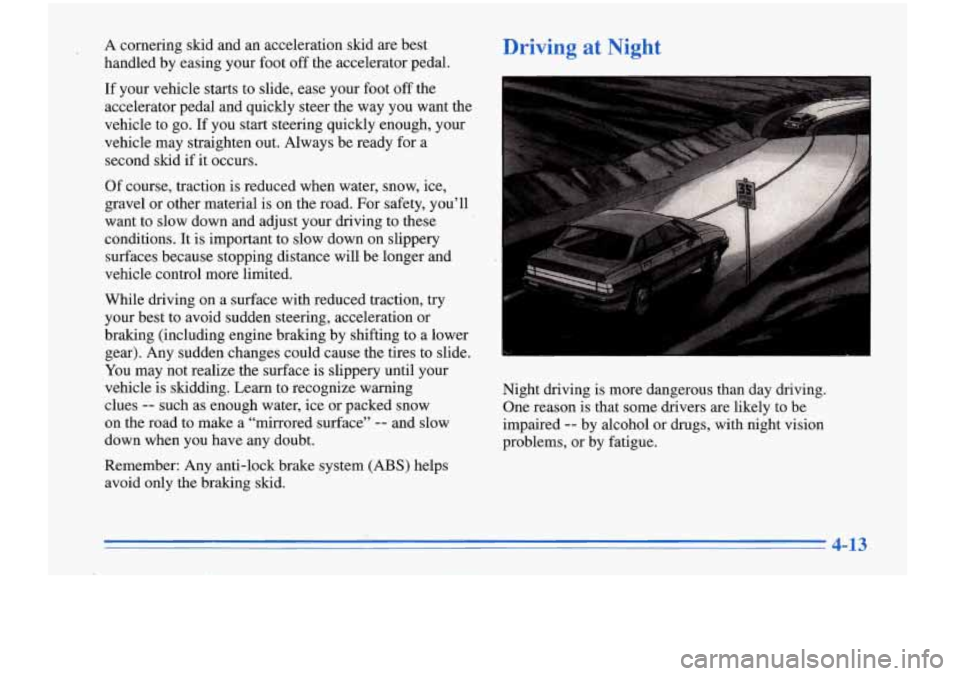
Driving at Night
Night driving is more dangerous than day driving.
One reason is that some drivers are likely to be
impaired
-- by alcohol or drugs, with night vision
problems, or by fatigue.
4-13
Page 162 of 356
Here are some tips on night driving.
0 Drive defensively.
0 Don’t drink and drive.
0 Adjust your inside rearview mirror to reduce the
0 Since you can’t see as well, you may need to slow
glare
from headlamps behind you.
down and keep more space between you and
other vehicles.
0 Slow down, especially on higher speed roads. Your
headlamps can light
up only so much road ahead.
0 In remote areas, watch for animals.
If you’re tired, pull off the road in a safe place
and rest.
Night Vision
have less trouble adjusting to night. But if you’re
driving, don’t wear sunglasses at night. They may cut
down on glare from headlamps, but they also make a lot
of things invisible.
You can be temporarily blinded by approaching
headlamps. It can take a second or two, or even several
seconds, for your eyes to readjust to the dark. When you
are faced with severe glare (as from a driver who
doesn’t lower the high beams, or a vehicle with
misaimed headlamps), slow down a little. Avoid staring
directly into the approaching headlamps.
Keep your windshield and all the glass on your vehicle
clean
-- inside and out. Glare at night is made much
~ worse by dirt on the glass. Even the inside of the glass
can build up a film caused by dust. Dirty glass makes
lights dazzle and flash more than clean glass would,
making the pupils
of your eyes contract repeatedly.
No one can see as well at night as in the daytime. But as Remember that your headlamps light up far less of a
we get older these differences increase. A 50-year-old roadway when you
are in a turn or curve. Keep your
driver may require at least twice as much light to see the eyes moving; that way, it’s easier to pick out dimly
same thing at night as a ‘20-year-old. lighted objects. Just as your headlamps should
be
What you
,do in the daytime can also affect your night
vision. For example, if you spend the day in bright
sunshine you are wise to wear sunglasses. Your eyes will
even aware of it.
checked regularly for proper aim, so should your eyes
be examined regularly. Some drivers suffer from night
blindness
-- the inability to see in dim light -- and
1
4-14
Page 350 of 356
I Loading Your Vehicle- ........................... 4-27
Locks .......................................... 2-3
Automatic Door ................................ 2-4
Cylihders ................................... 7-37
DCJDT ......................................... 2-3
Key Lock Cylinder Service ...................... 7-37
POWU Door .................................. 2-3
Steering
. Column Lock Check ................... 7-39
Trunk ....................................... 2-7
Window .................................... 2-25
Low Coolant Warning Light
...................... 2-50
Low Fuel Light .................................. 2-56
LOW Oil Level Light .............................. 2-55
Lubricants and HrJids ............................ 7-41
Lubrication Service,
Body ........................ 7-37
M~EO~S ......................................... 2-36
Convex Outside .............................. 2-37
Inside Day/Night Rearview ...................... 2-36
Power Outside ................................. .. 2-37,
Visor Vanity
................................. 2-40
"I' ......................................... 6-4
Mode Buttons. Automatic and Awriliary Temp Control . . 3-5
Mode
Knob, Climate Control System ................ 3-1
MountainRoads ................................. 4-21
Multifunction Lever
............................. 2-26
Net. Convenience .............................. 2-38
Neutral. Automatic Transaxle
..................... 2-15
New Vehicle "Break-In" .......................... 2-10
Nightvision ................................... 4-14
Maintenance. Normal Replacement parts
....... .' ... 6-70
Maintenance Record
............................ 7-43
Maintenanceschedule
............................ 7-1
Long TripMghway Definition
................... 7-5
Long Tripmighway Intervals
................ 7.5. 7.26
Owner Checks and Services
..................... 7-36
Periodic Maintenance Inspections
................ 7-40
Recommended Fluids and Lubricants
............. 7-41
Scheduled Maintenance Services'
.................. 7-3
Short Trip/Citv Definition
....................... 7-4 Odometer
................
Odometer. Trip .............
Off-Road Recovery .........
Oil. Engine ................
Oil
Waffling Light ..........
Overdrive. Automatic Transaxle
Overheating Engine .........
Owner Checks and SerVices ...
Owner Publications. Ordering .
.................... 2.44,
.................... 2-44
.................... 4-1Q
.................... 6-10
.................... 2-53
...................... 2-16
.................... 5-13
.................... 7-36
.................... 8-10
Short Tr$CiG Intervals
.................... 7.4. 7.6
Maintenance. Underbody
.. '. ...................... 6-57 Paint spotting. chemical
Maintenance When Trailer Towing 4-35
Park 6-57
Malfunction Indicator .Lamp
....................... 2-5 1 Automatic Transaxle ........................... 2-14 ManualFrontSeat ............................... 1-1
Methanol
...................................... 6-4 ShifIing-Out of .. ............................ 2-22
........................ .................
Shifting Into ................................. 2.- 13
9-6