brake light OLDSMOBILE SILHOUETTE 1993 User Guide
[x] Cancel search | Manufacturer: OLDSMOBILE, Model Year: 1993, Model line: SILHOUETTE, Model: OLDSMOBILE SILHOUETTE 1993Pages: 323, PDF Size: 17.13 MB
Page 145 of 323
m%p&:*g%
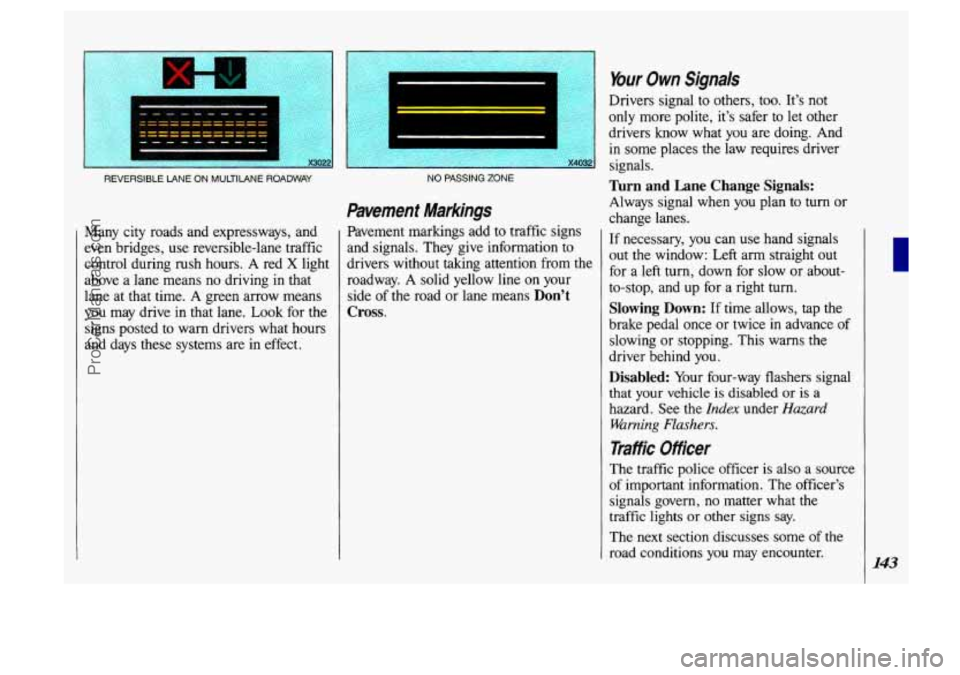
REVERSIBLE LANE ON MULTILANE ROADWAY
Many city roads and expressways, and
even bridges, use reversible-lane traffic
control during rush hours.
A red X light
above a lane means no driving in that
lane at that time. A green arrow means
you may drive in that lane.
Look for the
signs posted to warn drivers what hours
and days these systems are in effect.
~ ~~~
NO PASSING ZONE
Pavement Markings
Pavement markings add to traffic signs
and signals. They give information to
drivers without taking attention from the
roadway.
A solid yellow line on your
side of the road or lane means
Don’t
Cross.
Your Own Signals
Drivers signal to others, too. It’s not
only more polite, it’s safer
to let other
drivers know what
you are doing. And
in some places the law requires driver
signals.
Turn and Lane Change Signals:
Always signal when you plan to turn or
change lanes.
If necessary, you can use hand signals
out the window: Left arm straight out
for a left turn, down for slow or about-
to-stop, and up for a right turn.
Slowing Down: If time allows, tap the
brake pedal once or twice in advance of
slowing or stopping. This warns the
driver behind you.
Disabled: Your four-way flashers signal
that your vehicle is disabled or
is a
hazard. See the
Index under Hazard
Warning Flashers.
Traffic Officer
The traffic police officer is also a source
of important information. The officer’s
signals govern, no matter what the
traffic lights
or other signs say.
The next section discusses some
of the
road conditions you may encounter.
143
ProCarManuals.com
Page 150 of 323
148
Braking
Braking action involves perception time
and reaction time.
First, you have to decide to push on the
brake pedal. That’s
perception time.
Then you have to bring up your foot and
do it. That’s
reaction time.
Average reaction time is about % of a
second. But that’s only an average. It
might be less with one driver and as
long as two or three seconds or more
with another. Age, physical condition,
alertness, coordination, and eyesight all
play a part.
So do alcohol, drugs and
frustration. But even in
% of a second, a
vehicle moving at
60 mph (100 h/h)
travels
66 feet (20 m). That could be a
lot
of distance in an emergency, so
keeping enough space between your
vehicle and others is important. And,
of course, actual stopping
distances vary greatly with the surface
of the road (whether it’s pavement or
gravel); the condition
of the road (wet,
dry, icy); tire tread; and the condition
of
your brakes.
Most drivers treat their brakes with
care. Some, however, overwork the
braking system with poor driving habits.
Avoid needless heavy braking. Some
people drive in spurts-heavy
acceleration followed by heavy
braking-rather than keeping pace
with traffic. This is a mistake. Your
brakes may
not have time to cool
between hard stops. Your brakes will
wear out much faster if you
do a lot of
heavy braking.
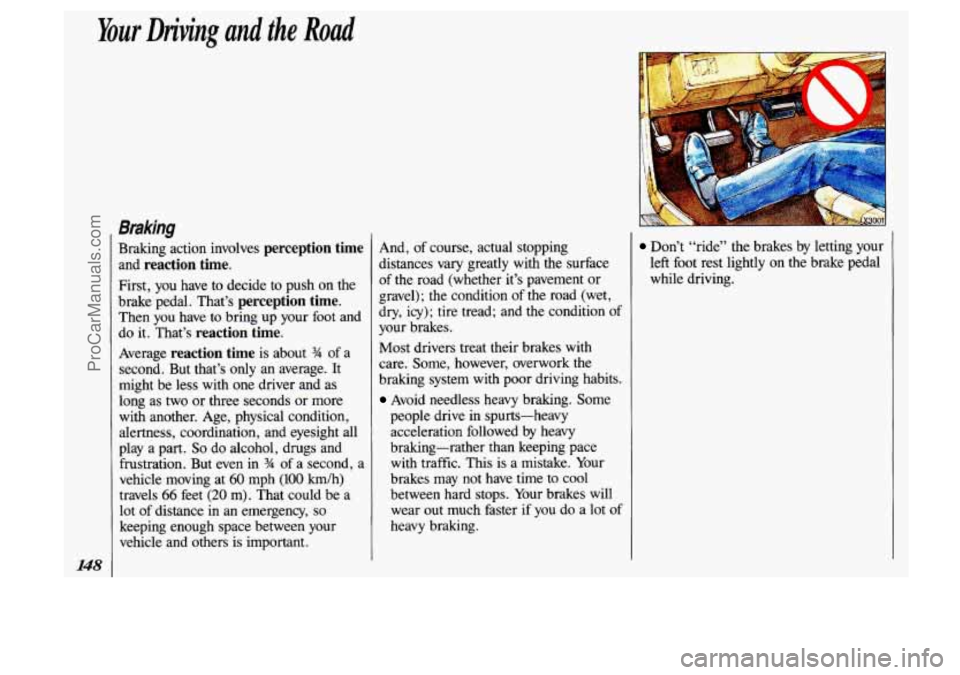
Don’t “ride” the brakes by letting your
left foot rest lightly on the brake pedal
while driving.
ProCarManuals.com
Page 152 of 323
Your
i
Anti-Lock Brakes (CONE)
This light on the instrument panel will
go on when you start your vehicle.
Your anti-lock brake system has
a two-
part system check:
When you start your vehicle and begin
to drive away you may hear a
momentary motor or clicking noise
and you may even notice that your
brake pedal moves a little while this is
going on. This is the
ABS system
testing itself. (You may
also hear this
noise if you leave the ignition in the
Run position for about four seconds
before starting the vehicle.)
If you have your foot on the brake
pedal, this check won’t happen until
the vehicle goes about
4 mph (6 Wh)
or until you take your foot off the
brake pedal.
You’ll also hear a clicking noise the
next time the vehicle goes about
4
mph (6 Wh).
If there’s a problem with the anti-lock
brake system, the anti-lock brake system
warning light will stay on
or flash. See
the
Inda under Anti-Lock Brake System
Warning Light.
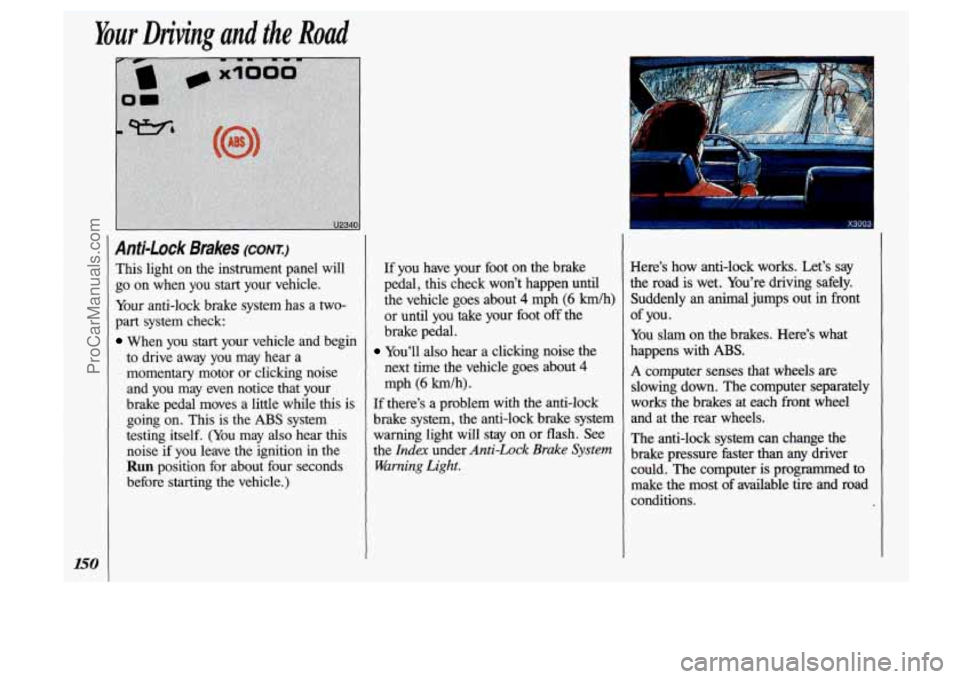
Here’s how anti-lock works. Let’s say
the road is wet. YOU’E driving safely.
Suddenly
an animal jumps out in front
You
slam on the brakes. Here’s what
happens with
ABS.
A computer senses that wheels are
slowing down. The computer separately
works the brakes at each front wheel
and at the rear wheels.
The anti-lock system can change the
brake pressure faster than any driver
could. The computer is programmed to
make the most of available tire and road
conditions.
of you.
ProCarManuals.com
Page 154 of 323
Your Driving and the Road
152
Disc Brake Wear Indicators (CONT.)
Some driving conditions or climates
may cause a brake squeal when
the
brakes are first applied or lightly
applied. This does not mean something
is wrong with your brakes.
Rear Drum Brakes
Your rear drum brakes don’t have wear
indicators, but if
you ever hear a rear
brake rubbing noise, have the rear brake
linings inspected. Also, the rear brake
drums should be removed and inspected
each time the tires are removed for
rotation or changing. When you have the
front brakes replaced, have the rear
brakes inspected, too.
Brake linings should always be replaced
as complete axle sets.
Brake Pedal Travel
See your dealer if the brake pedal does
not return to normal height, or if there
is
a rapid increase in pedal travel. This
could be a sign
of brake trouble.
ProCarManuals.com
Page 159 of 323
Watch for traffic signs, pavement
markings, and lines.
If you can see a
sign up ahead that might indicate a
turn or an intersection, delay your
pass.
A broken center line usually
indicates it’s all right to pass
(providing the road ahead is clear).
Never cross a solid line on your side
of the lane or a double solid line, even
if the road seems empty
of approaching
traffic.
vehicle you want to pass isn’t aware of
your presence, tap the horn a couple
of times before passing.
Do not get too close to the vehicle you
want to pass while you’re awaiting an
opportunity. For one thing, following
too closely reduces your area of
vision, especially if you’re following a
larger vehicle. Also, you won’t have
adequate space if the vehicle ahead
suddenly slows or stops. Keep back a
reasonable distance.
If you suspect that the driver of the
When it looks like a chance to pass is
coming up, start to accelerate but stay
in the right lane and don’t get too
close. Time your move
so you will be
increasing speed as
the time comes to
move into the other lane. If the way is
clear to pass,
you will have a “running
start” that more than makes up for the
distance you would lose by dropping
back. And
if something happens to
cause you
to cancel your pass, you
need only slow down and drop back
again and wait for another opportunity.
slow vehicle, wait your turn. But take
care that someone isn’t trying to pass
you as you pull out
to pass the slow
vehicle. Remember
to glance over
your shoulder and check the blind
spot.
If other cars are lined up to pass a
Check your mirrors, glance over your
shoulder, and start your left lane
change signal before moving out of the
right lane to pass. When you are far
enough ahead of the passed vehicle to
see its front in your inside mirror,
activate your right lane change signal
and move back into the right lane.
(Remember that your right outside
mirror
is convex. The vehicle you just
passed may seem to be farther away
from you than it really is.)
Try not to pass more than one vehicle
at a time on two-lane roads.
Reconsider before passing the
next
vehicle.
vehicle too rapidly. Even though the
brake lights are not flashing,
it may be
slowing down or starting to turn.
If you’re being passed, make it easy
for the following driver to get ahead
of
you. Perhaps you can ease a little to
the right.
Don’t overtake a slowly moving
157
ProCarManuals.com
Page 169 of 323
If you are moving from an outside to a
center lane on a freeway having more
than two lanes, make sure another
vehicle isn’t about to move into the same spot. Look at the vehicles two lanes
over and watch for telltale signs:
turn
signals flashing, an increase in speed, or
moving toward the edge of the lane. Be
prepared
to delay your move.
Once you are moving on the freeway,
make certain you allow a reasonable
following distance. Expect
to move
slightly slower at night.
Leaving the Fkeeway
When you want to leave the freeway,
move to the proper lane well
in advance.
Dashing across lanes at the last minute
is dangerous.
If you miss your exit do
not, under any circumstances, stop and
back up. Drive on
to the next exit.
At each exit point is a deceleration lane.
Ideally it should be long enough for
you
to enter it at freeway speed (after
signaling, of course) and then do your
braking before moving onto the exit
ramp. Unfortunately, not
all deceleration
lanes are long enough-some are too
short for all the braking. Decide when
to start braking.
If you must brake on
the through lane, and if there is traffic
close behind you, you can allow a little extra time and flash your brake lights (in
addition to your
turn signal) as extra
warning that you are about
to slow
down and exit.
The exit ramp can be curved, sometimes
quite sharply. The exit speed is usually
posted. Reduce your speed according to your speedometer, not
to your sense of
motion. After driving for any distance at
higher speeds, you may tend to
think
you are going slower than you actually
are. For example,
40 mph (65 km/h)
might seem like only 20 mph (30 km/h).
Obviously, this could lead to serious
trouble on a ramp designed for
20 mph
(30 Mh)!
I67
ProCarManuals.com
Page 175 of 323
Torque Lock
If you are parking on a hill and you
don’t shift your transaxle into
P (Park)
properly, the weight of the vehicle may
put too much force on the parking pawl
in the transaxle. You may find it difficult
to pull the shift lever out of
P (Park).
This is called “torque lock.” To prevent
torque lock, always be sure
to shift into
P (Park) properly before you leave the
driver’s seat. To find out how, see the
Index under Shifting Into P (Park).
When you are ready to drive, move the
shift lever out of P (Park) before you
release the parking brake.
If torque lock does occur, you may need
to have another vehicle push yours a
little uphill to take some of the pressure
from the transaxle,
so you can pull the
shift lever out of
P (Park).
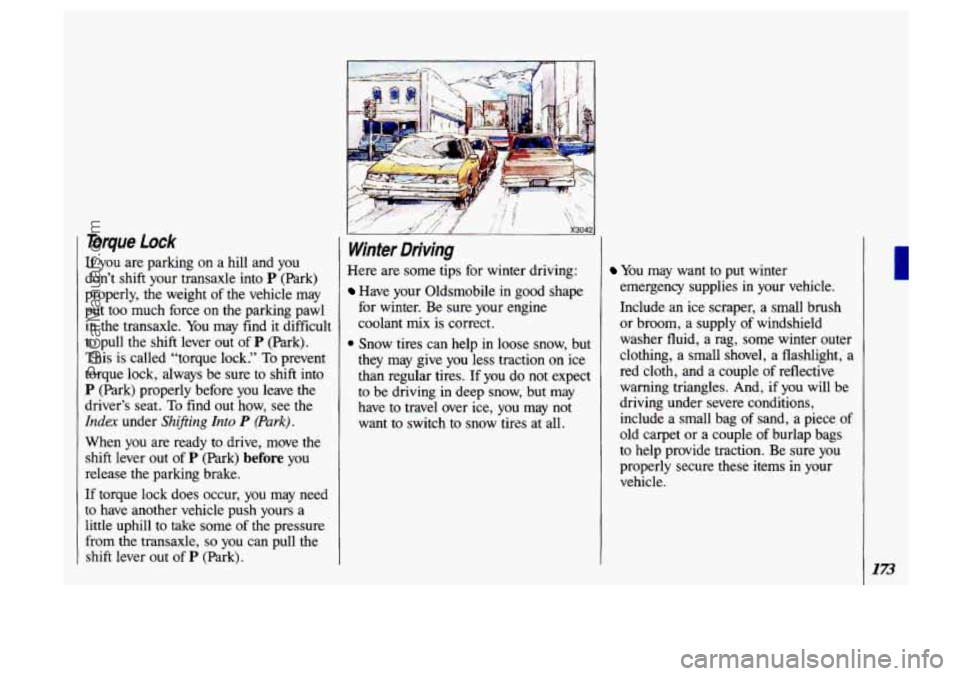
Winter Driving
Here are some tips for winter driving:
Have your Oldsmobile in good shape
for winter. Be sure your engine
coolant
mix is correct.
* Snow tires can help in loose snow, but
they may give you less traction on ice
than regular tires.
If you do not expect
to be driving in deep snow, but may
have to travel over ice, you may not
want
to switch to snow tires at all.
You may want to put winter
emergency supplies in your vehicle.
Include
an ice scraper, a small brush
or broom,
a supply of windshield
washer fluid, a rag,
some winter outer
clothing, a small shovel, a flashlight,
a
red cloth, and a couple of reflective
warning triangles. And,
if you will be
driving under severe conditions,
include a small bag
of sand, a piece of
old carpet or a couple of burlap bags
to help provide traction. Be sure you
properly secure these items
in your
vehicle.
173
ProCarManuals.com
Page 183 of 323
1 Driving with a Trailer
Towing a trailer requires a certain
amount of experience. Before setting out
for the open road, you’ll want to get
to
know your rig. Acquaint yourself with
the feel of handling and braking with the
added weight of the trailer. And always
keep in mind that the vehicle you are
driving is now a good deal longer and
not nearly
so responsive as your vehicle
is by itself.
Before you start, check the trailer hitch
and platform, safety chains, electrical
connector, lights, tires and mirror
adjustment.
If the trailer has electric
brakes,
start your vehicle and trailer
moving and then apply the trailer brake
controller by hand to be sure the brakes
are working. This lets you check your
electrical connection at the same time.
If you have a rear-most
window open and you pull a
mler with your‘vehicle, carbon
monoxide (CO) could come into
your vehicle. You can’t see or
smell CO. It can cause
unconsciousness or death (see the
Inh under Engine Exhausb). To I
maximize your safety when towing
a trailer:
@ Have your exhaust system
inspected for leaks, and Make
necessary yirs before starting
on your trip.
closed.
If exhaust does corne into your
vehicle through a window in the
fear or another opening, drive
with your front, main heating or
cmling system on and with the
fan on any speed. This WU bring
fresh, outside air into your
vehicle.
Do not use RECIRC
because it only recirculates the
air imide ywr vehick, See the
Index under Comfort &m&.
e KWP the =-most windows
During your trip, check occasionally to
be sure that the load is secure, and that
the lights and any trailer brakes are still
working.
Following Distance
Stay at least twice as far behind the
vehicle ahead as you would when
driving your vehicle without a trailer.
This can help you avoid situations that
require heavy braking and sudden turns.
Passing
You’ll need more passing distance up
ahead when you’re towing a trailer.
And, because you’re a good deal longer,
you’ll need to go much farther beyond
the passed vehicle before you can return
to your lane.
0
ProCarManuals.com
Page 184 of 323
Your Driving and the Road
Driving with a Trailer (CONT.)
Backing Up
Hold the bottom of the steering wheel
with one hand. Then, to move the trailer
to the left, just move that hand
to the
left. To move the trailer to the right,
move your hand to the right. Always
back up slowly and, if possible, have
someone guide you.
Making Turns
When you’re turning with a trailer,
make wider
turns than normal. Do this
so your trailer won’t strike soft
shoulders, curbs, road signs, trees, or
other objects. Avoid jerky or sudden
maneuvers. Signal well in advance.
Turn Signals When Towing a Trailer
When you tow a trailer, your vehicle has
to have a different
turn signal flasher
and extra wiring. The green arrows on
your instrument panel will flash
whenever you signal
a turn or lane
change. Properly hooked up, the trailer
lights will also flash, telling other
drivers you’re about to
turn, change
lanes or stop.
When towing a trailer, the green arrows
on your instrument panel will flash for
turns even if the bulbs on the trailer are
burned out. Thus, you may think drivers
behind you are seeing your signal when
they are not. It’s important to check
occasionally to be sure the trailer bulbs
are still working.
Driving On Grades
Reduce speed and shift to a lower gear
before you start down a long or steep
downgrade.
If you don’t shift down, you
might have to use your brakes
so much
that they would get hot and no longer
work well.
On a long uphill grade,
shift down and
reduce your speed to around
45 mph
(70 Wh) to reduce the possibility of
engine and transaxle overheating. If
your vehicle has a 3800 V6 engine, you
should also drive in
D instead of
Overdrive when towing a trailer on
fairly level roads. This will help your
engine and transaxle run cooler in
this
condition, too.
If you are towing a trailer that weighs
more
than 1,000 pounds (454 kg), and
you have an automatic transaxle with Overdrive, you may prefer to drive in
D
instead of Overdrive (or, as you need to,
a lower gear).
ProCarManuals.com
Page 190 of 323
Problems on the Road
i
I
I
I
I88
Jump Starting (CONT.)
2. Get the vehicles close enough so the
jumper cables can reach, but be sure
the vehicles aren’t touching each other.
If they are, it could cause a
ground connection you don’t want.
You wouldn’t be able to start your
Oldsmobile, and the bad grounding
could damage the electrical systems.
You could be injured
if the
L vehicles roll. Set the parking
brake
firmly on each vehicle. Put
an automatic transaxle in
P (Park)
or a manual transaxle
in N (Neutral).
3. Turn off the ignition on both
vehicles.
Turn off all lights that aren’t
needed, and radios.
This will avoid
sparks and help save both batteries.
And it could save your radio!
4. Open the hoods and locate the
batteries.
r An electric fan can start up
even when the engine is not
I
I uming and can injure you. Keep
hands, clothing and tools away
from any underhood electric fan.
Find the positive
(+) and negative
(-) terminals on each battery.
ProCarManuals.com