change time OLDSMOBILE SILHOUETTE 1993 User Guide
[x] Cancel search | Manufacturer: OLDSMOBILE, Model Year: 1993, Model line: SILHOUETTE, Model: OLDSMOBILE SILHOUETTE 1993Pages: 323, PDF Size: 17.13 MB
Page 152 of 323
Your
i
Anti-Lock Brakes (CONE)
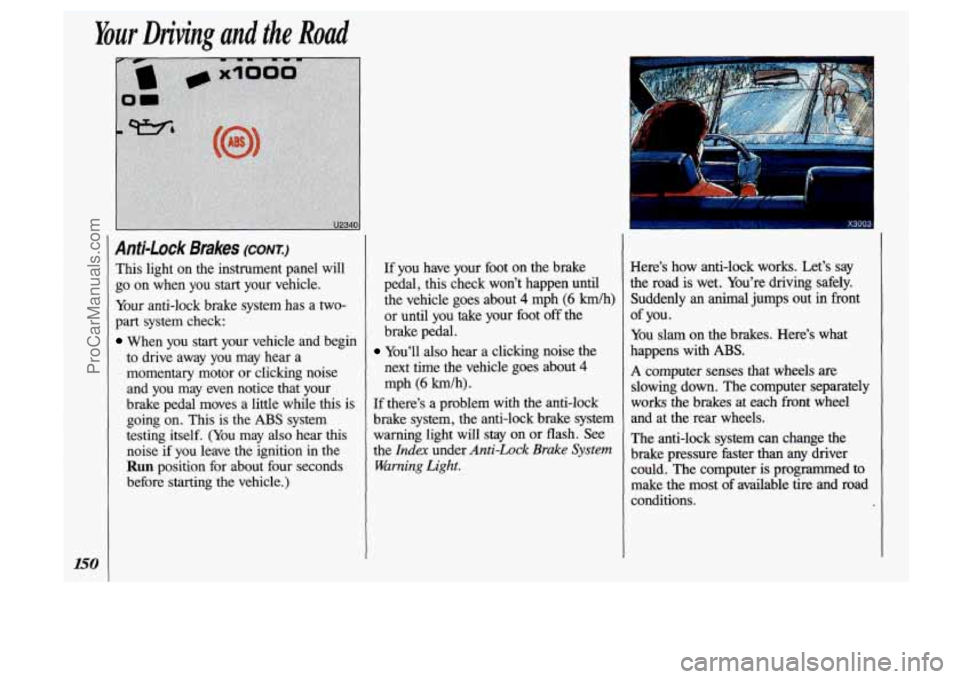
This light on the instrument panel will
go on when you start your vehicle.
Your anti-lock brake system has
a two-
part system check:
When you start your vehicle and begin
to drive away you may hear a
momentary motor or clicking noise
and you may even notice that your
brake pedal moves a little while this is
going on. This is the
ABS system
testing itself. (You may
also hear this
noise if you leave the ignition in the
Run position for about four seconds
before starting the vehicle.)
If you have your foot on the brake
pedal, this check won’t happen until
the vehicle goes about
4 mph (6 Wh)
or until you take your foot off the
brake pedal.
You’ll also hear a clicking noise the
next time the vehicle goes about
4
mph (6 Wh).
If there’s a problem with the anti-lock
brake system, the anti-lock brake system
warning light will stay on
or flash. See
the
Inda under Anti-Lock Brake System
Warning Light.
Here’s how anti-lock works. Let’s say
the road is wet. YOU’E driving safely.
Suddenly
an animal jumps out in front
You
slam on the brakes. Here’s what
happens with
ABS.
A computer senses that wheels are
slowing down. The computer separately
works the brakes at each front wheel
and at the rear wheels.
The anti-lock system can change the
brake pressure faster than any driver
could. The computer is programmed to
make the most of available tire and road
conditions.
of you.
ProCarManuals.com
Page 153 of 323
X3006 I
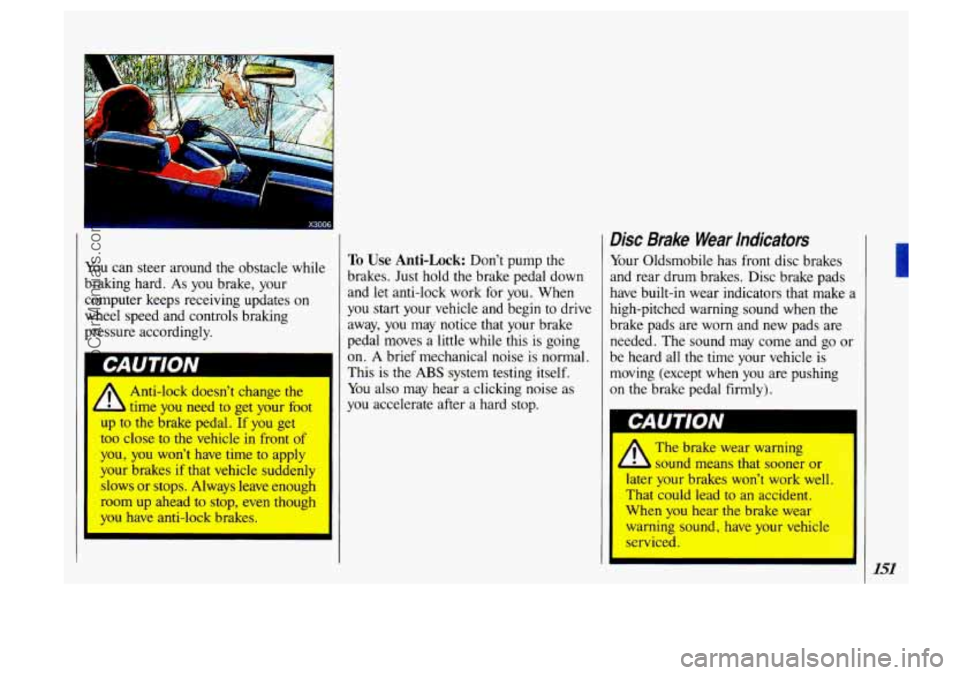
You can steer around the obstacle while
braking hard.
As you brake, your
computer keeps receiving updates on
wheel speed and controls braking
pressure accordingly.
1
‘t
Anti-lock doesn’t change the
time you need to get your foot
up
to the brake pedal. If you get
too close to the vehicle in front of
you, you won’t have time to apply
your brakes if that vehicle suddenly slows
or stops. Always leave enough
room up ahead to stop, even though
you have anti-lock brakes.
To Use Anti-Lock: Don’t pump the
brakes. Just hold the brake pedal down
and let anti-lock work for you. When
you start your vehicle and begin to drive
away, you may notice that your brake
pedal moves a little
while this is going
on.
A brief mechanical noise is normal.
This is
the ABS system testing itself.
You also may hear a clicking noise as
you accelerate after a hard stop.
Disc Brake Wear Indicators
Your Oldsmobile has front disc brakes
and rear drum brakes. Disc brake pads
have built-in wear indicators that make a
high-pitched warning sound when the
brake pads are worn and
new pads are
needed. The sound may come and
go or
be heard all
the time your vehicle is
moving (except when you are pushing
on the brake pedal firmly).
The brake wear warning
sound means that sooner or
later your brakes won’t work well
That could lead to an accident.
when you hear the brake wear
serviced. arning
sound, have your vehicle
151
ProCarManuals.com
Page 159 of 323
Watch for traffic signs, pavement
markings, and lines.
If you can see a
sign up ahead that might indicate a
turn or an intersection, delay your
pass.
A broken center line usually
indicates it’s all right to pass
(providing the road ahead is clear).
Never cross a solid line on your side
of the lane or a double solid line, even
if the road seems empty
of approaching
traffic.
vehicle you want to pass isn’t aware of
your presence, tap the horn a couple
of times before passing.
Do not get too close to the vehicle you
want to pass while you’re awaiting an
opportunity. For one thing, following
too closely reduces your area of
vision, especially if you’re following a
larger vehicle. Also, you won’t have
adequate space if the vehicle ahead
suddenly slows or stops. Keep back a
reasonable distance.
If you suspect that the driver of the
When it looks like a chance to pass is
coming up, start to accelerate but stay
in the right lane and don’t get too
close. Time your move
so you will be
increasing speed as
the time comes to
move into the other lane. If the way is
clear to pass,
you will have a “running
start” that more than makes up for the
distance you would lose by dropping
back. And
if something happens to
cause you
to cancel your pass, you
need only slow down and drop back
again and wait for another opportunity.
slow vehicle, wait your turn. But take
care that someone isn’t trying to pass
you as you pull out
to pass the slow
vehicle. Remember
to glance over
your shoulder and check the blind
spot.
If other cars are lined up to pass a
Check your mirrors, glance over your
shoulder, and start your left lane
change signal before moving out of the
right lane to pass. When you are far
enough ahead of the passed vehicle to
see its front in your inside mirror,
activate your right lane change signal
and move back into the right lane.
(Remember that your right outside
mirror
is convex. The vehicle you just
passed may seem to be farther away
from you than it really is.)
Try not to pass more than one vehicle
at a time on two-lane roads.
Reconsider before passing the
next
vehicle.
vehicle too rapidly. Even though the
brake lights are not flashing,
it may be
slowing down or starting to turn.
If you’re being passed, make it easy
for the following driver to get ahead
of
you. Perhaps you can ease a little to
the right.
Don’t overtake a slowly moving
157
ProCarManuals.com
Page 161 of 323
a lower gear). Any sudden changes
could cause the tires to slide. You may
not realize the surface is slippery until
your vehicle is skidding. Learn
to
recognize warning clues-such as
enough water, ice or packed snow on
the road to make a “mirrored
surface”-and slow down when
you
have any doubt.
Remember: Any anti-lock braking
system
(ABS) helps avoid only the
braking skid. Steer the way you want to
go.
Driving at Night
Night driving is more dangerous than
day driving. One reason
is that some
drivers are likely to be impaired-by
alcohol or drugs, with night vision
problems, or by fatigue.
Here are some tips on night driving.
Drive defensively. Remember, this is
the most dangerous time.
Don’t drink and drive. (See the Index
under Drunken Driving for more on
this problem.)
Adjust your inside rearview mirror to
reduce the glare from headlights
behind you.
Since you can’t see as well, you may
need to slow down and keep more
space between
you and other vehicles.
It’s hard to tell how fast the vehicle
ahead is going just by looking at its
taillights.
speed roads. Your headlights can light
up only
so much road ahead.
Slow down, especially on higher
In remote areas, watch for animals.
If you’re tired, pull off the road in a
safe place and rest.
159
ProCarManuals.com
Page 171 of 323
On the Road
Unless you are the only driver, it is
good to share the driving task with
others. Limit turns behind the wheel to
about 100 miles
(160 km) or two hours
at a sitting. Then, either change drivers
or stop for some refreshment like coffee,
tea or
soft drinks and some limbering
up. But do stop and move around. Eat
lightly along the way. Heavier meals
tend to make some people sleepy.
On two-lane highways or undivided
multilane highways that do not have
controlled access, you’ll want to watch
for some situations not usually found on
freeways. Examples are: stop signs and
signals, shopping centers with direct
access to the highway, no passing zones
and school zones, vehicles turning left
and right
off the road, pedestrians,
cyclists, parked vehicles, and even animals.
Highway Hypnosis
Is there actually such a condition as
“highway hypnosis”? Or is it just plain
falling asleep at the wheel? Call it
highway hypnosis, lack
of awareness, or
whatever.
There is something about an easy stretch
of road with the same scenery, along
with the hum of the tires on the road,
the drone of the engine, and the rush
of
the wind against the vehicle that can
make you sleepy. Don’t let
it happen to
you! If it does, your vehicle can leave
the road in
less than a second, and you
could crash and be injured.
What can you do about highway
hypnosis? First, be aware that it can
happen.
Then here are some tips:
Make sure your vehicle is well
ventilated, with a comfortably cool interior.
Keep your eyes moving. Scan the road
ahead and to the sides. Check your
rearview mirrors frequently and your
instruments from time
to time. This
can help
you avoid a fixed stare.
Wear good sunglasses in bright light.
Glare can cause drowsiness. But don’t
wear sunglasses at night. They will
drastically reduce
your overall vision
at the very time you need all the
seeing power you have.
If you get sleepy, pull off the road into
a rest, service,
or parking area and
take a nap, get some exercise, or both.
For safety, treat drowsiness on the
highway as an emergency.
As in any driving situation, keep pace
with traffic and allow adequate following distances.
169
ProCarManuals.com
Page 179 of 323
Towing a Tmiler
I I If you don’t use the correct I
L L equipment and drive properly,
you can lose control when you pull
a trailer. For example, if the trailer
is too heavy, the brakes may not
work well-or even at all. You and
your passengers could be seriously
injured. Pull a trailer only
if you
have followed all the steps in this section. Your
Oldsmobile can tow a trailer. To
identify what the vehicle trailering
capacity is for your vehicle, you should
read the information in
Weight of the
Trailer
that appears later in this section.
But trailering
is different than just
driving your vehicle
by itself. Trailering
means changes
in handling, durability,
and fuel economy. Successful, safe
trailering takes correct equipment, and
it
has to be used properly.
That’s the reason for
this section, In it
are many time-tested, important
trailering tips and safety rules. Many of
these are important for your safety and
that of your passengers.
So please read
this section carefully before you pull a
trailer. Load-pulling components such as the
engine, transaxle, wheel assemblies, and
tires
are forced to work harder against
the drag of the added weight. The engine
is required to operate at relatively higher
speeds and under greater loads, generating
extra heat. What’s more, the trailer adds
considerably to wind resistance, increasing the pulling requirements.
All
of that means changes in:
Handling
Durability
Fuel economy
177
ProCarManuals.com
Page 231 of 323
Engine Oil Additives
Don't add anything to your oil. Your
Oldsmobile dealer is ready to advise if
you think something should be added.
When to Change Engine Oil
See if any one of these is true for you:
Most trips are less than 4 miles (6 km).
It's below freezing outside and most
trips are less than
10 miles (16 km).
The engine is at low speed most of the
time (as in door-to-door delivery, or in
stop-and-go traffic).
You tow a trailer often.
Most trips are through dusty places.
If any one of these is true for your
vehicle, then
you need to change your
oil and filter every 3,000 miles
(5 000 km) or 3 months-whichever
comes first.
If none of them is true, change the oil
every 7,500 miles (12 500 km) or 12
months-whichever comes first. Change
the filter at the first oil change and at
every other oil change after that.
Engine Block Heater (omoN)
An engine block heater can be a big
help if you have to park outside in very
cold weather,
0°F (-18" C) or colder. If
your vehicle has this option, see the
Index under Engine Block Heater.
229
ProCarManuals.com
Page 234 of 323
Service & Appearance Care
232
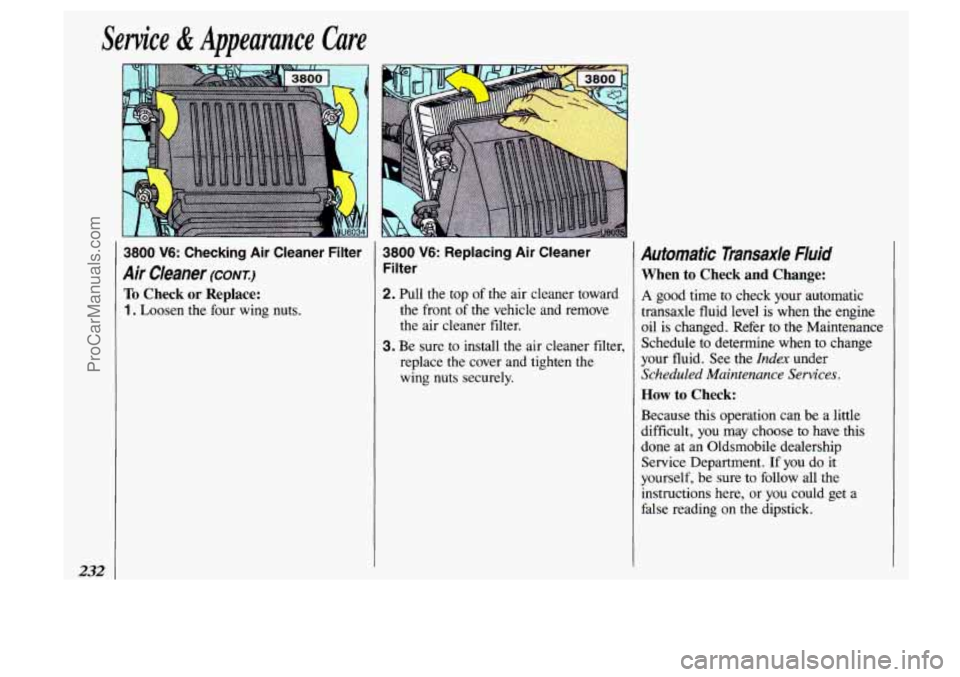
3800 V6: Checking Air Cleaner Filter
To Check or Replace:
I,+ Loosen the four wing nuts.
Air Cleaner (CONT.)
3800 V6: Replacing Air Cleaner
Filter
2. Pull the top of the air cleaner toward
the front of the vehicle and remove
the air cleaner filter.
3. Be sure to install the air cleaner filter,
replace the cover and tighten the
wing nuts securely.
Automatic Transaxle Fluid
When to Check and Change:
A good time to check your automatic
transaxle fluid level is when the engine
oil is changed. Refer to the Maintenance
Schedule to determine when to change
your fluid. See the
Index under
Scheduled Maintenance Services.
How to Check:
Because this operation can be a little
difficult, you may choose to have this
done at an Oldsmobile dealership
Service Department. If you do it
yourself, be sure to follow all the
instructions here, or you could get a
false reading on the dipstick.
ProCarManuals.com
Page 244 of 323
Sewice & Appearaj
The braking system on a modern vehicle
is complex. Its many parts have to be of
top quality and work well together if the
vehicle is to have really good braking.
Vehicles we design and test have top-
quality GM brake parts
in them, as your
Oldsmobile does when it is new. When
you replace parts of your braking
system-for example, when your brake
linings wear down and you have to have
new ones put in-be sure you get new
genuine
GM replacement parts. If you
don’t, your brakes may no longer work
properly. For example, if someone puts
in brake linings that are wrong for your
vehicle, the balance between your front and rear brakes can change, for the
worse. The braking performance you’ve
come to expect can change in many
other ways if someone puts
in the wrong
replacement brake parts.
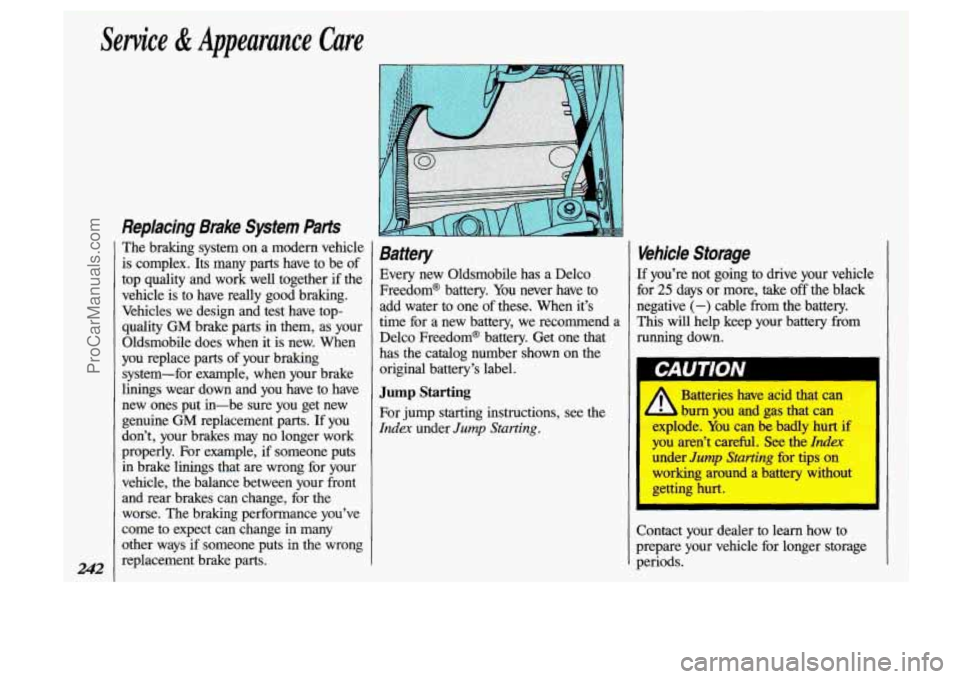
Battery
Every new Oldsmobile has a Delco
Freedom@ battery. You never have to
add water to one
of these. When it’s
time for a new battery, we recommend a
Delco Freedom@ battery. Get one that
has the catalog number shown on the
original battery’s label.
Jump Starting
For jump starting instructions, see the
Index under Jump Starting.
Vehide Storage
If you’re not going to drive your vehicle
for
25 days or more, take off the black
negative
(-) cable from the battery.
This will help keep your battery
from
running down.
II
- Batteries have acid that can
1 burn you and gas that can
plode. You can be badly hurt if
u aren’t careful. See the Index
der Jump Starting for tips on
Irking around a battery without
tting
hurt.
- -
”
Contact your dealer to learn how to
prepare your vehicle for longer storage
periods.
ProCarManuals.com
Page 251 of 323
Tire lnspection and Rotation
ro make your tires last longer, have them
[nspected and rotated at the mileages
recommended in the Maintenance
Schedule. See the
Index under
Ycheduled Maintenance Services.
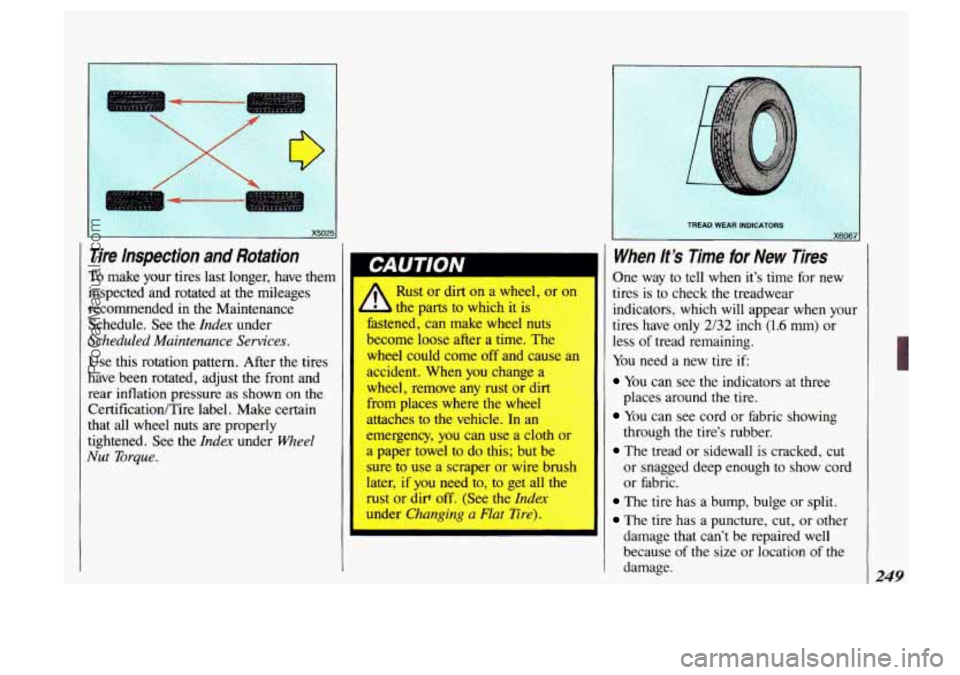
Use this rotation pattern. After the tires
nave been rotated, adjust the front and
rear inflation pressure
as shown on the
Zertification/Tire label. Make certain
:hat all wheel nuts are properly
ightened. See the
Index under Wheel
Vut Torque.
1
b the parts to which it i
astened, can make wheel
3ecome loose after a time.
wheel could come off and cause an
dccident. When you change a
wheel, remove any
rust or dirl
from places where the wheel
ttaches
to the vehicle. In ar
ergency, you can use a clot1
L paper towel to do this; but b
sure
to use a scraper or wire 1:
later, if you need to, to get all the '
rust or die off. (See the Idex
under Changing a Flat Tire).
When lt's Time for New Tires
One way to tell when it's time for new
tires is to check the treadwear
indicators, which will appear when your
tires have only
2/32 inch (1.6 mm) or
less
of tread remaining.
You need a new tire if:
You can see the indicators at three
You can see cord or fabric showing
The tread or sidewall is cracked, cut
places
around the tire,
through the tire's rubber.
or snagged deep enough to show cord
or fabric.
The tire has a bump, bulge or split.
The tire has a puncture, cut, or other
damage that can't be repaired well
because of the size or location of the
damage.
ProCarManuals.com