fuel OLDSMOBILE SILHOUETTE 1993 User Guide
[x] Cancel search | Manufacturer: OLDSMOBILE, Model Year: 1993, Model line: SILHOUETTE, Model: OLDSMOBILE SILHOUETTE 1993Pages: 323, PDF Size: 17.13 MB
Page 170 of 323
Driving a Long Distance
Although most long trips today are
Before Leaving on a Long Trip
Make sure you’re ready. Try to be well
I
I
I
168
J
7
1
1
-
made on freeways, there are still many
made on regular highways.
Long-distance driving on freeways and regular highways is the same in some
ways. The trip has to be planned and the
vehicle prepared, you drive at higher-
than-city speeds, and there are longer
turns behind the wheel. You’ll enjoy
your trip more if you and your vehicle
are
in good shape. Here are some tips
for a successful long trip. rested.
If you
must start when you’re not
fresh-such as after a day’s work-don’t
plan to make too many miles that first
part of the journey. Wear comfortable
clothing and shoes you can easily drive
in.
Is your vehicle ready for a long trip? If
you keep it serviced and maintained, it’s
ready to go.
If it needs service, have it
done before starting out.
Of course,
you’ll find experienced and able service
experts in Oldsmobile dealerships all across
North America. They’ll be ready
and willing to help
if you need it. Here
are some things you can check
before a trip:
Windshield Washer Fluid: Is the
reservoir full? Are
all windows clean
inside and outside?
Wiper Blades: Are they in good
shape?
Fuel, Engine Oil, Other Fluids:
Have you checked all levels?
Lights: Are they all working? Are the
lenses clean?
Tires: They are vitally important to a
safe, trouble-free trip.
Is the tread
good enough for long-distance
driving? Are the tires
all inflated to
the recommended pressure?
weather outlook along your route? Should you delay your trip a short
time to avoid a major storm system?
Maps: Do you have up-to-date maps?
Weather Forecasts: What’s the
ProCarManuals.com
Page 178 of 323
Your Driving and the Road
176
lf You’re Caught in a Blizard
(CON X)
Run your engine only as long as you
must. This saves fuel. When you run
the engine, make it go a little faster
than just idle. That is, push the
accelerator slightly. This uses less fuel for the heat that you get and it keeps
the battery charged.
You will need a
well-charged battery to restart the
vehicle and possibly for signaling later
on with your headlights. Let the heater
run for a while. Then,
shut the engine off and close
the window almost all the way to preserve the heat.
Start the engine
again and repeat this only when you feel really uncomfortable from the
cold. But
do it as little as possible.
Preserve the fuel as long as you can.
To help keep warm, you can get out of
the vehicle and do some fairly
vigorous exercises every half-hour or
so until help comes.
If Mu’re Stuck in Deep Snow
This manual explains how to get the
vehicle out
of deep snow without
damaging it. See the
Index under
Rocking Your Ehicle.
ProCarManuals.com
Page 179 of 323
Towing a Tmiler
I I If you don’t use the correct I
L L equipment and drive properly,
you can lose control when you pull
a trailer. For example, if the trailer
is too heavy, the brakes may not
work well-or even at all. You and
your passengers could be seriously
injured. Pull a trailer only
if you
have followed all the steps in this section. Your
Oldsmobile can tow a trailer. To
identify what the vehicle trailering
capacity is for your vehicle, you should
read the information in
Weight of the
Trailer
that appears later in this section.
But trailering
is different than just
driving your vehicle
by itself. Trailering
means changes
in handling, durability,
and fuel economy. Successful, safe
trailering takes correct equipment, and
it
has to be used properly.
That’s the reason for
this section, In it
are many time-tested, important
trailering tips and safety rules. Many of
these are important for your safety and
that of your passengers.
So please read
this section carefully before you pull a
trailer. Load-pulling components such as the
engine, transaxle, wheel assemblies, and
tires
are forced to work harder against
the drag of the added weight. The engine
is required to operate at relatively higher
speeds and under greater loads, generating
extra heat. What’s more, the trailer adds
considerably to wind resistance, increasing the pulling requirements.
All
of that means changes in:
Handling
Durability
Fuel economy
177
ProCarManuals.com
Page 217 of 323
Here you will find information about
the care of your Oldsmobile
. This
part begins with service and fuel
information. and then it shows how to
check important fluid and lubricant levels
. There is also technical
information about your vehicle. and a section devoted to its appearance care
.
Part 6
Service di Appearance Care
Service ......................................................... 216
Fuel ........................................................... 217
HoodRelease
.................................................... 221
Engineoil
...................................................... 225
Aircleaner
..................................................... 230
TransaxleFluid
.................................................. 232
Enginecoolant
.................................................. 235
Power Steering Fluid
.............................................. 238
Windshield Washer Fluid
........................................... 239
Brakes
......................................................... 240
Battery
......................................................... 242
Bulb Replacement
................................................ 243
Windshield Wiper Blade Replacement
................................. 245
Loading Your Vehicle
............................................. 245
Tires
.......................................................... 247
Appearancecare ................................................. 254
Vehicle Identification Number (VIN)
................................. 262
Add-on Electrical Equipment
....................................... 263
Fuses
& Circuit Breakers ........................................... 264
Capacities
& Specifications ......................................... 269
Normal Maintenance Replacement Parts
............................... 271
Fluids
& Lubricants ............................................... 272
ReplacementBulbs
................................................ 273
215
ProCarManuals.com
Page 219 of 323
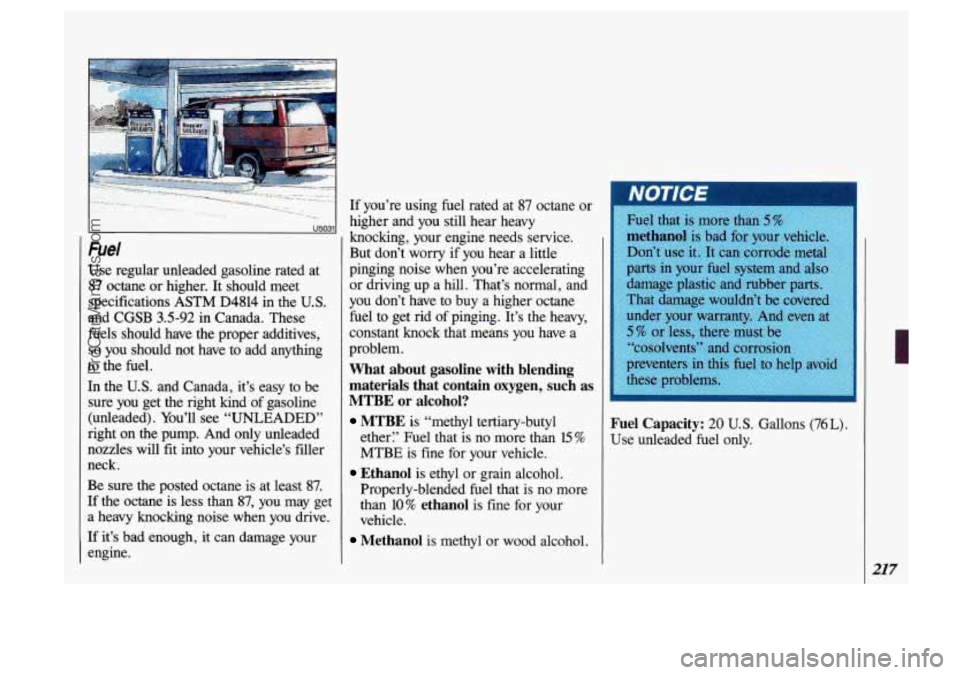
Fuel
Use regular unleaded gasoline rated at
87 octane or higher. It should meet
specifications
ASTM D4814 in the U.S.
and
CGSB 3.5-92 in Canada. These
fuels should have the proper additives,
so you should not have to add anything
to the fuel.
In the U.S. and Canada, it’s easy to be
sure you get the right kind of gasoline
(unleaded). You’ll see
“UNLEADED”
right on the pump. And only unleaded
nozzles will fit into your vehicle’s filler
neck.
Be sure the posted octane
is at least 87.
If the octane is less than 87, you may get
a heavy knocking noise when you drive.
If it’s bad enough, it can damage your
engine.
If you’re using fuel rated at 87 octane or
higher and you still hear heavy
knocking, your engine needs service.
But don’t worry
if you hear a little
pinging noise when you’re accelerating or driving up
a hill. That’s normal, and
you don’t have to buy a higher octane
fuel to get rid of pinging. It’s the heavy,
constant knock that means you have a
problem.
What about gasoline with blending
materials that contain oxygen, such
as
MTBE or alcohol?
MTBE is “methyl tertiary-butyl
ether:’ Fuel that is no more than
15 %
MTBE is fine for your vehicle.
Ethanol is ethyl or grain alcohol.
Properly-blended fuel that
is no more
than
10% ethanol is fine for your
vehicle.
Methanol is methyl or wood alcohol.
Fuel Capacity: 20 U.S. Gallons (76L).
Use unleaded fuel only.
227
ProCarManuals.com
Page 220 of 323
Service & Appearance Care
218
Gasolines for Cleaner Air
Your use of gasoline with detergent
additives will help prevent deposits from
forming in your engine and fuel system.
That helps keep your engine in tune and
your emission control system working properly. It’s good for your vehicle, and
you’ll be doing your part for cleaner air.
Many gasolines are now blended with
materials called oxygenates. General
Motors recommends that you use
gasolines with these blending materials,
such as MTBE and ethanol. By doing
so, you can help clean the air, especially
in those parts of the country that have
high carbon monoxide levels.
In addition, some gasoline suppliers are
now producing reformulated gasolines.
These gasolines are specially designed
to reduce vehicle emissions. General Motors recommends that you use
reformulated gasoline. By doing
so, you
can help clean the air, especially in
those parts of the country that have high
ozone levels.
You should ask your service station
operators
if their gasolines contain
detergents and oxygenates, and
if they
have been reformulated to reduce
vehicle emissions.
”z
Fuels in Foreign Countries
If you plan on driving in another
country outside the
U.S. or Canada,
unleaded fuel may be hard to find.
Do
not use leaded gasoline. If you use even
one tankful, your emission controls
won’t work well or at all. With
continuous use, spark plugs can get
fouled, the exhaust system can corrode,
and your engine oil can deteriorate
quickly. Your vehicle’s oxygen sensor
will be damaged. All of that means
costly repairs that wouldn’t be covered
by your warranty.
ProCarManuals.com
Page 221 of 323
To check on fuel availability, ask an auto
club, or contact
a major oil company
that does business in the country where
you'll be driving.
You can
also write us at the following
address for advice. Just tell us where
you're going and give your Vehicle
Identification Number (VIN)
.
General Motors of Canada Ltd.
International
Export Sales
P.O. Box 828
Oshawa, Ontario LlH 7N1, Canada
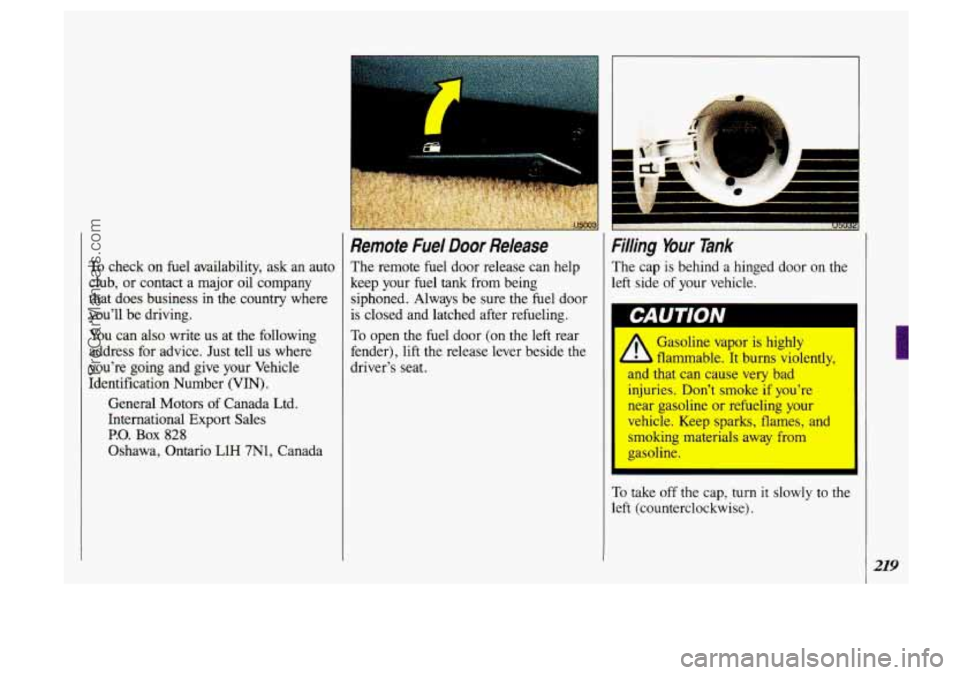
Remote Fuel Door Release
The remote fuel door release can help
keep your fuel tank from being siphoned. Always be sure the fuel door
is closed and latched after refueling.
To open the fuel door (on the left rear
fender), lift the release lever beside the
driver's seat.
Filling Your Tank
The cap is behind a hinged door on the
left side
of your vehicle.
h nammable. It burns violently,
lsoline vapor is highly
ana that can cause very bad
injuries. Don't smoke if you're
near gasoline or refueling your
vehicle. Keep sparks, flames, and
smoking materials away from
gasoline. I
1
To take off the cap, turn it slowly to the
left (counterclockwise).
219
ProCarManuals.com
Page 222 of 323
Service & Appearance Care
220
* If you get gasoline on you and
- then something ignites it, yor
could be badly burned. Gasoline
can spray out on you
if you open
the fuel filler cap too quickly. This
spray can happen if your
tank is
nearly full, and is more likely in
hot weather. Open the fuel filler
noise
to stop. Then unscrew the
cap all the way.
ap slowly and wait
for any "hiss'
type. Your dealer can
If you get
the
your fuel tank
not fit or have
I
Checking Things Under
the
Hood
The following sections tell you how to
check fluids, lubricants
and important
parts underhood.
When
you put the cap back on, turn it to
the right until you hear a clicking noise.
ProCarManuals.com
Page 227 of 323
Underhood Light
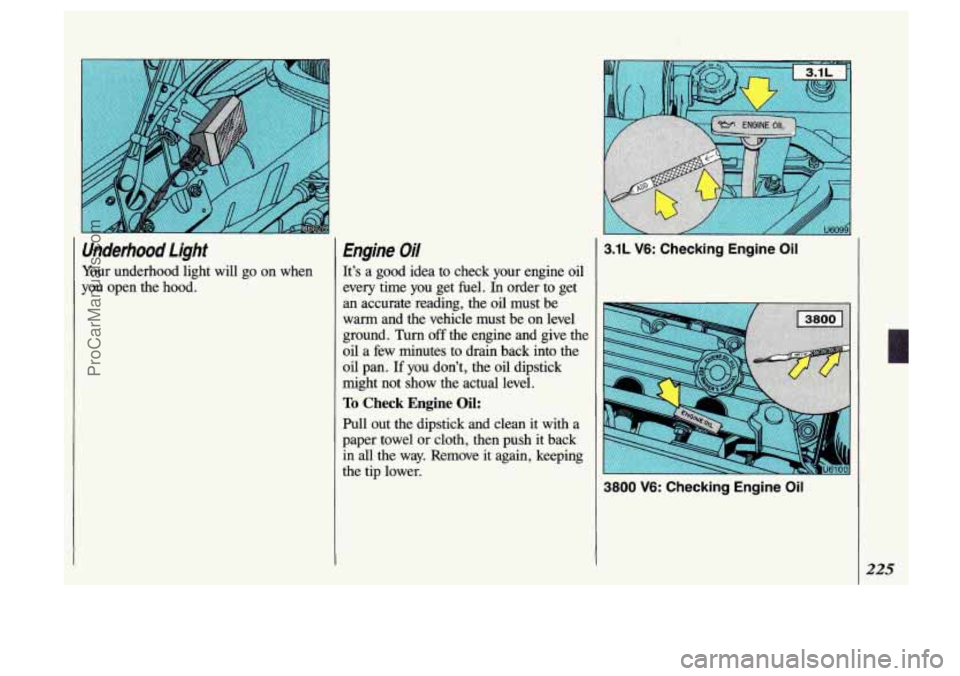
Your underhood light will go on when
you open the hood.
Engine Oil
It’s a good idea to check your engine oil
every time you get fuel. In order to get
an accurate reading, the oil must be
warm and the vehicle must be on level
ground.
Turn off the engine and give the
oil a few minutes to drain back into the
oil pan. If you don’t, the oil dipstick
might not show the actual level.
To Check Engine Oil:
Pull out the dipstick and clean it with a
paper towel or cloth, then push it back
in
all the way. Remove it again, keeping
the tip lower.
I 3.1L V6: Checking Engine Oil
3800 V6: Checking Engine Oil
225
ProCarManuals.com
Page 229 of 323
SG
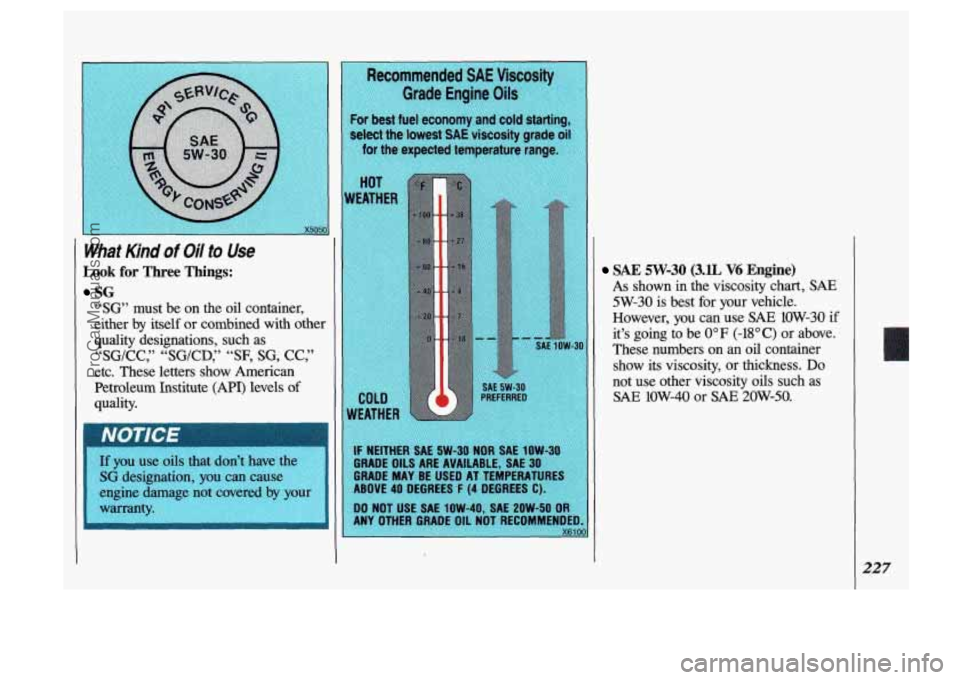
“SG” must be on the oil container,
either by itself or combined with other
quality designations, such as
“SGICC,” “SGICD,” “SF, SG, CC,”
etc. These letters show American
Petroleum Institute
(API) levels of
quality.
If you use oils that don’t have the
SG designation? you can cause
engine damage not covered by your
warranty.
Grade E
For best fuel economy and cold starting,
select the lowest SAE viscosity grade oil
for the expected temperature range.
SAE 5W-30 (3.X V6 Engine)
As shown in the viscosity chart, SAE
5W-30 is best for your vehicle.
However, you can use
SAE 1OW-30 if
it’s going to be 0°F (-18°C) or above.
These numbers on
an oil container
show
its viscosity, or thickness. Do
not use other viscosity oils such as
SAE 1OW-40 or SAE 20W-50.
ProCarManuals.com