steering wheel OLDSMOBILE SILHOUETTE 1993 User Guide
[x] Cancel search | Manufacturer: OLDSMOBILE, Model Year: 1993, Model line: SILHOUETTE, Model: OLDSMOBILE SILHOUETTE 1993Pages: 323, PDF Size: 17.13 MB
Page 158 of 323
YOUP Driving and the Road
Ofi-Road Recovery
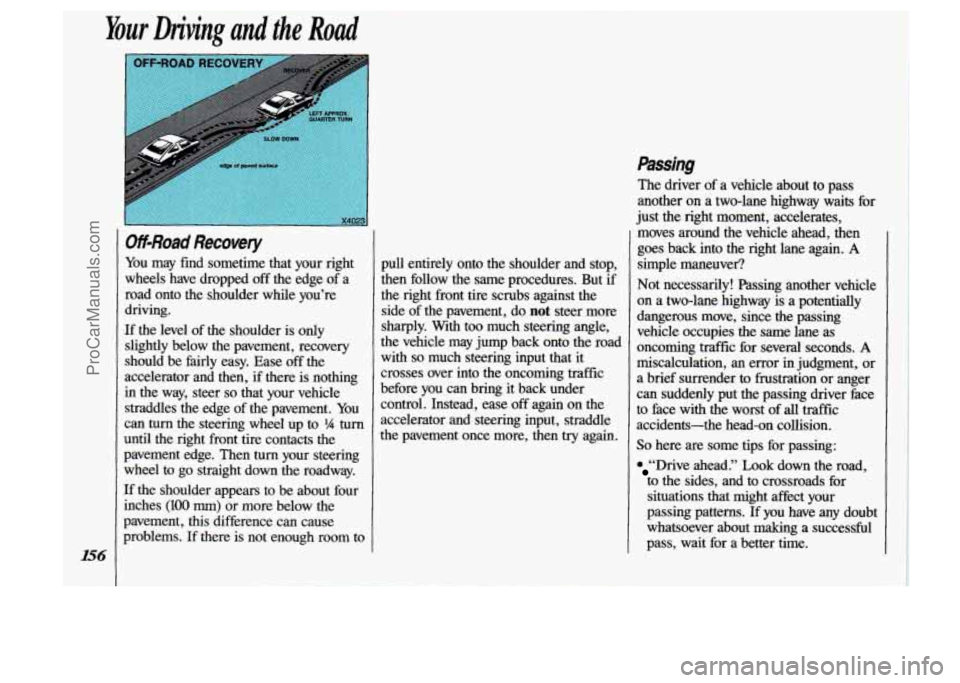
You may find sometime that your right
wheels have dropped
off the edge of a
road onto the shoulder while you’re
driving.
If the level of the shoulder is only
slightly below the pavement, recovery
should be fairly easy. Ease
off the
accelerator and then,
if there is nothing
in the way, steer
so that your vehicle
straddles the edge
of the pavement. You
can turn the steering wheel up to
?4 turn
until the right front tire contacts the
pavement edge. Then
turn your steering
wheel
to go straight down the roadway.
If the shoulder appears to be about four
inches
(100 mm) or more below the
pavement, this difference can cause
problems.
If there is not enough room to pull entirely onto the shoulder and stop,
then follow the same procedures. But
if
the
right front tire scrubs against the
side of the pavement, do
not steer more
sharply.
With too much steering angle,
the vehicle may jump back onto the road
with
so much steering input that it
crosses over into the oncoming traffic
behre you can bring
it back under
control. Instead, ease
off again on the
accelerator and steering input, straddle
the pavement once more, then
try again.
Passing
The driver of a vehicle about to pass
another
on a two-lane highway waits for
just the right moment, accelerates,
moves around the vehicle ahead, then
goes back into the right lane again.
A
simple maneuver?
Not necessarily! Passing another vehicle
on a two-lane highway is a potentially
dangerous move, since the passing
vehicle occupies the same lane as
oncoming traffic for several seconds.
A
miscalculation, an error in judgment, or
a brief surrender to frustration or anger
can suddenly put the passing driver face
to face with the worst of all traffic
accidents-the head-on collision.
So here are some tips for passing:
“Drive ahead.” Look down the road,
to
the sides, and to crossroads for
situations that might affect your
passing patterns.
If you have any doubt
whatsoever about making
a successful
pass, wait for a better time.
ProCarManuals.com
Page 160 of 323
Loss of Control
Let’s review what driving experts say
about what happens when the
three
control systems (brakes, steering and
acceleration) don’t have enough friction
where the tires meet the road to do what
the driver has asked.
In any emergency, don’t give up. Keep
trying
to steer and constantly seek an
escape route or area of less danger.
Skidding
In a skid, a driver can lose control of
the vehicle. Defensive drivers avoid
most skids by taking reasonable care
suited to existing conditions, and
by not
“overdriving” those conditions. But
skids are always possible.
The three types of skids correspond to
your Oldsmobile’s
three control systems.
In the braking skid your wheels aren’t
rolling.
In the steering or cornering
skid, too much speed or steering in a
curve causes tires to slip and lose
cornering force. And
in the acceleration
skid too much throttle causes the driving
wheels to spin.
A cornering skid and an acceleration
skid are best handled by easing your
foot
off the accelerator pedal. If your
vehicle
starts to slide (as when you turn
a corner on a wet, snow- or ice-covered road), ease your
foot
off the accelerator
pedal as soon as you feel the vehicle
start to slide. Quickly steer the way you
want the vehicle to go.
E you start
steering quickly enough, your vehicle
will straighten out. As it does, straighten
the front wheels.
Of course, traction is reduced when
water, snow, ice, gravel, or other
material is on the road. For safety, you’ll
want to slow down and adjust your
driving to these conditions.
It is
important to slow down
on slippery
surfaces because stopping distance will
be longer and vehicle control more
limited.
While driving
on a surface with reduced
traction,
try your best to avoid sudden
steering, acceleration,
or braking
(including engine braking by shifting to
I
ProCarManuals.com
Page 176 of 323
Your Driving and the Road
Driving on Snow or Ice
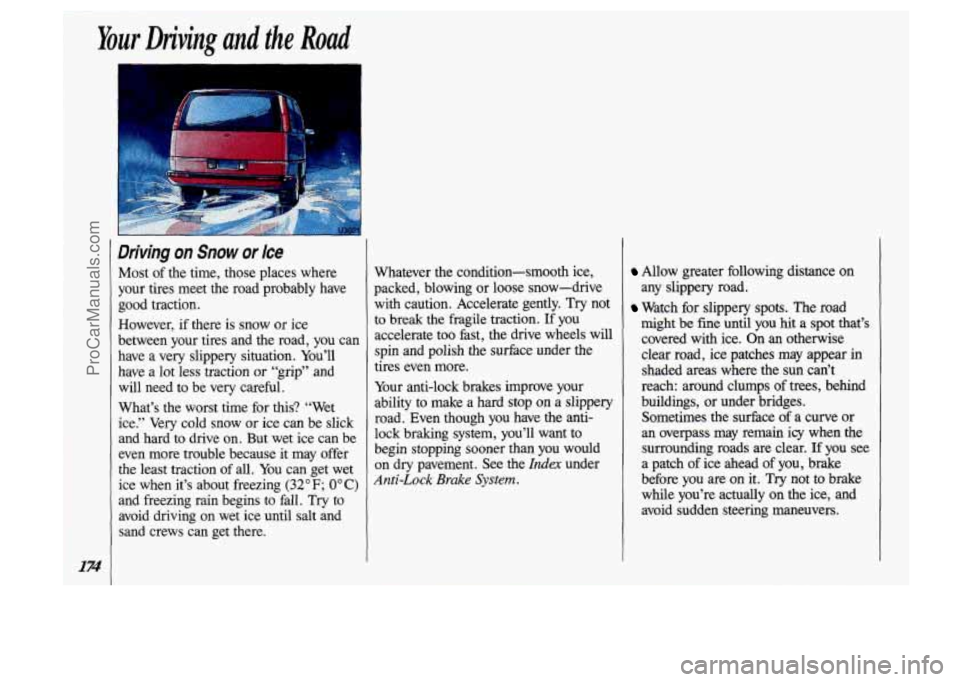
Most of the time, those places where
your tires meet the road probably have
good traction.
However, if there is snow or ice
between your tires and the road, you can
have a very slippery situation. You’ll
have
a lot less traction or “grip” and
will need to be very careful.
What’s the worst time for this? “Wet
ice.” Very cold snow or ice can be slick
and hard
to drive on. But wet ice can be
even more trouble because it may offer
the least traction
of all. You can get wet
ice when it’s about freezing
(32°F; 0°C)
and freezing rain begins to fd. Try to
avoid driving on wet ice until salt and
sand crews can get there. Whatever the condition-smooth ice,
packed, blowing or loose snow-drive
with caution. Accelerate gently. Try not
to break the fragile traction.
If you
accelerate too fast, the drive wheels will
spin and polish the surface under the
tires even more.
Your anti-lock brakes improve your
ability
to make a hard stop on a slippery
road. Even though you have the anti-
lock braking system, you’ll want to
begin stopping sooner
than you would
on dry pavement.
See the Index under
Anti-Lock Brake System.
Allow greater following distance on
any slippery road.
Watch for slippery spots. The road
might be fine until you
hit a spot that’s
covered with ice. On an otherwise
clear road, ice patches may appear
in
shaded areas where the sun can’t
reach: around clumps of trees, behind
buildings, or under bridges.
Sometimes the surface
of a curve or
an overpass may remain icy when the surrounding roads are clear.
If you see
a patch of ice ahead
of you, brake
before
you are on it. Try not to brake
while you’re actually on the ice, and
avoid sudden steering maneuvers.
174
ProCarManuals.com
Page 184 of 323
Your Driving and the Road
Driving with a Trailer (CONT.)
Backing Up
Hold the bottom of the steering wheel
with one hand. Then, to move the trailer
to the left, just move that hand
to the
left. To move the trailer to the right,
move your hand to the right. Always
back up slowly and, if possible, have
someone guide you.
Making Turns
When you’re turning with a trailer,
make wider
turns than normal. Do this
so your trailer won’t strike soft
shoulders, curbs, road signs, trees, or
other objects. Avoid jerky or sudden
maneuvers. Signal well in advance.
Turn Signals When Towing a Trailer
When you tow a trailer, your vehicle has
to have a different
turn signal flasher
and extra wiring. The green arrows on
your instrument panel will flash
whenever you signal
a turn or lane
change. Properly hooked up, the trailer
lights will also flash, telling other
drivers you’re about to
turn, change
lanes or stop.
When towing a trailer, the green arrows
on your instrument panel will flash for
turns even if the bulbs on the trailer are
burned out. Thus, you may think drivers
behind you are seeing your signal when
they are not. It’s important to check
occasionally to be sure the trailer bulbs
are still working.
Driving On Grades
Reduce speed and shift to a lower gear
before you start down a long or steep
downgrade.
If you don’t shift down, you
might have to use your brakes
so much
that they would get hot and no longer
work well.
On a long uphill grade,
shift down and
reduce your speed to around
45 mph
(70 Wh) to reduce the possibility of
engine and transaxle overheating. If
your vehicle has a 3800 V6 engine, you
should also drive in
D instead of
Overdrive when towing a trailer on
fairly level roads. This will help your
engine and transaxle run cooler in
this
condition, too.
If you are towing a trailer that weighs
more
than 1,000 pounds (454 kg), and
you have an automatic transaxle with Overdrive, you may prefer to drive in
D
instead of Overdrive (or, as you need to,
a lower gear).
ProCarManuals.com
Page 194 of 323
Problems on the Road
192
Towing Your Oldsmobile (CONT.:)
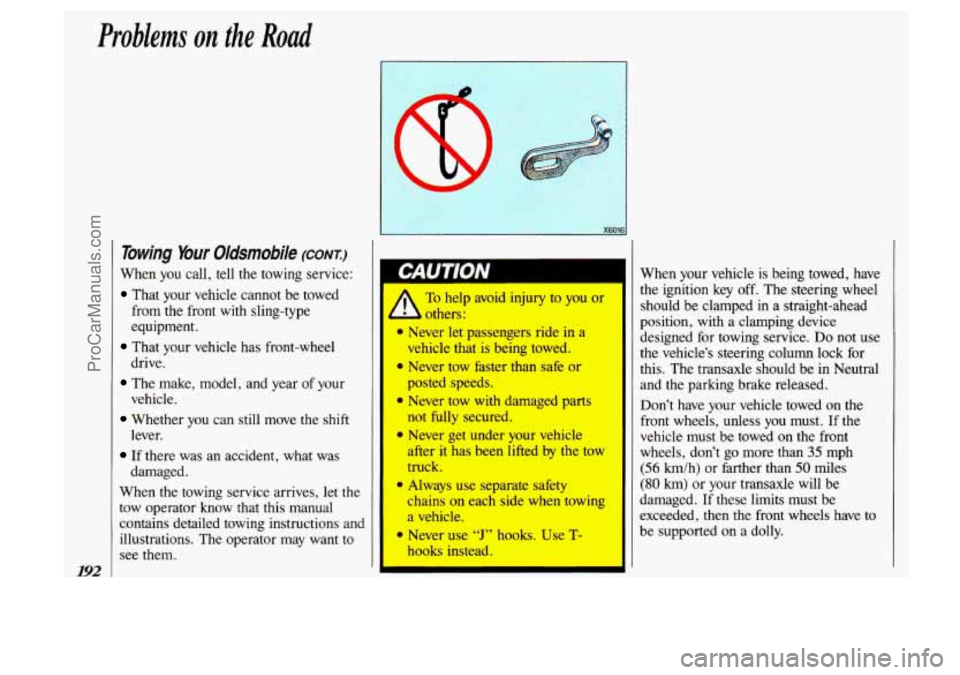
When you call, tell the towing service:
That your vehicle cannot be towed
from the front with sling-type
equipment.
drive.
vehicle. lever.
damaged.
That your vehicle has front-wheel
The make, model, and year of your
Whether you can still move the shift
If there was an accident, what was
When the towing service arrives, let the
tow operator know that this manual
contains detailed towing instructions and
illustrations. The operator may want to
see them.
1 X6016
m,. ,
L ‘~‘n help avoid injury to you or
0 Never let passengers ride in a
vehicle that is
being towed.
* Never tow faster than safe or
0 Never tow with damaged parts
0 Never get under your vehicle
posted speeds.
not fully secured.
after it has been lifted by the tow
truck.
chains on each side when towing
a vehicle.
Never use “J” hooks. Use T-
hooks instead.
* Always use separate safety When your vehicle is being towed, have
the
ignition key
off. The steering wheel
should be clamped in a straight-ahead
position, with
a clamping device
designed for towing service. Do not use
the vehicle’s steering column lock for
this. The transaxle should be
in Neutral
and the parking brake released.
Don’t have your vehicle towed on
the
front wheels, unless you must. If the
vehicle must be towed on the front
wheels, don’t
go more than 35 mph
(56 km/h) or farther than 50 miles
(80 km) or your transaxle will be
damaged. If these limits must be
exceeded,
then the front wheels have to
be supported on a dolly.
ProCarManuals.com
Page 205 of 323
Ifa Tire Goes Hat
It’s unusual for a tire to “blow out”
while you’re driving, especially if
you
maintain your tires properly. If air goes
out of a tire, it’s much more likely to
leak out slowly. But if you should ever
have a “blowout:’ here are a few tips
about what
to expect and what to do:
If a front tire
fails, the flat tire will
create a drag that pulls
the vehicle
toward that side. Take your foot off the
accelerator pedal and grip the steering
wheel
firmly. Steer to maintain lane
position, then gently brake to a stop well
out of the traffic lane.
A rear blowout, particularly on a curve,
acts much like a skid and may require
the same correction you’d use in a skid.
In any rear blowout, remove your foot
from the accelerator pedal. Get
the
vehicle under control by steering the
way you want the vehicle to go.
It may
be very bumpy and noisy, but you can still steer. Gently brake to a stop, well
off the road if possible.
If your tire goes flat, the next section
shows how
to use your jacking
equipment to change a flat tire safely.
Air Inflator
Your vehicle may have an air inflator for
use
in bringing tires up to the proper
pressure.
To learn about it, see the Index
under Air Inflator System.
Inflating something too much
can make it explode, and
you
or others could be injured. Be sure
to read the inflator instructions and
inflate any object only to
its
recommended pressure.
I
203
ProCarManuals.com
Page 215 of 323
If You’re Stuck: In Sand, Mud,
Ice or Snow
What you don’t want to do when your
vehicle is stuck is to spin your wheels.
The method known as “rocking” can
help you get out when you’re stuck, but
you must use caution.
‘ If you let your tires spin at
high speed, they can explode
and
you or others could be injured.
And, the transaxle or other parts of
the vehicle can overheat. That could
cause an engine compartment fire
or other damage. When you’re
stuck, spin the wheels as little as
possible. Don’t spin
the wheels
above
35 mph (56 km/h) as shown
on the speedometer.
.~.. .. . .
$ back and forth, you can desi
F$ your transaxle.
Rocking Your Vehicle to Get it Out:
First, turn your steering wheel left and
right. That will clear the area around
your front wheels. Then shift back and
forth between
R (Reverse) and a
forward gear, spinning the wheels as
little as possible. Release the accelerator
pedal while
you shift, and press lightly
on
the accelerator pedal when the
transaxle is
in gear. If that doesn’t get
you out after a few tries, you may need
to be towed out. If you do need to be
towed out, see the
Index- under Towing
Your Oldsmobile.
213
ProCarManuals.com
Page 272 of 323
Service & Appearance Care
Capacities & Specifications (CONT.)
Refrigerant, Air Conditioning .......................... See refrigerant charge label under hood.
Not all air conditioning refrigerants are the same. If the air
conditioning system in your vehicle needs refrigerant, be sure
the proper refrgerant
is used. If you’re not sure, ask your
Oldsmobile dealer.
FuelTank ........................................... 20gallons
Power Steering
3.n V6 Engine:
Pump Only ...................................... 1 pint
Complete System
.................................. 1 ?4 pints
76.00 L
0.50 L
0.60 L
3800 V6 Engine:
pump only ...................................... 1 pint
Complete System.
................................. 1 pints
0.50 L
.70 L
Tire Pressures, Sizes .................................. See Certification/Tire label on driver’s door.
Wheel Nut Torque ................................... 100 pound-feet (140 Nem)
NOTE: All capacities are approximate. When adding, be sure to fiil to the appropriate level, as recommended in this manual.
ProCarManuals.com
Page 286 of 323
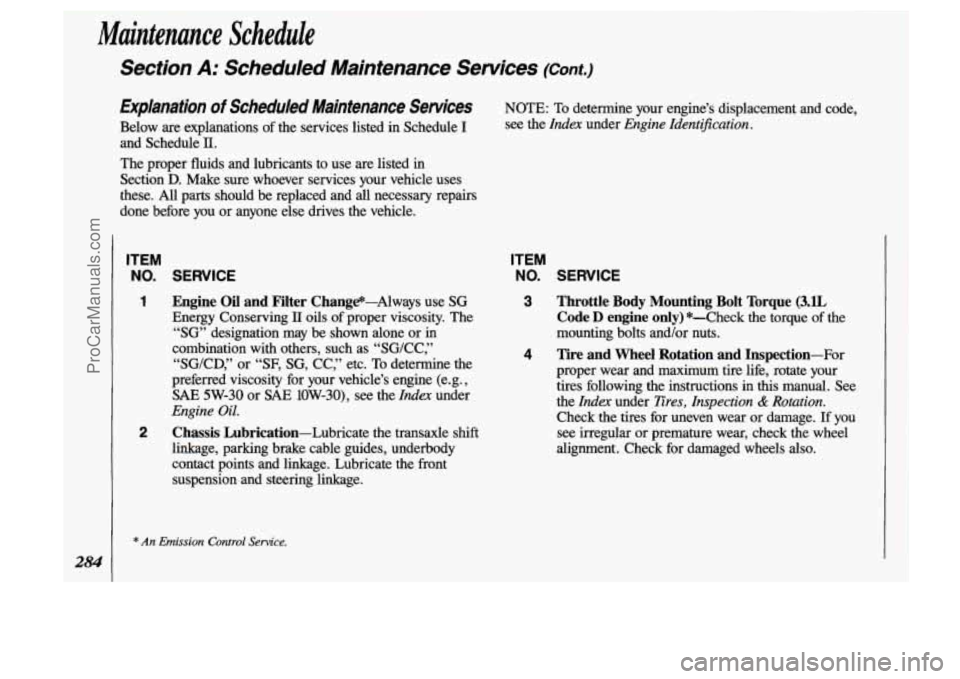
Maintenance Schedule
Section A: Scheduled Maintenance Services (Cont.)
284
Explanation of Scheduled Maintenance Services
Below are explanations of the services listed in Schedule I
and Schedule II.
The proper fluids and lubricants to use are listed in
Section D. Make sure whoever services your vehicle uses
these. All parts should be replaced
and all necessary repairs
done before you or anyone else drives the vehicle.
ITEM
NO. SERVICE
1 Engine Oil and Filter Chang@-Always use SG
Energy Conserving
II oils of proper viscosity. The
“SG” designation may be shown alone or in
combination with others, such as “SG/CC,” “SG/CD,” or
“SF, SG, CC,” etc. To determine the
preferred viscosity for your vehicle’s engine (e.g.,
SAE 5W-30 or SAE 10W-30), see the
Index under
Engine Oil.
2 Chassis Lubrication-Lubricate the transaxle shift
linkage, parking brake cable guides, underbody
contact points and linkage. Lubricate the front
suspension and steering linkage. NOTE:
To determine your engine’s displacement and code,
see the
Index under Engine IdentiJication.
ITEM
NO. SERVICE
3 Throttle Body Mounting Bolt Torque (3.a
Code D engine only) *-Check the torque of the
mounting bolts and/or nuts.
4 Tire and Wheel Rotation and Inspection-For
proper wear and maximum tire life, rotate your
tires following the instructions
in this manual. See
the
Index under Eres, Inspection & Rotation.
Check the tires for uneven wear or damage. If you
see irregular or premature wear, check the wheel
alignment. Check for damaged wheels
also.
* An Emission Control Senice.
ProCarManuals.com
Page 292 of 323
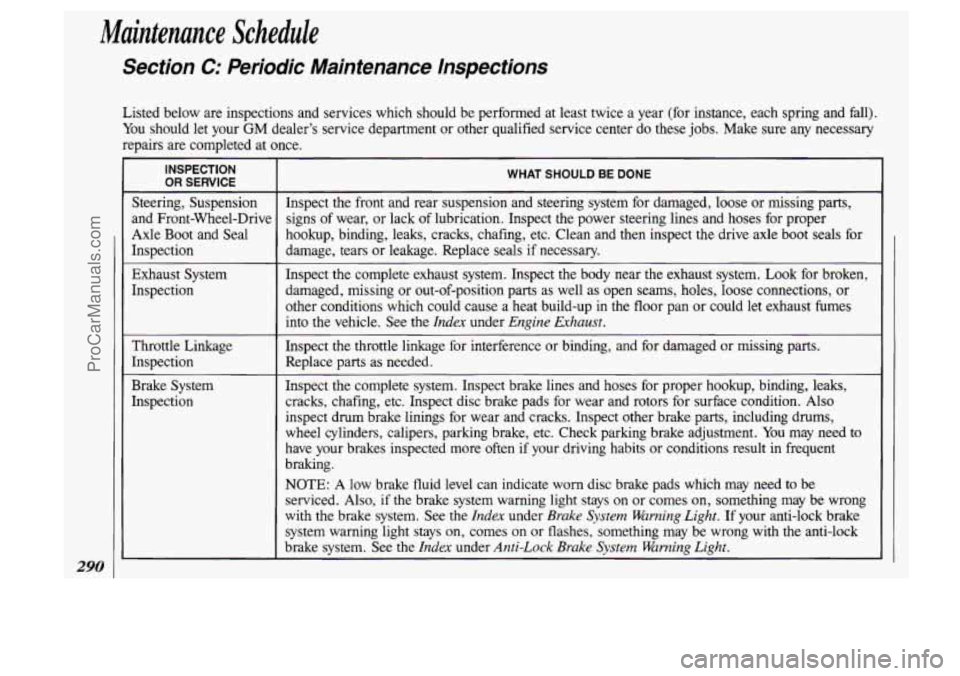
Maintenance Schedule
Section C: Periodic Maintenance lnspections
Listed below are inspections and services which should be performed at least twice a year (for instance, each spring and fall).
You should let your GM dealer’s service department or other qualified service center do these jobs. Make sure any necessary
repairs are completed at once.
290
INSPECTION
OR SERVICE
Steering, Suspension
and Front-Wheel-Drive
Axle Boot and Seal
Inspection
Exhaust System
Inspection
Throttle Linkage
Inspection
Brake System
Inspection
WHAT SHOULD BE DONE
Inspect the front and rear suspension and steering system for damaged, loose or missing parts,
signs of wear, or lack of lubrication. Inspect the power steering lines and hoses for proper
hookup, binding, leaks, cracks, chafing, etc. Clean and then in\
spect the drive axle boot seals for
damage, tears or leakage. Replace seals if necessary.
Inspect the complete exhaust system. Inspect the body near the exhaust system. Look for broken,
damaged, missing or out-of-position parts as well as open seams, holes, loose connections, or
other conditions which could cause a heat build-up in the floor pan or could let exhaust fumes
into the vehicle. See the
Index under Engine Exhaust.
Inspect the throttle linkage for interference or binding, and for damaged or missing parts.
Replace parts as needed.
Inspect the complete system. Inspect brake lines and hoses for \
proper hookup, binding, leaks,
cracks, chafing, etc. Inspect disc brake pads for wear and rotors for surface condition. Also
inspect drum brake linings for wear and cracks. Inspect other brake parts, including drums,
wheel cylinders, calipers, parking brake, etc. Check parking brake adjustment.
You may need to
have your brakes inspected more often
if your driving habits or conditions result in frequent
braking.
NOTE: A low brake fluid level can indicate worn disc brake pads which may need to be
serviced. Also, if the brake system warning light stays on or comes on, something may be wrong
with the brake system.
See the Index under Brake System Warning Light. If your anti-lock brake
system warning light stays on, comes on or flashes, something may be wrong with the anti-lock
brake system. See the
Index under Anti-Lock Brake System Warning Light.
ProCarManuals.com