wheel OLDSMOBILE SILHOUETTE 1993 Owner's Manual
[x] Cancel search | Manufacturer: OLDSMOBILE, Model Year: 1993, Model line: SILHOUETTE, Model: OLDSMOBILE SILHOUETTE 1993Pages: 323, PDF Size: 17.13 MB
Page 160 of 323
Loss of Control
Let’s review what driving experts say
about what happens when the
three
control systems (brakes, steering and
acceleration) don’t have enough friction
where the tires meet the road to do what
the driver has asked.
In any emergency, don’t give up. Keep
trying
to steer and constantly seek an
escape route or area of less danger.
Skidding
In a skid, a driver can lose control of
the vehicle. Defensive drivers avoid
most skids by taking reasonable care
suited to existing conditions, and
by not
“overdriving” those conditions. But
skids are always possible.
The three types of skids correspond to
your Oldsmobile’s
three control systems.
In the braking skid your wheels aren’t
rolling.
In the steering or cornering
skid, too much speed or steering in a
curve causes tires to slip and lose
cornering force. And
in the acceleration
skid too much throttle causes the driving
wheels to spin.
A cornering skid and an acceleration
skid are best handled by easing your
foot
off the accelerator pedal. If your
vehicle
starts to slide (as when you turn
a corner on a wet, snow- or ice-covered road), ease your
foot
off the accelerator
pedal as soon as you feel the vehicle
start to slide. Quickly steer the way you
want the vehicle to go.
E you start
steering quickly enough, your vehicle
will straighten out. As it does, straighten
the front wheels.
Of course, traction is reduced when
water, snow, ice, gravel, or other
material is on the road. For safety, you’ll
want to slow down and adjust your
driving to these conditions.
It is
important to slow down
on slippery
surfaces because stopping distance will
be longer and vehicle control more
limited.
While driving
on a surface with reduced
traction,
try your best to avoid sudden
steering, acceleration,
or braking
(including engine braking by shifting to
I
ProCarManuals.com
Page 170 of 323
Driving a Long Distance
Although most long trips today are
Before Leaving on a Long Trip
Make sure you’re ready. Try to be well
I
I
I
168
J
7
1
1
-
made on freeways, there are still many
made on regular highways.
Long-distance driving on freeways and regular highways is the same in some
ways. The trip has to be planned and the
vehicle prepared, you drive at higher-
than-city speeds, and there are longer
turns behind the wheel. You’ll enjoy
your trip more if you and your vehicle
are
in good shape. Here are some tips
for a successful long trip. rested.
If you
must start when you’re not
fresh-such as after a day’s work-don’t
plan to make too many miles that first
part of the journey. Wear comfortable
clothing and shoes you can easily drive
in.
Is your vehicle ready for a long trip? If
you keep it serviced and maintained, it’s
ready to go.
If it needs service, have it
done before starting out.
Of course,
you’ll find experienced and able service
experts in Oldsmobile dealerships all across
North America. They’ll be ready
and willing to help
if you need it. Here
are some things you can check
before a trip:
Windshield Washer Fluid: Is the
reservoir full? Are
all windows clean
inside and outside?
Wiper Blades: Are they in good
shape?
Fuel, Engine Oil, Other Fluids:
Have you checked all levels?
Lights: Are they all working? Are the
lenses clean?
Tires: They are vitally important to a
safe, trouble-free trip.
Is the tread
good enough for long-distance
driving? Are the tires
all inflated to
the recommended pressure?
weather outlook along your route? Should you delay your trip a short
time to avoid a major storm system?
Maps: Do you have up-to-date maps?
Weather Forecasts: What’s the
ProCarManuals.com
Page 171 of 323
On the Road
Unless you are the only driver, it is
good to share the driving task with
others. Limit turns behind the wheel to
about 100 miles
(160 km) or two hours
at a sitting. Then, either change drivers
or stop for some refreshment like coffee,
tea or
soft drinks and some limbering
up. But do stop and move around. Eat
lightly along the way. Heavier meals
tend to make some people sleepy.
On two-lane highways or undivided
multilane highways that do not have
controlled access, you’ll want to watch
for some situations not usually found on
freeways. Examples are: stop signs and
signals, shopping centers with direct
access to the highway, no passing zones
and school zones, vehicles turning left
and right
off the road, pedestrians,
cyclists, parked vehicles, and even animals.
Highway Hypnosis
Is there actually such a condition as
“highway hypnosis”? Or is it just plain
falling asleep at the wheel? Call it
highway hypnosis, lack
of awareness, or
whatever.
There is something about an easy stretch
of road with the same scenery, along
with the hum of the tires on the road,
the drone of the engine, and the rush
of
the wind against the vehicle that can
make you sleepy. Don’t let
it happen to
you! If it does, your vehicle can leave
the road in
less than a second, and you
could crash and be injured.
What can you do about highway
hypnosis? First, be aware that it can
happen.
Then here are some tips:
Make sure your vehicle is well
ventilated, with a comfortably cool interior.
Keep your eyes moving. Scan the road
ahead and to the sides. Check your
rearview mirrors frequently and your
instruments from time
to time. This
can help
you avoid a fixed stare.
Wear good sunglasses in bright light.
Glare can cause drowsiness. But don’t
wear sunglasses at night. They will
drastically reduce
your overall vision
at the very time you need all the
seeing power you have.
If you get sleepy, pull off the road into
a rest, service,
or parking area and
take a nap, get some exercise, or both.
For safety, treat drowsiness on the
highway as an emergency.
As in any driving situation, keep pace
with traffic and allow adequate following distances.
169
ProCarManuals.com
Page 173 of 323
vehicle is passing you and doesn't have
enough room, slow down to make
it
easier for the other vehicle to get by.
As you go over the top of a hill, be
alert. There could be something in
your lane, like a stalled car or an
accident.
You may see highway signs on
mountains that warn of special
problems. Examples are
long grades,
passing or no passing zones,
a falling
rocks area, or winding roads. Be alert
to these and take appropriate action.
problems. See the
Index under Winter
Driving.
Winter driving can present special
Parking on Hills
Hills and mountains mean spectacular
scenery. But please be careful where you
stop
if you decide to look at the view or
take pictures.
Look for pull-offs or
parking areas provided for scenic
viewing.
Another part of this manual tells how to
use your parking brake (see the
Index
under Parking Brake). But on a
mountain or steep hill, you can do one
more thing. You can turn your front
wheels to keep your vehicle from rolling
downhill or out into traffic.
Here's how:
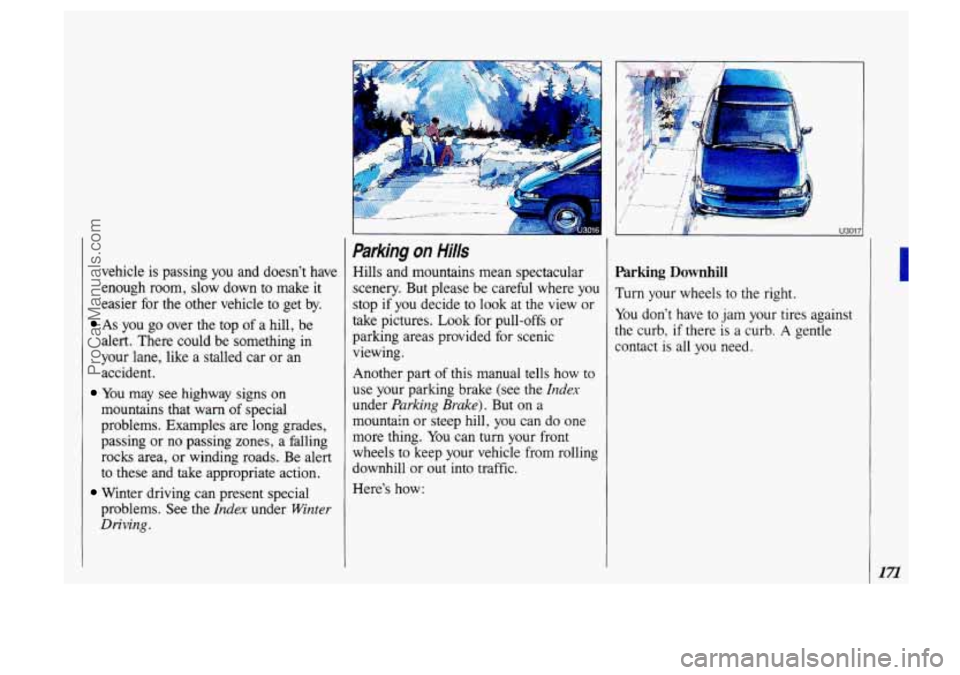
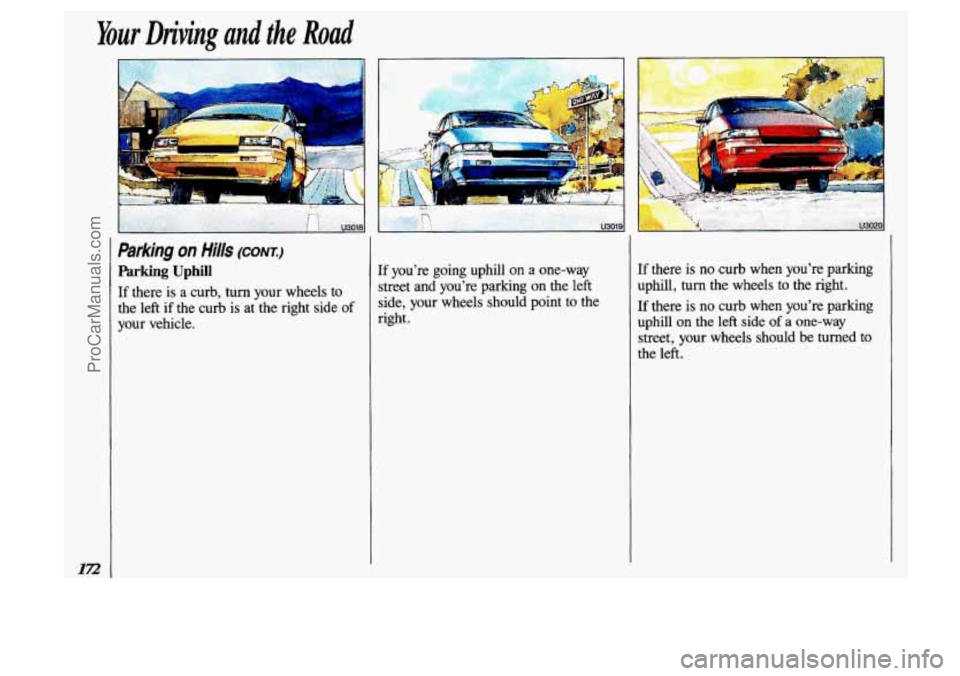
Parking Downhill
Turn your wheels to the right.
You don't have to jam your tires against
the curb,
if there is a curb. A gentle
contact
is all you need.
ProCarManuals.com
Page 174 of 323
Your Driving and the Road
Parking on Hills (CONT.)
Parking Uphill
If there is a curb, turn your wheels to
the left
if the curb is at the right side of
your vehicle.
I ..
If you’re going uphill on a one-way
street and you’re parking on the left side, your wheels should point
to the
right.
If there is no curb when you’re parking
uphill,
turn the wheels to the right.
If there is no curb when you’re parking
uphill
on the left side of a one-way
street, your wheels should be turned to
the left.
ProCarManuals.com
Page 176 of 323
Your Driving and the Road
Driving on Snow or Ice
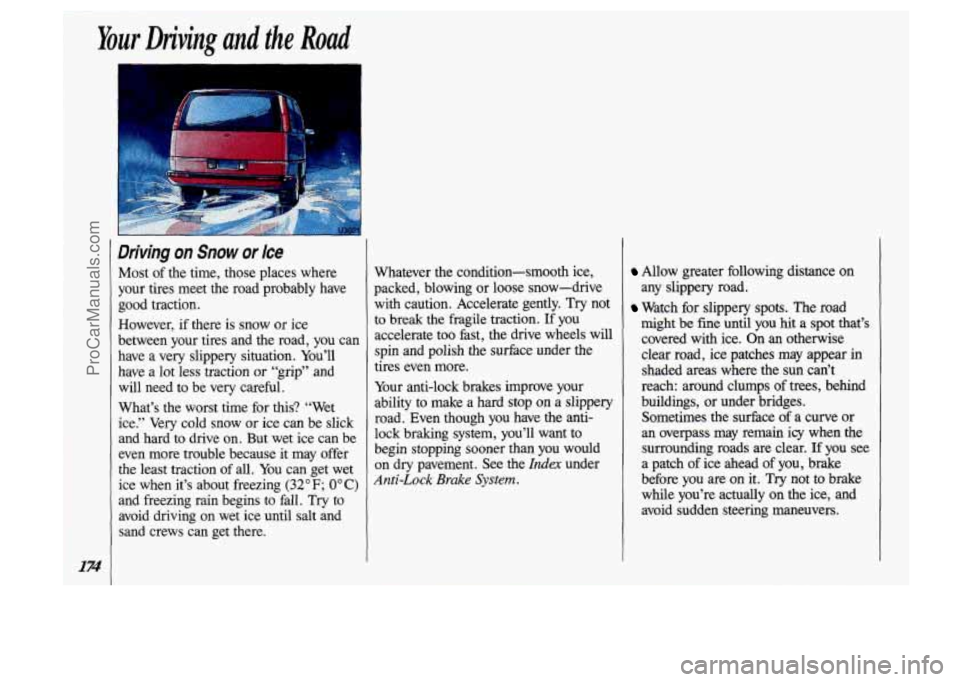
Most of the time, those places where
your tires meet the road probably have
good traction.
However, if there is snow or ice
between your tires and the road, you can
have a very slippery situation. You’ll
have
a lot less traction or “grip” and
will need to be very careful.
What’s the worst time for this? “Wet
ice.” Very cold snow or ice can be slick
and hard
to drive on. But wet ice can be
even more trouble because it may offer
the least traction
of all. You can get wet
ice when it’s about freezing
(32°F; 0°C)
and freezing rain begins to fd. Try to
avoid driving on wet ice until salt and
sand crews can get there. Whatever the condition-smooth ice,
packed, blowing or loose snow-drive
with caution. Accelerate gently. Try not
to break the fragile traction.
If you
accelerate too fast, the drive wheels will
spin and polish the surface under the
tires even more.
Your anti-lock brakes improve your
ability
to make a hard stop on a slippery
road. Even though you have the anti-
lock braking system, you’ll want to
begin stopping sooner
than you would
on dry pavement.
See the Index under
Anti-Lock Brake System.
Allow greater following distance on
any slippery road.
Watch for slippery spots. The road
might be fine until you
hit a spot that’s
covered with ice. On an otherwise
clear road, ice patches may appear
in
shaded areas where the sun can’t
reach: around clumps of trees, behind
buildings, or under bridges.
Sometimes the surface
of a curve or
an overpass may remain icy when the surrounding roads are clear.
If you see
a patch of ice ahead
of you, brake
before
you are on it. Try not to brake
while you’re actually on the ice, and
avoid sudden steering maneuvers.
174
ProCarManuals.com
Page 179 of 323
Towing a Tmiler
I I If you don’t use the correct I
L L equipment and drive properly,
you can lose control when you pull
a trailer. For example, if the trailer
is too heavy, the brakes may not
work well-or even at all. You and
your passengers could be seriously
injured. Pull a trailer only
if you
have followed all the steps in this section. Your
Oldsmobile can tow a trailer. To
identify what the vehicle trailering
capacity is for your vehicle, you should
read the information in
Weight of the
Trailer
that appears later in this section.
But trailering
is different than just
driving your vehicle
by itself. Trailering
means changes
in handling, durability,
and fuel economy. Successful, safe
trailering takes correct equipment, and
it
has to be used properly.
That’s the reason for
this section, In it
are many time-tested, important
trailering tips and safety rules. Many of
these are important for your safety and
that of your passengers.
So please read
this section carefully before you pull a
trailer. Load-pulling components such as the
engine, transaxle, wheel assemblies, and
tires
are forced to work harder against
the drag of the added weight. The engine
is required to operate at relatively higher
speeds and under greater loads, generating
extra heat. What’s more, the trailer adds
considerably to wind resistance, increasing the pulling requirements.
All
of that means changes in:
Handling
Durability
Fuel economy
177
ProCarManuals.com
Page 184 of 323
Your Driving and the Road
Driving with a Trailer (CONT.)
Backing Up
Hold the bottom of the steering wheel
with one hand. Then, to move the trailer
to the left, just move that hand
to the
left. To move the trailer to the right,
move your hand to the right. Always
back up slowly and, if possible, have
someone guide you.
Making Turns
When you’re turning with a trailer,
make wider
turns than normal. Do this
so your trailer won’t strike soft
shoulders, curbs, road signs, trees, or
other objects. Avoid jerky or sudden
maneuvers. Signal well in advance.
Turn Signals When Towing a Trailer
When you tow a trailer, your vehicle has
to have a different
turn signal flasher
and extra wiring. The green arrows on
your instrument panel will flash
whenever you signal
a turn or lane
change. Properly hooked up, the trailer
lights will also flash, telling other
drivers you’re about to
turn, change
lanes or stop.
When towing a trailer, the green arrows
on your instrument panel will flash for
turns even if the bulbs on the trailer are
burned out. Thus, you may think drivers
behind you are seeing your signal when
they are not. It’s important to check
occasionally to be sure the trailer bulbs
are still working.
Driving On Grades
Reduce speed and shift to a lower gear
before you start down a long or steep
downgrade.
If you don’t shift down, you
might have to use your brakes
so much
that they would get hot and no longer
work well.
On a long uphill grade,
shift down and
reduce your speed to around
45 mph
(70 Wh) to reduce the possibility of
engine and transaxle overheating. If
your vehicle has a 3800 V6 engine, you
should also drive in
D instead of
Overdrive when towing a trailer on
fairly level roads. This will help your
engine and transaxle run cooler in
this
condition, too.
If you are towing a trailer that weighs
more
than 1,000 pounds (454 kg), and
you have an automatic transaxle with Overdrive, you may prefer to drive in
D
instead of Overdrive (or, as you need to,
a lower gear).
ProCarManuals.com
Page 185 of 323
Parking on Hills
You really should not park your vehicle,
with a trailer attached, on a hill. If
something goes wrong, your rig could
start to move. People can be injured,
and both your vehicle and the trailer can
be damaged.
But if you ever have to park your rig on
a hill, here’s how to do it:
1 . Apply your regular brakes, but don’t
shift into
P (Park) yet.
2. Have someone place chocks under
the trailer wheels.
3. When the wheel chocks are in place,
release the regular brakes until the
chocks absorb the load.
apply your parking brake, and then shift to
P (Park).
4. Reapply the regular brakes. Then
5. Release the regular brakes.
When You Are Ready to Leave After
Parking on a Hill
1. Apply your regular brakes and hold
the pedal down while you:
Start your engine;
Shift into a gear; and
Release the parking brake.
2. Let up on the brake pedal.
3. Drive slowly until the trailer is clear
4. Stop and have someone pick up and
of the chocks.
store the chocks.
Maintenance When Trailer
Towing
Your vehicle will need service more
often when you’re pulling a trailer. See
the Maintenance Schedule for more on
this. Things that are especially
important in trailer operation are
automatic transaxle fluid (don’t overfill)
engine oil, belts, cooling system, and
brake adjustment. Each
of these is
covered in this manual, and the
Index
will help you find them quickly. If
you’re trailering, it’s a good idea to
review these sections before you
start
your trip.
Check periodically
to see that all hitch
nuts and bolts are tight.
183
ProCarManuals.com
Page 193 of 323
10. Now start the vehicle with the good
battery and run the engine for a
while.
1 1. Try to start the vehicle with the
dead battery.
If it won’t start after a
few tries, it probably needs service.
-wP
1
1 2. Remove the cables in reverse order
to prevent electrical shorting. Take
care that they don’t touch each other
or any other metal.
X51 O(
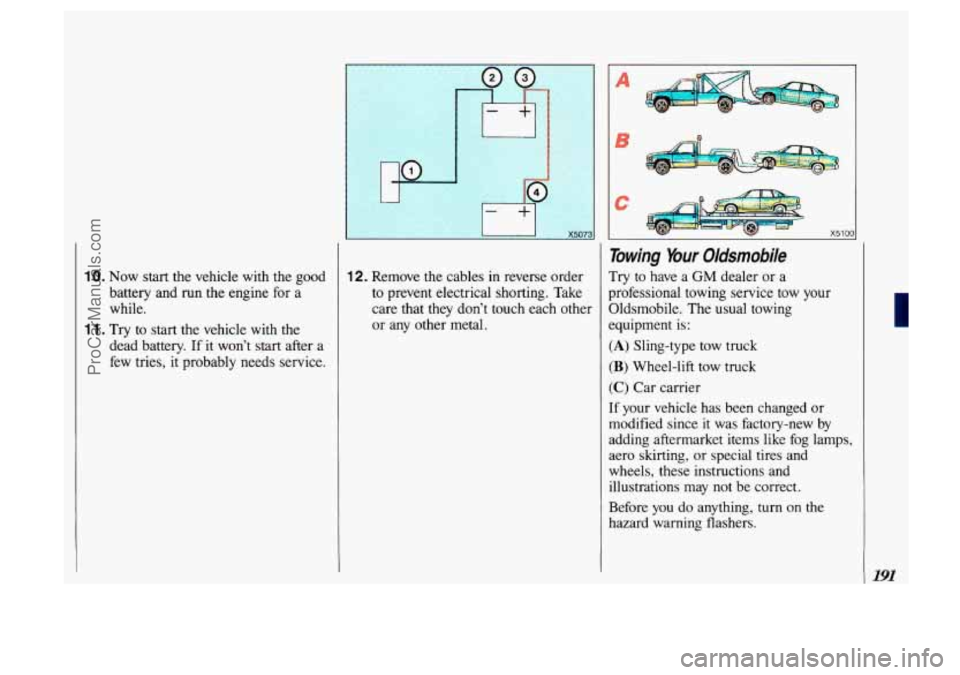
Towing Your Oldsmobile
Try to have a GM dealer or a
professional towing service tow your
Oldsmobile. The usual towing
equipment is
:
(A) Sling-type tow truck
(B) Wheel-lift tow truck
(C) Car carrier
If your vehicle has been changed or
modified since it was factory-new by
adding aftermarket items like
fog lamps,
aero skirting, or special tires and
wheels, these instructions and
illustrations may not be correct.
Before
you do anything, turn on the
hazard warning flashers.
191
ProCarManuals.com