belt OLDSMOBILE SILHOUETTE 1993 Owner's Guide
[x] Cancel search | Manufacturer: OLDSMOBILE, Model Year: 1993, Model line: SILHOUETTE, Model: OLDSMOBILE SILHOUETTE 1993Pages: 323, PDF Size: 17.13 MB
Page 45 of 323
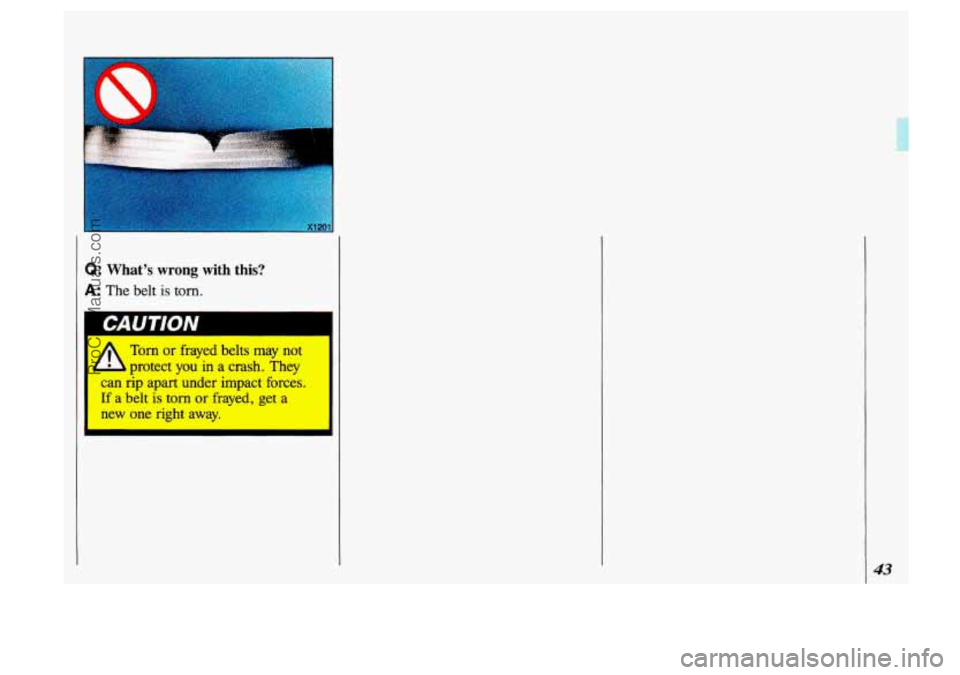
Q: What's wrong with this?
A: The belt is torn.
I' Torn or frayed belts may not
protect you in a crash. They
can rip apart under impact forces.
If a belt
is torn or frayed, get a
new one right away.
ProCarManuals.com
Page 49 of 323
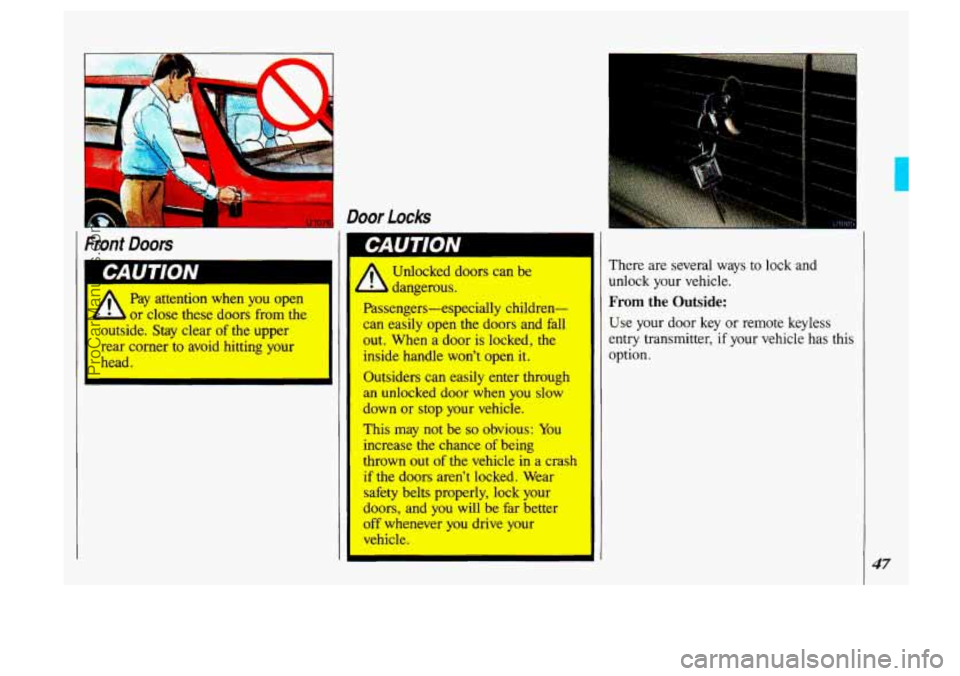
Front Doors
k
Pay attention when you open
or close these doors from the
c ;ide. Stay clear of the upper
rear corner to avoid hitting your
head.
‘ Door Locks
I
dangerous. I
Passengers-especially children-
can easily open the doors and fall
out. When a door is locked, the
inside handle won’t open it.
Outsiders can easily enter throl 1
an unlocked door when you slow
down or stop pur vehicle.
This may not be so obvious: You
increase
the chance of being
thrown out of the vehicle in a crash
if the doors aren’t locked. Wear
safety belts properly, lock your
doors, and you will be far better
off whenever you drive yuur
vehicle. I
I
I
There are several ways to lock and
unlock your vehicle.
From the Outside:
Use your door key or remote keyless
entry transmitter, if your vehicle has this
option.
47
ProCarManuals.com
Page 146 of 323
Your Driving and the Road
Defensive Driving
The best advice anyone can give about
driving is: Drive defensively.
Please start with a very important safety
device in your Oldsmobile: Buckle up.
(See the
Index under Safety Belts.)
Defensive driving really means “be
ready for anything.” On city streets,
rural roads, or freeways, it means
“always expect the unexpected.”
Assume that pedestrians or other drivers
are going to be careless and make
mistakes. Anticipate what they might
do. Be ready for their mistakes.
Expect children to dash
out from behind
parked cars, often followed by other
children. Expect occupants in parked
cars to open doors into traffic. Watch for
movement in parked cars-someone
may be about
to open a door. Expect
other drivers to run stop signs
when
you are on a through street. Be
ready to brake if necessary as you go
through intersections. You may not have
to use the brake, but if you do, you will
be ready.
If you’re driving through a shopping
center parking lot where there are well-
marked lanes, directional arrows, and
designated parking areas, expect some
drivers to ignore all these markings and
dash straight toward one part of the lot.
Pedestrians can be careless. Watch for
them. In general, you must give way to
pedestrians even if you know you have
the right of way.
Rear-end collisions are about the most
preventable of accidents. Yet they are
common. Allow enough following distance.
It’s the best defensive driving
maneuver, in both city and rural
driving, You never know when the
vehicle in front
of you is going to brake
or
turn suddenly.
Here’s a final bit of information about
defensive driving. The most dangerous
time for driving in the
U.S. is very early
on Sunday morning.
In fact, GM
Research studies show that the most and
the least dangerous times for driving,
every week, fall on the same day. That
day is Sunday. The most dangerous time
is Sunday from
3 a.m. to 4 a.m. The
safest time is Sunday from
10 a.m. to
11 a.m. Driving the same distance on a
Sunday at
3 a.m. isn’t just a little more
dangerous than it is at
10 a.m. It’s about
134 times more dangerous!
That leads
to the next section.
ProCarManuals.com
Page 157 of 323
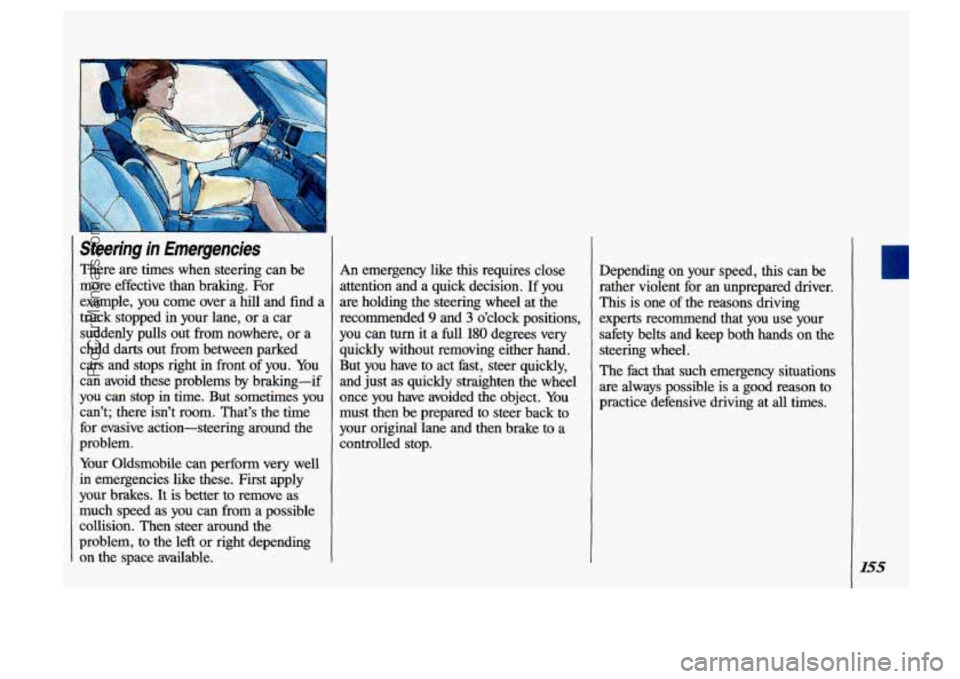
1 Steering in Emergencies
There are times when steering can be
more effective than braking. For
example, you come over a
hill and find a
truck stopped in your lane, or a car
suddenly pulls out from nowhere, or a
child
darts out from between parked
cars and stops right in front of you. You
can avoid these problems by braking-if
you can stop
in time. But sometimes you
can’t; there isn’t room. That’s the time
for evasive action-steering around the
problem.
, Your Oldsmobile can perform very well
in emergencies like these. First apply
your brakes.
It is better to remove as
much speed
as you can from a possible
collision. Then steer around
the
problem, to the left or right depending
on the space available.
An emergency like this requires close
attention and a quick decision.
If you
are holding the steering wheel at the
recommended
9 and 3 o’clock positions,
you can turn it a
full 180 degrees very
quickly without removing either hand.
But you have to act fast, steer quickly,
and just as quickly straighten the wheel
once
you have avoided the object. You
must then be prepared to steer back to
your
original lane and then brake to a
controlled stop. Depending on your
speed,
this can be
rather violent for an unprepared driver.
This is one of the reasons driving
experts recommend that you use your
safety belts and keep
both hands on the
steering wheel.
The fact that such emergency situations
are always possible is a
good reason to
practice defensive driving at all times.
ProCarManuals.com
Page 185 of 323
Parking on Hills
You really should not park your vehicle,
with a trailer attached, on a hill. If
something goes wrong, your rig could
start to move. People can be injured,
and both your vehicle and the trailer can
be damaged.
But if you ever have to park your rig on
a hill, here’s how to do it:
1 . Apply your regular brakes, but don’t
shift into
P (Park) yet.
2. Have someone place chocks under
the trailer wheels.
3. When the wheel chocks are in place,
release the regular brakes until the
chocks absorb the load.
apply your parking brake, and then shift to
P (Park).
4. Reapply the regular brakes. Then
5. Release the regular brakes.
When You Are Ready to Leave After
Parking on a Hill
1. Apply your regular brakes and hold
the pedal down while you:
Start your engine;
Shift into a gear; and
Release the parking brake.
2. Let up on the brake pedal.
3. Drive slowly until the trailer is clear
4. Stop and have someone pick up and
of the chocks.
store the chocks.
Maintenance When Trailer
Towing
Your vehicle will need service more
often when you’re pulling a trailer. See
the Maintenance Schedule for more on
this. Things that are especially
important in trailer operation are
automatic transaxle fluid (don’t overfill)
engine oil, belts, cooling system, and
brake adjustment. Each
of these is
covered in this manual, and the
Index
will help you find them quickly. If
you’re trailering, it’s a good idea to
review these sections before you
start
your trip.
Check periodically
to see that all hitch
nuts and bolts are tight.
183
ProCarManuals.com
Page 252 of 323
Sewice & Appearance Care
250
Buying New Tires
To find out what kind and size of tires
you need, look at the Certification/Tire
label. The tires installed on your vehicle
when it was new had a Tire Performance
Criteria Specification (TPC Spec)
number
on each tire’s sidewall. When
you get new tires, get ones with that
same
TPC Spec number. That way, your
vehicle will continue to have tires that
are designed to give proper endurance,
handling, speed rating, traction, ride
and other things during normal service
on your vehicle.
If your tires have an all-
season tread design, the TPC number
will be followed by a
“MS” (for mud
and snow).
If
you ever replace your tires with those
not having a
TPC Spec number, make
sure they are the same size, load range,
speed rating and construction type (bias,
bias-belted or radial)
as your original
tires. Mixing tires could
cause
you
to lose control while driving.
If you mix tires of different sizes
or types (radial and bias-belted
tires), the vehicle may not handle
properly, and you could have a
crash. Be sure to use the same size
and type tires on all four wheels.
It’s all right
to drive with your
compact spare, though.
It was
developed for use on your vehicle.
Uniform Tire Quality
Grading
The following information relates to the
system developed by the United States
National Highway Traffic Safety
Administration which grades tires by
treadwear, traction and temperature
performance. (This applies only to
vehicles sold
in the United States.)
u
ProCarManuals.com
Page 260 of 323
Service & Appearance Care
258
Cleaning the Top of the
Instrument Panel
Use only mild soap and water to clean
the top surfaces of the instrument panel.
Sprays containing silicones or waxes
may cause annoying reflections in the
windshield and even make it difficult to
see through the windshield under certain
conditions.
Vacuum the carpeted area as needed,
and clean as you would any other
carpet.
Care of Safety Belts
Keep belts clean and dry.
A Do not bleach or dye safety
severely weaken them. In a crash
they might not be able to provide I
adequate protection. Clean safety
belts
only with mild soap and
lukewarm water.
- L belts. If you do, it may
Glass
Glass should be cleaned often. GM
Glass Cleaner (GM Part No. 1050427)
or a liquid household glass cleaner will
remove normal tobacco smoke and dust
films.
Don’t use abrasive cleaners on glass,
because they may cause scratches. Avoid
placing decals on the inside rear
window, since they may have
to be
scraped off later.
If abrasive cleaners are used on the
inside of the rear window, an electric
defogger element may be damaged. Any
temporary license should not be attached across the defogger grid.
ProCarManuals.com
Page 267 of 323
t
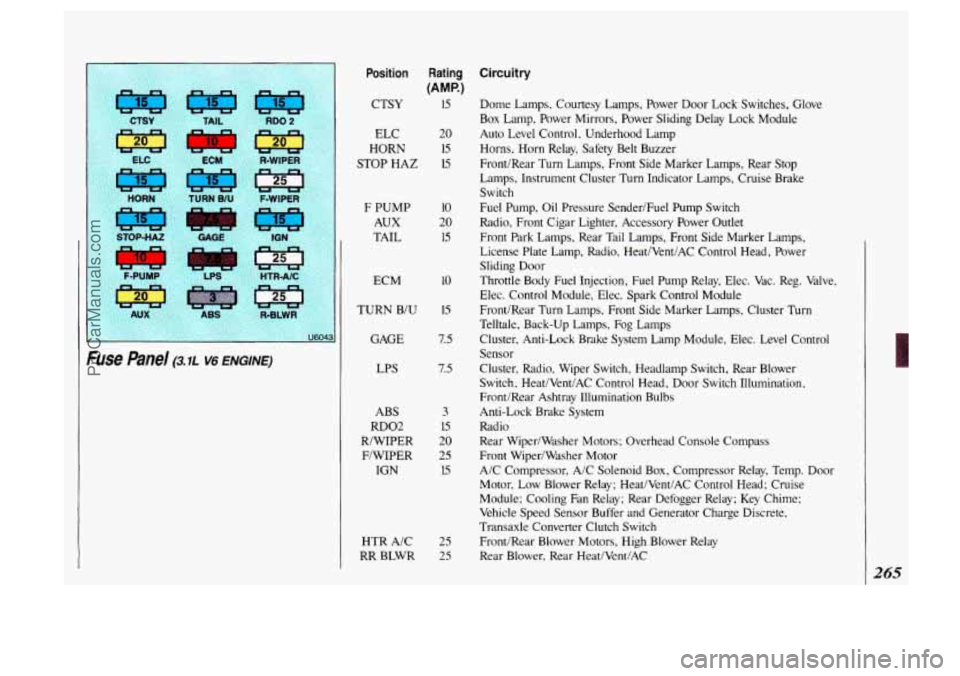
Fuse Pane/ (3.1L V6 ENGINE)
Position Rating
(AMP.)
CTSY ELC
HORN
STOP
HA2
15
20
15
15
F PUMP 10
AUX 20
TAIL 15
ECM
TURN B/U
GAGE
LPS
ABS
RD02
R/WIPER F/WIPER
IGN
HTR A/C
RR BLWR
10
15
7.5
7.5
3
15
20
25
15
25
25
Circuitry
Dome Lamps, Courtesy Lamps, Power Door Lock Switches, Glove
Box Lamp, Power Mirrors, Power Sliding Delay Lock Module
Auto Level Control, Underhood Lamp
Horns. Horn Relay, Safety Belt Buzzer
Front/Rear Turn Lamps, Front Side Marker Lamps, Rear Stop
Lamps, Instrument Cluster Turn Indicator Lamps, Cruise Brake
Switch
Fuel Pump, Oil Pressure Sender/Fuel Pump Switch
Radio, Front Cigar Lighter, Accessory Power Outlet
Front Park Lamps. Rear Tail Lamps, Front Side Marker Lamps,
License Plate Lamp, Radio, Heat/Vent/AC Control Head, Power
Sliding Door
Throttle Body Fuel Injection, Fuel Pump Relay, Elec. Vac. Reg. Valve,
Elec. Control Module, Elec. Spark Control Module
Front/Redr Turn Lamps, Front Side Marker Lamps, Cluster Turn
Telltale, Back-up Lamps, Fog Lamps
Cluster, Anti-Lock Brake System Lamp Module, Elec. Level Control
Sensor
Cluster, Radio, Wiper Switch, Headlamp Switch, Rear Blower
Switch, Heat/Vent/AC Control Head, Door Switch Illumination.
Front/Rear Ashtray Illumination Bulbs
Anti-Lock Brake System Radio
Rear WipedWasher Motors; Overhead Console Compass
Front Wiper/Washer Motor
A/C Compressor, A/C Solenoid Box, Compressor Relay, Temp. Door
Motor, Low Blower Relay; Heat/Vent/AC Control Head; Cruise
Module; Cooling Fan Relay; Rear Defogger Relay; Key Chime;
Vehicle Speed Sensor Buffer and Generator Charge Discrete,
Transaxle Converter Clutch Switch Front/Rear Blower Motors, High Blower Relay
Rear Blower, Rear Heat/Vent/AC
265
ProCarManuals.com
Page 268 of 323
Service di Appearance Care
266
1 d HORN
I STOP-HAZ
'tf4 1 RDO1 ..., X
. ECW
Ca
p"1
TURN 0IU
GAGE
INJ 3365
F-WIPF"
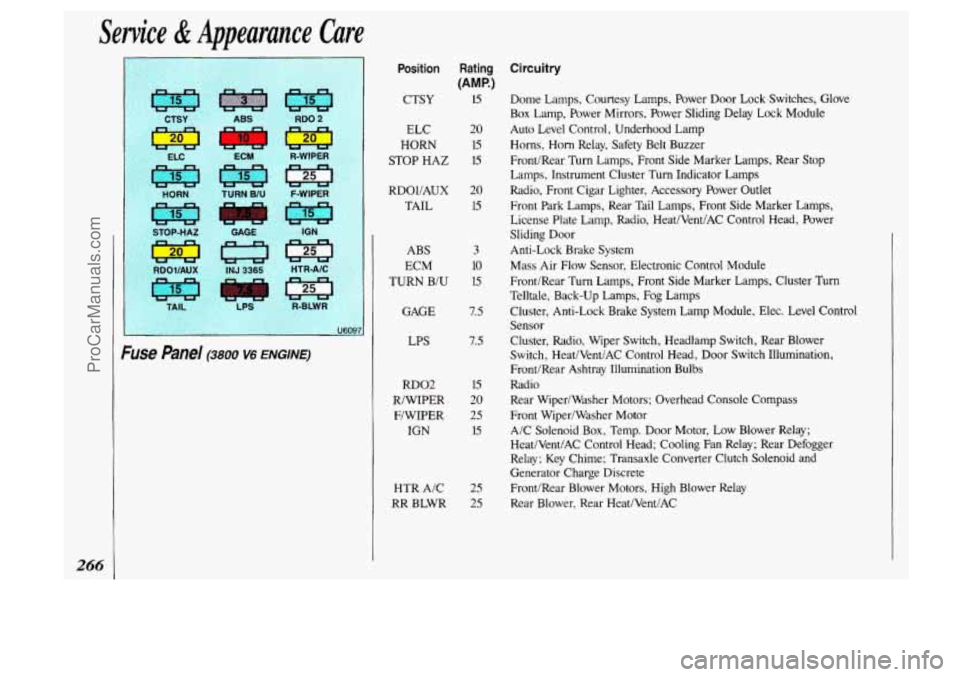
H1 n
Fuse Panel (3800 v6 ENGINE)
Position Rating
(AMP.)
CTSY ELC
HORN
STOP HAZ
RDOl/AUX TAIL
ABS
ECM
TURN B/U
GAGE LPS
RD02
R/WIPER
F/WIPER IGN
HTR A/C
RR BLWR 15
20
15
15
20 15
3
10
15
7.5
7.5
15
20 25
15
25
25 Circuitry
Dome Lamps, Courtesy Lamps, Power Door Lock Switches, Glove
Box Lamp, Power Mirrors, Power Sliding Delay Lock Module
Auto Level Control, Underhood Lamp
Horns, Horn Relay, Safety Belt Buzzer
Front/Rear Turn Lamps, Front Side Marker Lamps, Rear Stop
Lamps, Instrument Cluster Turn Indicator Lamps
Radio, Front Cigar Lighter, Accessory Power Outlet
Front Park Lamps, Rear Tail Lamps, Front Side Marker Lamps,
License Plate Lamp, Radio, Heat/Vent/AC Control Head, Power
Sliding Door
Anti-Lock Brake System
Mass Air Flow Sensor, Electronic Control Module
Front/Rear Turn Lamps, Front Side Marker Lamps, Cluster
Turn
Telltale, Back-up Lamps, Fog Lamps
Cluster, Anti-Lock Brake System Lamp Module, Elec. Level Control
Sensor
Cluster, Radio, Wiper Switch, Headlamp Switch, Rear Blower Switch, HeatlVentiAC Control Head, Door Switch Illumination,
Front/Rear Ashtray Illumination Bulbs
Radio
Rear Wiper/Wdsher Motors; Overhead Console Compass
Front Wiper/Washer Motor A/C Solenoid
Box, Temp. Door Motor, Low Blower Relay;
Heat/Vent/AC Control Head; Cooling Fan Relay; Rear Defogger
Relay; Key Chime; Transaxle Converter Clutch Solenoid and
Generator Charge Discrete
Front/Rear Blower Motors, High Blower Relay
Rear Blower, Rear Heat/Vent/AC
ProCarManuals.com
Page 287 of 323
ITEM
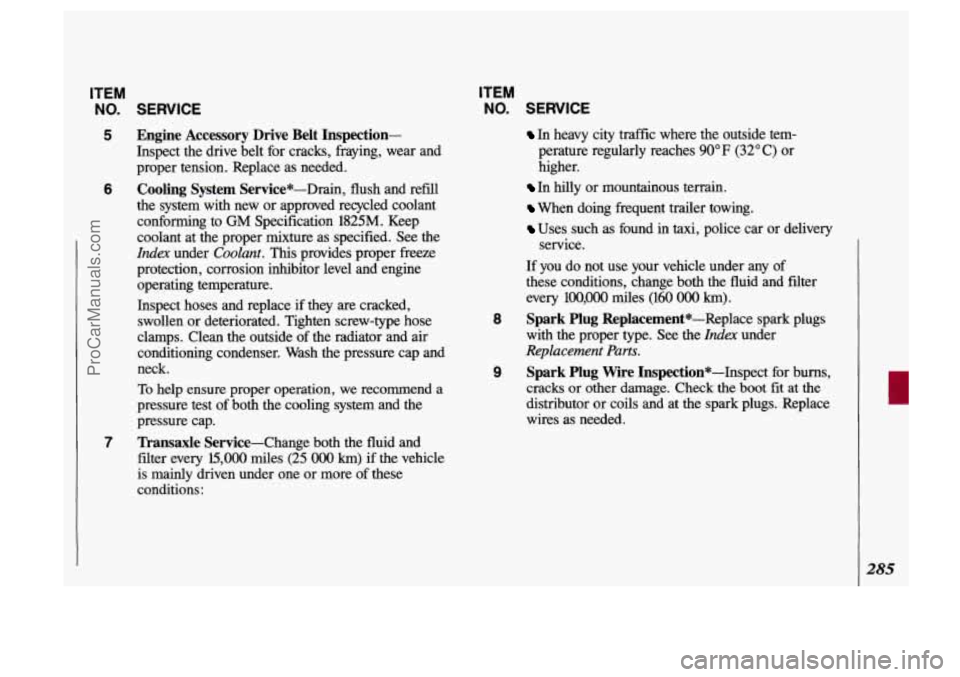
NO.
5
6
7
SERVICE
Engine Accessory Drive Belt Inspection-
Inspect the drive belt for cracks, hying, wear and
proper tension. Replace as needed.
Cooling
System Service*-Drain, flush and refill
the system with new or approved recycled coolant
conforming to
GM Specification 1825M. Keep
coolant at the proper mixture as specified. See the
Index under Coolant. This provides proper freeze
protection, corrosion inhibitor level and engine operating temperature.
Inspect hoses and replace if they
are cracked,
swollen or deteriorated. Tighten screw-type hose
clamps. Clean the outside of the radiator and air
conditioning condenser. Wash the pressure cap and
neck.
To help ensure proper operation, we recornmend a
pressure test of both the cooling system
and the
pressure cap.
Transaxle Service-Change both the fluid and
filter every
15,000 miles (25 000 km) if the vehicle
is mainly driven under one or more
of these
conditions:
ITEM
NO. SERVICE
In heavy city traffic where the outside tem-
perature regularly reaches
90" F (32" C) or
higher.
In hilly or mountainous terrain.
When doing frequent trailer towing.
Uses such as found in taxi, police car or delivery
If you do not use your vehicle under any of
these conditions, change both the fluid and filter
every
100,OOO miles (160 000 km).
with the proper type. See the Index under
Replacement Parts.
9 Spark Plug Wire Inspection*-Inspect for burns,
cracks
or other damage. Check the boot fit at the
distributor or coils and at the spark plugs. Replace
wires as needed. service.
8 Spark Plug
Replacement*-Replace spark plugs
285
ProCarManuals.com