lock OLDSMOBILE SILHOUETTE 1993 Workshop Manual
[x] Cancel search | Manufacturer: OLDSMOBILE, Model Year: 1993, Model line: SILHOUETTE, Model: OLDSMOBILE SILHOUETTE 1993Pages: 323, PDF Size: 17.13 MB
Page 152 of 323
Your
i
Anti-Lock Brakes (CONE)
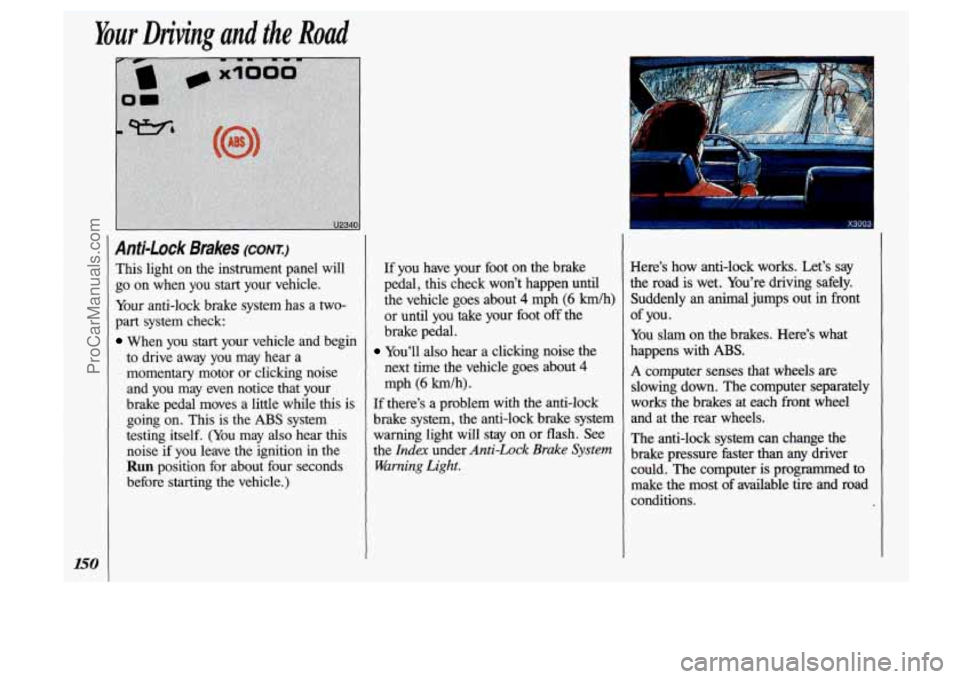
This light on the instrument panel will
go on when you start your vehicle.
Your anti-lock brake system has
a two-
part system check:
When you start your vehicle and begin
to drive away you may hear a
momentary motor or clicking noise
and you may even notice that your
brake pedal moves a little while this is
going on. This is the
ABS system
testing itself. (You may
also hear this
noise if you leave the ignition in the
Run position for about four seconds
before starting the vehicle.)
If you have your foot on the brake
pedal, this check won’t happen until
the vehicle goes about
4 mph (6 Wh)
or until you take your foot off the
brake pedal.
You’ll also hear a clicking noise the
next time the vehicle goes about
4
mph (6 Wh).
If there’s a problem with the anti-lock
brake system, the anti-lock brake system
warning light will stay on
or flash. See
the
Inda under Anti-Lock Brake System
Warning Light.
Here’s how anti-lock works. Let’s say
the road is wet. YOU’E driving safely.
Suddenly
an animal jumps out in front
You
slam on the brakes. Here’s what
happens with
ABS.
A computer senses that wheels are
slowing down. The computer separately
works the brakes at each front wheel
and at the rear wheels.
The anti-lock system can change the
brake pressure faster than any driver
could. The computer is programmed to
make the most of available tire and road
conditions.
of you.
ProCarManuals.com
Page 153 of 323
X3006 I
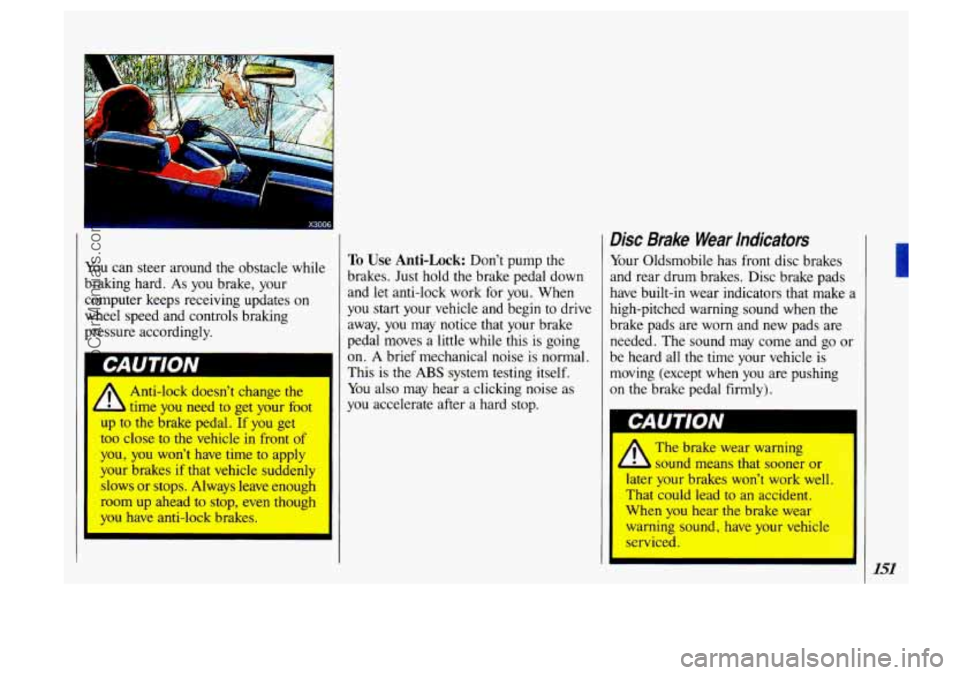
You can steer around the obstacle while
braking hard.
As you brake, your
computer keeps receiving updates on
wheel speed and controls braking
pressure accordingly.
1
‘t
Anti-lock doesn’t change the
time you need to get your foot
up
to the brake pedal. If you get
too close to the vehicle in front of
you, you won’t have time to apply
your brakes if that vehicle suddenly slows
or stops. Always leave enough
room up ahead to stop, even though
you have anti-lock brakes.
To Use Anti-Lock: Don’t pump the
brakes. Just hold the brake pedal down
and let anti-lock work for you. When
you start your vehicle and begin to drive
away, you may notice that your brake
pedal moves a little
while this is going
on.
A brief mechanical noise is normal.
This is
the ABS system testing itself.
You also may hear a clicking noise as
you accelerate after a hard stop.
Disc Brake Wear Indicators
Your Oldsmobile has front disc brakes
and rear drum brakes. Disc brake pads
have built-in wear indicators that make a
high-pitched warning sound when the
brake pads are worn and
new pads are
needed. The sound may come and
go or
be heard all
the time your vehicle is
moving (except when you are pushing
on the brake pedal firmly).
The brake wear warning
sound means that sooner or
later your brakes won’t work well
That could lead to an accident.
when you hear the brake wear
serviced. arning
sound, have your vehicle
151
ProCarManuals.com
Page 155 of 323
Brake Adjustment
Every time you make a brake stop, your
brakes adjust for wear.
If you rarely
make a moderate or heavier stop, then
your brakes might not adjust correctly.
If you drive in that way, then-very
carefully-make a few moderate brake
stops about every
1,000 miles (1 600 km),
so your brakes will adjust properly.
Braking In Emergencies
Use your anti-lock braking system when
you need to. With anti-lock, you can
steer and brake at the same time.
In
many emergencies, steering can help
you more than even the very best
braking.
Power Steering
If you lose power steering assist because
the engine stops or the system fails to
function, you can steer but it will take
much more effort.
153
ProCarManuals.com
Page 157 of 323
1 Steering in Emergencies
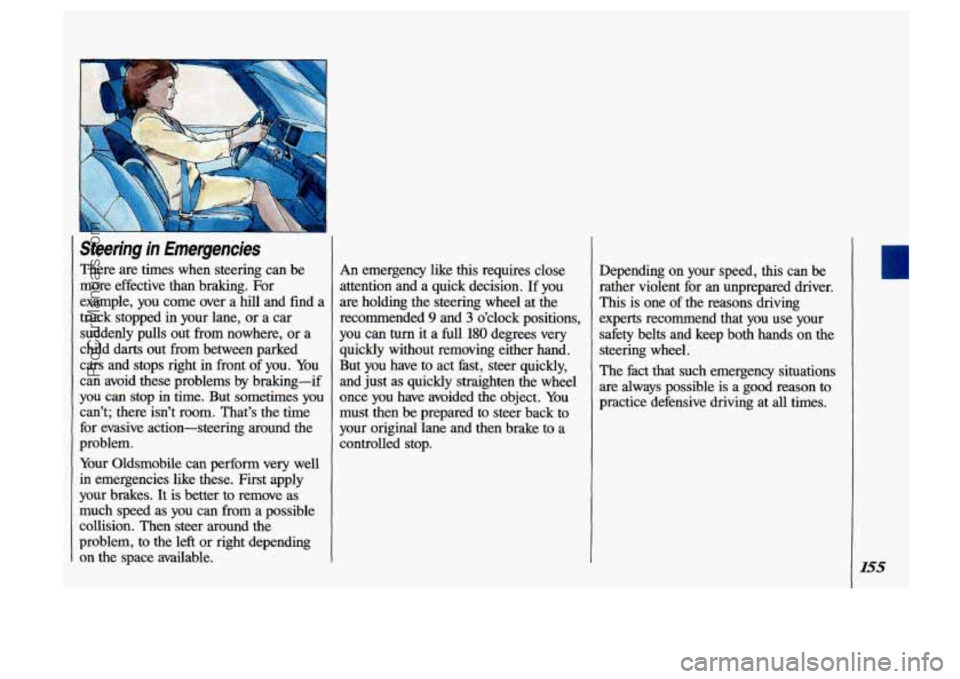
There are times when steering can be
more effective than braking. For
example, you come over a
hill and find a
truck stopped in your lane, or a car
suddenly pulls out from nowhere, or a
child
darts out from between parked
cars and stops right in front of you. You
can avoid these problems by braking-if
you can stop
in time. But sometimes you
can’t; there isn’t room. That’s the time
for evasive action-steering around the
problem.
, Your Oldsmobile can perform very well
in emergencies like these. First apply
your brakes.
It is better to remove as
much speed
as you can from a possible
collision. Then steer around
the
problem, to the left or right depending
on the space available.
An emergency like this requires close
attention and a quick decision.
If you
are holding the steering wheel at the
recommended
9 and 3 o’clock positions,
you can turn it a
full 180 degrees very
quickly without removing either hand.
But you have to act fast, steer quickly,
and just as quickly straighten the wheel
once
you have avoided the object. You
must then be prepared to steer back to
your
original lane and then brake to a
controlled stop. Depending on your
speed,
this can be
rather violent for an unprepared driver.
This is one of the reasons driving
experts recommend that you use your
safety belts and keep
both hands on the
steering wheel.
The fact that such emergency situations
are always possible is a
good reason to
practice defensive driving at all times.
ProCarManuals.com
Page 161 of 323
a lower gear). Any sudden changes
could cause the tires to slide. You may
not realize the surface is slippery until
your vehicle is skidding. Learn
to
recognize warning clues-such as
enough water, ice or packed snow on
the road to make a “mirrored
surface”-and slow down when
you
have any doubt.
Remember: Any anti-lock braking
system
(ABS) helps avoid only the
braking skid. Steer the way you want to
go.
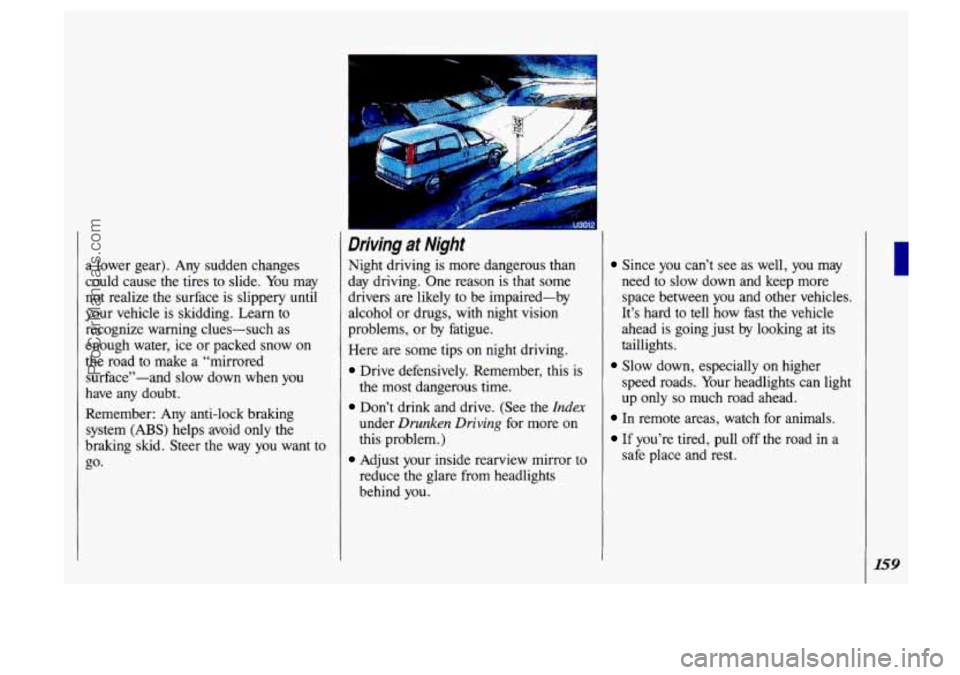
Driving at Night
Night driving is more dangerous than
day driving. One reason
is that some
drivers are likely to be impaired-by
alcohol or drugs, with night vision
problems, or by fatigue.
Here are some tips on night driving.
Drive defensively. Remember, this is
the most dangerous time.
Don’t drink and drive. (See the Index
under Drunken Driving for more on
this problem.)
Adjust your inside rearview mirror to
reduce the glare from headlights
behind you.
Since you can’t see as well, you may
need to slow down and keep more
space between
you and other vehicles.
It’s hard to tell how fast the vehicle
ahead is going just by looking at its
taillights.
speed roads. Your headlights can light
up only
so much road ahead.
Slow down, especially on higher
In remote areas, watch for animals.
If you’re tired, pull off the road in a
safe place and rest.
159
ProCarManuals.com
Page 162 of 323
Night Vision
No one can see as well at night as in the
daytime. But as we get older these
differences increase.
A 50-year-old
driver may require at least twice as
much light
to see the same thing at night
as a 20-year-old.
What you do in the daytime can also
affect your night vision. For example,
if
you spend the day in bright sunshine you
are wise to wear sunglasses. Your eyes
will have less trouble adjusting to night.
But if you're driving, don't wear
sunglasses at night. They may cut down
on glare from headlights, but they also
make a lot of things invisible that should
remain visible-such as parked cars,
obstacles, pedestrians, or even trains
blocking railway crossings. You may
want to put on your sunglasses after you
have pulled into a brightly-lighted
service or refreshment area. Eyes shielded from that glare
may adjust
more quickly to darkness back on the
road. But be sure to remove your
sunglasses before you leave the service
area.
You can be temporarily blinded by
approaching lights. It can take a second
or two, or even several seconds, for your
eyes to readjust to the dark. When you
are faced with severe glare (as
from a
driver who doesn't lower the high
beams, or a vehicle with misaimed
headlights), slow down a little. Avoid
staring directly into the approaching
lights. If there is a line of opposing
traffic, make occasional glances over the
line of headlights to make certain that
one of the vehicles isn't starting to move
into your lane. Once you are past the
bright lights, give your eyes the to
readjust before resuming speed.
High Beams
If the vehicle approaching you has its
high beams on, signal by flicking yours
to
high and then back to low beam. This
is the usual signal to lower the headlight
beams. If the other driver still doesn't
lower the beams, resist the temptation to
put your high beams on. This only
makes two half-blinded drivers.
On a freeway, use your high beams only
in remote areas where you won't impair
approaching drivers.
In some places,
like cities, using high beams is illegal.
When you follow another vehicle on a
freeway or highway, use low beams.
True, most vehicles now have day-night
mirrors that enable the driver to reduce
glare. But outside mirrors are not
of this
type and high beams from behind can
bother the driver ahead.
ProCarManuals.com
Page 175 of 323
Torque Lock
If you are parking on a hill and you
don’t shift your transaxle into
P (Park)
properly, the weight of the vehicle may
put too much force on the parking pawl
in the transaxle. You may find it difficult
to pull the shift lever out of
P (Park).
This is called “torque lock.” To prevent
torque lock, always be sure
to shift into
P (Park) properly before you leave the
driver’s seat. To find out how, see the
Index under Shifting Into P (Park).
When you are ready to drive, move the
shift lever out of P (Park) before you
release the parking brake.
If torque lock does occur, you may need
to have another vehicle push yours a
little uphill to take some of the pressure
from the transaxle,
so you can pull the
shift lever out of
P (Park).
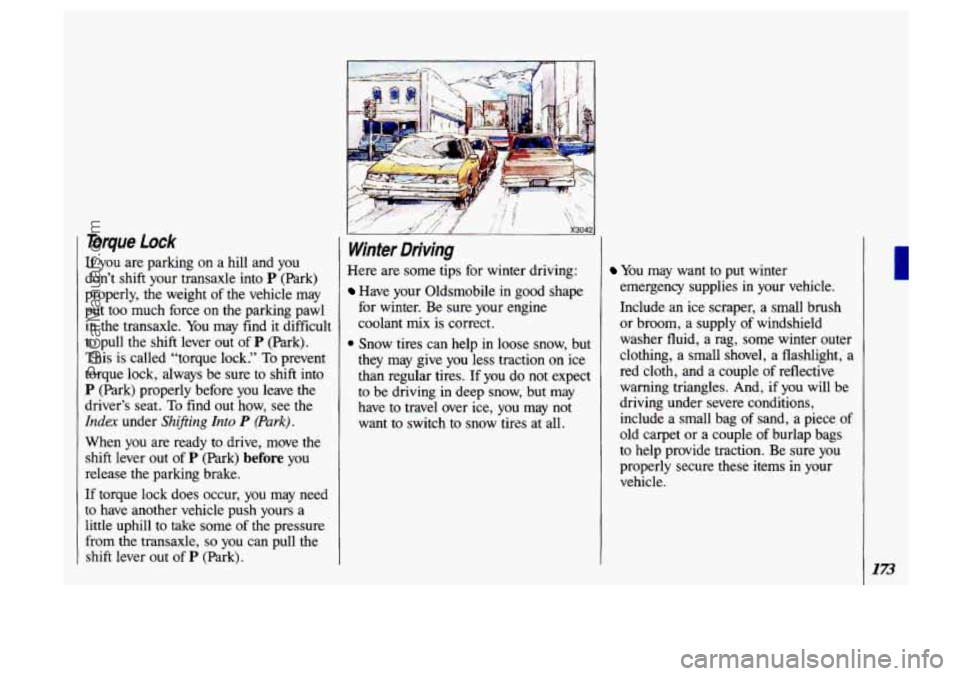
Winter Driving
Here are some tips for winter driving:
Have your Oldsmobile in good shape
for winter. Be sure your engine
coolant
mix is correct.
* Snow tires can help in loose snow, but
they may give you less traction on ice
than regular tires.
If you do not expect
to be driving in deep snow, but may
have to travel over ice, you may not
want
to switch to snow tires at all.
You may want to put winter
emergency supplies in your vehicle.
Include
an ice scraper, a small brush
or broom,
a supply of windshield
washer fluid, a rag,
some winter outer
clothing, a small shovel, a flashlight,
a
red cloth, and a couple of reflective
warning triangles. And,
if you will be
driving under severe conditions,
include a small bag
of sand, a piece of
old carpet or a couple of burlap bags
to help provide traction. Be sure you
properly secure these items
in your
vehicle.
173
ProCarManuals.com
Page 176 of 323
Your Driving and the Road
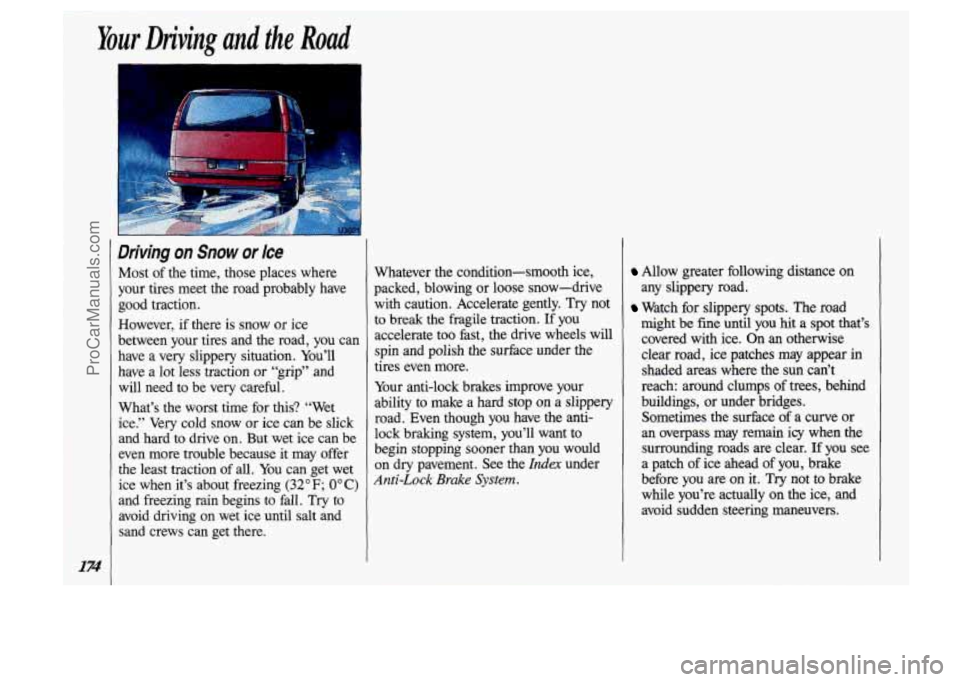
Driving on Snow or Ice
Most of the time, those places where
your tires meet the road probably have
good traction.
However, if there is snow or ice
between your tires and the road, you can
have a very slippery situation. You’ll
have
a lot less traction or “grip” and
will need to be very careful.
What’s the worst time for this? “Wet
ice.” Very cold snow or ice can be slick
and hard
to drive on. But wet ice can be
even more trouble because it may offer
the least traction
of all. You can get wet
ice when it’s about freezing
(32°F; 0°C)
and freezing rain begins to fd. Try to
avoid driving on wet ice until salt and
sand crews can get there. Whatever the condition-smooth ice,
packed, blowing or loose snow-drive
with caution. Accelerate gently. Try not
to break the fragile traction.
If you
accelerate too fast, the drive wheels will
spin and polish the surface under the
tires even more.
Your anti-lock brakes improve your
ability
to make a hard stop on a slippery
road. Even though you have the anti-
lock braking system, you’ll want to
begin stopping sooner
than you would
on dry pavement.
See the Index under
Anti-Lock Brake System.
Allow greater following distance on
any slippery road.
Watch for slippery spots. The road
might be fine until you
hit a spot that’s
covered with ice. On an otherwise
clear road, ice patches may appear
in
shaded areas where the sun can’t
reach: around clumps of trees, behind
buildings, or under bridges.
Sometimes the surface
of a curve or
an overpass may remain icy when the surrounding roads are clear.
If you see
a patch of ice ahead
of you, brake
before
you are on it. Try not to brake
while you’re actually on the ice, and
avoid sudden steering maneuvers.
174
ProCarManuals.com
Page 177 of 323
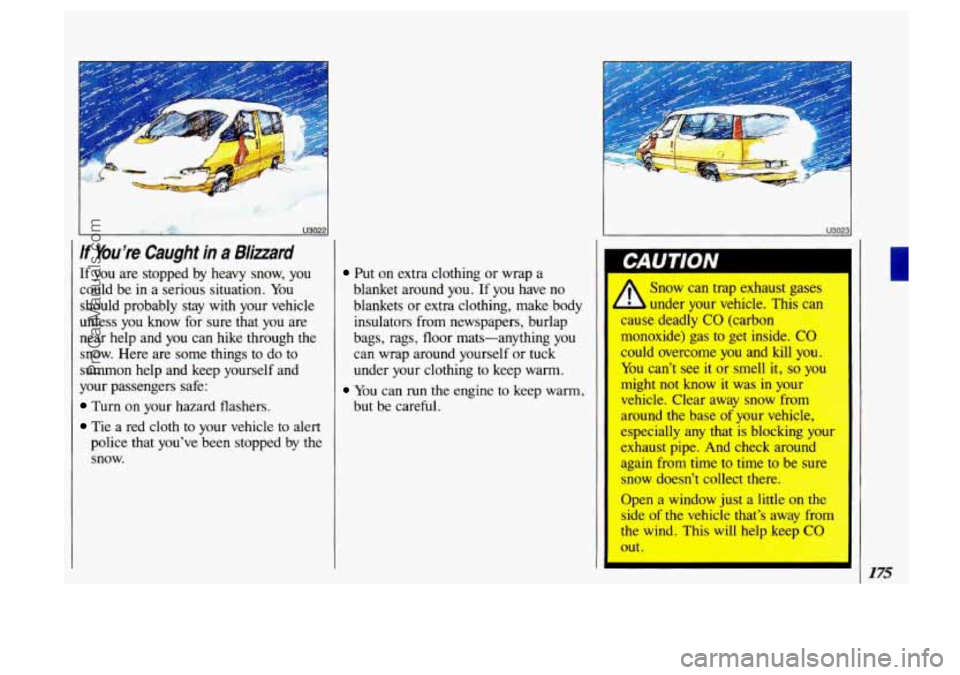
If You’re Caught in a Blimrd
If you are stopped by heavy snow, you
could be in a serious situation. You
should probably stay with your vehicle
unless you know for sure that you are
near help and you can hike through the
snow. Here are some things to
do to
summon help and keep yourself and
your passengers safe:
Turn on your hazard flashers.
Tie a red cloth to your vehicle to alert
police that you’ve been stopped by the
snow.
U3023
Put on extra clothing or wrap a
blanket around you. If you have
no
blankets or extra clothing, make body
insulators from newspapers, burlap
bags, rags, floor mats-anything you
can wrap around yourself or tuck
under your clothing to keep warm.
but be careful.
You can run the engine to keep warm, Snow can trap exhaust gases
under your vehicle. This ca
Lituse deadly CO (carbon
monoxide) gas to get inside.
CC
could overcome you and kill yo1
You can’t see
it or smell it, so v(
might not know it was in you
vehicle. Clear away snow from
around the base of your vehicle,
especially any that
is blocking your
exhaust pipe. And check around
again from time to time to be sure
snow doesn’t collect there.
.. -.~~-G~~:~.-~:::j~ . ., , -.> i2-j /: ,-.;-z$ Open a window just a little on-the
side
of the vehicle that’s away from
+% wind. This will help keep CO
vu t .
I
I
I
175
I
ProCarManuals.com
Page 182 of 323
Your Driving and the Road
180
If You Do Decide to Pull a Trailer
(CON X)
Hitches
It’s important to have the correct hitch
equipment. Crosswinds, large trucks
going by, and rough roads are a few
reasons why you’ll need the right hitch.
Here are some rules to follow:
If you’ll be pulling a trailer that, when
loaded, will weigh more than 2,000
pounds (900 kg), be sure to use a
properly mounted, weight-distributing hitch and sway control of the proper
size. This equipment is very important
for proper vehicle loading and good
handling when you’re driving.
Will you have to make any holes in the
body of your vehicle when you install
a trailer hitch?
If you do, then be sure
to seal the holes later when you remove
the hitch. If
you don’t seal them, deadly
carbon monoxide (CO) from your
exhaust can get into your vehicle. (See
Index under Carbon Monoxide in
Exhaust.) Dirt and water can, too.
The bumpers on your vehicle are not
intended for hitches. Do not attach
rental hitches or other bumper-type
hitches to them. Use only a frame-
mounted hitch that does not attach to
the bumper.
Safety Chains
You should always attach chains
between your vehicle and your trailer. Cross the safety chains under the tongue
of the trailer
so that the tongue will not
drop to the road if it becomes separated
from
the hitch. Instructions about safety
chains may be provided by the hitch
manufacturer or by the trailer
manufacturer. Follow the manufacturer’s
recommendation for attaching safety
chains. Always leave just enough slack
so you can turn with your rig. And, never
allow safety chains to drag on the
ground.
Trailer Brakes
If your trailer weighs more than 1,OOO
pounds (450 kg) loaded, then it needs its
own brakes-and they must be adequate.
Be sure to read and follow the
instructions for the trailer brakes
so
you’ll be able to install, adjust and
maintain them properly.
Because you have anti-lock brakes, do
not try to
tap into your vehicle’s brake
system. If
you do, both brake systems
won’t work well, or at all.
ProCarManuals.com