four wheel drive OLDSMOBILE SILHOUETTE 1993 Owners Manual
[x] Cancel search | Manufacturer: OLDSMOBILE, Model Year: 1993, Model line: SILHOUETTE, Model: OLDSMOBILE SILHOUETTE 1993Pages: 323, PDF Size: 17.13 MB
Page 62 of 323
Features & Controls
60
Liitgate Ajar Warning light (CONT.) New Vehicle “Break-In”
It can be dangerous to dr’ A
b with the liftgate open. Cam
lllvnoxide
(CO) gas can come in1
your vehicle. You can’t see or
smell
CO. It can cause uncon-
sciousness and even death.
If you must drive with
tk lifti
open:
Make sure all window
Turn the fan on your heatinl
cooling system to its high--*
speed
with the setting on
LEV (Bi-Level) or UPPER
That will force outside air ir
your vehicle. See
the Index under I
Comfort Controls.
If you have air vents on or under
the instrument panel, open the1
all the way.
I
four modern Olasmobile doesnt
need
an elaborate “break-in.” But
it will
perform better in the long
run if you follow these guidelines:
Don’t drive at any one speed-
fast or slow-for the first 500
miles (804 km). Don’t make full- I
throttle starts.
Avoid making hard stops for the
first
200 miles (322 km) or so.
During this time your new brake
linings aren’t yet broken in. Hard
stops with new linings can mean
I
premature wear and earlier
I
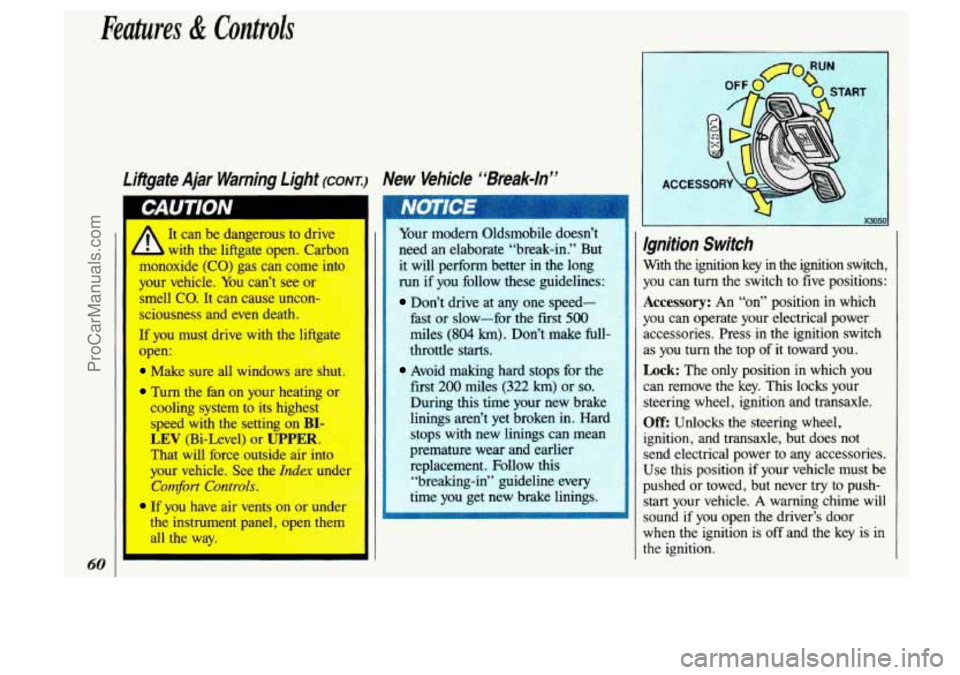
lgnition Switch
With the ignition key in the ignition switch,
you can turn the switch to five positions:
Accessory: An “on” position in which
you can operate your electrical power
accessories. Press in the ignition switch
as you turn the top of it toward you.
Lock: The only position in which you
can remove the key. This locks your
steering wheel, ignition and transaxle.
Off: Unlocks the steering wheel,
ignition, and transaxle, but does not
send electrical power to any accessories.
Use this position if your vehicle must be
pushed or towed, but never try to push-
start your vehicle. A warning chime will
sound if
you open the driver’s door
when the ignition is off and the key is in
the ignition.
ProCarManuals.com
Page 152 of 323
Your
i
Anti-Lock Brakes (CONE)
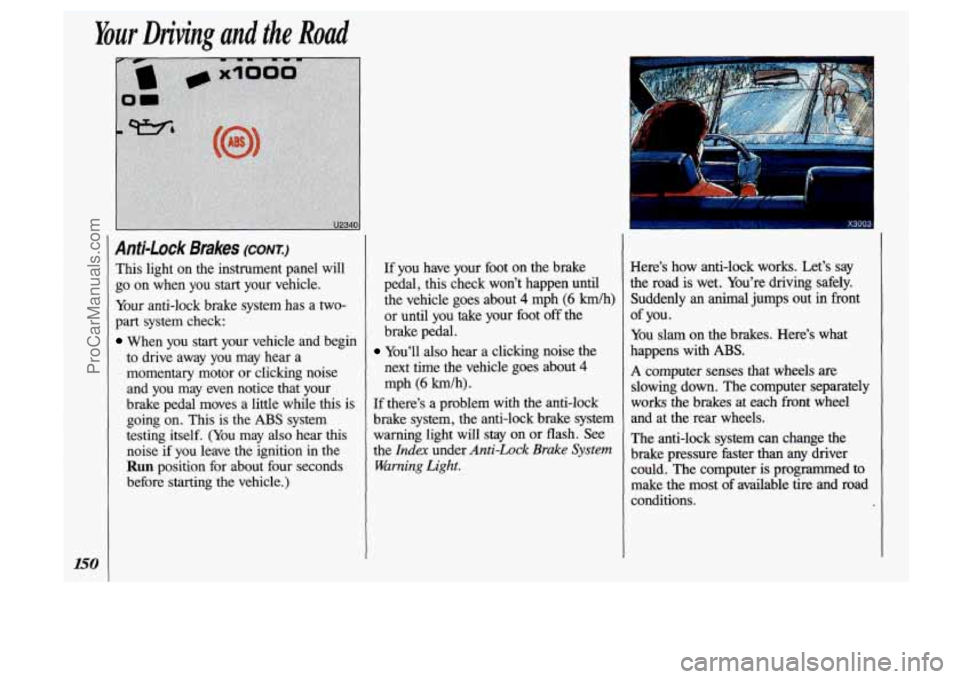
This light on the instrument panel will
go on when you start your vehicle.
Your anti-lock brake system has
a two-
part system check:
When you start your vehicle and begin
to drive away you may hear a
momentary motor or clicking noise
and you may even notice that your
brake pedal moves a little while this is
going on. This is the
ABS system
testing itself. (You may
also hear this
noise if you leave the ignition in the
Run position for about four seconds
before starting the vehicle.)
If you have your foot on the brake
pedal, this check won’t happen until
the vehicle goes about
4 mph (6 Wh)
or until you take your foot off the
brake pedal.
You’ll also hear a clicking noise the
next time the vehicle goes about
4
mph (6 Wh).
If there’s a problem with the anti-lock
brake system, the anti-lock brake system
warning light will stay on
or flash. See
the
Inda under Anti-Lock Brake System
Warning Light.
Here’s how anti-lock works. Let’s say
the road is wet. YOU’E driving safely.
Suddenly
an animal jumps out in front
You
slam on the brakes. Here’s what
happens with
ABS.
A computer senses that wheels are
slowing down. The computer separately
works the brakes at each front wheel
and at the rear wheels.
The anti-lock system can change the
brake pressure faster than any driver
could. The computer is programmed to
make the most of available tire and road
conditions.
of you.
ProCarManuals.com
Page 158 of 323
YOUP Driving and the Road
Ofi-Road Recovery
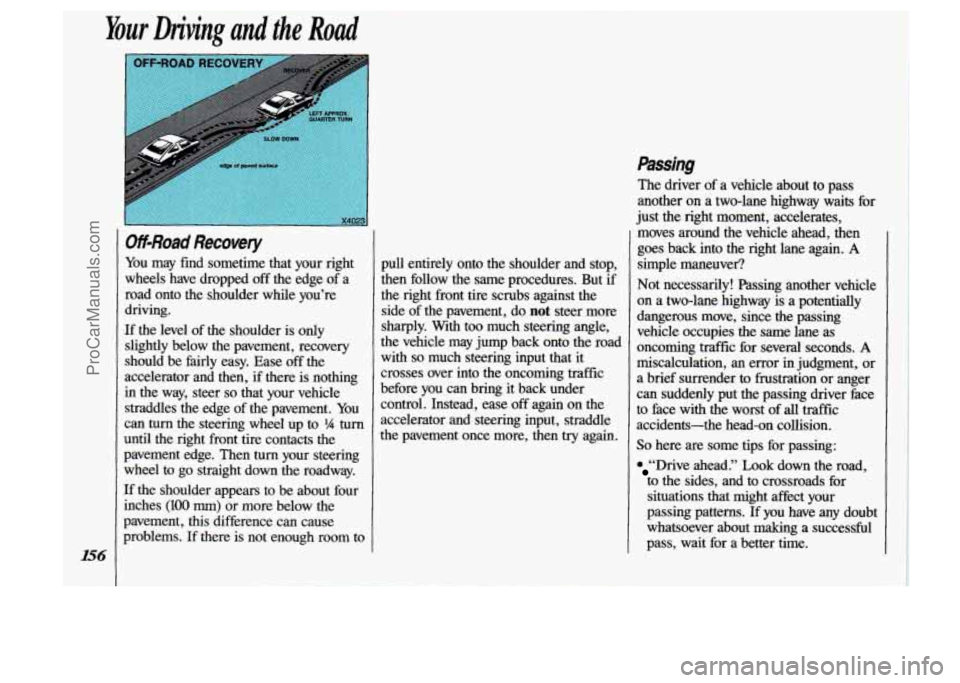
You may find sometime that your right
wheels have dropped
off the edge of a
road onto the shoulder while you’re
driving.
If the level of the shoulder is only
slightly below the pavement, recovery
should be fairly easy. Ease
off the
accelerator and then,
if there is nothing
in the way, steer
so that your vehicle
straddles the edge
of the pavement. You
can turn the steering wheel up to
?4 turn
until the right front tire contacts the
pavement edge. Then
turn your steering
wheel
to go straight down the roadway.
If the shoulder appears to be about four
inches
(100 mm) or more below the
pavement, this difference can cause
problems.
If there is not enough room to pull entirely onto the shoulder and stop,
then follow the same procedures. But
if
the
right front tire scrubs against the
side of the pavement, do
not steer more
sharply.
With too much steering angle,
the vehicle may jump back onto the road
with
so much steering input that it
crosses over into the oncoming traffic
behre you can bring
it back under
control. Instead, ease
off again on the
accelerator and steering input, straddle
the pavement once more, then
try again.
Passing
The driver of a vehicle about to pass
another
on a two-lane highway waits for
just the right moment, accelerates,
moves around the vehicle ahead, then
goes back into the right lane again.
A
simple maneuver?
Not necessarily! Passing another vehicle
on a two-lane highway is a potentially
dangerous move, since the passing
vehicle occupies the same lane as
oncoming traffic for several seconds.
A
miscalculation, an error in judgment, or
a brief surrender to frustration or anger
can suddenly put the passing driver face
to face with the worst of all traffic
accidents-the head-on collision.
So here are some tips for passing:
“Drive ahead.” Look down the road,
to
the sides, and to crossroads for
situations that might affect your
passing patterns.
If you have any doubt
whatsoever about making
a successful
pass, wait for a better time.
ProCarManuals.com
Page 252 of 323
Sewice & Appearance Care
250
Buying New Tires
To find out what kind and size of tires
you need, look at the Certification/Tire
label. The tires installed on your vehicle
when it was new had a Tire Performance
Criteria Specification (TPC Spec)
number
on each tire’s sidewall. When
you get new tires, get ones with that
same
TPC Spec number. That way, your
vehicle will continue to have tires that
are designed to give proper endurance,
handling, speed rating, traction, ride
and other things during normal service
on your vehicle.
If your tires have an all-
season tread design, the TPC number
will be followed by a
“MS” (for mud
and snow).
If
you ever replace your tires with those
not having a
TPC Spec number, make
sure they are the same size, load range,
speed rating and construction type (bias,
bias-belted or radial)
as your original
tires. Mixing tires could
cause
you
to lose control while driving.
If you mix tires of different sizes
or types (radial and bias-belted
tires), the vehicle may not handle
properly, and you could have a
crash. Be sure to use the same size
and type tires on all four wheels.
It’s all right
to drive with your
compact spare, though.
It was
developed for use on your vehicle.
Uniform Tire Quality
Grading
The following information relates to the
system developed by the United States
National Highway Traffic Safety
Administration which grades tires by
treadwear, traction and temperature
performance. (This applies only to
vehicles sold
in the United States.)
u
ProCarManuals.com
Page 319 of 323
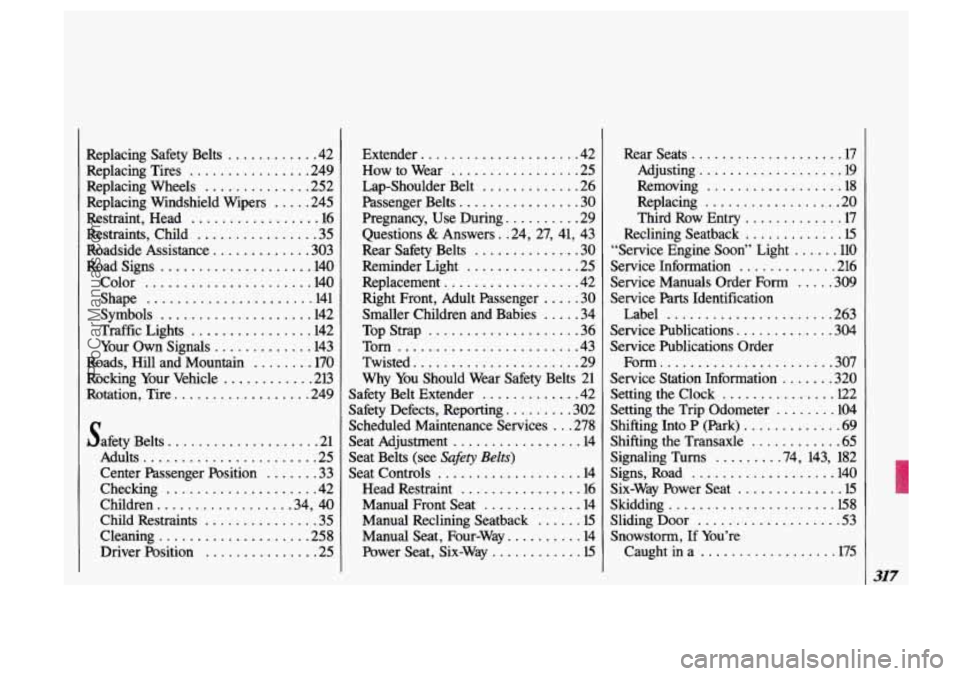
Replacing Safety Belts ............ 42
Replacing Tires
................ 249
Replacing Windshield Wipers
..... 245
Replacing Wheels
.............. 252
Restraint, Head
................. 16
Restraints. Child ................ 35
Roadside Assistance
............. 303
RoadSigns
.................... 140
Color
...................... 140
Shape
...................... 141
Symbols
.................... 142
Traffic Lights
................ 142
Your Own Signals
............. 143
Roads. Hill and Mountain
........ 170
Rocking Your Vehicle ............ 213
Rotation. Tire
.................. 249
safety Belts
.................... 21
Adults
....................... 25
Center Passenger Position
....... 33
Checking
.................... 42
Children
................. .34, 40
Child Restraints
............... 35
Cleaning .................... 258
Driver Position
............... 25 Extender
..................... 42
How to Wear
................. 25
Passenger Belts
................ 30
Questions
& Answers . .24, 27. 41. 43
Lap-Shoulder Belt
............. 26
Pregnancy, Use During
.......... 29
Rear Safety Belts
.............. 30
Reminder Light
............... 25
Right Front. Adult Passenger
..... 30
Replacement
.................. 42
Smaller Children and Babies
.... -34
Top Strap
.................... 36
Torn
........................ 43
Twisted ..................... -29
Why You Should Wear Safety Belts 21
Safety Belt Extender
............. 42
Scheduled Maintenance Services ... 278
Seat Adjustment
................. 14
Seat Belts (see
Safety Belts)
Seat Controls ................... 14
Head Restraint
................ 16
Manual Front Seat
............. 14
Manual Reclining Seatback
...... 15
Manual Seat. Four-Way .......... 14
Power Seat. Six-Way
............ 15
Safety Defects. Reporting ......... 302 RearSea
ts .................... 17
Adjusting
................... 19
Removing
.................. 18
Replacing
................. -20
Third
Row Entry ............. 17
Reclining Seatback
............. 15
“Service Engine Soon” Light ...... 110
Service Information
............. 216
Service Manuals Order Form
..... 309
Service
Parts Identification
Label
...................... 263
Service Publications
............. 304
Service Publications Order
Form ....................... 307
Service Station Information
....... 320
Setting
the Clock ............... 122
Setting the Trip Odometer
........ 104
Shifting Into
P (Park) ............. 69
Shifting the Transaxle
........... -65
Six-Way Power Seat
.............. 15
Signaling Turns ........ .74, 143, 182
Signs, Road
................... 140
Skidding
...................... 158
Sliding Door ................... 53
Snowstorm, If You’re
Caught in a
.................. 175
317
ProCarManuals.com