air condition OLDSMOBILE SILHOUETTE 1994 User Guide
[x] Cancel search | Manufacturer: OLDSMOBILE, Model Year: 1994, Model line: SILHOUETTE, Model: OLDSMOBILE SILHOUETTE 1994Pages: 276, PDF Size: 15.82 MB
Page 226 of 276
Service & Appearance Care
224
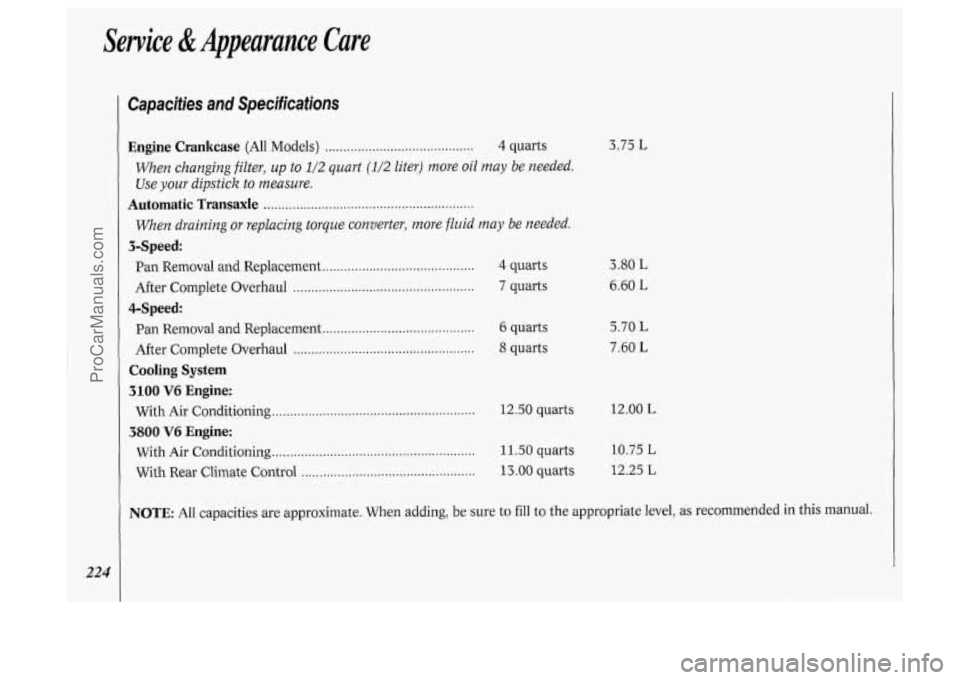
Capacities and Specifications
Engine Crankcase (All Models) ......................................... 4 quarts
When changing filter, up to 112 quart (1/2 liter) more oil may be needed.
Use
your dipstick to measure.
Automatic Transaxle ..........................................................
When draining or replacing torque converter, more fluid may be needed.
Pan Removal and Replacement .......................................... 4 quarts
After Complete Overhaul
.................................................. 7 quarts
3-Speed:
4-Speed:
Pan Removal and Replacement .......................................... 6 quarts
After Complete Overhaul
.................................................. 8 quarts
Cooling System
3100 V6 Engine:
3800 V6 Engine:
With Air Conditioning ........................................................ 12.50 quarts
With Air Conditioning ........................................................ 11.50 quarts
With Rear Climate Control
................................................ 13 .OO quarts
3.75 L
3.80 L
6.60 L
5.70 L
7.60 L
12.00 L
10.75
L
12.25 L
NOTE: All capacities are approximate. When adding, be sure to fill to the appropriate level, as recommended in this manual.
ProCarManuals.com
Page 227 of 276
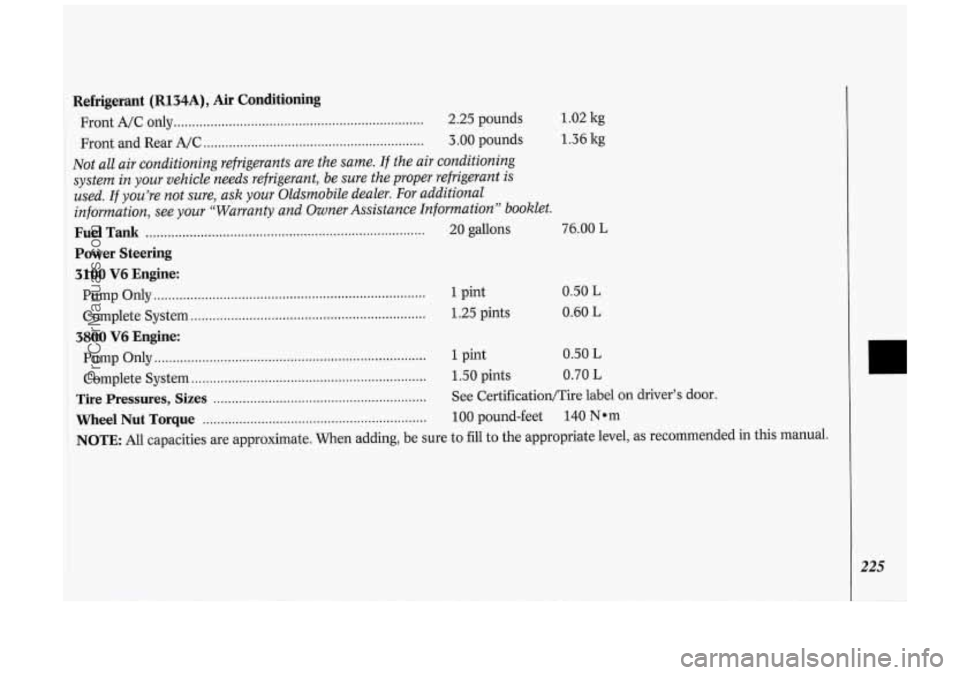
1.02 kg
1.36 kg
Refrigerant (R134A), Air Conditioning
Front A/C only .................................................................... 2.25 pounds
Front and Rear A/C
............................................................ 3.00 pounds
Not all air conditioning refrigerants are the same. If the air conditioning
system in your vehicle needs refrigerant, be sure the proper refrigerant
is
used. If you’re not sure, ask your Oldsmobile dealer. For additional
infomation, see your “Warranty and Owner Assistance Information
” booklet.
Fuel Tank ........................................................................\
..... 20 gallons 76.00 L
Power Steering
3100
V6 Engine:
Pump Only ........................................................................\
..
Complete System ................................................................
1 pint
1.25 pints 0.50 L
0.60 L
3800 V6 Engine:
Pump Only ........................................................................\
.. 1 pint 0.50 L
Complete System ................................................................ 1.50 pints 0.70 L
Tire Pressures, Sizes .......................................................... See CertificatiorVTire label on driver’s door.
Wheel Nut Torque ............................................................. 100 pound-feet 140 Nom
NOTE: All capacities are approximate. When adding, be sure to fill to the appropriate level, as recommended in this manual.
r
ProCarManuals.com
Page 234 of 276
Maintenance Schedule
232
Introduction
A Word About Maintenance
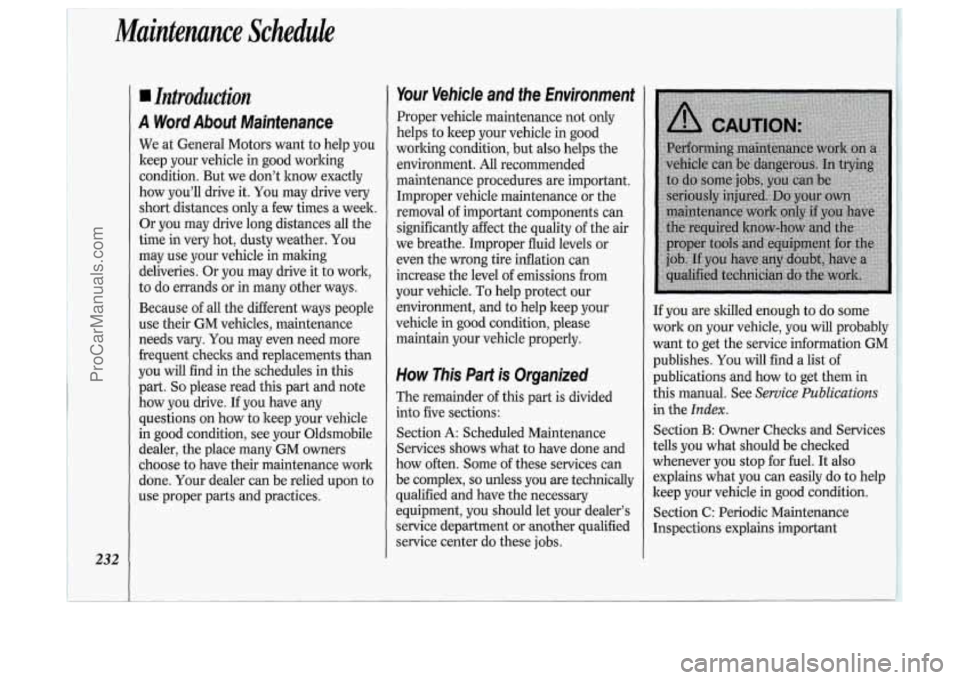
We at General Motors want to help you
keep your vehicle in good working
condition. But we don’t lmow exactly
how you’ll drive it. You may drive very
short distances only a few times a week.
Or you may drive long distances all the
time in very hot, dusty weather.
You
may use your vehicle in malting
deliveries. Or
you may drive it to work,
to do errands or in many other ways.
Because of all the different ways people
use their GM vehicles, maintenance
needs vary.
You may even need more
frequent checks and replacements than
you will find in the schedules in this
part.
So please read this part and note
how you drive. If you have any
questions on how to keep your vehicle
in good condition, see your Oldsmobile
dealer, the place many GM owners
choose to have their maintenance work
done. Your dealer can be relied upon to
use proper parts and practices.
Your Vehicle and the Environment
Proper vehicle maintenance not only
helps to keep your vehicle in good
working condition, but also helps the
environment. All recommended
maintenance procedures are important. Improper vehicle maintenance or the
removal of important components can
significantly affect the quality
of the air
we breathe. Improper fluid levels or
even the wrong tire inflation can
increase the level of emissions from
your vehicle.
To help protect our
environment, and to help keep your
vehicle in good condition, please
maintain your vehicle properly.
How This Part is Organized
The remainder of this part is divided
into five sections:
Section
A: Scheduled Maintenance
Services shows what to have done and
how often. Some of these services can
be complex,
so unless you are technically
qualified and have the necessary
equipment, you should let your dealer’s
service department or another qualified
service center do these jobs. If
you are skulled enough to do some
work on your vehicle, you will probably
want to get the service information GM
publishes. You will find a list of
publications and how to get them in
this manual. See
Service Publications
in the Index.
Section B: Owner Checks and Services
tells you what should be checked
whenever you stop for fuel. It also
explains what you can easily do to help
keep your vehicle in good condition.
Section
C: Periodic Maintenance
Inspections explains important
ProCarManuals.com
Page 235 of 276
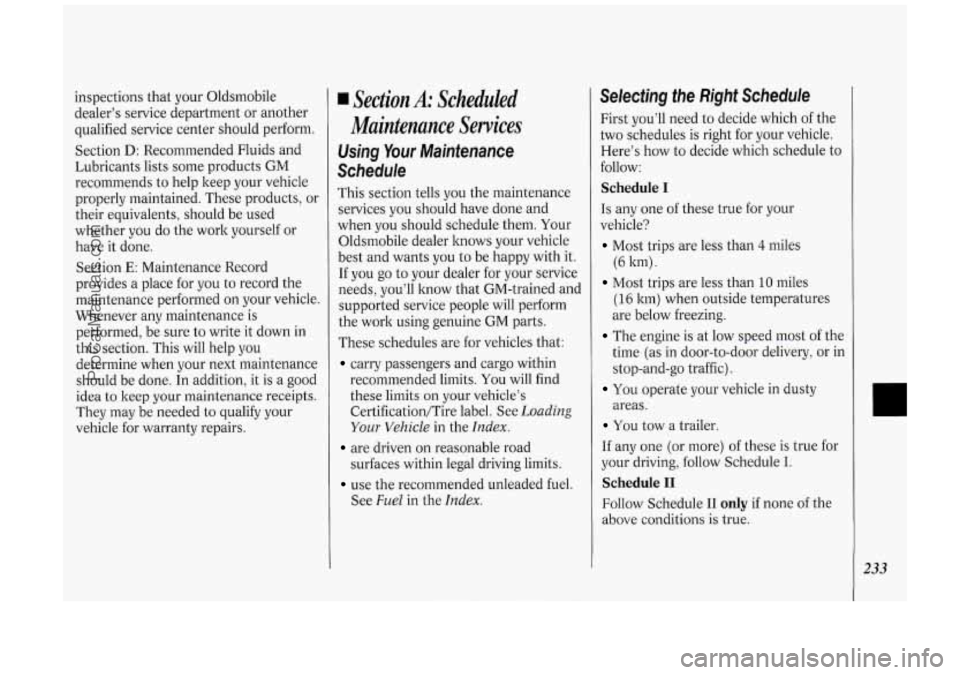
inspections that your Oldsmobile
dealer’s service department or another
qualified service center should perform.
Section
D: Recommended Fluids and
Lubricants lists some products
GM
recommends to help keep your vehicle
properly maintained. These products, or
their equivalents, should be used
whether you do the work yourself or
have
it done.
Section
E: Maintenance Record
provides
a place for you to record the
maintenance performed on your vehicle.
Whenever any maintenance is
performed, be sure to write
it down in
this section. This will help you
determine when your next maintenance
should be done. In addition, it is
a good
idea to keep your maintenance receipts.
They may be needed to qualify your
vehicle for warranty repairs.
Section A: Scheduled
Maintenance Services
Using Your Maintenance
Schedule
This section tells you the maintenance
services you should have done and
when you should schedule them. Your
Oldsmobile dealer knows your vehicle
best and wants you to be happy with it.
If
you go to your dealer for your service
needs, you’ll know that GM-trained and
supported service people will perform
the work using genuine
GM parts.
These schedules are for vehicles that:
carry passengers and cargo within
recommended limits.
You will find
these limits on your vehicle’s
CertificatiodTire label. See
Loading
Your Vehicle in the Index.
are driven on reasonable road
surfaces within legal driving limits.
use the recommended unleaded fuel.
See
Fuel in the Index.
Selecting the Right Schedule
First you’ll need to decide which of the
two schedules is right for your vehicle.
Here’s how to decide which schedule to
follow:
Schedule I
Is any one of these true for your
vehicle?
Most trips are less than 4 miles
Most trips are less than 10 miles
(6 ltm) .
(16 ltm) when outside temperatures
are below freezing.
The engine is at low speed most of the
time (as in door-to-door delivery, or in
stop-and-go traffic).
areas.
You operate your vehicle in dusty
You tow a trailer.
If any one (or more) of these is true for
your driving, follow Schedule
I.
Schedule I1
Follow Schedule I1 only if none of the
above conditions is true.
233
ProCarManuals.com
Page 236 of 276
Muintenunce Schedule
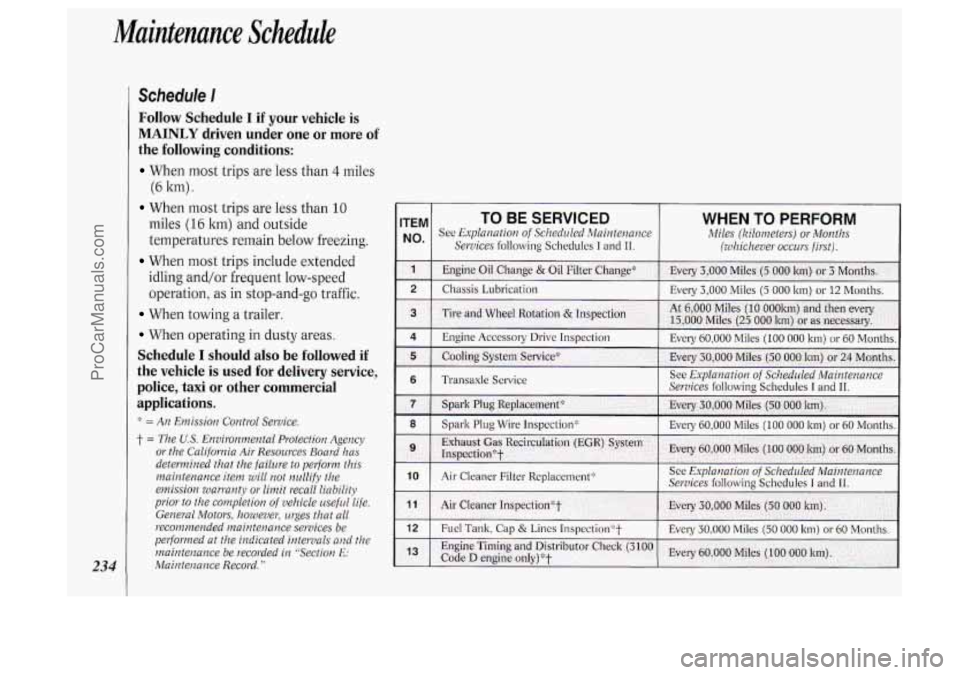
234
Schedule I
Follow Schedule I if your vehicle is
MAINLY driven under one or more of
the following conditions:
When most trips are less than 4 miles
When most trips are less than 10
(6
ltm)
.
miles (16 ltrn) and outside
temperatures remain below freezing.
When most trips include extended
idling and/or frequent low-speed
operation, as in stop-and-go traffic.
When towing a trailer.
When operating in dusty areas.
Schedule I should also be followed if
the vehicle is used for delivery service,
police, taxi
or other commercial
applications.
::: = An Emission Control Service.
j- = The U.S. Emiyonmental Protection Agency
or the California Air Resources Board has
determined that the failure
to pelform this
maintenance item will
not nullify the
emission warranty or limit recall liability
prior
to the completion of vehicle useful life.
General Motors, however, urges that all
recommended maintenance services be
pelformed at the indicated intervals and the
maintenance be recorded in “Section
E:
Maintenance Record.”
ITEM TO BE SERVICED WHEN TO PERFORM
No* See Explanation of Scheduled Maintenance Miles (Kilometers) or Months
Services
following Schedules I and 11. (whichever occurs firsl).
1 Engine Oil Change & Oil Filter Change* Every 3,000 Miles (5 000 km) or 3 Montl~s..
2 Chassis Lubrication Every 3,000 Miles (5 000 lm) or 12 Months.
ProCarManuals.com
Page 240 of 276
Maintenance Schedule
238
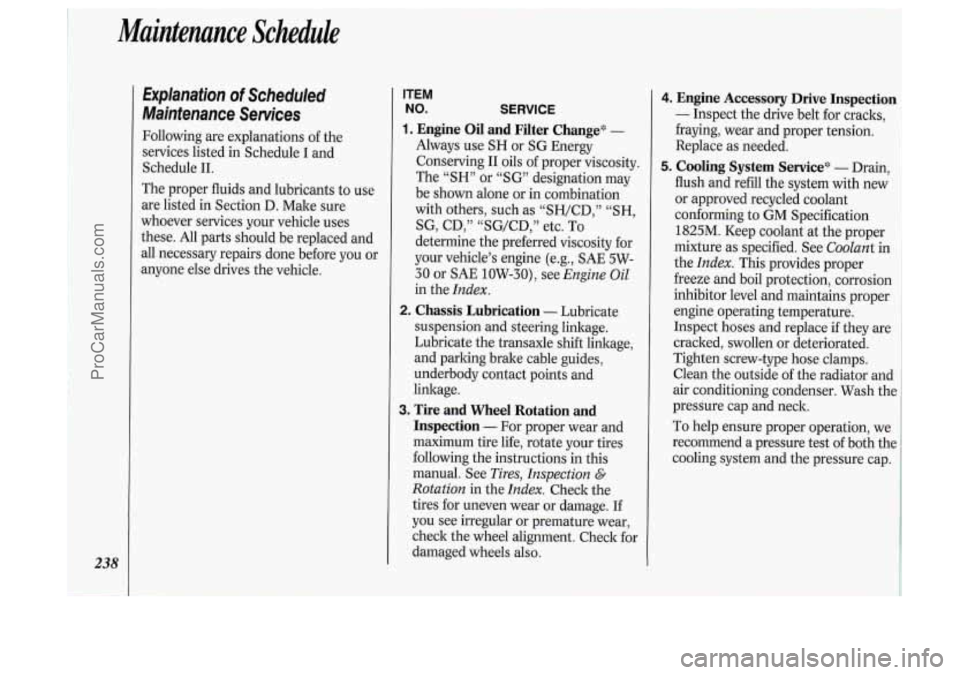
Explanation of Scheduled
Maintenance Services
Following are explanations of the
services listed in Schedule I and
Schedule 11.
The proper fluids and lubricants to use
are listed in Section D. Make sure
whoever services your vehicle uses
these. All parts should be replaced and
all necessary repairs done before you or
anyone else drives the vehicle.
ITEM
NO. SERVICE
1. Engine Oil and Filter Change* -
Always use SH or SG Energy
Conserving
I1 oils of proper viscosity.
The
“SH” or “SG” designation may
be shown alone
or in combination
with others, such as “SH/CD,”
“SH,
SG, CD,” “SG/CD,” etc. To
determine the preferred viscosity for
your vehicle’s engine (e.g.,
SAE 5W-
30 or SAE 10W-30), see
Engine Oil
in the Index.
2. Chassis Lubrication - Lubricate
suspension and steering linkage.
Lubricate the transaxle shift linkage,
and parking brake cable guides,
underbody contact points and
linkage.
3. Tire and Wheel Rotation and
Inspection
- For proper wear and
maximum tire life, rotate your tires
following the instructions in this
manual. See
Tires, Inspection E.
Rotation in the Index. Check the
tires for uneven wear
or damage. If
you see irregular or premature wear,
check the wheel alignment. Check for
damaged wheels also.
Engine Accessory Drive Inspection
- Inspect the drive belt for cracks,
fraying, wear and proper tension.
Replace as needed.
I
Cooling System Servicee - Drain,
flush and refill the system with new
or approved recycled coolant
conforming to GM Specification
I
1825M. Keep coolant at the proper 1
mixture as specified. See Coolant in
the
Index. This provides proper
freeze and boil protection, corrosion
I
inhibitor level and maintains proper ’
engine operating temperature.
Inspect hoses
and replace if they are
cracked, swollen or deteriorated.
Tighten screw-type hose clamps.
Clean the outside of the radiator and
air conditioning condenser. Wash tht
pressure cap and neck.
To help ensure proper operation, we
recommend
a pressure test of both the
cooling system and the pressure cap.
ProCarManuals.com
Page 241 of 276

6. Transaxle Service - Change both
the fluid and filter every
15,000 miles
(25 000 ltm) if the vehicle is mainly
driven under one or more of these
conditions:
In heavy city traffic where the
outside temperature regularly
reaches
90°F (32°C) or higher.
In hilly or mountainous terrain.
When doing frequent trailer towing.
Uses such as found in taxi, police
car or delivery service.
If you do not use your vehicle under
any of these conditions, change both
the
fluid and filter every 100,000 miles
(166 000 ltm) .
7. Spark Plug Replacement::' -
Replace spark plugs with the proper
type. See
Replacement Parts in the
Index.
8. Spark Plug Wire Inspection''-
Inspect for burns, cracks or other
damage. Check the boot fit at the
distributor or coils and at the spark
plugs. Replace wires
as needed.
9. Exhaust Gas Recirculation (EGR)
System 1nspection':t
- Conduct
the
EGR system service as described
in the service manual.
To purchase a
service manual, see
Service
Publications
in the Index.
IO. Air Cleaner Filter Replacement+-
Replace every 30,000 miles
(50 000 ltm) or more often under
dusty conditions.
Ask your dealer
for the proper replacement intervals
for your driving conditions.
11. Air Cleaner Inspection''? - Inspect
all hoses and ducts for proper
hookup. Make sure the valve works
properly.
1nspection';:t - Inspect fuel tank,
cap and lines for damage
or leaks.
Inspect fuel cap gasket for an even
filler neck imprint or any damage.
Replace parts as needed. Periodic
replacement of the fuel filter
is not
required.
12. Fuel Tank, Cap and Lines
13. Engine Timing and Distributor
Check
(3100 Code D engine
only)'xt
- Adjust the timing to the
underhood label specifications.
Inspect the inside and outside
of the
distributor cap and rotor for cracks,
carbon tracking and corrosion.
Clean or replace as needed.
NOTE: To determine your engine's
displacement and code, see
Engine
Identification
in the Index.
': = An Enzission Control Service.
t = The U.S. Environmental Protection Agency
or the California Air Resources Boa1.d has
determined that the failure
to pelform this
maintenance item will
not nullify the
emission warranty
or limit recall liability
prior
to fhe completion of ~~ehicle useful life.
General
Motors: however, urges that all
recornmended maintenance services be
performed at the indicated intervals and the
maintenance be recorded
in "Section E:
Maintenance Record."
239
ProCarManuals.com
Page 245 of 276

Section C: Periodic Maintenance Inspections fall). You should let your GM dealer’s service department or
other qualified service center do these jobs. Make sure any
Listed below are inspections and services which should be necessary repairs are completed at once.
performed at least twice a year (for instance, each spring and
Restraint Systems
Steering, Suspension
and Front-Wheel-
Drive Axle Boot and
Seal Inspection
Exhaust System
Inspection
Throttle Linkage
Inspection
Brake System Inspection
~~ ~
WHAT SHOULD BE DONE
~ ~~~
Now and then, make sure all your belts, buckles, latch plates, retractors, anchorages and
reminder systems are working properly. Look for any loose parts or damage.
If you see anything
that might keep
a restraint system from doing its job, have it repaired.
Inspect the front and rear suspension
and steering system for damaged, loose or missing parts,
signs of wear, or lack of lubrication. Inspect the power steering lines and hoses for proper
hookup, binding, leaks, cracks, chafing, etc. Clean and then inspect the drive axle boot seals for
damage, tears or leakage. Replace seals if necessary.
Inspect the complete exhaust system. Inspect the body near the exhaust system. Look for broken,
damaged, missing or out-of-position parts as well
as open seams, holes, loose connections, or
other conditions which could cause a heat build-up in the floor pan or could let exhaust fumes
into the vehicle. See
Engine Exhaust in the Index.
Inspect the throttle linkage for interference or binding, and for damaged or missing parts.
Replace parts as needed.
Inspect the complete system. Inspect brake lines and hoses for proper hook-up, binding, leaks,
cracks, chafing, etc. Inspect disc brake pads for wear and rotors for surface condition. Also inspect
drum brake linings for wear and cracks. Inspect other brake parts, including drums, wheel
cylinders, calipers, parking brake, etc. Check parking brake adjustment.
You may need to have
your brakes inspected more often
if your driving habits or conditions result in frequent braking.
NOTE:
A low brake fluid level can indicate worn disc brake pads which may need to be serviced.
Also, if the brake system warning light stays on or comes on, something may be wrong with the
brake system. See the
Index under Brake System Warning Light. If your anti-lock brake system
warning light stays on or comes on, something may be wrong with the anti-lock brake system.
See the
Index under Anti-Lock Brake System Wawing Light.
ProCarManuals.com
Page 256 of 276
Customer Assistance Information
254
Service Publications
Information on how to obtain Product
Service Publications, Subscriptions and
Indexes and Service Manuals as
described below is applicable only in the
fifty
U.S. states (and the District of
Columbia) and only for cars and light
trucks with GVWR less than
10,000
pounds (4 536 kg).
In Canada, information pertaining to
Product Service Bulletins and Indexes
can be obtained by writing to:
General Motors of Canada Limited
Service Publications Department
1908 Colonel Sam Drive
Oshawa, Ontario L1H 8P7
Oldsmobile regularly sends its dealers
useful service bulletins about
Oldsmobile products. Oldsmobile
monitors product performance in the
field. We then prepare bulletins for
servicing our products better. Now, you
can get these bulletins too.
Bulletins cover various subjects. Some
pertain to the proper use and care of
your vehicle. Some describe costly
repairs. Others describe inexpensive repairs which,
if done
on time with the
latest parts, may avoid future costly
repairs. Some bulletins tell a technician
how to repair a new or unexpected
condition. Others describe a quicker
way to fix your vehicle. They can help a
technician service your vehicle better.
Most bulletins apply to conditions
affecting a small number of cars or
trucks. Your Oldsmobile dealer or a
qualified technician may have to
determine if a specific bulletin applies
to your vehicle.
You can subscribe to all Oldsmobile
bulletins. This way you’ll get them as
they come out. You can wait a while
and get an index to the bulletins.
You
can also get individual bulletins.
However, you’ll need the index to
identify them.
Subscriptions
You can subscribe to all Oldsmobile
Product Service Publications
(PSP’s).
This will include bulletins for all
vehicles sold by Oldsmobile and will not
be limited to PSP’s applicable to any
particular model. For subscription costs
and ordering information call the toll
free number shown in the following
text.
What You’ll Find in the lndex
A list of all PSP’s published by
Oldsmobile in a model year (1990 or
later).
PSP’s covering all models of
Oldsmobile vehicles are listed in the
same index.
Price information for the PSP’s you
may want to buy.
How You Can Get an lndex
Indexes are published periodically.
Most
of the PSP’s which could
potentially apply to the most recent
Oldsmobile models will be listed in the
ProCarManuals.com
Page 265 of 276
lndex
Accessory Power Outlet ................... 84
Adding Brake Fluid
............................. 201. 227
Electrical Equipment
........ .60. 117 . 2 19
Engine Coolant
.......... 167.197.224. 227
Engine Oil
.............................. 190. 224
Power Steering Fluid
..... 199.225. 227
Sound Equipment
.......................... 11 7
Transaxle Fluid
.............. 195. 224. 227
Windshield Washer Fluid
...... 200. 227
Air Bag Readiness Light
..................... 27
Air Bags
............................................... 26
Air Cleaner
............................... 194. 226
Air Conditioner
................................ 11 1
Air Inflator System ............................. 85
Alcohol. Driving Under the
Influence
of ..................................... 132
Alcohol in Gasoline
.......................... 183
Aluminum Wheels .................... 21 1. 216
Antenna
............................................ 129
Anti-Lock
.......................................... 135
Anti-Lock Brake System
................... 135
Brake Master Cylinder ................... 201
Junction Block Fuse
...................... 222
Warning Light
................................ 104
Appearance Care
.............................. 212
Adjusting
Rear Seats
.......................... 17
Antifreeze
......................... 197. 224. 227
Ashtrays and Lighter
.................... 89. 90 Audio
Systems
.................................. 117
AM/FM Stereo Radio
.................... 1 19
AM/FM Stereo Radio with Compact
Disc Player
..................................... 124
Care
of Audio Systems .................. 128
Setting the Clock
........................... 117
Steering Wheel Touch Controls
.... 127
Adding Fluid
.................. 197. 225. 227
Checking Fluid
............................... 195
Shifting
............................................. 62
Battery
............................................ 203
Jump Starting
................................. 158
Battery Warning Gage ...................... 103
Blizzard
............................................. 149
Brake Cassette
Player
...................... 120. 122
Radio Reception. For the Best
...... 128
Automatic Transaxle
(( Blowout. .. Tire ................................ 172
Adjustment
.................................... 202
Anti-Lock Brakes
.......................... 135
Anti-Lock Brake System Warning
Light
............................................ 104
Fluid
....................................... 201. 227
Parking
............................................. 65
Pedal Travel
................................... 202
Rear
Drums .................................... 202
Junction
Block Fuse
...................... 222
Master Cylinder
............................. 201 Warning Light
................................ 103
Wear Indicators
............................. 202
Brake System Warning Light
........... 103
Braking
............................................. 134
Braking in Emergencies
................... 138
Braking Technique
........................... 134
“Break.1n.
.. New Vehicle ............. 57. 152
Bucket Seats. Removable Rear
.......... 15
Buckling Up (see
Safety Belts)
Bulb Replacement
Headlight
....................................... 203
Taillight
.......................................... 204
Bulbs, Replacement
.......................... 228
Capacities
81 Specifications ............ 224
Carbon Monoxide in
Exhaust
...................... 57, 68. 150. 154
Cassette Tape Player
(see
Audio Systems )
Center Passenger Position
(see
Safety Belts)
Chains. Safety ................................... 154
Chains. Tire
.............................. 179, 212
Changing a Flat Tire
......................... 172
Checking
Brake Fluid
.................................... 201
Engine Coolant
.............................. 197
Engine Oil ...................................... 190
Power Steering Fluid
..................... 199
Safety Belt Systems
......................... 41
.
263
ProCarManuals.com