ECU OLDSMOBILE SILHOUETTE 1994 Owner's Manual
[x] Cancel search | Manufacturer: OLDSMOBILE, Model Year: 1994, Model line: SILHOUETTE, Model: OLDSMOBILE SILHOUETTE 1994Pages: 276, PDF Size: 15.82 MB
Page 150 of 276
Your Driving and the Road
148
Ihow how to go uphill. You may
want to shift down to a lower gear.
The lower gears help cool your engine
and transaxle, and you can climb the
hill better.
Stay in your own lane when driving
on two-lane roads in hills or
mountains. Don’t swing wide or cut
across the center
of the road. Drive at
speeds that let you stay in your own
lane.
As you go over the top of a hill, be
alert. There could be something in
your lane, like a stalled car or an
accident.
You may see highway signs on
mountains that warn of special
problems. Examples are long grades,
passing or no-passing zones, a falling
rocks area, or winding roads. Be alert
to these and take appropriate action.
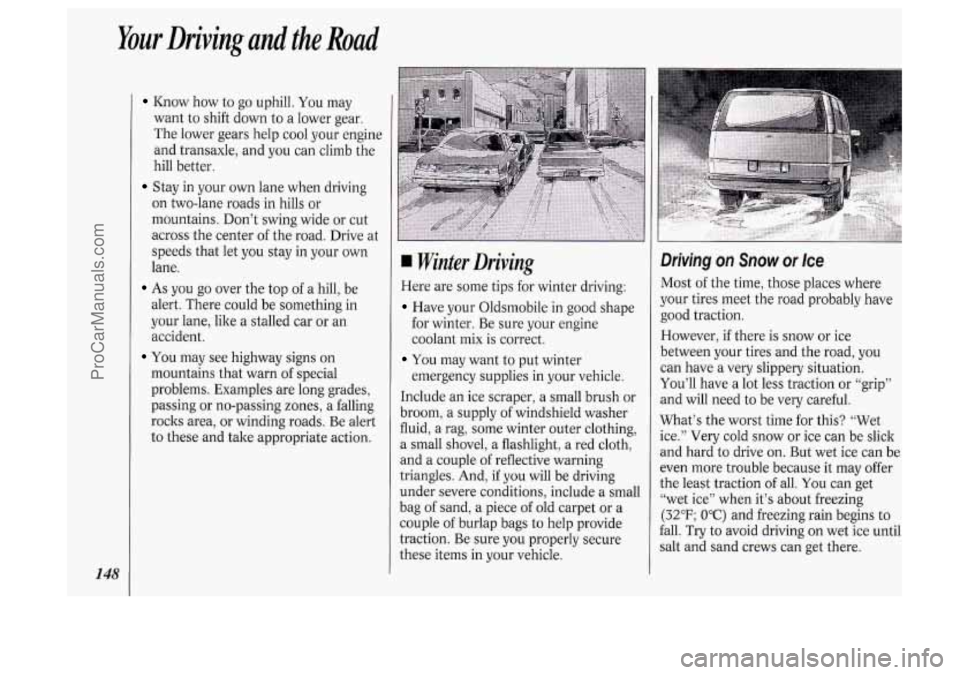
Winter Driving
Here are some tips for winter driving:
Have your Oldsmobile in good shape
for winter. Be sure your engine
coolant mix is correct.
You may want to put winter
emergency supplies in your vehicle.
Include an ice scraper, a small brush or
broom, a supply
of windshield washer
fluid,
a rag, some winter outer clothing,
a small shovel, a flashlight, a red cloth,
and a couple of reflective warning
triangles. And, if you will be driving
under severe conditions, include a small
bag of sand, a piece of old carpet or a
couple of burlap bags to help provide
traction. Be sure you properly secure
these items in your vehicle.
Driving on Snow or Ice
Most of the time, those places where
your tires meet the road probably have
good traction.
However,
if there is snow or ice
between your tires and the road, you
can have a very slippery situation.
You’ll have a lot less traction
or “grip”
and will need to be very careful.
What’s the worst time for this? “Wet
ice.” Very cold snow or ice can be slick
and hard to drive
on. But wet ice can be
even more trouble because it may offer
the least traction of all. You can get
“wet ice” when it’s about freezing
(32°F; O’C) and freezing rain begins to
fall. Try to avoid driving on wet ice until
salt and sand crews can get there.
ProCarManuals.com
Page 157 of 276
During your trip, check occasionally to
be sure that the load is secure, and that
the lights and
any trailer brakes are still
working.
Following Distance
Stay at least twice as far behind the
vehicle ahead as you would when
driving your vehicle without a trailer.
This can help you avoid situations that
require heavy braking and sudden
turns.
Passing
You’ll need more passing distance up
ahead when you’re towing a trailer.
And, because you’re a good deal longer,
you’ll need to go much farther beyond
the passed vehicle before you can return
to your lane.
Backing Up
Hold the bottom of the steering wheel
with one hand. Then, to move the
trailer to the left, just move that hand to
the left.
To move the trailer to the right,
move your hand to the right. Always back up
slowly and, if possible, have
someone guide you.
Making Turns
When you’re turning with a trailer,
make wider turns than normal. Do this
so your trailer won’t strike soft
shoulders, curbs, road signs, trees, or
other objects. Avoid jerky or sudden
maneuvers. Signal well in advance.
Turn Signals When Towing a
Trailer
When you tow a trailer, your vehicle has
to have a different turn signal flasher
and extra wiring. The green arrows on
your instrument panel will flash
whenever you signal a turn or lane
change. Properly hooked up, the trailer
lights will
also flash, telling other
drivers you’re about to turn, change
lanes or stop.
When towing a trailer, the green arrows
on your instrument panel will flash for
turns even
if the bulbs on the trailer are
burned out. Thus, you may think
drivers behind you are seeing your signal
when they are not.
It’s important
to check occasionally to be sure the
trailer bulbs are still working.
Driving On Grades
Reduce speed and shift to a lower gear
before you start down a long or steep
downgrade. If you don’t
shift down, you
might have to use your brakes
so much
that they would get hot and
no longer
work well.
On a long uphill grade, shift down and
reduce your speed to around
45 mph
(70 lwh) to reduce the possibility of
engine and transaxle overheating.
If you are towing a trailer that weighs
more than
1,000 pounds (454 kg), and
you have an automatic transaxle with
Overdrive, you may prefer to drive in
D
instead of Overdrive (or, as you need to,
a lower gear). This will minimize heat
build-up and extend the life of your
transaxle.
n
ProCarManuals.com
Page 197 of 276
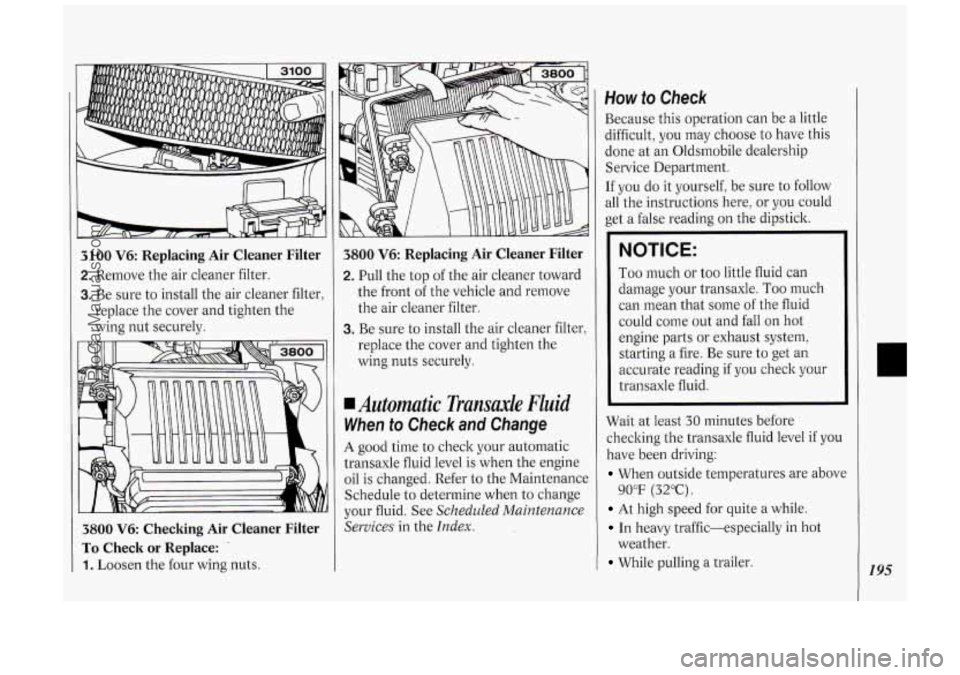
3100 V6: Replacing Air Cleaner Filter
2. Remove the air cleaner filter.
3. Be sure to install the air cleaner filter,
replace the cover and tighten the
wing nut securely.
3800 V6 Checking Air Cleaner Filter
To Check or Replace: .
1. Loosen the four wing nuts.
3800 V6: Replacing Air Cleaner Filter
2. Pull the top of the air cleaner toward
the front of the vehicle and remove
the air cleaner filter.
3. Be sure to install the air cleaner filter,
replace the cover and tighten the
wing nuts securely.
Automatic Transaxle Fluid
When to Check and Change
A good time to check your automatic
transaxle fluid level is when the engine
oil is changed. Refer
to the Maintenance
Schedule to determine when to change
your fluid. See
Scheduled Maintenance
Services
in the Index.
How to Check
Because this operation can be a little
difficult, you may choose to have this
done at an Oldsmobile dealership
Service Department.
If you do it yourself, be sure to follow
all the instructions here, or you could
get a false reading on the dipstick.
NOTICE:
Too much or too little fluid can
damage your transaxle.
Too much
can mean that some of the fluid
could come out and fall on hot
engine parts or exhaust system,
starting a fire. Be sure to get an
accurate reading if you check your
transaxle fluid.
Wait at least
30 minutes before
checking the transaxle fluid level
if you
have been driving:
When outside temperatures are above
At high speed for quite a while.
In heavy traffic-especially in hot
While pulling a trailer.
90°F (32°C).
weather.
195
ProCarManuals.com
Page 207 of 276
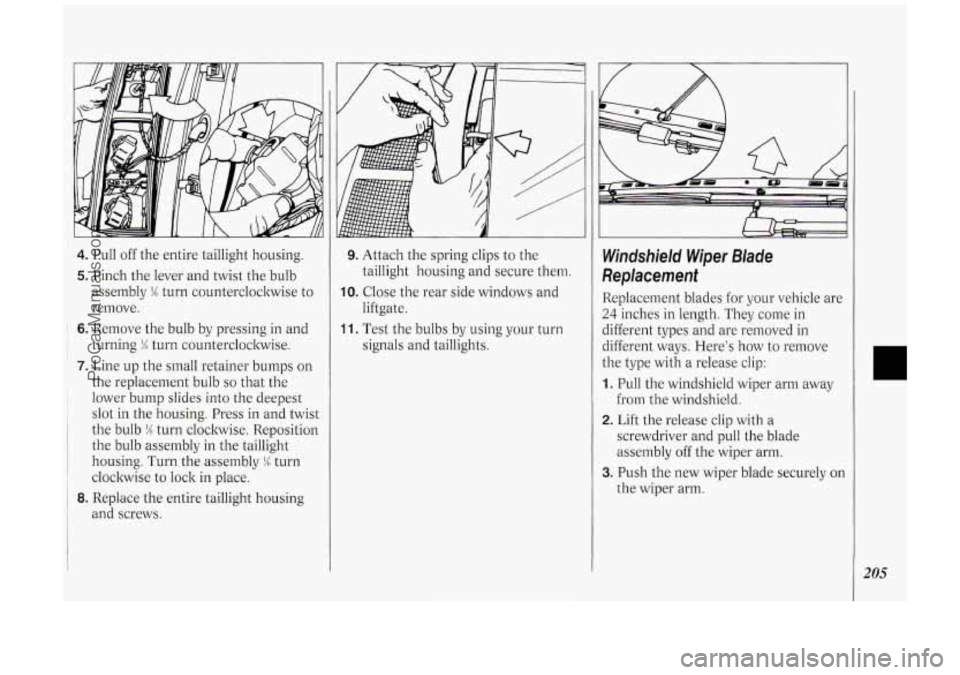
4. Pull off the entire taillight housing.
5. Pinch the lever and twist the bulb
assembly
M turn countercloclwise to
remove.
~ 6. Remove the bulb by pressing in and
1 turning % turn counterclockwise.
7. Line up the small retainer bumps on
the replacement bulb
so that the
1 lower bump slides into the deepest
' slot in the housing. Press in and twist
the bulb
!4 turn clockwise. Reposition
the bulb assembly in the taillight
housing. Turn the assembly
M turn
clockwise to lock in place.
' 8. Replace the entire taillight housing
and screws.
9. Attach the spring clips to the
taillight housing and secure them.
liftgate.
signals and taillights.
IO. Close the rear side windows and
11. Test the bulbs by using your turn
Windshield Wiper Blade
Replacement
Replacement blades for your vehicle are
24 inches in length. They come in
different types and are removed in
different ways. Here's how to remove
the type with a release clip:
1. Pull the windshield wiper arm away
from the windshield.
2. Lift the release clip with a
screwdriver and pull the blade
assembly off the wiper arm.
the wiper arm.
3. Push the new wiper blade securely on
205
ProCarManuals.com
Page 214 of 276
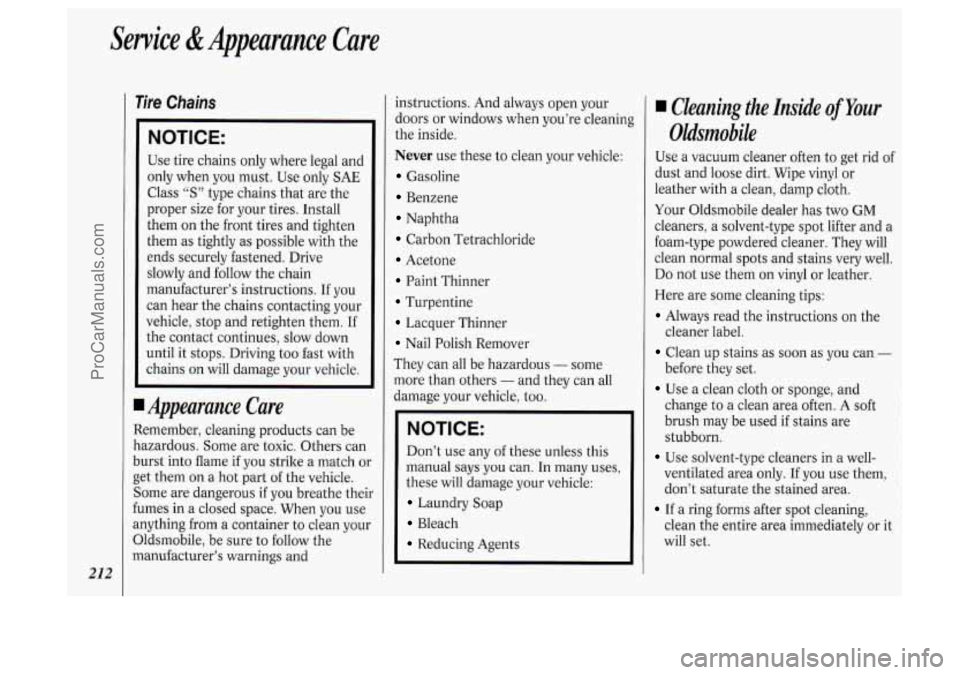
Service &Appearance Cure
212
Tire Chains
NOTICE:
Use tire chains only where legal and
only when you must. Use only SAE
Class
“S” type chains that are the
proper size for your tires. Install
them on the front tires and tighten
them as tightly as possible with the
ends securely fastened. Drive
slowly and follow the chain
manufacturer’s instructions. If you
can hear the chains contacting your
vehicle, stop and retighten them,
If
the contact continues, slow down
until it stops. Driving too fast with
chains on will damage your vehicle.
Appearance Care
Remember, cleaning products can be
hazardous. Some are toxic. Others can
burst into flame if you strike
a match or
get them on a hot part
of the vehicle.
Some are dangerous
if you breathe their
fumes in a closed space. When you use
anything from a container to clean your
Oldsmobile, be sure to follow the
manufacturer’s warnings and instructions.
And always open your
doors or windows when you’re cleanin,
the inside.
Never use these to clean your vehicle:
Gasoline
Benzene
Naphtha
Carbon Tetrachloride
Acetone
Paint Thinner
Turpentine
Lacquer Thinner
Nail Polish Remover
They can all be hazardous
- some
more than others
- and they can all
damage your vehicle, too.
NOTICE:
Don’t use any of these unless this
manual says you can. In many uses,
these will damage
your vehicle:
Laundry Soap
Bleach
Reducing Agents
Cleaning the Inside of Your
Oldsmobile
Use a vacuum cleaner often to get rid of
dust and loose dirt. Wipe vinyl or
leather with a clean, damp cloth.
Your Oldsmobile dealer has two
GM
cleaners, a solvent-type spot lifter and a
foam-type powdered cleaner. They will
clean normal spots and stains very well.
Do not use them on vinyl or leather.
Here are some cleaning tips:
Always read the instructions on the
cleaner label.
Clean up stains as soon as you can - I
before they set.
Use a clean cloth or sponge, and
change to
a clean area often. A soft
brush may be used
if stains are
stubborn.
Use solvent-type cleaners in a well-
ventilated area only. If you use them,
don’t saturate the stained area.
If a ring forms after spot cleaning,
clean the entire area immediately or it
will set.
ProCarManuals.com
Page 266 of 276
264
Things Under the Hood ................ 186
Transaxle Fluid
.............................. 195
Chemical Paint Spotting
.................. 217
Child Restraints
.................................. 35
How to Install
.................................. 35
Where to Put
.................................... 36
Children and Safety Belts
............ 34. 39
Child Security Lock
............................ 55
Circuit BrealtedRelay Panel ............ 222
Circuit Breakers
& Fuses ................. 219
City Driving
...................................... 145
Cleaner, Air
.............................. 194, 226
Cleaning Aluminum Wheels
......................... 216
Compact Discs
............................... 129
Fabric
..................................... 213, 214
Finish Care
..................................... 216
Foreign Material
............................ 2 16
Glass
.............................................. 215
Inside of Your Oldsmobile
............ 212
Leather and Vinyl
.......................... 214
Outside
of the Windshield and Wiper
Blades
............................................. 215
Outside
of Your Oldsmobile ......... 215
Safety Belts
.................................... 214
Special Problems
........................... 213
Stains. Removing
........................... 213
Cigarette Lighter
................................ 89
Cassette Tape Player
...................... 128
Top of the Instrument Panel
......... 214 Underbody
Maintenance
............... 217
Vinyl or Leather
............................. 214
Warnings
........................................ 2 12
Weatherstrips
................................. 216
Windshield
..................................... 215
Climate Control System
............ 11 1. 113
Clock. Setting the
............................. 117
Cluster. Instrument Panel .................. 98
Comfort Controls
............................. 11 1
Air Conditioner .............................. 11 1
Heater ............................................ 111
Rear ................................................ 113
Ventilation ..................................... 1 16
(see
Audio Systems )
Compact Disc Player
Compact Overhead Console
.............. 95
Compact Spare Tire
......................... 178
Compass Display
................................ 81
Console, Overhead ............................. 79
Control
of a Vehicle ......................... 134
Convenience Net
................................ 91
Convex Outside Mirror
...................... 87
Coolant ............................................. 197
Checking
& Adding ....................... 198
Proper Mixture to Use
............ 168, 197
Safety Warnings About
.................. 167, 168, 169, 198
Temperature Gage
......................... 103
Cruise Control
.................................... 72
Cup Holder/Ashtray, Front
............... 89 Curves. Driving
on
........................... 138
Customer Assistance Information
... 249
Dead Battery: What to
Do ............. 158
Defensive Driving
............................ 132
Defogger. Rear Window
................... 115
Defogging and Defrosting
................ 115
Delco LOC II@
................................. 126
Dome Lights
....................................... 84
Door Locks
............................. 45. 46. 52
Door. Power Sliding ................... 52. 107
Door. Sliding
...................................... 51
Driver Position
................................... 22
Driving At Night
......................................... 142
City
................................................. 145
Controlling a Skid
......................... 141
Defensively
.................................... 132
Drunlten
......................................... 132
Freeway
.......................................... 145
Hill and Mountain
......................... 147
In a Foreign Country ..................... 184
In Rain
........................................... 143
Long Distance
................................ 146
Loss
of Control .............................. 141
On Curves
...................................... 138
Passing ........................................... 140
Through Deep Standing Water
....... 60
Winter Driving
............................... 148
With a Trailer
................................. 151
ProCarManuals.com