warning OLDSMOBILE SILHOUETTE 1994 Owner's Guide
[x] Cancel search | Manufacturer: OLDSMOBILE, Model Year: 1994, Model line: SILHOUETTE, Model: OLDSMOBILE SILHOUETTE 1994Pages: 276, PDF Size: 15.82 MB
Page 196 of 276
Service &Appearance Care
194
What to Do with Used Oil
Did you know that used engine oil
contains certain elements that may be
unhealthy for your skin and could even
cause cancer? Don’t let used oil stay on
your skin for very long. Clean your skin
and nails with soap and water, or a
good hand cleaner. Wash or properly
throw away clothing or rags containing
used engine oil. (See the manufacturer’s
warnings about the
use and disposal of
oil products.)
Used oil can be
a real threat to the
environment. If you change your own
oil, be sure to drain all free-flowing oil
from the filter before disposal. Don’t
ever dispose
of oil by putting it in the
trash, pouring it on the ground, into
sewers, or into streams or bodies
of
water. Instead, recycle it by taking it to
a place that collects used oil. If you
have a problem properly disposing
of
your used oil, ask your dealer, a service
station or a local recycling center for
help.
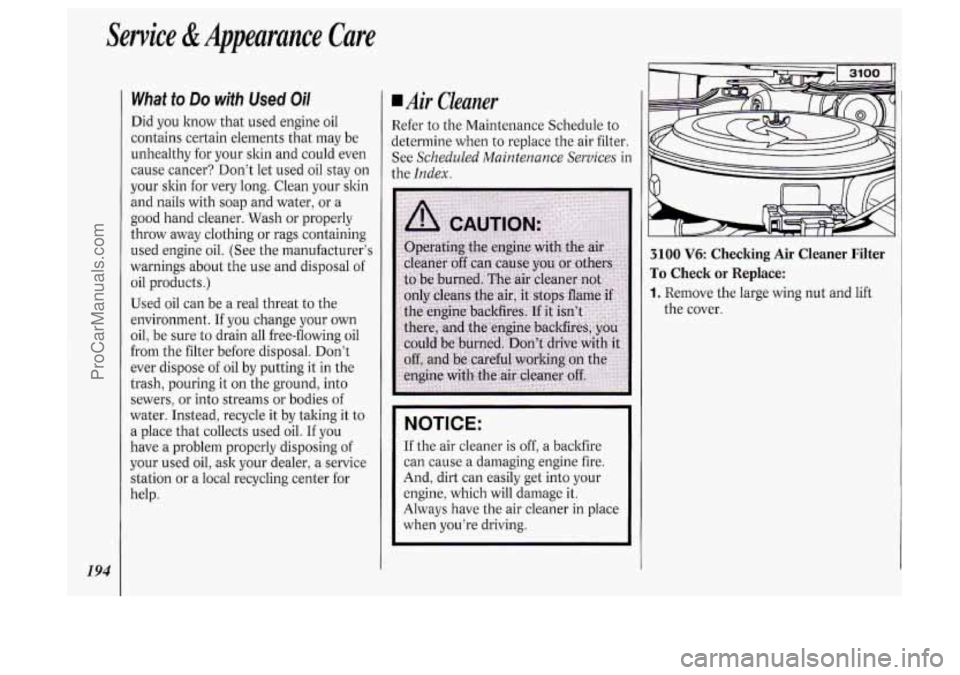
Air Cleaner
Refer to the Maintenance Schedule to
determine when to replace the air filter.
See
Scheduled Maintenance Services in
the Index.
NOTICE:
If the air cleaner is off, a backfire
can cause
a damaging engine fire.
And, dirt can easily get into your
engine, which will damage it.
Always have the air cleaner in place
when you’re driving.
ProCarManuals.com
Page 199 of 276
How to Add Fluid
Refer to the Maintenance Schedule to
determine what kind of transaxle fluid
to use. See
Recommended Fluids and
Lubricants
in the Index.
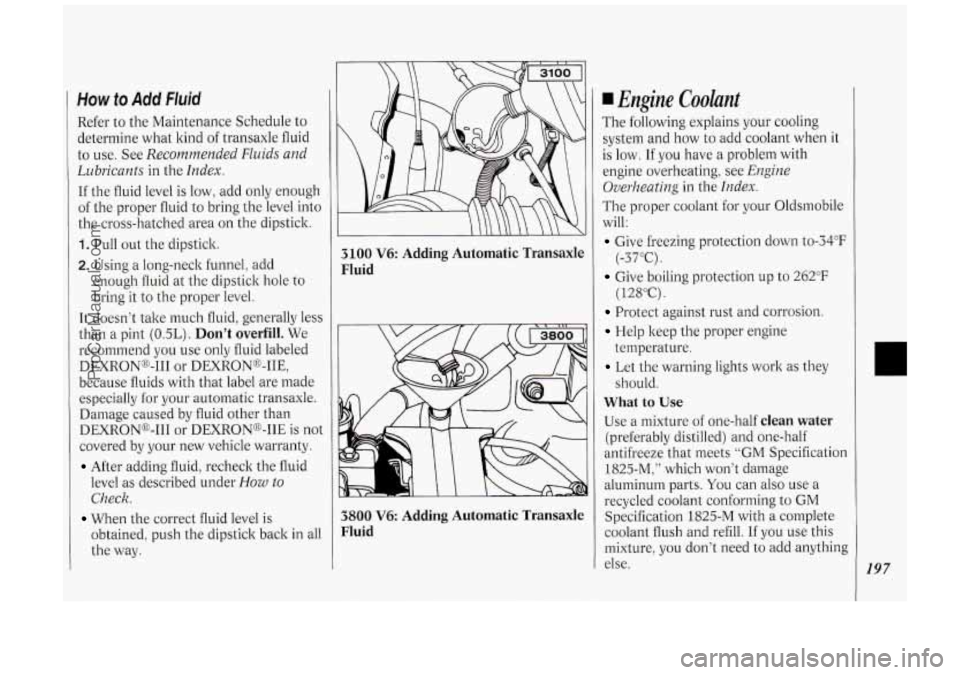
If the fluid level is low, add only enough
of the proper fluid to bring the level into
the cross-hatched area
on the dipstick.
1. Pull out the dipstick.
2. Using a long-neck funnel: add
enough fluid at the dipstick hole to
bring it to the proper level.
It doesn’t take much fluid, generally less
than a pint
(OSL). Don’t overfill. We
recommend you use only fluid labeled
DEXRONo-I11 or DEXRON@-IIE,
because fluids with that label are made
especially for your automatic transaxle.
Damage caused by fluid other than
DEXRONo-I11 or DEXRONB-IIE is not
covered by your new vehicle warranty.
After adding fluid, recheck the fluid
level as described under
How to
Check.
obtained, push the dipstick back in all
the way.
When the correct fluid level is
3100 V6: Adding Automatic Transaxle
Fluid
3800 V6: Adding Automatic Transaxle
Fluid
Engine Coolant
The following explains your cooling
system and how to add coolant when it
is
low. If you have a problem with
engine overheating, see
Engine
Overheating
in the Index.
The proper coolant for your Oldsmobile
will:
Give freezing protection down to-34”F
Give boiling protection up to 262°F
Protect against rust and corrosion.
Help keep the proper engine
Let the warning lights work as they
What to Use
Use a mixture of one-half clean water
(preferably distilled) and one-half
antifreeze that meets
“GM Specification
1825-M:” which won’t damage
aluminum parts.
You can also use a
recycled coolant conforming to
GM
Specification 1825-M with a complete
coolant flush and refill.
If you use this
mixture,
you don’t need to add anything
else.
(-37°C).
( 12SoC).
temperature. should.
197
ProCarManuals.com
Page 203 of 276
NOTICE:
When using concentrated washer
fluid, follow the manufacturer’s
instructions for adding water.
Don’t mix water with ready-to-
use washer fluid. Water can cause
the solution to freeze and damage
your washer fluid tank and other
parts of the washer system. Also,
water doesn’t clean as well as
washer fluid.
Fill your washer fluid tank only %
full when it’s very cold. This
allows for expansion, which could
damage the tank
if it is
completely full.
Don’t use radiator antifreeze in
your windshield washer. It can
damage your washer system and
paint.
I
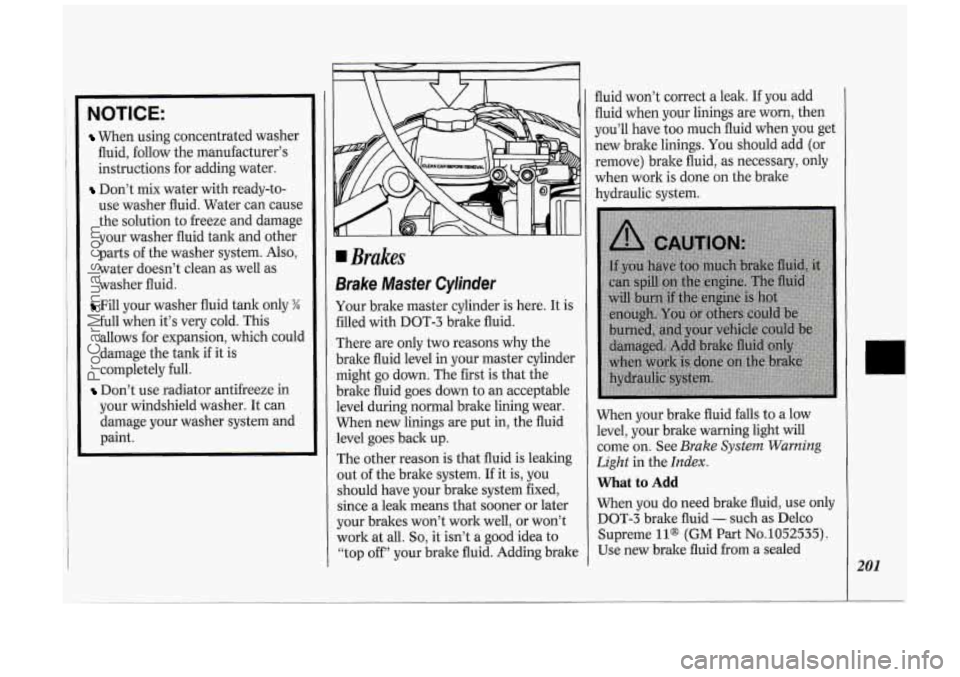
Brakes
Brake Master Cylinder
Your brake master cylinder is here. It is
filled with DOT-3 brake fluid.
There are only
two reasons why the
brake fluid level in your master cylinder
might go down. The first is that the
brake fluid goes down to an acceptable
level during normal brake lining wear.
When new linings are put in, the fluid
level goes back up.
The other reason is that fluid is leaking
out of the brake system. If it is, you
should have your brake system fixed,
since a leak means that sooner or later
your brakes won’t work well, or won’t
work at all.
So, it isn’t a good idea to
“top off’’ your brake fluid. Adding brake fluid
won’t correct a leak. If you add
fluid when your linings are worn, then
you’ll have too much fluid when you get
new brake linings. You should add (or
remove) brake fluid, as necessary, only
when work is done on the brake
hydraulic system.
When your brake fluid falls to a low
level, your brake warning light will
come on. See
Brake System Warning
Light
in the Index.
What to Add
When you do need brake fluid, use only
DOT-3 brake fluid
- such as Delco
Supreme
ll@ (GM Part No.1052535).
Use new brake fluid from a sealed
201
ProCarManuals.com
Page 204 of 276
Service & Appearance Care
202
container only, and always clean the
brake fluid reservoir cap before
removing it.
NOTICE:
DOT-5 silicone brake fluid can
Don’t let someone put in the
damage
your vehicle. Don’t use it.
wrong kind of fluid. For example,
just a few drops of mineral-based
oil, such
as engine oil, in your
brake system can damage brake
system parts
so badly that they’ll
have to be replaced.
Brake fluid can damage paint, so
be careful not to spill brake fluid
on your vehicle. If you do, wash it
off immediately. See
Appearance
Care
in the Index.
Brake Wear
Your Oldsmobile has front disc brakes
and rear drum brakes.
Disc brake pads have built-in wear
indicators that make
a high-pitched
warning sound when the brake pads are worn
and new pads are needed. The
sound may come and go or be heard all
the time your vehicle is moving (except
when you are pushing on the brake
pedal firmly).
NOTICE:
Continuing to drive with worn-out
brake pads could result in costly
brake repair.
Some driving conditions or climates
may cause
a brake squeal when the
brakes are first applied or lightly
applied. This does not mean something
is wrong with your brakes. Your
rear drum brakes don’t have wear
indicators, but if you ever hear a rear
brake rubbing noise, have the rear brake
linings inspected. Also, the rear brake
drums should be removed and
inspected each time the tires are
removed for rotation or changing. When
you have the front brakes replaced,
have the rear brakes inspected, too.
Brake linings should always be replaced
as complete axle sets.
Brake Pedal Travel
See your dealer if the brake pedal does
not return to normal height, or if there
is a rapid increase in pedal travel. This
could be a sign of brake trouble.
Brake Adjustment
Every time you apply the brakes
moderately, with or without the vehicle
moving, your brakes adjust for wear.
ProCarManuals.com
Page 212 of 276
Service &Appearance Care
21 0
Uniform Tire Quality Grading
The following information relates to the
system developed by the United States
National Highway Traffic Safety
Administration which grades tires by
treadwear, traction and temperature
performance. (This applies only to
vehicles sold in the United States.)
Treadwear
The treadwear grade is a comparative
rating based on the wear rate
of the tire
when tested under controlled conditions
on a specified government
test course. For example, a tire graded
150 would wear one and a half (1 %)
times as well on the government course
as a tire graded
100. The relative
performance of tires depends upon the
actual conditions of their use, however,
and may depart significantly from the
norm due to variations in driving habits,
service practices and differences in road
characteristics and climate.
Traction-A, B, C
The traction grades, from highest to
lowest are:
A, B, and C. They represent
the tire’s ability to stop on wet
pavement as measured under controlled
conditions on specified government test
surfaces of asphalt and concrete.
A tire
marked
C may have poor traction
performance.
Warning: The traction grade assigned to
this tire is based on braking (straight-
ahead) traction tests and does not
include cornering (turning) traction.
Temperature-A, B, C
The temperature grades are A (the
highest)
B, and C, representing the
tire’s resistance to the generation of heat and its
ability to dissipate heat
when tested under controlled
conditions on a specified indoor
laboratory test wheel. Sustained high
temperature can cause the material
of
the tire to degenerate and reduce tire
life, and excessive temperature can lead
to sudden tire failure. The grade
C
corresponds to a level of performance
which all passenger car tires must meet
under the Federal Motor Vehicle Safety
Standard
No. 109. Grades B and A
represent higher levels of performance
on the laboratory test wheel than the
minimum required by law.
Warning: The temperature grade for
this tire is established for a tire that is
properly inflated and not overloaded.
Excessive speed, underinflation, or
excessive loading, either separately or in
combination, can cause heat buildup
and possible tire failure.
These grades are molded
on the
sidewalls of passenger car tires.
While the tires available as standard or
optional equipment on General Motors
vehicles may vary with respect to these
grades, all such tires meet General
Motors performance standards and
ProCarManuals.com
Page 214 of 276
Service &Appearance Cure
212
Tire Chains
NOTICE:
Use tire chains only where legal and
only when you must. Use only SAE
Class
“S” type chains that are the
proper size for your tires. Install
them on the front tires and tighten
them as tightly as possible with the
ends securely fastened. Drive
slowly and follow the chain
manufacturer’s instructions. If you
can hear the chains contacting your
vehicle, stop and retighten them,
If
the contact continues, slow down
until it stops. Driving too fast with
chains on will damage your vehicle.
Appearance Care
Remember, cleaning products can be
hazardous. Some are toxic. Others can
burst into flame if you strike
a match or
get them on a hot part
of the vehicle.
Some are dangerous
if you breathe their
fumes in a closed space. When you use
anything from a container to clean your
Oldsmobile, be sure to follow the
manufacturer’s warnings and instructions.
And always open your
doors or windows when you’re cleanin,
the inside.
Never use these to clean your vehicle:
Gasoline
Benzene
Naphtha
Carbon Tetrachloride
Acetone
Paint Thinner
Turpentine
Lacquer Thinner
Nail Polish Remover
They can all be hazardous
- some
more than others
- and they can all
damage your vehicle, too.
NOTICE:
Don’t use any of these unless this
manual says you can. In many uses,
these will damage
your vehicle:
Laundry Soap
Bleach
Reducing Agents
Cleaning the Inside of Your
Oldsmobile
Use a vacuum cleaner often to get rid of
dust and loose dirt. Wipe vinyl or
leather with a clean, damp cloth.
Your Oldsmobile dealer has two
GM
cleaners, a solvent-type spot lifter and a
foam-type powdered cleaner. They will
clean normal spots and stains very well.
Do not use them on vinyl or leather.
Here are some cleaning tips:
Always read the instructions on the
cleaner label.
Clean up stains as soon as you can - I
before they set.
Use a clean cloth or sponge, and
change to
a clean area often. A soft
brush may be used
if stains are
stubborn.
Use solvent-type cleaners in a well-
ventilated area only. If you use them,
don’t saturate the stained area.
If a ring forms after spot cleaning,
clean the entire area immediately or it
will set.
ProCarManuals.com
Page 245 of 276

Section C: Periodic Maintenance Inspections fall). You should let your GM dealer’s service department or
other qualified service center do these jobs. Make sure any
Listed below are inspections and services which should be necessary repairs are completed at once.
performed at least twice a year (for instance, each spring and
Restraint Systems
Steering, Suspension
and Front-Wheel-
Drive Axle Boot and
Seal Inspection
Exhaust System
Inspection
Throttle Linkage
Inspection
Brake System Inspection
~~ ~
WHAT SHOULD BE DONE
~ ~~~
Now and then, make sure all your belts, buckles, latch plates, retractors, anchorages and
reminder systems are working properly. Look for any loose parts or damage.
If you see anything
that might keep
a restraint system from doing its job, have it repaired.
Inspect the front and rear suspension
and steering system for damaged, loose or missing parts,
signs of wear, or lack of lubrication. Inspect the power steering lines and hoses for proper
hookup, binding, leaks, cracks, chafing, etc. Clean and then inspect the drive axle boot seals for
damage, tears or leakage. Replace seals if necessary.
Inspect the complete exhaust system. Inspect the body near the exhaust system. Look for broken,
damaged, missing or out-of-position parts as well
as open seams, holes, loose connections, or
other conditions which could cause a heat build-up in the floor pan or could let exhaust fumes
into the vehicle. See
Engine Exhaust in the Index.
Inspect the throttle linkage for interference or binding, and for damaged or missing parts.
Replace parts as needed.
Inspect the complete system. Inspect brake lines and hoses for proper hook-up, binding, leaks,
cracks, chafing, etc. Inspect disc brake pads for wear and rotors for surface condition. Also inspect
drum brake linings for wear and cracks. Inspect other brake parts, including drums, wheel
cylinders, calipers, parking brake, etc. Check parking brake adjustment.
You may need to have
your brakes inspected more often
if your driving habits or conditions result in frequent braking.
NOTE:
A low brake fluid level can indicate worn disc brake pads which may need to be serviced.
Also, if the brake system warning light stays on or comes on, something may be wrong with the
brake system. See the
Index under Brake System Warning Light. If your anti-lock brake system
warning light stays on or comes on, something may be wrong with the anti-lock brake system.
See the
Index under Anti-Lock Brake System Wawing Light.
ProCarManuals.com
Page 265 of 276
lndex
Accessory Power Outlet ................... 84
Adding Brake Fluid
............................. 201. 227
Electrical Equipment
........ .60. 117 . 2 19
Engine Coolant
.......... 167.197.224. 227
Engine Oil
.............................. 190. 224
Power Steering Fluid
..... 199.225. 227
Sound Equipment
.......................... 11 7
Transaxle Fluid
.............. 195. 224. 227
Windshield Washer Fluid
...... 200. 227
Air Bag Readiness Light
..................... 27
Air Bags
............................................... 26
Air Cleaner
............................... 194. 226
Air Conditioner
................................ 11 1
Air Inflator System ............................. 85
Alcohol. Driving Under the
Influence
of ..................................... 132
Alcohol in Gasoline
.......................... 183
Aluminum Wheels .................... 21 1. 216
Antenna
............................................ 129
Anti-Lock
.......................................... 135
Anti-Lock Brake System
................... 135
Brake Master Cylinder ................... 201
Junction Block Fuse
...................... 222
Warning Light
................................ 104
Appearance Care
.............................. 212
Adjusting
Rear Seats
.......................... 17
Antifreeze
......................... 197. 224. 227
Ashtrays and Lighter
.................... 89. 90 Audio
Systems
.................................. 117
AM/FM Stereo Radio
.................... 1 19
AM/FM Stereo Radio with Compact
Disc Player
..................................... 124
Care
of Audio Systems .................. 128
Setting the Clock
........................... 117
Steering Wheel Touch Controls
.... 127
Adding Fluid
.................. 197. 225. 227
Checking Fluid
............................... 195
Shifting
............................................. 62
Battery
............................................ 203
Jump Starting
................................. 158
Battery Warning Gage ...................... 103
Blizzard
............................................. 149
Brake Cassette
Player
...................... 120. 122
Radio Reception. For the Best
...... 128
Automatic Transaxle
(( Blowout. .. Tire ................................ 172
Adjustment
.................................... 202
Anti-Lock Brakes
.......................... 135
Anti-Lock Brake System Warning
Light
............................................ 104
Fluid
....................................... 201. 227
Parking
............................................. 65
Pedal Travel
................................... 202
Rear
Drums .................................... 202
Junction
Block Fuse
...................... 222
Master Cylinder
............................. 201 Warning Light
................................ 103
Wear Indicators
............................. 202
Brake System Warning Light
........... 103
Braking
............................................. 134
Braking in Emergencies
................... 138
Braking Technique
........................... 134
“Break.1n.
.. New Vehicle ............. 57. 152
Bucket Seats. Removable Rear
.......... 15
Buckling Up (see
Safety Belts)
Bulb Replacement
Headlight
....................................... 203
Taillight
.......................................... 204
Bulbs, Replacement
.......................... 228
Capacities
81 Specifications ............ 224
Carbon Monoxide in
Exhaust
...................... 57, 68. 150. 154
Cassette Tape Player
(see
Audio Systems )
Center Passenger Position
(see
Safety Belts)
Chains. Safety ................................... 154
Chains. Tire
.............................. 179, 212
Changing a Flat Tire
......................... 172
Checking
Brake Fluid
.................................... 201
Engine Coolant
.............................. 197
Engine Oil ...................................... 190
Power Steering Fluid
..................... 199
Safety Belt Systems
......................... 41
.
263
ProCarManuals.com
Page 266 of 276
264
Things Under the Hood ................ 186
Transaxle Fluid
.............................. 195
Chemical Paint Spotting
.................. 217
Child Restraints
.................................. 35
How to Install
.................................. 35
Where to Put
.................................... 36
Children and Safety Belts
............ 34. 39
Child Security Lock
............................ 55
Circuit BrealtedRelay Panel ............ 222
Circuit Breakers
& Fuses ................. 219
City Driving
...................................... 145
Cleaner, Air
.............................. 194, 226
Cleaning Aluminum Wheels
......................... 216
Compact Discs
............................... 129
Fabric
..................................... 213, 214
Finish Care
..................................... 216
Foreign Material
............................ 2 16
Glass
.............................................. 215
Inside of Your Oldsmobile
............ 212
Leather and Vinyl
.......................... 214
Outside
of the Windshield and Wiper
Blades
............................................. 215
Outside
of Your Oldsmobile ......... 215
Safety Belts
.................................... 214
Special Problems
........................... 213
Stains. Removing
........................... 213
Cigarette Lighter
................................ 89
Cassette Tape Player
...................... 128
Top of the Instrument Panel
......... 214 Underbody
Maintenance
............... 217
Vinyl or Leather
............................. 214
Warnings
........................................ 2 12
Weatherstrips
................................. 216
Windshield
..................................... 215
Climate Control System
............ 11 1. 113
Clock. Setting the
............................. 117
Cluster. Instrument Panel .................. 98
Comfort Controls
............................. 11 1
Air Conditioner .............................. 11 1
Heater ............................................ 111
Rear ................................................ 113
Ventilation ..................................... 1 16
(see
Audio Systems )
Compact Disc Player
Compact Overhead Console
.............. 95
Compact Spare Tire
......................... 178
Compass Display
................................ 81
Console, Overhead ............................. 79
Control
of a Vehicle ......................... 134
Convenience Net
................................ 91
Convex Outside Mirror
...................... 87
Coolant ............................................. 197
Checking
& Adding ....................... 198
Proper Mixture to Use
............ 168, 197
Safety Warnings About
.................. 167, 168, 169, 198
Temperature Gage
......................... 103
Cruise Control
.................................... 72
Cup Holder/Ashtray, Front
............... 89 Curves. Driving
on
........................... 138
Customer Assistance Information
... 249
Dead Battery: What to
Do ............. 158
Defensive Driving
............................ 132
Defogger. Rear Window
................... 115
Defogging and Defrosting
................ 115
Delco LOC II@
................................. 126
Dome Lights
....................................... 84
Door Locks
............................. 45. 46. 52
Door. Power Sliding ................... 52. 107
Door. Sliding
...................................... 51
Driver Position
................................... 22
Driving At Night
......................................... 142
City
................................................. 145
Controlling a Skid
......................... 141
Defensively
.................................... 132
Drunlten
......................................... 132
Freeway
.......................................... 145
Hill and Mountain
......................... 147
In a Foreign Country ..................... 184
In Rain
........................................... 143
Long Distance
................................ 146
Loss
of Control .............................. 141
On Curves
...................................... 138
Passing ........................................... 140
Through Deep Standing Water
....... 60
Winter Driving
............................... 148
With a Trailer
................................. 151
ProCarManuals.com
Page 267 of 276
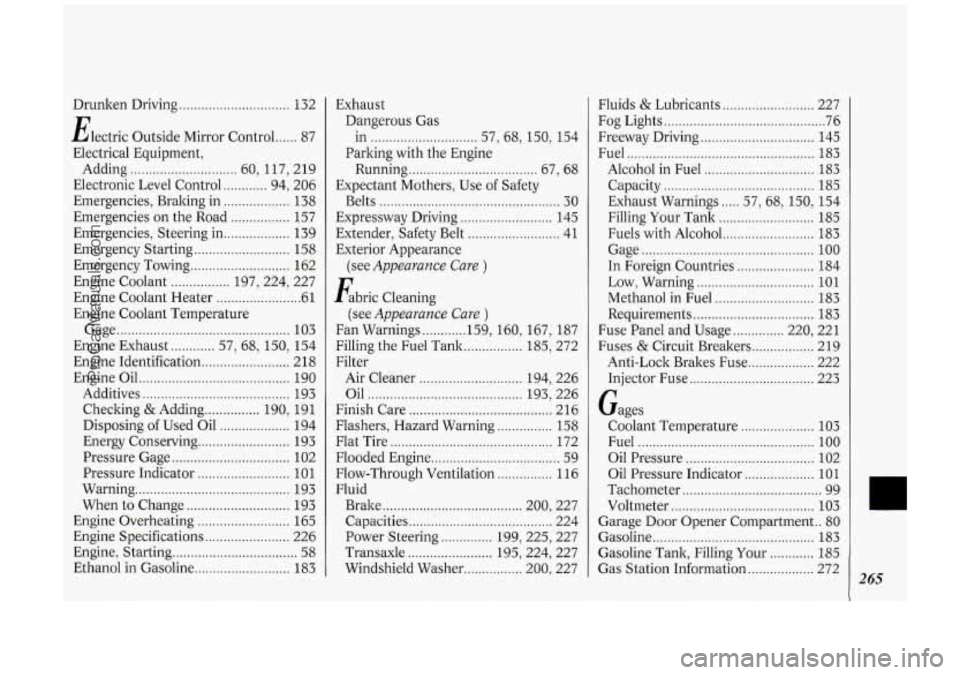
Drunken Driving .............................. 132
Electric Outside Mirror Control
...... 87
Electrical Equipment.
Adding
............................. 60. 117. 219
Electronic Level Control
............ 94. 206
Emergencies. Braking in
.................. 138
Emergencies on the Road
................ 157
Emergencies. Steering in
.................. 139
Emergency Starting
.......................... 158
Emergency Towing ........................... 162
Engine Coolant
................ 197, 224, 227
Engine Coolant Heater
....................... 61
Engine Coolant Temperature
Gage
............................................... 103
Engine Exhaust
............ 57. 68, 150, 154
Engine Identification
........................ 218
Engine Oil
......................................... 190
Additives
........................................ 193
Checking
& Adding ............... 190. 191
Disposing of Used Oil
................... 194
Energy Conserving
......................... 193
Pressure Gage
................................ 102
Pressure Indicator
......................... 101
Warning
.......................................... 193
When to Change
............................ 193
Engine Overheating
......................... 165
Engine Specifications
....................... 226
Engine. Starting
.................................. 58
Ethanol in Gasoline .......................... 183
Exhaust
Dangerous Gas
Parking with the Engine
in
............................. 57.
68. 150. 154
Running
................................... 67. 68
Expectant Mothers. Use
of Safety
Belts
................................................. 30
Expressway Driving
......................... 145
Extender. Safety Belt
......................... 41
Exterior Appearance
Fabric Cleaning
Fan Warnings
............ 159. 160. 167. 187
Filling the Fuel Tank ................ 185. 272
Filter Air Cleaner
............................ 194. 226
Oil
.......................................... 193. 226
Finish Care
....................................... 216
Flat Tire
............................................ 172
Flooded Engine
................................... 59
Fluid (see
Appearance
Care )
(see Appearance Care )
Flashers. Hazard Warning ............... 158
Flow-Through Ventilation
............... 116
Brake
...................................... 200. 227
Capacities
....................................... 224
Power Steering
.............. 199. 225. 227
Transaxle
....................... 195. 224. 227
Windshield Washer
................ 200. 227 Fluids
& Lubricants ......................... 227
Fog Lights
............................................ 76
Freeway Driving
............................... 145
Fuel
................................................... 183
Alcohol in Fuel
.............................. 183
Capacity
......................................... 185
Exhaust Warnings ..... 57. 68. 150. 154
Filling
Your Tank .......................... 185
Fuels with Alcohol
......................... 183
Gage
............................................... 100
In Foreign Countries ..................... 184
Low. Warning
................................ 101
Methanol in Fuel
........................... 183
Requirements ................................. 183
Fuse Panel and Usage .............. 220. 221
Fuses
& Circuit Breakers ................. 219
Anti-Lock Brakes Fuse
.................. 222
Injector Fuse
.................................. 223
Gages Coolant Temperature
.................... 103
Fuel
................................................ 100
Oil Pressure ................................... 102
Oil Pressure Indicator
................... 101
Tachometer
...................................... 99
Voltmeter
....................................... 103
Garage Door Opener Compartment
.. 80
Gasoline
............................................ 183
Gasoline Tank, Filling Your
............ 185
Gas Station Information .................. 272 265
ProCarManuals.com