air condition OLDSMOBILE SILHOUETTE 1996 User Guide
[x] Cancel search | Manufacturer: OLDSMOBILE, Model Year: 1996, Model line: SILHOUETTE, Model: OLDSMOBILE SILHOUETTE 1996Pages: 372, PDF Size: 19.39 MB
Page 248 of 372
You can be injured and your vehicle could be
damaged if you try to do service work on a vehicle without knowing enough about it.
Be sure you have sufficient knowledge, experience, and the- proper replacement
parts and tools before you attempt any
vehicle maintenance task.
Be sure to use the proper nuts, bolts and
other fasteners. “English” and “metric”
fasteners can be easily confused.
If you use
the wrong fasteners, parts can later break
or fall
off. You could be hurt.
Fuel
Use regular unleaded gasoline rated at 87 octane or
higher. At a minimum, it should meet specifications
ASTM D4814 in the United States and CGSB 3.S-M93
in Canada. Improved gasoline specifications have been
developed by the American Automobile Manufacturers
Association (AAMA) for better vehicle performance
and engine protection. Gasolines meeting
the AAMA specification could provide improved driveability
and
emission control system protection compared to other gasolines.
Be sure
the posted octane is at least 87. If the octane is
less than
87, you may get a heavy knocking noise when
you drive.
If it’s bad enough, it can damage your engine.
If you’re using fuel rated at 87 octane or higher and you
still hear heavy knocking, your engine needs service.
But don’t worry
if you hear a little pinging noise when
you’re accelerating or driving up
a hill. That’s normal,
and you don’t have to buy
a higher octane fuel to get rid
of pinging. It’s the heavy, constant knock that means
you have
a problem.
If your vehicle is certified to meet California Emission
Standards (indicated on the underhood tune-up label),
it is designed to operate on fuels that meet California
specifications. If such fuels are not available
in states
adopting California emissions standards, your vehicle
will operate satisfactorily
on fuels meeting federal
specifications, but emission control system performance
may be affected. The malfunction indicator lamp on
your instrument panel may turn
on and/or your vehicle
may fail a smog-check test. If this occurs, return to
your authorized Oldsmobile retailer for diagnosis to
determine the cause of failure. In the event
it is
determined that the cause of the condition
is the type of
fuels used, repairs may not be covered by your warranty.
6-2
ProCarManuals.com
Page 261 of 372

Checking or Replacing the Air Cleaner
1. Loosen the four wing nuts.
2. Pull the top of the air cleaner toward the fro t of the
vehicle and remove the air cleaner filter.
P
3. Be sure to install the air cleaner filter, replace the
cover and tighten the wing nuts securely.
Automatic Transaxle Fluid
When to Check and Change
A good time to check your automatic transaxle fluid
level is when the engine oil is changed.
Change both the fluid and filter every
50,000 miles
(83 000 krn) if the vehicle is mainly dnven under one or
more of these conditions:
In heavy city traffic where the outside temperature
regularly reaches
90 OF (3 2 O C) or higher.
0 In hilly or mountainous terrain.
0 When doing frequent trailer towing.
Uses such as found in taxi, police or delivery service.
If you do not use your vehicle under any
of these
conditions, the fluid and filter do not require changing.
See “Scheduled Maintenance Services” in the Index.
6-15
ProCarManuals.com
Page 273 of 372
Brake Wear
Your Oldsmobile has front disc brakes and rear
drum brakes.
Disc brake pads have built-in wear indicators that
make a high-pitched warning sound when the brake
pads are
worn and new pads are needed. The sound may
come and go or be heard all the time your vehicle is
moving (except when you
are pushing on the brake
pedal firmly).
The brake wear warning sound means that
sooner or later your brakes won’t work well.
That could lead to an accident. When
you hear
the brake wear warning sound, have your
vehicle serviced.
NOTICE:
Continuing to drive with worn-out brake pads
could result in costly brake repair.
Some driving conditions or climates may cause a brake
squeal when the brakes
are first applied or lightly
applied. This does not mean something is wrong with
your brakes.
Free movement of brake calipers and properly torqued
wheel nuts are necessary to help prevent brake
pulsation. When tires are rotated, inspect brake calipers
for movement, brake pads
for wear, and evenly torque
wheel nuts in the proper sequence to
GM specifications.
Your rear drum brakes don’t have wear indicators, but
if
you
ever hear a rear brake rubbing noise, have the rear
brake linings inspected. Also, the rear brake drums
should be removed and inspected each time the tires
are removed for rotation or changing. When you
have the front brakes replaced, have the rear brakes
inspected, too.
Brake linings should always be replaced
as complete
axle sets.
6-27
ProCarManuals.com
Page 286 of 372
Warning: The traction grade assigned to this tire is based
on braking (straightahead) traction tests and does not
include cornering (turning) traction.
Temperature -- A, B, C
The temperature grades are A (the highest), B, and C,
representing the tire’s resistance to the generation of
heat and its ability to dissipate heat when tested under
controlled conditions on a specified indoor laboratory
test wheel. Sustained high temperature can cause the
material
of the tire to degenerate and reduce tire life, and
excessive temperature can lead to sudden tire failure.
The grade
C corresponds to a level of performance
which all passenger car tires must meet under the
Federal Motor Vehicle Safety Standard
No. 109. Grades
B and A represent higher levels of performance on the
laboratory test wheel than the minimum required by law.
Warning: The temperature grade for this tire is
established for a tire that is properly inflated and not
overloaded. Excessive speed, underinflation, or
excessive loading, either separately or in combination,
can cause heat buildup and possible tire failure.
Wheel Alignment and Tire Balance
The wheels on your vehicle were aligned and balanced
carefully at the factory to give
you the longest tire life
and best overall performance.
In most cases, you will not need to have your wheels
aligned again. However, if you notice unusual tire wear
or your vehicle pulling one way or the other, the
alignment may need to be reset. If you notice your
vehicle vibrating when driving on a smooth road, your
wheels may need
to be rebalanced.
Wheel Replacement
Replace any wheel that is bent, cracked, or badly rusted
or corroded. If wheel
nuts keep coming loose, the wheel,
wheel bolts and wheel nuts should be replaced. If the
wheel leaks air, replace it (except some aluminum
wheels, which can sometimes be repaired). See your
Oldsmobile retailer if any of these conditions exist.
Your retailer will know the kind
of wheel you need.
Each new wheel should have
the same load-carrying
capacity, diameter, width, offset and be mounted the
same way as the one it replaces.
6-40
ProCarManuals.com
Page 295 of 372
Underbody Maintenance
Chemicals used for ice and snow removal and dust
control can collect on the underbody. If these are
not
removed, accelerated corrosion (rust) can occur on
the underbody parts such as fuel lines, frame, floor
pan and exhaust system even though they have
corrosion protection.
At least every spring, flush these materials from the
underbody with plain water. Clean any areas where mud
and other debris can collect. Dirt packed in closed areas
of the frame should be loosened before being flushed.
Your retailer or an underbody vehicle washing system
can do this for you.
Collision Repair
Your vehicle was built with composite SMC (Sheet
Molded Compound) fiberglass body panels and molded
RIM (Reaction Injection Molded) front fenders and
bumper covers. These panels require different collision
repair procedures than metal-paneled vehicles. See your
Oldsmobile retailer for information on collision repair.
Chemical Paint Spotting
Some weather and atmospheric conditions can create a
chemical fallout. Airborne pollutants can fall upon and
attack painted surfaces on your vehicle. This damage
can take
two forms: blotchy, ringlet-shaped
discolorations, and small irregular dark spots etched into
the paint surface.
Although no defect in the paint job causes this,
Oldsmobile will repair, at no charge to the owner,
the surfaces of new vehicles damaged by this fallout
condition within
12 months or 12,000 miles (20 000 km)
of purchase, whichever occurs first.
6-49
ProCarManuals.com
Page 302 of 372

.
Circuit Breakermelay Panel
Circuit breakers and relays are located in the circuit
breakerhelay panel.
This is located belund the panel
under the glove box, near the passenger’s door.
Circuit
Breakers Usage
1 Hazard Flashers
2 Automatic Transaxle, Evaporative
(fuse) Emission (EVAP) Canister Purge
Solenoid Valve, Evaporative Emissions
Canister Purge Vacuum Diagnostic
Switch, Linear Exhaust Gas Recirculation
(EGR) Valve, Front Engine Fan Relay,
Heated Oxygen Sensors, Mass Air
Flow (MAF) Sensor, Powertrain Control
Module (PCM)
3
4
5
6
7
8
9
10
6-56
Not Used
Power Windows
Power Seat, Power Sliding
Door
Controller, Power Door Locks
Rear Defogger
Air Conditioning Blower,
Rear Blower Motor
Horns
Safety Belt Reminder Chime, Lamps on
Reminder, Key In the Ignition, Warning
(Chime Module)
Rear Defogger Timer
1
ProCarManuals.com
Page 305 of 372
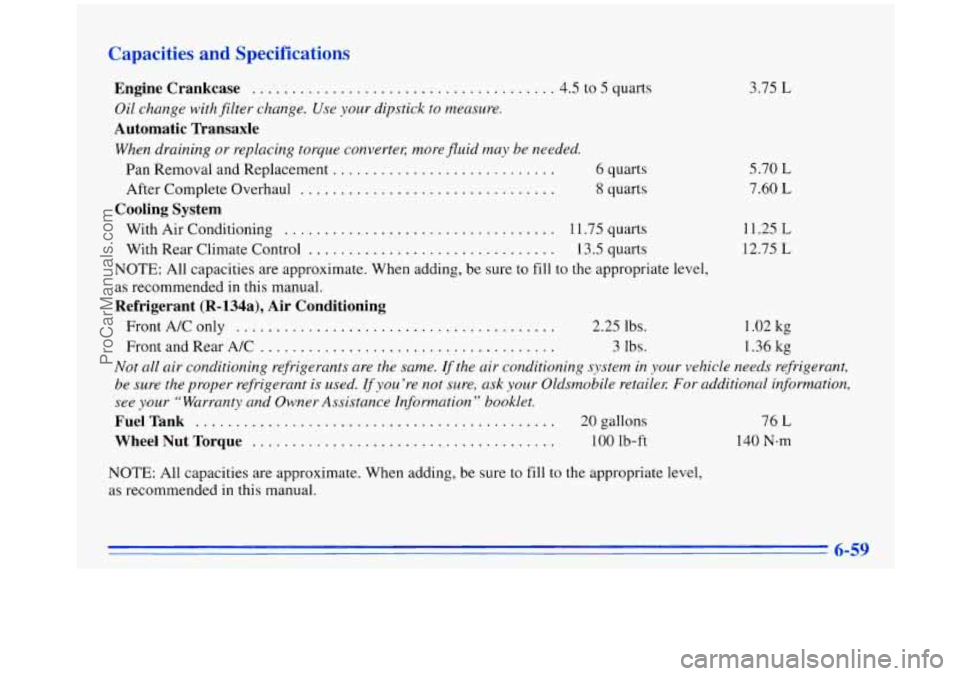
Capacities and Specifications
Engine Crankcase ...................................... 4.5 to 5 quarts
Oil change with filter change. Use your dipstick to measure.
Automatic Transaxle
When draining or replacing torque convertel; more fluid may be needed.
Pan Removal and Replacement ............................ 6 quarts
After Complete Overhaul
................................ 8 quarts
With Air Conditioning
.................................. 11.75 quarts
With Rear Climate Control
............................... 13.5 quarts
Cooling System
NOTE: All capacities are approximate. When adding, be sure to fill to the appropriate level,
as recommended in this manual.
Refrigerant (R-l34a), Air Conditioning
FrontA/Conly ........................................ 2.25 lbs. 1.02 kg
Front and Rear A/C ..................................... 3 lbs. 1.36 kg
Not all air conditioning refrigerants are the same. rfthe air conditioning system in your vehicle needs refrigerant,
be sure the proper refrigerant is used.
lfyou ’re not sure, ask your Oldsmobile retailez For additional information,
see
your “Warranty and Owner Assistance Information ” booklet.
FuelTank ............................................. 20gallons 76 L
WheelNutTorque ...................................... 100 lb-ft 140 N-m
NOTE: All capacities are approximate. When adding, be sure to fill to the appropriate level,
as recommended
in this manual. 3.75
L
5.70 L
7.60 L
11.25 L
12.75 L
6-59
ProCarManuals.com
Page 307 of 372
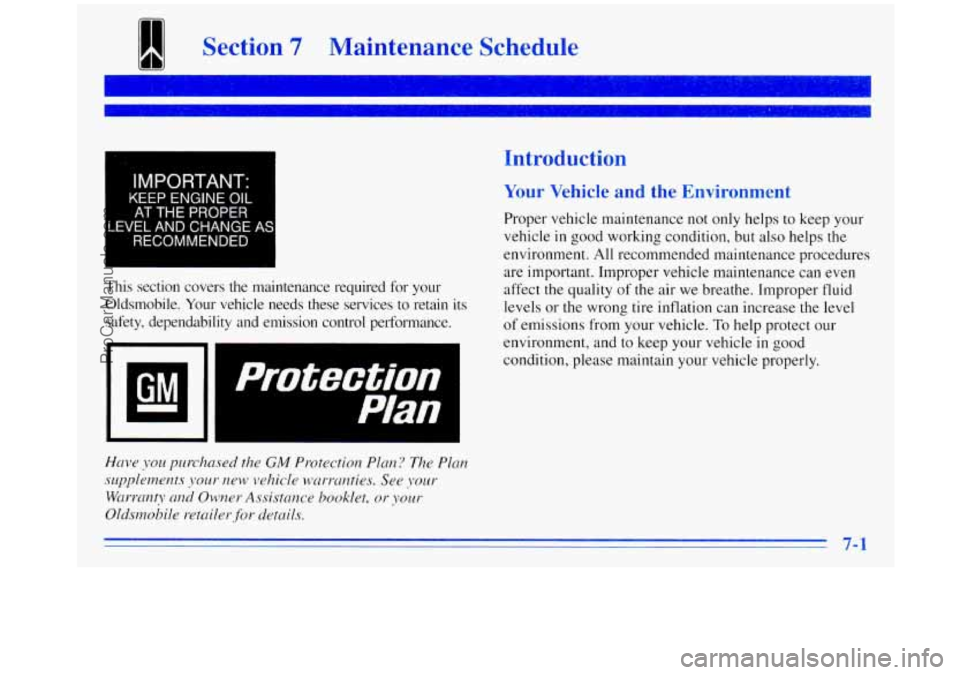
Section 7 Maintenance Schedule
KEEP ENGINE OIL
AT THE PROPER
EVEL
AND CHANGE AS
RECOMMENDED
I
This section covers the maintenance required for your
Oldsmobile. Your vehicle needs these services to retain its
safety, dependability and emission control performance.
I protection
Huve yo~t purchased the GM Protection Plan? The Plan
SLqplements yo~tr new vehicle warranties. See your
Warrfllzni and Owner Assistance booklet, oy your
Oldsnwbile retailer for details.
Introduction
Your Vehicle and the Environment
Proper vehicle maintenance not only helps to keep your
vehicle
in good working condition, but also helps the
environment.
All recommended maintenance procedures
are important. Improper vehicle maintenance can even
affect the quality of the air we breathe. Improper fluid
levels or the wrong tire inflation can increase the level
of emissions from your vehicle. To help protect our
environment, and to keep your vehicle in good
condition, please maintain your vehicle properly.
7-1
ProCarManuals.com
Page 308 of 372
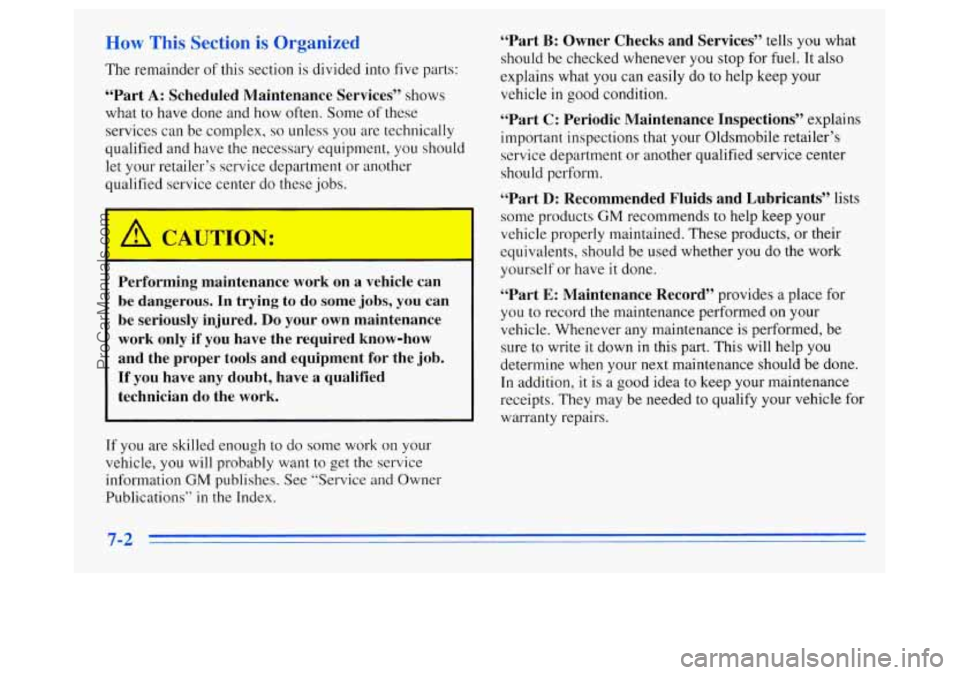
IW This Section is Organized
The remainder of this section is divided into five parts:
“Part A: Scheduled Maintenance Services” shows
what to have done and how often. Some of these
services can be complex,
so unless you are technically
qualified and have
the necessary equipment, you should
let your retailer’s service department or another
qualified service center do these jobs.
r
Performing maintenance work on a vehicle can
be dangerous. In trying
to do some jobs, you can
be seriously injured.
Do your own maintenance
work only if you have the required know-how
and the proper tools and equipment for the job.
If you have any doubt, have a qualified
technician do the work.
If you are skilled enough to do some work on your
vehicle, you will probably want
to get the service
information
GM publishes. See “Service and Owner
Publications”
in the Index.
“Part B: Owner Checks and Services” tells you what
should be checked whenever you stop for
fuel. It also
explains what you can easily do
to help keep your
vehicle
in good condition.
“Part C: Periodic Maintenance Inspections” explains
important inspections that your Oldsmobile retailer’s service department or another qualified service center
should perform.
“Part D: Recommended Fluids and Lubricants” lists
some products
GM recommends to help keep your
vehicle properly maintained, These products, or their
equivalents, should be used whether you
do the work
yourself or have
it done.
“Part E: Maintenance Record” provides a place for
you to record the maintenance performed on your
vehicle. Whenever any maintenance
is performed, be
sure to write
it down in this part. This will help you
determine when your next maintenance should be done.
In addition, it is a good idea to keep your maintenance
receipts. They may be needed to qualify your vehicle for
warranty repairs.
7-2
ProCarManuals.com
Page 309 of 372
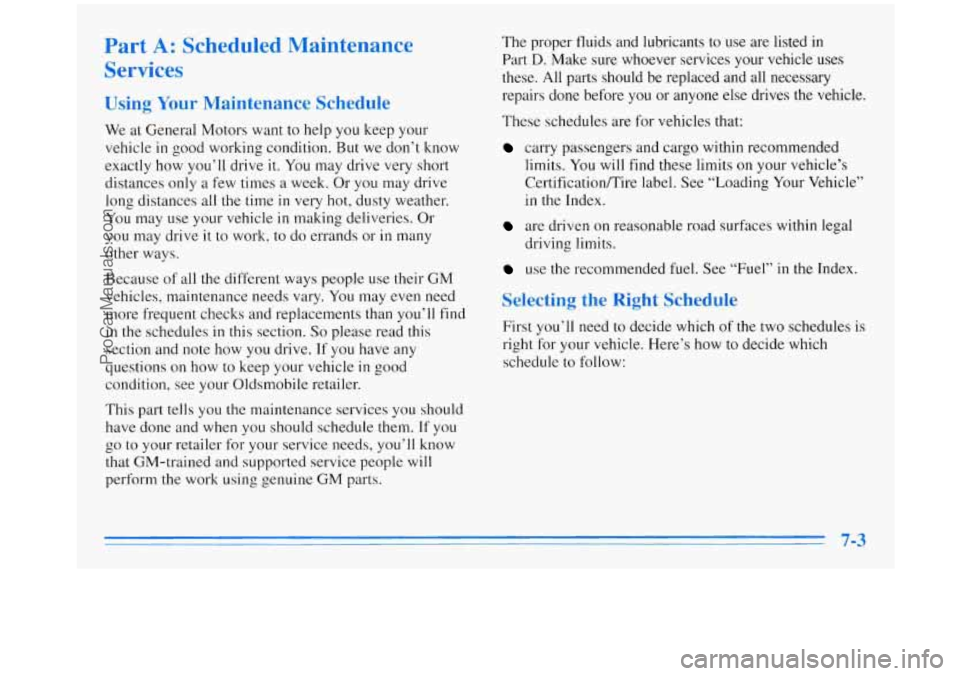
Part A: Scheduled Maintenance
Services
Using Your Maintenance Schedule
We at General Motors want to help you keep your
vehicle
in good working condition. But we don’t know
exactly how you’ll drive
it. You may drive very short
distances only a few times
a week. Or you may drive
long distances all the time
in very hot, dusty weather.
You may use your vehicle in making deliveries. Or
you may drive it to work, to do errands or in many
other ways.
Because of all the different ways people use their
GM
vehicles, maintenance needs vary. You may even need
more frequent checks and replacements than you’ll find
in the schedules in this section. So please read this
section and note how you drive. If you have any
questions
on how to keep your vehicle in good
condition, see your Oldsmobile retailer.
This part tells you
the maintenance services you should
have done and when you should schedule them. If you
go to your retailer for your service needs, you’ll know
that GM-trained and supported service people will
perform the work using genuine
GM parts. The
proper fluids and lubricants to use are listed
in
Part D. Make sure whoever services your vehicle uses
these. All parts should be replaced and all necessary
repairs done before you or anyone else drives the vehicle.
These schedules are for vehicles that:
carry passengers and cargo within recommended
limits. You will find these limits on your vehicle’s
CertificatiodTire label. See “Loading Your Vehicle”
in the Index.
are driven on reasonable road surfaces within legal
use the recommended fuel. See “Fuel” in the Index.
driving limits.
Selecting the Right Schedule
First you’ll
need to decide which of the two schedules is
right for your vehicle. Here’s how to decide which
schedule to follow:
7-3
ProCarManuals.com