tires OLDSMOBILE SILHOUETTE 1996 User Guide
[x] Cancel search | Manufacturer: OLDSMOBILE, Model Year: 1996, Model line: SILHOUETTE, Model: OLDSMOBILE SILHOUETTE 1996Pages: 372, PDF Size: 19.39 MB
Page 196 of 372

If you drive regularly in steep country, or if you’re
planning
to visit there, here are some tips that can make
your trips safer and more enjoyable.
Keep your vehicle in good shape. Check all fluid
levels and also the brakes, tires, cooling system
and transaxle. These parts can work hard on
mountain roads.
Know how to go down hills. The most important
thing to
know is this: let your engine do some of the
slowing down. Shift to
a lower gear when you go
down a steep or long hill.
I
If you don’t shift down, your brakes could get so
hot that they wouldn’t work well. You would then
have poor braking or even none going down
a hill.
You could crash. Shift down to let your engine
assist your brakes on
a steep downhill slope.
‘ A CA,TIO,/:
I
Coasting downhill in NEUTRAL (N) or with the
ignition
off is dangerous. Your brakes will have to
do all the work of slowing down. They could get
so
hot that they wouldn’t work well. You would then
have poor braking or even none going down
a hill.
You could crash. Always have your engine running
and your vehicle in gear when you go downhill.
Know how to go uphill. You may want to shift down
to a lower gear. The lower gears help cool your engine
and transaxle, and you can climb the
hll better.
Stay in your own lane when driving on two-lane
roads
in hills or mountains. Don’t swing wide or cut
across
the center of the road. Drive at speeds that let
you stay
in your own lane.
As you go over the top of a hill, be alert. There could be
something in your lane, like a stalled car or an accident.
You may see highway signs on mountains that warn of
special problems. Examples are long grades, passing or
no-passing zones,
a falling rocks area or winding
roads.
Be alert to these and take appropriate action.
4-22
ProCarManuals.com
Page 197 of 372
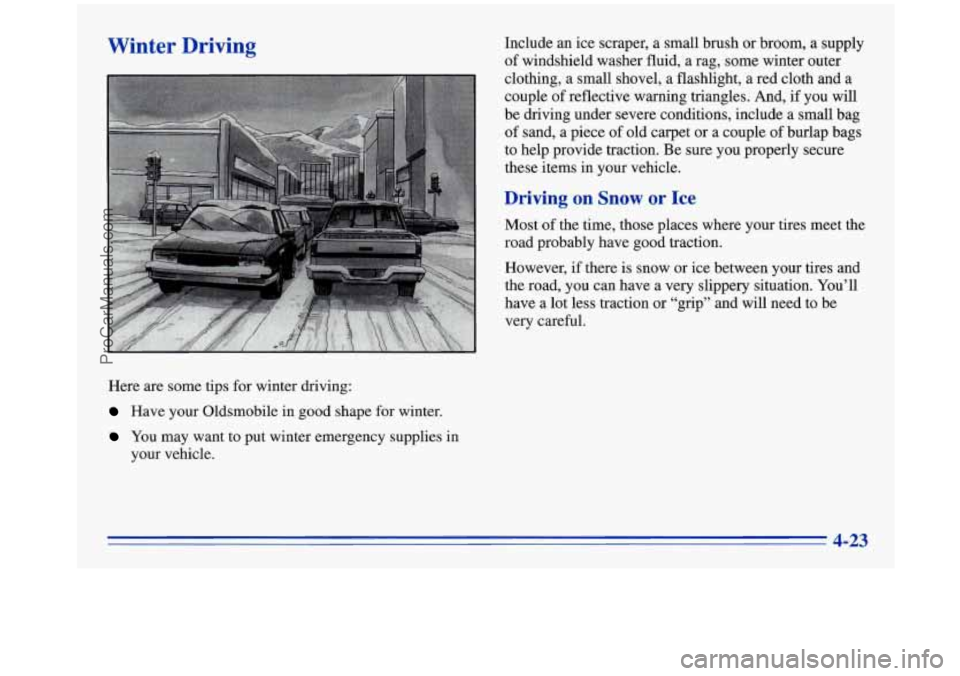
Winter Driving
Here are some tips for winter driving:
Have your Oldsmobile in good shape for winter.
You may want to put winter emergency supplies in
your vehicle. Include an ice scraper, a small brush or broom, a supply
of
windshield washer fluid, a rag, some winter outer
clothing, a small shovel, a flashlight, a red cloth and
a
couple of reflective warning triangles. And, if you will
be driving under severe conditions, include a small bag of sand, a piece of old carpet or a couple of burlap bags
to help provide traction.
Be sure you properly secure
these items in your vehicle.
Driving on Snow or Ice
Most of the time, those places where your tires meet the
road probably have good traction.
However, if there is snow or ice between your tires and the road, you can have a very slippery situation. You’ll
have a lot less traction or “grip” and will need to be \
very careful.
4-23
ProCarManuals.com
Page 198 of 372
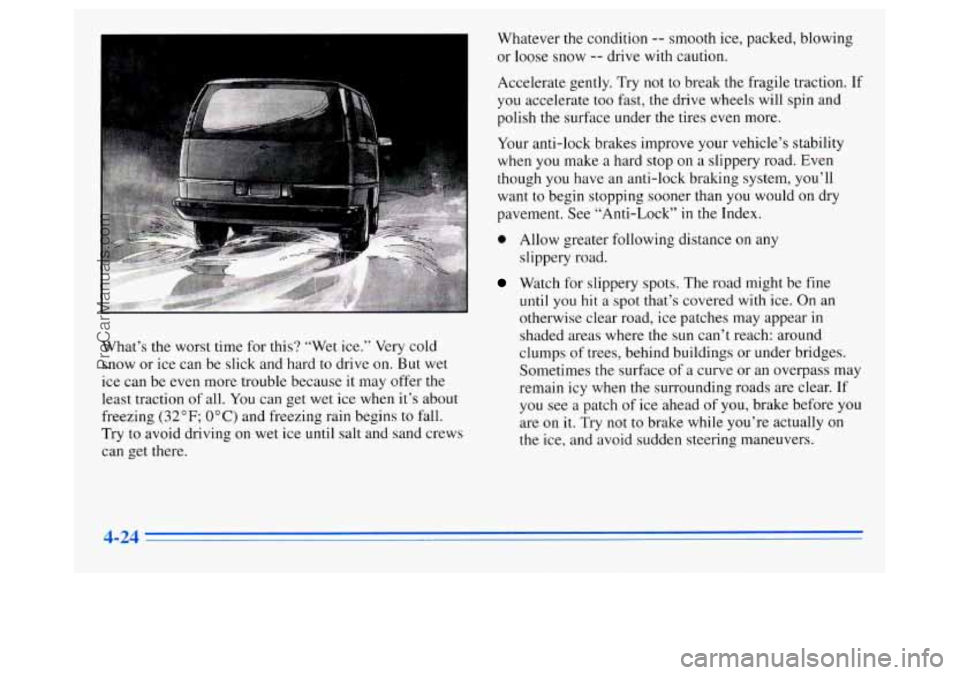
What’s the worst time for this? “Wet ice.” Very cold
snow or ice can be slick and hard to drive on. But wet
ice can be even more trouble because it may offer the
least traction
of all. You can get wet ice when it’s about
freezing
(32°F; 0°C) and freezing rain begins to fall.
Try to avoid driving on wet ice
until salt and sand crews
can get there. Whatever
the condition -- smooth ice, packed, blowing
or loose snow
-- drive with caution.
Accelerate gently. Try not
to break the fragile traction. If
you accelerate too fast, the drive wheels will spin and
polish the surface under the tires even more.
Your anti-lock brakes improve your vehicle’s stability
when
you make a hard stop on a slippery road. Even
though you have an anti-lock braking system, you’ll
want to begin stopping sooner than you would on dry
pavement. See “Anti-Lock”
in the Index.
0 Allow greater following distance on any
slippery road.
Watch for slippery spots. The road might be fine
until you hit a spot that’s covered with ice. On an
otherwise clear road, ice patches may appear
in
shaded areas where the sun can’t reach: around
clumps of trees, behind buildings or under bridges.
Sometimes the surface
of a curve or an overpass may
remain icy when the surrounding roads are clear. If
you see a patch of ice ahead of you, brake before you
are
on it. Try not to brake while you’re actually on
the ice, and avoid sudden steering maneuvers.
44 -
ProCarManuals.com
Page 201 of 372
Loading Your Vehicle
ml GVWR MFD
BY GENERAL MOTORS CORP XWXX
GAWR
FRT GAWR RR
LB/KCI
THIS VEHICLE CONFORMS TO ALL. APPLICABLE
U.S. FEDERAL
MOTOR VEHICLE SAFETY STANDARDS IN EFFECT ON THE DATE
OF MANUFACTURE SHOWN ABOVE.
MODEL:
MPBY TIRE
SIZE RTC. RIM
FRT
RR
SPA SERIAL NUMBER
M.P.V.
SPEED
SEE OWNERS MANUAL FOR ADDITIONAL INFORMATION PSVKPA
(COLD
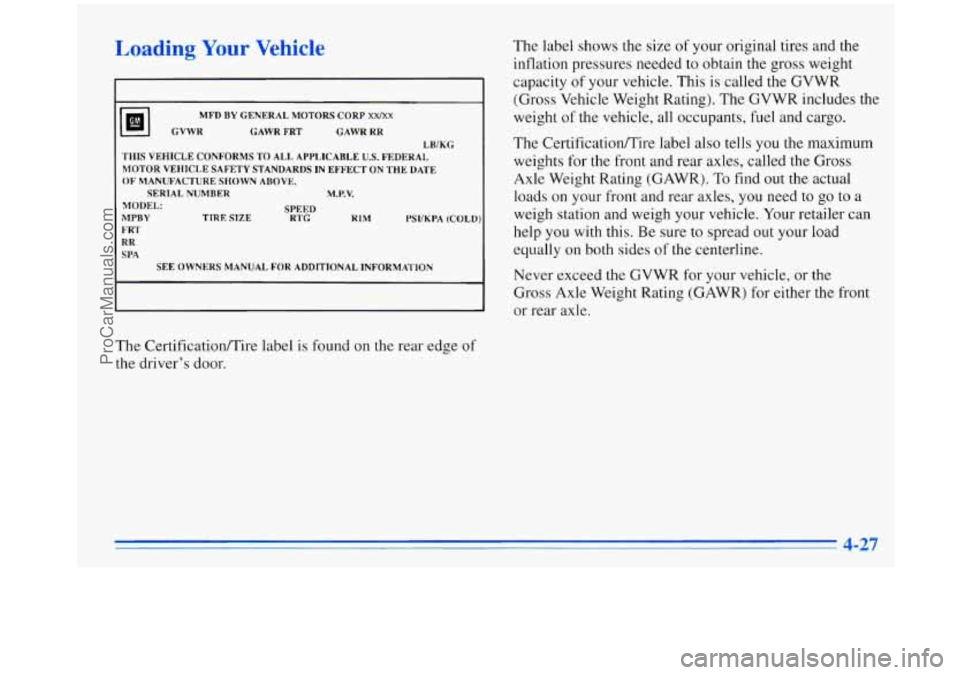
The Certification/Tire label is found on the rear edge of
the driver’s door. The
label shows the size of your original tires and the
inflation pressures needed to obtain the gross weight
capacity
of your vehicle. This is called the GVWR
(Gross Vehicle Weight Rating). The GVWR includes the
weight
of the vehicle, all occupants, fuel and cargo.
The CertificatiodTire label also tells
you the maximum
weights for the front and rear axles, called
the Cross
Axle Weight Rating (GAWR). To find out the actual
loads on your front and rear axles,
you need to go to a
weigh station and weigh your vehicle. Your retailer can
help you with this. Be sure to spread out your load
equally on both sides of the centerline.
Never exceed the GVWR for your vehicle, or the
Gross Axle Weight Rating (GAWR) for either the front
or rear axle.
!7
ProCarManuals.com
Page 204 of 372
Your vehicle can tow a trailer. To identify what the
vehicle trailering capacity is for your vehicle, you
should read the information in “Weight of the Trailer”
that appears later in this section. But trailering is
different than just driving your vehicle by itself.
Trailering means changes
in handling, durability and
fuel economy. Successful, safe trailering takes correct
equipment, and it has
to be used properly.
That’s the reason for this section.
In it are many
time-tested, important trailering tips and safety rules.
Many
of these are important for your safety and that of
your passengers.
So please read this section carefully
before you pull a trailer.
Load-pulling components such as the engine, transaxle,
wheel assemblies and tires are forced to work harder
against the drag
of the added weight. The engine is
required to operate at relatively higher speeds and under
greater loads, generating extra heat. What’s more, the
trailer adds considerably to wind resistance, increasing
the pulling requirements.
If You Do Decide To Pull A Trailer
If you do, here are some important points:
0
0
0
0
0
There are many different laws, including speed limit
restrictions, having to do with trailering. Make sure
your rig will be legal, not only where you live but
also where you’ll be driving.
A good source for this
information can be state or provincial police.
Consider using a sway control
if your trailer will
weigh
2,000 lbs. (900 kg) or less. You should always
use
a sway control if your trailer will weigh more
than
2,000 lbs. (900 kg). You can ask a hitch dealer
about sway controls.
Don’t tow
a trailer at all during the first 500 miles
(800 km) your new vehicle is driven. Your engine,
axle or other parts could be damaged.
Then, during the first
500 miles (800 km) that you
tow a trailer, don’t drive over
50 mph (80 km/h) and
don’t make starts at full throttle. This helps your
engine and other parts of your vehicle wear in at the
heavier loads.
You should use THIRD (D) (or, as you need to, a
lower gear) when towing a trailer. Operating your
vehicle
in THIRD (D) when towing a trailer will
minimize heat buildup and extend the life of
your transaxle.
4-30
ProCarManuals.com
Page 205 of 372
Three important considerations have to do with weight:
the weight of the trailer,
the weight of the trailer tongue
and the weight on your vehicle’s tires.
Weight of the Trailer
How heavy can a trailer safely be?
It should never weigh more than
1,400 lbs. (630 kg)
with up to six occupants or more than
2,000 lbs.
(900 kg) with up to two occupants. If you have the
optional trailer towing package, your vehicle can tow up
to
2,400 lbs. (1 090 kg) with up to six occupants or up
to 3,000 lbs.
(1 360 kg) with up to two occupants. But
even that can be too heavy. It
depends on how you plan to use your rig. For
example, speed, altitude, road grades, outside
temperature and how much your vehicle
is used to pull a
trailer are all important. And, it can also depend
on any
special equipment that you have on your vehicle.
You can ask your retailer for our trailering information
or advice, or you can write
us at:
Oldsmobile Customer Assistance
P.O. Box 30095
Lansing, MI 48909
In Canada, write to:
General Motors
of Canada Limited
Customer Communication Centre
1908 Colonel Sam Drive
Oshawa, Ontario
L1H 8P7
4-3 1
ProCarManuals.com
Page 206 of 372
Weight of the Trailer Tongue
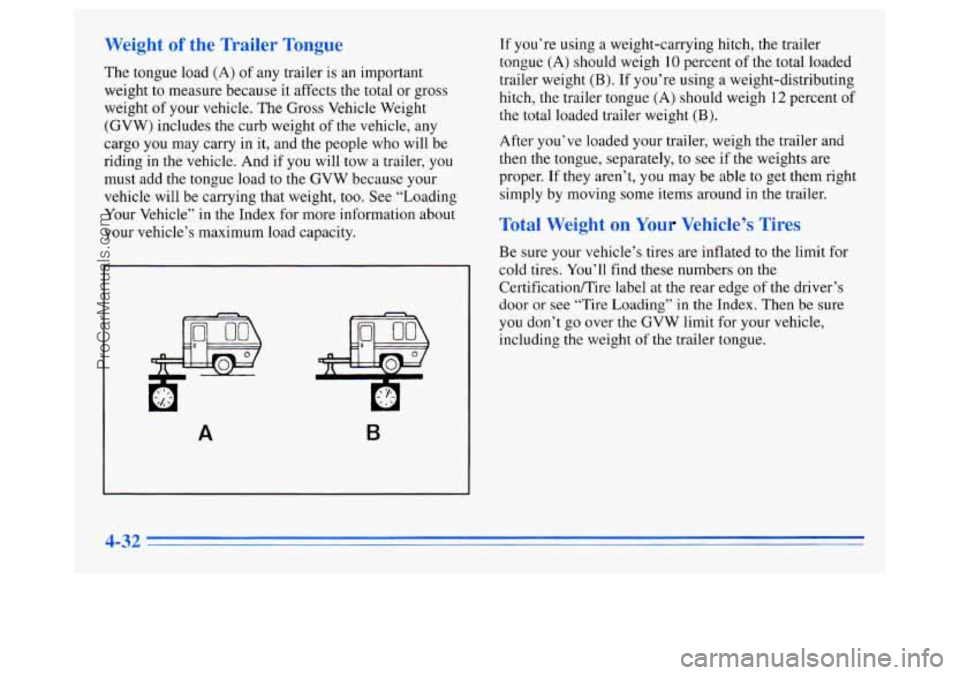
The tongue load (A) of any trailer is an important
weight to measure because it affects the total or gross
weight
of your vehicle. The Gross Vehicle Weight
(GVW) includes the curb weight of the vehicle, any
cargo
you may carry in it, and the people who will be
riding in
the vehicle. And if you will tow a trailer, you
must add the tongue load to the GVW because your
vehicle will be carrying that weight, too. See “Loading
Your Vehicle” in the Index for more information about
your vehicle’s maximum load capacity.
A B
If you’re using a weight-carrying hitch, the trailer
tongue (A) should weigh
10 percent of the total loaded
trailer weight
(B). If you’re using a weight-distributing
hitch, the trailer tongue
(A) should weigh 12 percent of
the total loaded trailer weight
(B).
After you’ve loaded your trailer, weigh the trailer and
then the tongue, separately, to see
if the weights are
proper. If they aren’t, you may be able
to get them right
simply by moving some items around in the trailer.
Total Weight on Yo Vehicle’s Tires
Be sure your vehicle’s tires are inflated to the limit for
cold tires. You’ll find these numbers on the
CertificationEire label at the rear edge of the driver’s
door or see “Tire Loading”
in the Index. Then be sure
you don’t
go over the GVW limit for your vehicle,
including the weight of the trailer tongue.
4-32
ProCarManuals.com
Page 208 of 372

Driving with a Trailer
A -CAUTION:
I
If you have a rear-most window open and you
pull
a trailer with your vehicle, carbon monoxide
(CO) could come into your vehicle. You can’t see
or smell CO. It can cause unconsciousness or
death. (See “Engine Exhaust” in the Index.)
To
maximize your safety when towing a trailer:
Have your exhaust system inspected for
leaks, and make necessary repairs before
starting
on your trip.
0 Keep the rear-most windows closed.
0 If exhaust does come into your vehicle
through a window in the rear or another
opening, drive with your front, main
heating or cooling system on and with the
fan on any speed. This will bring fresh,
outside air into your vehicle.
Do not use
RECIRC because it only recirculates the
air inside your vehicle. (See “Comfort
Controls” in the Index.)
Towing a trailer requires a certain amount of experience.
Before setting out for the open road, you’ll want to get
to know your rig. Acquaint yourself with the feel of
handling and braking with the added weight
of the
trailer. And always keep in mind that the vehicle you are
driving
is now a good deal longer and not nearly as
responsive as your vehicle is by itself.
Before
you start, check the trailer hitch and platform
(and attachments), safety chains, electrical connector,
lamps, tires and mirror adjustment.
If the trailer has
electric brakes, start your vehicle and trailer moving and
then apply the trailer brake controller by hand to be sure
the brakes are working. This lets you check your
electrical connection
at the same time.
During your trip, check occasionally to be sure that the
load is secure, and that the lamps and any trailer brakes
are still working.
Following Distance
Stay at least twice as far behind the vehicle ahead as you
would when driving your vehicle without
a trailer. This
can help you avoid situations that require heavy braking
and sudden turns.
ProCarManuals.com
Page 219 of 372
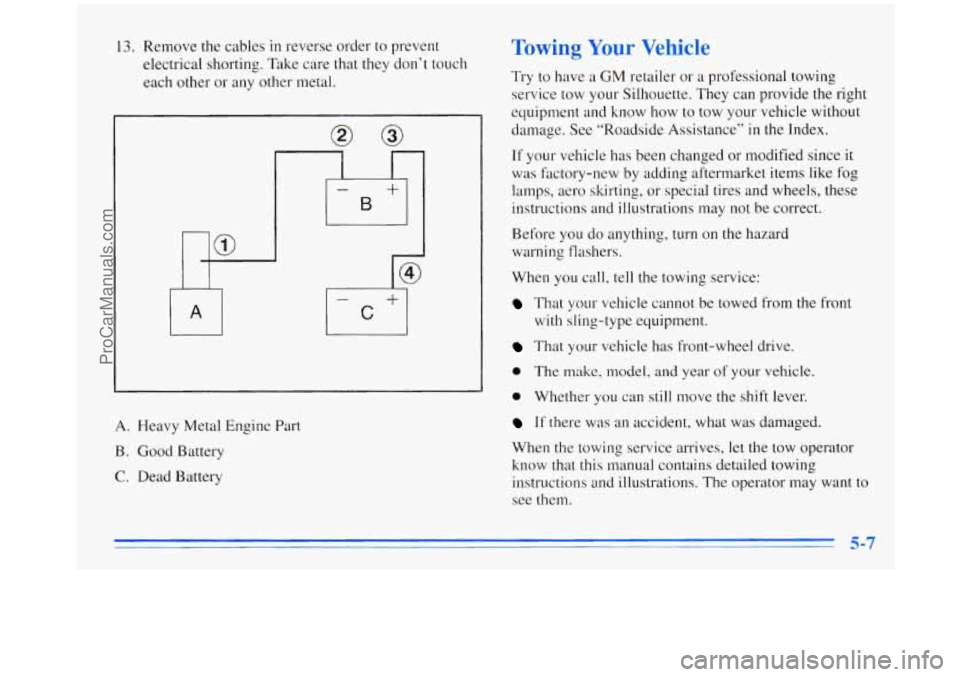
13. Remove the cables in reverse order to prevent
electrical shorting. Take care that
they don’t touch
each other or any other metal.
A. Heavy Metal Engine Part
B. Good Battery
C. Dead Battery
Towing Your Vehicle
Try to have a GM retailer or a professional towing
service tow your Silhouette. They can provide the right
equipment and know how to tow your vehicle without
damage. See “Roadside Assistance”
in the Index.
If your vehicle has been changed or modified since it
was factory-new by adding aftermarket items like fog
lamps, aero skirting, or special tires and wheels, these
instructions and illustrations may not be correct.
Before you do anything, turn on
the hazard
warning flashers.
When
you call, tell the towing service:
That your vehicle cannot be towed from the front
with sling-type equipment.
That your whicle has front-wheel drive.
0 The make, model, and year of your vehicle.
0 Whether you can still move the shift lever.
If there was an accident, what was damaged.
When the towing service arrives,
let the tow operator
know that this manual contains detailed towing
instructions and illustrations.
The operator may want to
see them.
5-7
ProCarManuals.com
Page 234 of 372
If a Tire Goes Flat
It’s unusual for a tire to “blow out” while you’re driving,
especially if you maintain your tires properly. If air goes
out of a tire, it’s much more likely to leak out slowly.
But if you should ever have a “blowout,” here are a
few tips about what to expect and what to do:
If a front tire fails, the flat tire will create a drag that
pulls the vehicle toward that side. Take your’foot off
the accelerator pedal and grip the steering wheel firmly.
Steer to maintain lane position, and then gently brake to
a stop well out of the traffic lane.
A rear blowout, particularly on a curve, acts much like a
skid and may require the same correction you’d use in a
skid. In any rear blowout, remove your foot from the
accelerator pedal. Get the vehicle under control by
steering the way you want the vehicle to
go. It may be
very bumpy and noisy, but you can still steer. Gently
brake
to a stop -- well off the road if possible.
If a tire goes flat, the next part shows how to use your
jacking equipment to change a flat tire safely.
Air Inflator (Option)
Your vehicle may have an air inflator used to bring tires
up
to the proper pressure. See “Air Inflator System” in
the Index for more details.
Changing a Flat Tire
If a tire goes flat, avoid further tire and wheel damage
by driving slowly to a level place. Turn on your hazard
warning flashers.
Changing a tire can cause an injury. The vehicle
can slip off the jack and roll over you
or other
people. You and they could be badly injured.
Find a level place to change your tire. To help
prevent the vehicle from moving:
1. Set the parking brake firmly.
2. Put the shift lever in PARK (P).
3. Turn off the engine.
To be even more certain the vehicle won’t move,
you can put blocks at the front and rear of the
tire farthest away from the one being changed.
That would be the tire on the other side of the
vehicle, at the opposite end.
5-22
ProCarManuals.com