instrument panel OLDSMOBILE SILHOUETTE 1996 Owner's Manual
[x] Cancel search | Manufacturer: OLDSMOBILE, Model Year: 1996, Model line: SILHOUETTE, Model: OLDSMOBILE SILHOUETTE 1996Pages: 372, PDF Size: 19.39 MB
Page 150 of 372
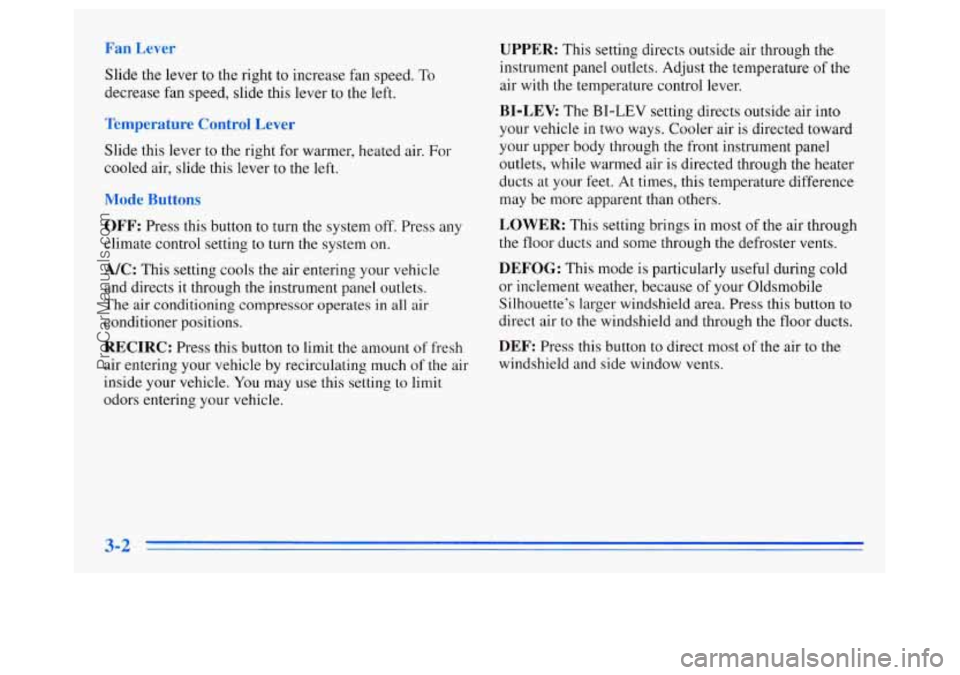
Slide the lever to the right to increase fan speed. To
decrease fan speed, slide this lever to the left.
I 1 *_I.
Slide this lever to the right for warmer, heated air. For
cooled air, slide this lever to the left.
Mode B.
OFF: Press this button to turn the system off. Press any
climate control setting to turn the system
on.
A/C: This setting cools the air entering your vehicle
and directs it through the instrument panel outlets.
The air conditioning compressor operates
in all air
conditioner positions.
RECIRC: Press this button to limit the amount of fresh
air entering your vehicle by recirculating much
of the air
inside your vehicle.
You may use this setting to limit
odors entering your vehicle.
UPPER: This setting directs outside air through the
instrument panel outlets. Adjust the temperature of the
air with the temperature control lever.
BI-LEV: The BI-LEV setting directs outside air into
your vehicle
in two ways. Cooler air is directed toward
your upper body through the front instrument panel
outlets, while warmed air is directed through the heater
ducts at your feet. At times, this temperature difference
may be more apparent than others.
LOWER: This setting brings in most of the air through
the floor ducts and some through the defroster vents.
DEFOG: This mode is particularly useful during cola
or inclement weather, because of your Oldsmobile
Silhouette’s larger windshield area. Press this button to
direct air to the windshield and through the floor ducts.
DEF: Press this button to direct most of the air to the
windshield and side window vents.
3-2
ProCarManuals.com
Page 153 of 372
Please keep the area around the base of the center
instrument panel console and the area between and
under the front seats free of objects that could obstruct
airflow
to the rear.
The control for the rear fan is located below the audio
system. Select
LOWER, BI-LEV or DEFOG to direct
airflow to the rear air outlet and to the rear side windows.
Use
the temperature control lever to adjust the temperature
setting. Select the force of air
you want, from LO to HI,
by sliding the rear fan control to the desired setting.
To maintain a comfortable temperature in the rear area
without making the front passengers uncomfortable,
adjust the front fan speed first, then adjust the
temperature setting.
To turn off the rear fan, slide the control to OFF.
Ventilation Tips
Keep the hood and front air inlet free of ice, snow
or any other obstruction (such as leaves). This will
allow the heater and defroster to work much better,
reducing the chance of fogging the inside of
.- your windows.
When you enter a vehicle in cold weather, turn the
blower fan to HIGH for a few moments before
driving off. This helps clear the intake ducts of snow
and moisture, and reduces
the chance of fogging the
inside of your windows.
Keep the area around the base of the center
instrument panel console and
the air path under the
front seats clear of objects. This helps air to circulate
throughout your vehicle.
ProCarManuals.com
Page 154 of 372
2tion,
If you have this option, you will have a master control
for the rear fan
on the center instrument panel console,
and a rear control next to
the second row seat, on the
driver’s side
of the vehicle.
To maintain a comfortable temperature in the rear, use
either rear
fan control to adjust the force of air coming
through the rear outlets. See “Rear Fan
-- Master
Control” and “Rear Fan
-- Rear Control” later in
this section.
Select the desired climate control mode using the
directional controls on the instrument panel (see “Mode
Buttons” earlier in the section). The mode you choose
will regulate both the front and rear climate control
systems.
The temperature of heated or cooled air
directed to the rear of the vehicle cannot be adjusted
with the temperature control lever.
Select RECIRC, UPPER,
BI-LEV or LOWER when
outside temperatures are warm or moderate. In the
RECIRC mode, or if you press A/C when the
system is in the
UPPER or BI-LEV modes, cooled air
will be directed to the rear of the vehicle through the
overhead and third-row air conditioning outlets. If you
select A/C in the LOWER mode, cooled air
will be
directed through the rear floor vent (see “Rear Air
Vents” later
in this section) unless the temperature
control lever is set approximately
30 percent from the
full cold setting. Heated air will result with the
temperature control lever setting above
30 percent from
the
full cold setting. Temperature adjustment of the
heated air is not possible. Cooled air will again return
when the temperature control lever setting is returned to
approximately
25 percent from the full cold setting.
If you do not select A/C in the UPPER or BI-LEV
modes, air directed to the rear of the vehicle will be
cabin temperature.
Select LOWER, DEFOG or
DEF when outside
temperatures are cool. In these modes, heated air will be
directed to the rear of the vehicle through the rear side
window vents and the rear
floor heater vent.
3-6
ProCarManuals.com
Page 155 of 372
I
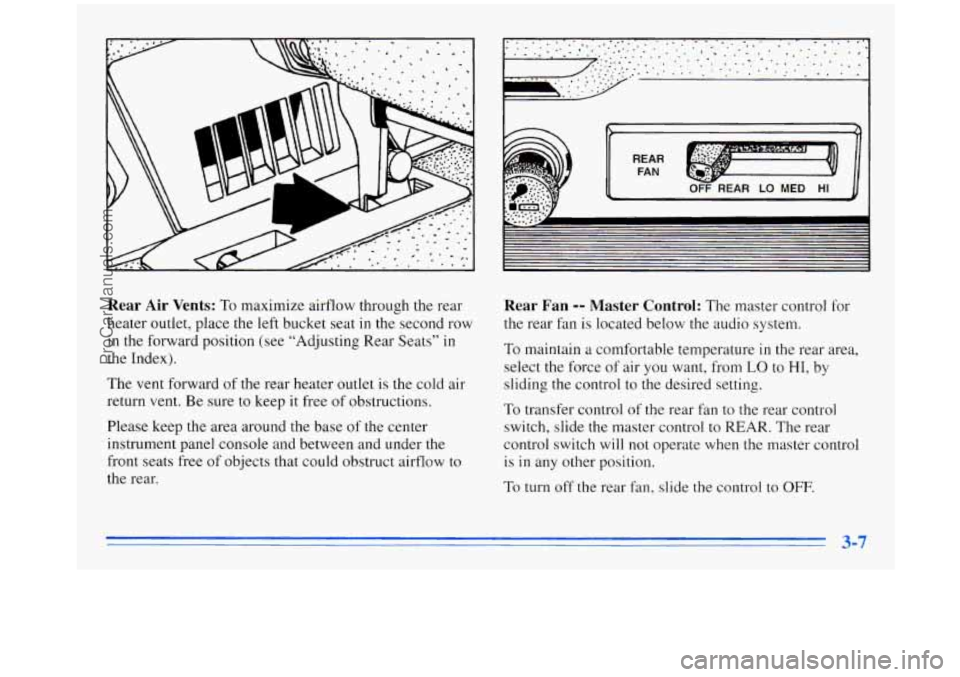
Rear Air Vents: To maximize airflow through the rear
heater outlet, place the
left bucket seat in the second row
in
the forward position (see “Adjusting Rear Seats” in
the Index).
The vent forward of the rear heater outlet is
the cold air
return vent. Be sure to keep
it free of obstructions.
Please keep the area around the base
of the center
instrument panel console and between and under the
front seats free of objects that could obstruct airflow
to
the rear.
Rear Fan -- Master Control: The master control for
the rear fan is located below the audio system.
To maintain a comfortable temperature in the rear area,
select the force of air
you want, from LO to HI, by
sliding the control to the desired setting.
To transfer control of the rear fan to the rear control
switch, slide the master control to REAR. The rear
control switch will not operate when the master control
is in any other position.
To turn off the rear
fan, slide the control to OFF.
ProCarManuals.com
Page 156 of 372
LOW MED I
REAR FAN
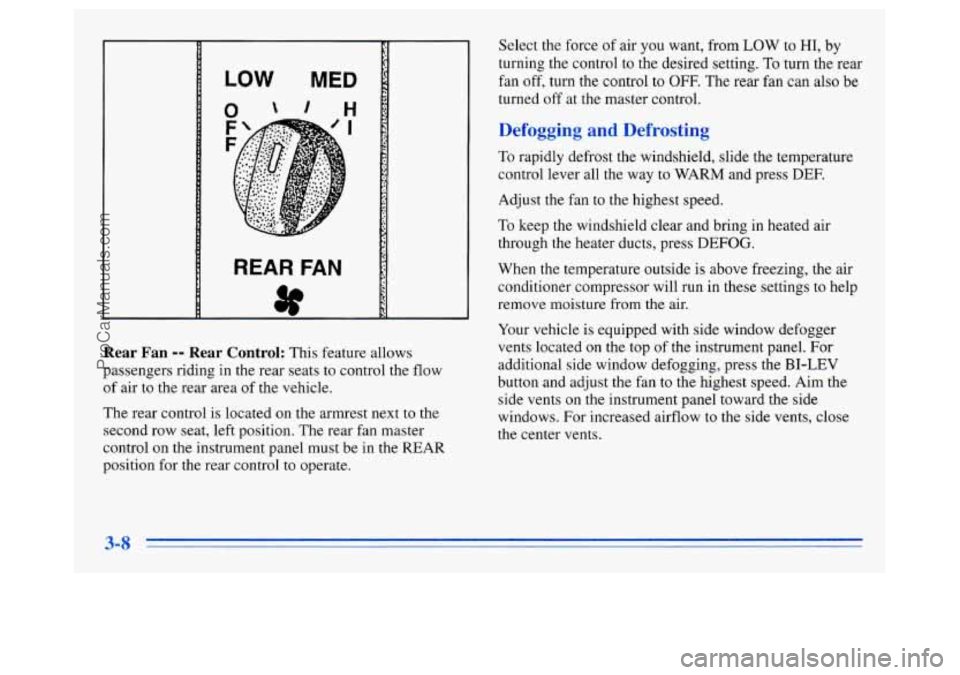
Rear Fan -- Rear Control: This feature allows
passengers riding in the rear seats to control the flow
of air to the rear area of the vehicle.
The rear control is located
on the armrest next to the
second row seat, left position. The rear fan master
control on the instrument panel must be
in the REAR
position for the rear control to operate. Select the force
of air you want, from
LOW to HI, by
turning the control to the desired setting. To 'turn
the rear
fan
off, turn the control to OFF. The rear fan can also be
turned off at the master control.
Defogging and Defrosting
To rapidly defrost the windshield, slide the temperature
control lever all the way to WARM and press DEE
Adjust the fan to
the highest speed.
To keep the windshield clear and bring in heated air
through the heater ducts, press DEFOG.
When the temperature outside is above freezing, the air
conditioner compressor will run in these settings
to help
remove moisture from the air.
Your vehicle is equipped with side window defogger
vents located on the top of the instrument panel. For
additional side window defogging, press the
BI-LEV
button and adjust the fan to the highest speed. Aim the
side vents on the instrument panel toward the side
windows. For increased airflow to the side vents, close
the center vents.
3-8
ProCarManuals.com
Page 209 of 372
Passing
You’ll need more passing distance up ahead when
you’re towing a trailer. And, because you’re a good deal
longer, you’ll need to go much farther beyond the
passed vehicle before you can return to your lane.
Backing Up
Hold the bottom of the steering wheel with one hand.
Then, to move the trailer to the left, just move that hand
to the left. To move the trailer to the right, move your
hand to
the right. Always back up slowly and, if
possible, have someone guide you.
Making Tbms
Making very sharp turns while trailering could
cause the trailer to come in contact with the
vehicle. Your vehicle could be damaged. Avoid
making very sharp turns while trailering.
When you’re turning with a trailer, make wider turns than
normal.
Do this so your trailer won’t strike soft shoulders,
curbs, road signs, trees or other objects. Avoid jerky or
sudden maneuvers. Signal well
in advance.
Turn Signals When Towing a Trailer
When you tow a trailer, your vehicle has to have extra
wiring and a different turn signal flasher (included in the
optional trailering package).
The arrows on your instrument panel will flash
whenever you signal a turn or lane change. Properly
hooked up, the trailer lamps will also flash, telling other
drivers you’re about to turn, change lanes or
stop.
When towing a trailer, the arrows on your instrument
panel will flash for turns even
if the bulbs on the trailer
are burned out. Thus, you may think drivers behind you
are seeing your signal when they are not. It’s important
to check occasionally to be sure the trailer bulbs are
still working.
4-35
ProCarManuals.com
Page 224 of 372
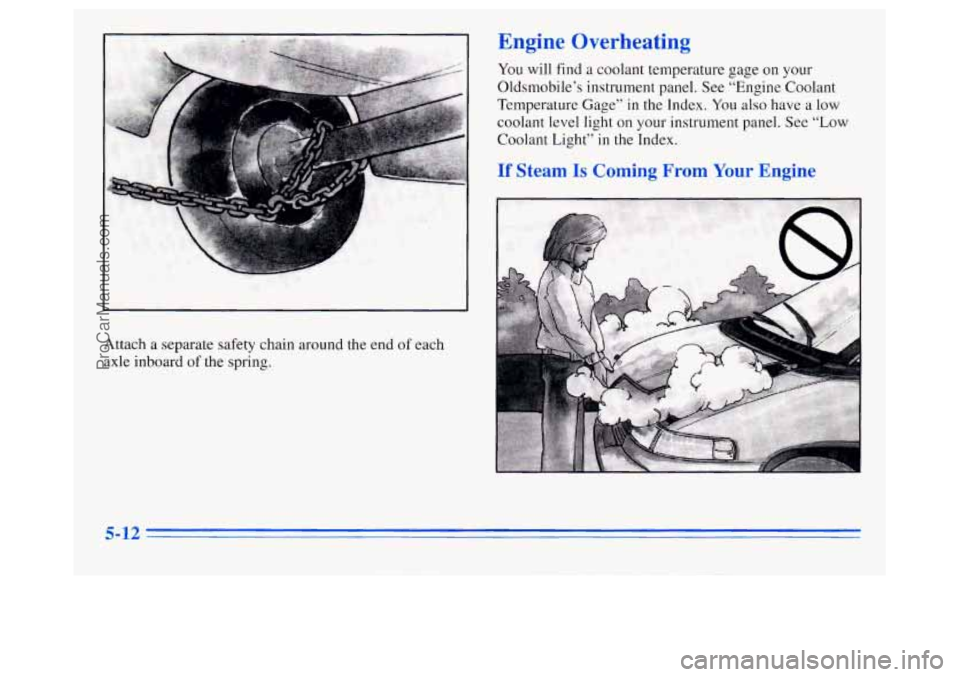
Attach a separate safety chain around the end of each
axle inboard
of the spring.
Engir Overheating
You will find a coolant temperature gage on your
Oldsmobile’s instrument panel. See “Engine Coolant
Temperature Gage”
in the Index. You also have a low
coolant level light on your instrument panel. See “Low
Coolant Light” in the Index.
Steam Is COI d r From Your ine
I
5-12
ProCarManuals.com
Page 248 of 372
You can be injured and your vehicle could be
damaged if you try to do service work on a vehicle without knowing enough about it.
Be sure you have sufficient knowledge, experience, and the- proper replacement
parts and tools before you attempt any
vehicle maintenance task.
Be sure to use the proper nuts, bolts and
other fasteners. “English” and “metric”
fasteners can be easily confused.
If you use
the wrong fasteners, parts can later break
or fall
off. You could be hurt.
Fuel
Use regular unleaded gasoline rated at 87 octane or
higher. At a minimum, it should meet specifications
ASTM D4814 in the United States and CGSB 3.S-M93
in Canada. Improved gasoline specifications have been
developed by the American Automobile Manufacturers
Association (AAMA) for better vehicle performance
and engine protection. Gasolines meeting
the AAMA specification could provide improved driveability
and
emission control system protection compared to other gasolines.
Be sure
the posted octane is at least 87. If the octane is
less than
87, you may get a heavy knocking noise when
you drive.
If it’s bad enough, it can damage your engine.
If you’re using fuel rated at 87 octane or higher and you
still hear heavy knocking, your engine needs service.
But don’t worry
if you hear a little pinging noise when
you’re accelerating or driving up
a hill. That’s normal,
and you don’t have to buy
a higher octane fuel to get rid
of pinging. It’s the heavy, constant knock that means
you have
a problem.
If your vehicle is certified to meet California Emission
Standards (indicated on the underhood tune-up label),
it is designed to operate on fuels that meet California
specifications. If such fuels are not available
in states
adopting California emissions standards, your vehicle
will operate satisfactorily
on fuels meeting federal
specifications, but emission control system performance
may be affected. The malfunction indicator lamp on
your instrument panel may turn
on and/or your vehicle
may fail a smog-check test. If this occurs, return to
your authorized Oldsmobile retailer for diagnosis to
determine the cause of failure. In the event
it is
determined that the cause of the condition
is the type of
fuels used, repairs may not be covered by your warranty.
6-2
ProCarManuals.com
Page 249 of 372
In Canada, some gasolines contain an octane-enhancing
additive called MMT. If you use such fuels, your
emission control system performance may deteriorate
and the malfunction indicator lamp on your instrument
panel may turn on. If this happens, return to your
authorized Oldsmobile retailer for service.
To provide cleaner air, all gasolines in the United States
are now required to contain additives that will help prevent
deposits from forming in your engine and
fuel system,
allowing your emission control system to function
properly. Therefore,
you should not have to add anything
to
the fuel. In addition, gasolines containing oxygenates,
such as ethers and ethanol, and reformulated gasolines
may be available in your area
to help clean the air. General
Motors recommends that you use these gasolines
if they
comply with the specifications described earlier.
NOTICE:
Your vehicle was not designed for fuel that
contains methanol. Don’t use it. It can corrode
metal parts
in your fuel system and also damage
plastic and rubber parts. That damage wouldn’t
be covered under your warranty.
Fuels in Foreign Countries
If you plan on driving in another country outside the
United States or Canada, the proper fuel may be hard
to find. Never use leaded gasoline or any other fuel not
recommended in the previous text on fuel. Costly repairs
caused by use of improper fuel wouldn’t be covered by
your warranty.
To check on fuel availability, ask an auto club, or
contact a major oil company that does business in
the country where you’ll be driving.
You can also write us at the following address for
advice. Just tell us where you’re going and give your
Vehicle Identification Number (VIN).
General Motors Overseas Distribution Corporation,
North American Export Sales (NAES)
1908 Colonel Sam Drive
Oshawa, Ontario
Ll H 8P7
6-3
ProCarManuals.com
Page 255 of 372
Pull forward on the hood prop to release it from its
storage clip.
Put the end of the hood prop into the slot in
the underside of the hood.
Before closing the hood, be sure all the filler caps are on
properly. Lift the hood to relieve the pressure on
the
hood prop. Remove the hood prop from the slot in the
hood and return the prop to its retainer. Let the hood
down and close
it firmly.
Underhood Lamp
Your underhood lamp will go on when you open
the hood.
Engine Oil
LOW
OIL
If the LOW OIL light on the
instrument panel comes
on,
it means you need to check
your engine oil level right
away.
For more information,
see "LOW
OIL Light" in the
Index. You should check
your engine oil level
regularly; this is
an
added reminder. It's
a good idea
to check your engine oil every time you
get fuel.
In order to get an accurate reading, the oil must
be warm and the vehicle must be on level ground.
.-
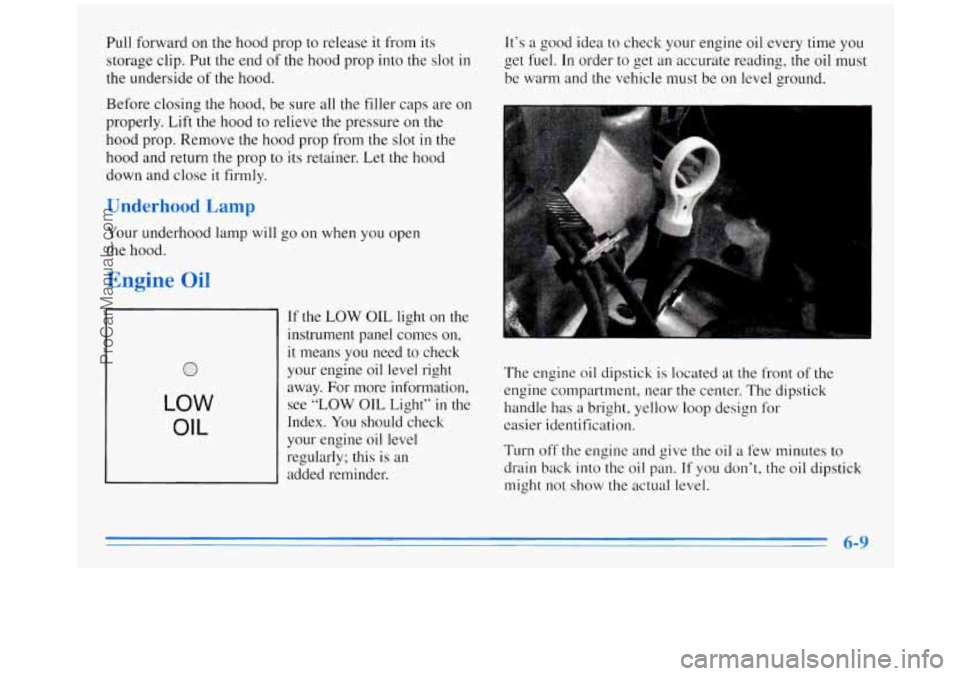
The engine oil dipstick is located at the front of the
engine compartment, near the center. The dipstick
handle has
a bright, yellow loop design for
easier identification.
Turn off the engine
and give the oil a few minutes to
drain back into the
oil pan. If you don't, the oil dipstick
might not show the actual level.
ProCarManuals.com