lock OLDSMOBILE SILHOUETTE 1997 Owners Manual
[x] Cancel search | Manufacturer: OLDSMOBILE, Model Year: 1997, Model line: SILHOUETTE, Model: OLDSMOBILE SILHOUETTE 1997Pages: 436, PDF Size: 21.87 MB
Page 261 of 436
Trailer Brakes
If your trailer weighs more than 1,000 lbs. (450 kg)
loaded, then
it needs its own brakes -- and they must be
adequate. Be sure to read and follow the instructions for
the trailer brakes
so you’ll be able to install, adjust and
maintain them properly.
Because you have anti-lock brakes, do not try to tap into
your vehicle’s brake system.
If you do, both brake
systems won’t work
well, or at all.
DI a TI iler
If you have a rear-most window open and you
pull a trailer with your vehicle, carbon monoxide
(CO) could come into
your vehicle. You can’t see
or smell CO.
It can cause unconsciousness or
death. (See “Engine Exhaust”
in the Index.) To
maximize your safety when towing
a trailer:
0 Have your exhaust system inspected for
leaks, and make necessary repairs before
starting on your trip.
CAUTION: (Continued)
0 Keep the rear-most windows closed.
0 If exhaust does come into your vehicle
through
a window in the rear or another
opening, drive with your front, main
heating or cooling system on and with the
fan on any speed. This will bring fresh,
outside air into your vehicle.
Do not use
RECIRC because it only recirculates the
air inside your vehicle. (See
‘‘ Comfort
Controls” in the Index.)
Towing
a trailer requires a certain amount of experience.
Before setting
out for the open road, you’ll want to get
to know your rig. Acquaint yourself with the feel
of
handling and braking with the added weight of the
trailer. And always keep in mind that the vehicle you
are driving is now a good deal longer and not nearly as
responsive
as your vehicle is by itself.
- 4-35
ProCarManuals.com
Page 273 of 436
A vehicle can fall from a car carrier if it isn’t
adequately secured. This can cause a collision,
serious personal injury and vehicle damage. The
vehicle should be tightly secured with chains or
steel cables before it
is transported.
Don’t use substitutes (ropes, leather straps,
canvas webbing, etc.) that can be cut by sharp
edges underneath the towed vehicle.
Always use
T-hooks inserted in the T-hook slots. Never use
J-hooks. They will damage drivetrain and
suspension components.
When
your vehicle is being towed, have the ignition
key in the OFF position. The steering wheel should
be clamped in
a straight-ahead position, with a
clamping device designed for towing service.
Do not
use
the vehicle’s steering column lock for this. The
transaxle should be in
NEUTRAL (N) and the parking
brake released.
NOTICE:
Your vehicle has front-wheel drive; do not have it
towed with the front wheels in contact with the
ground or vehicle damage may occur.
A dolly
must be used under the front wheels when towing
from the rear or the vehicle must be transported
on a flat bed carrier.
Be careful not to damage brake fluid lines when
securing the vehicle
with safety chains.
5-9
ProCarManuals.com
Page 283 of 436
How to Add Coolant to the Radiator
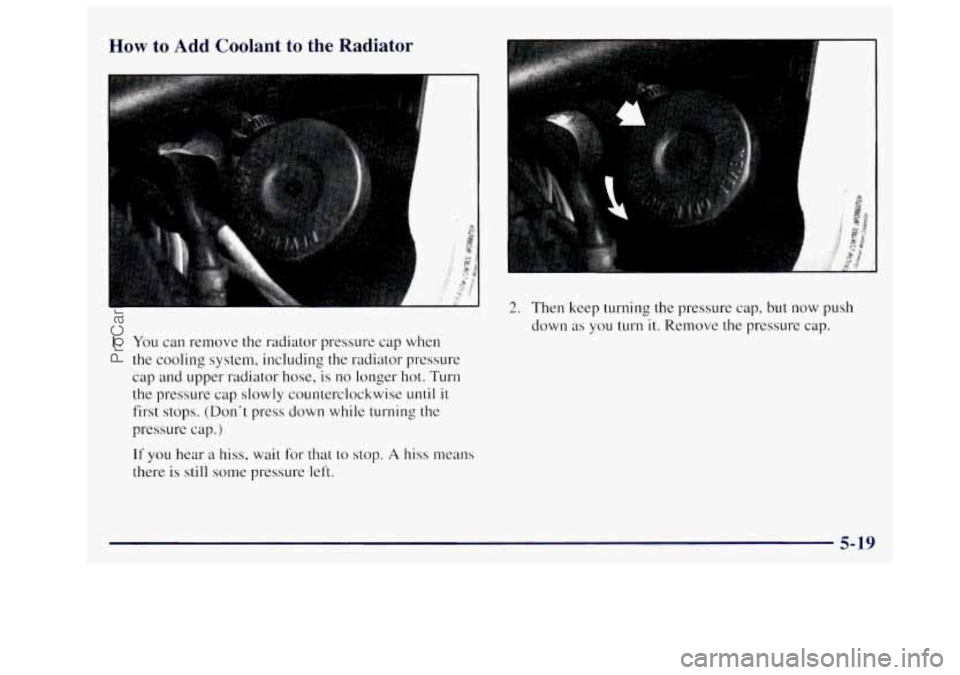
1. You can remove the radiator pressure cap when
the cooling system, including the radiator pressure
cap and upper radiator hose, is no longer hot. Turn
the pressure cap slowly counterclockwise
until it
first stops. (Don’t press down while turning the
pressure cap.)
If you hear a hiss, wait for that to stop. A hiss means
there
is still some pressure left.
2. Then keep turning the pressure cap, but now push
down
as you turn it. Remove the pressure cap.
5-19
ProCarManuals.com
Page 286 of 436
If a Tire Goes Flat
It’s unusual for a tire to “blow out” while you’re driving,
especially if you maintain your tires properly. If air goes
out of a tire, it’s much more likely to leak out slowly.
But if you should ever have
a “blowout,” here are a few
tips about what to expect and what to do:
If a front tire fails, the flat tire will create a drag that
pulls the vehicle toward that side. Take your foot off
the
accelerator pedal and grip the steering wheel firmly.
Steer
to maintain lane position, and then gently brake to
a stop well out
of the traffic lane.
A rear blowout, particularly on a curve, acts much like a
skid and may require the same correction you’d use
in a
skid. In any rear blowout, remove your foot from the
accelerator pedal. Get the vehicle under control by
steering the way you want the vehicle to go. It may be
very bumpy and noisy, but you can still steer. Gently
brake
to a stop -- well off the road if possible.
If
a tire goes flat, the next part shows how to use your
jacking equipment to change a flat tire safely.
Air Inflator (Option)
Your vehicle may have an air inflator used to bring tires
up
to the proper pressure. See “Air Inflator” in the Index
for more details.
Changing a Flat Tire
If a tire goes flat, avoid further tire and wheel damage
by driving slowly to a level place. Turn on your hazard
warning flashers.
Changing
a tire can cause an injury. The vehicle
can slip off the jack and roll over you or other
people. You and they could be badly injured.
Find
a level place to change your tire. To help
prevent the vehicle from moving:
1. Set the parking brake firmly.
2. Put the shift lever in PARK (P).
3. lhrn off the engine.
To be even more certain the vehicle won’t move,
you can put blocks at the front and rear of the
tire farthest away from the one being changed.
That would be the tire on the other side
of the
vehicle, at the opposite end.
5-22
ProCarManuals.com
Page 288 of 436
1
STRAP
1 BRACKET
iOOLS VU JACKING INSTRUCTIONS
JACK & TOOL STORAGE
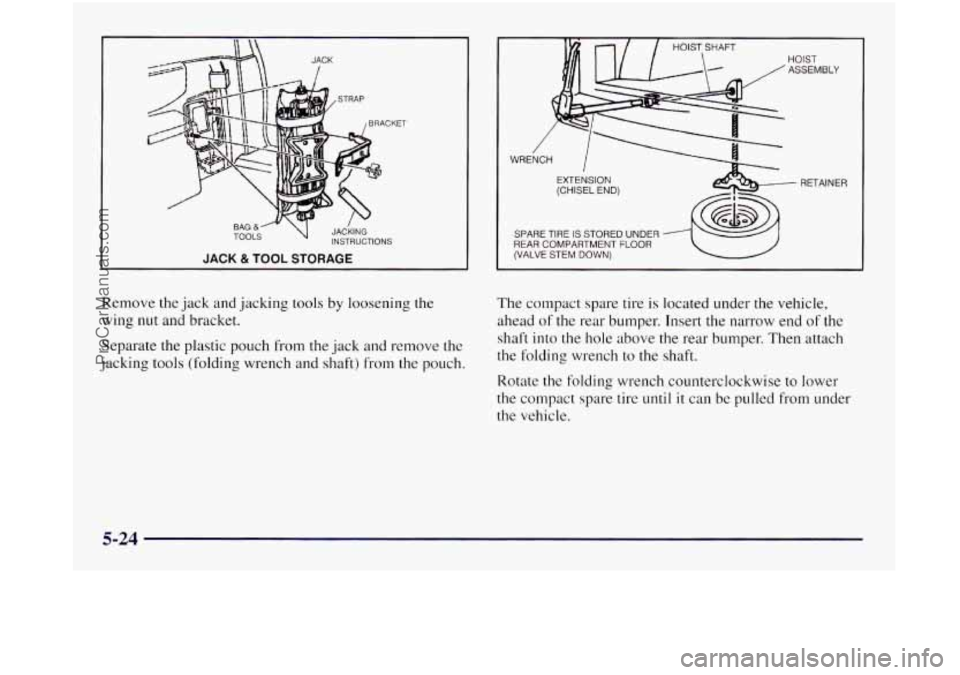
Remove the jack and jacking tools by loosening the
wing nut and bracket.
Separate the plastic pouch from the jack and remove the
jacking
tools (folding wrench and shaft) from the pouch.
HOIST SHAFT
HOIST
ASSEMBLY
EXTENSION
(CHISEL END)
SPARE TIRE
IS STORED UNDER REAR COMPARTMENT FLOOR (VALVE STEM DOWN)
The compact spare tire is located under the vehicle,
ahead
of the rear bumper. Insert the narrow end of the
shaft into the hole above
the rear bumper. Then attach
the folding wrench
to the shaft.
Rotate the folding wrench counterclockwise to lower
the compact spare tire
until it can be pulled from under
the vehicle.
5-24
ProCarManuals.com
Page 292 of 436
Do not raise the vehicle yet. Put the conlpact spare
tire near
you.
Getting under a vehicle when it is jacked up is
dangerous.
If the vehicle slips off the jack, you
could be badly injured or killed. Never get under
a vehicle when it
is supported only by a jack.
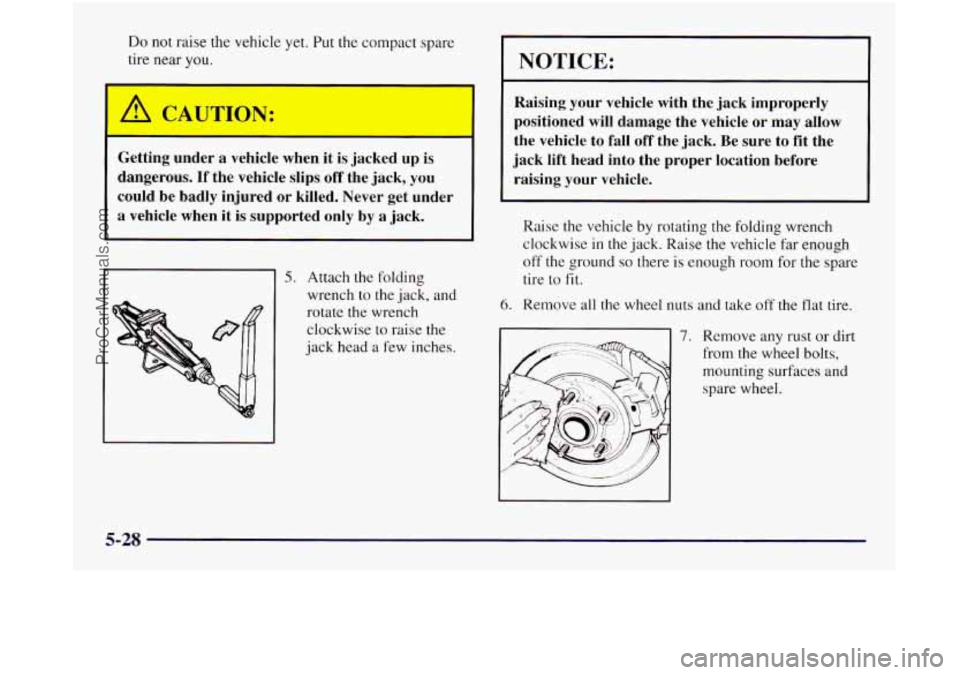
-1 5. Attach the folding
wrench to the jack, and
rotate
the wrench
clockwise to raise the
jack head
a few inches.
NOTICE:
Raising your vehicle with the jack improperly
positioned will damage the vehicle or may allow
the vehicle to fall off the jack. Be sure to fit the
jack lift head into the proper location before
raising your vehicle.
Raise the vehicle by rotating the folding wrench
clockwise
in the jack. Raise the vehicle far enough
off the ground
so there is enough room for the spare
tire to
fit.
6. Remove all the wheel nuts and take off the flat tire.
7. Remove any rust or dirt
from the wheel bolts,
mounting surfaces and
spare wheel.
5-28
ProCarManuals.com
Page 294 of 436
OLDS ONLY
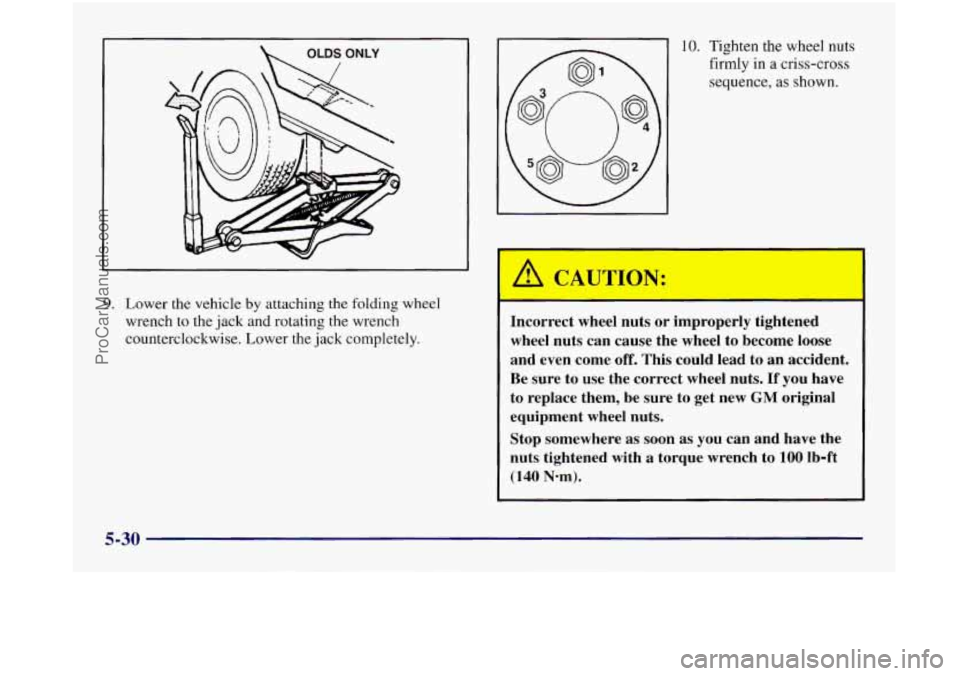
9. Lower the vehicle by attaching the folding wheel
wrench to the jack and rotating the wrench
counterclockwise. Lower the
jack completely.
10. Tighten the wheel nuts
firmly in a criss-cross
sequence,
as shown.
IL IJ:
Incorrect wheel nuts or improperly tightened
wheel nuts can cause the wheel to become loose
and even come
off. This could lead to an accident.
Be sure to use the correct wheel nuts.
If you have
to replace them, be sure to get new GM original
equipment wheel nuts.
Stop somewhere
as soon as you can and have the
nuts tightened with a torque wrench to
100 Ib-ft
(140 N-m).
5-30
ProCarManuals.com
Page 305 of 436
When you put the cap back on, turn it to the right
(clockwise) until you hear a clicking sound. Make sure
you fully install the cap. The diagnostic system can
determine if the fuel cap has been left
off or improperly
installed. Ths would allow
fuel to evaporate into the
atmosphere. See “Malfunction Indicator Lamp” in
the Index.
NOTICE:
If you need a new cap, be sure to get the right
type. Your retailer can get one for you.
If you get
the wrong type,
it may not fit properly. This may
cause your malfunction indicator lamp to light
and your fuel tank and emissions system may be
damaged. See “Malfunction Indicator Lamp” in
the Index.
Checking Things Under the Hood
An electric fan under the hood can start up and
injure you even when the engine is not running.
Keep hands, clothing and tools away from any
underhood electric fan.
1
Things that burn can get on hot engine parts and
start a fire. These include liquids like gasoline,
oil, coolant, brake fluid, windshield washer and
other fluids, and plastic or rubber.
You or others
could be burned. Be careful not to drop or spill
things that will burn onto a hot engine.
6-7
ProCarManuals.com
Page 333 of 436
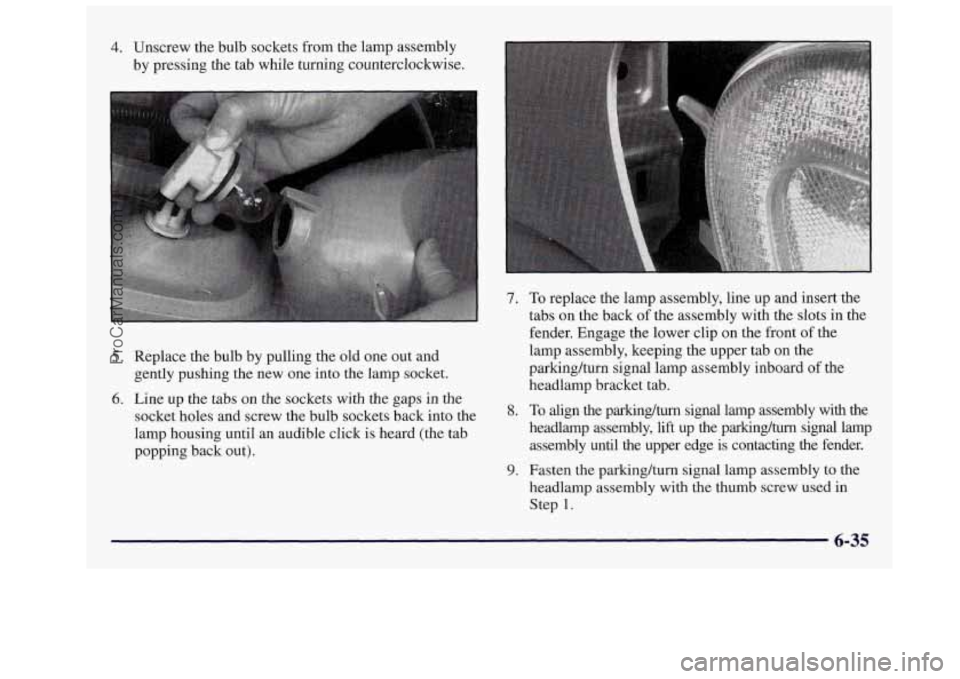
4. Unscrew the bulb sockets from the lamp assembly
by pressing the tab while turning counterclockwise.
7. To replace the lamp assembly, line up and insert the
tabs on the back
of the assembly with the slots in the
fender. Engage the lower clip
on the front of the
5. Replace the bulb by pulling the old one out and lamp assembly, keeping the upper tab on the
6. Line up the tabs on the sockets with the gaps in the
gently pushing the
new one into the lamp socket. parkinghm signal lamp assembly inboard of
the
socket holes and screw the bulb sockets back into the 8. To align the parking/turn signal lamp assembly with the
lamp housing until an audible click
is heard (the tab headlamp assembly, lift up the parking/turn signal lamp
popping back out). assembly until the upper
edge is contacting the fender.
headlamp bracket tab.
9. Fasten the parkinghurn signal lamp assembly
to the
headlamp assembly with the thumb screw used in
Step
1.
6-35
ProCarManuals.com
Page 334 of 436
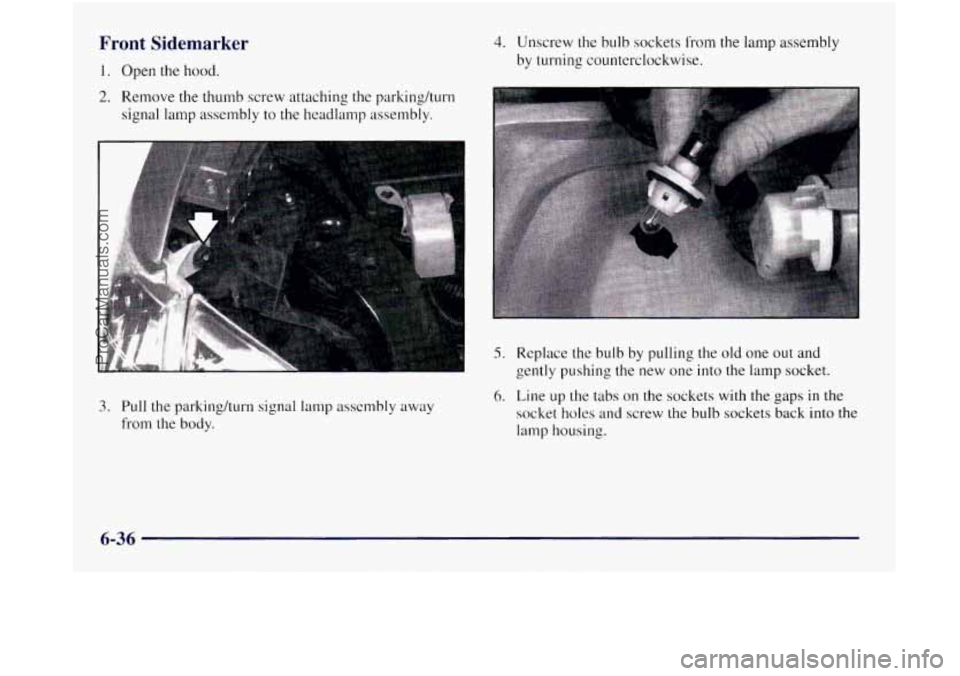
Front Sidemarker
1. Open the hood.
2. Remove the thumb screw attaching the parking/turn
signal lamp assembly
to the headlamp assembly.
3. Pull the parkinghurn signal lamp assembly away
from the body.
4. Unscrew the bulb sockets from the lamp assembly
by turning counterclockwise.
5. Replace the bulb by pulling the old one out and
gently pushing the new one into the lamp socket.
6. Line up the tabs on the sockets with the gaps in the
socket holes
and screw the bulb sockets back into the
lamp housing.
6-36
ProCarManuals.com