ECU OLDSMOBILE SILHOUETTE 1997 User Guide
[x] Cancel search | Manufacturer: OLDSMOBILE, Model Year: 1997, Model line: SILHOUETTE, Model: OLDSMOBILE SILHOUETTE 1997Pages: 436, PDF Size: 21.87 MB
Page 76 of 436

5. Rotate the head restraint forward and push it all the
Just like
the other restraint systems in your vehicle, your
built-in child restraint needs to be periodically checked and may need to have parts replaced after a crash. See
“Checking Your Restraint Systems’’ and “Replacing Seat
and Restraint System Parts After a Crash”
in the Index.
way
down.
Child Restraints
Be sure the child restraint is designed to be used in a
vehicle. If
it is, it will have a label saying that it meets
Federal Motor Vehicle Safety Standards.
Then follow the instructions for the restraint.
You may
find these instructions
on the restraint itself or in a
booklet, or both. These restraints use the belt system in
your vehicle, but
the child also has to be secured within
the restraint to help reduce the chance of personal injury.
The instructions that come with the infant or child
restraint will show you
how to do that.
Where to Put the Restraint
Accident statistics show that children are safer if they
are restrained in the rear rather than the front seat. We at
General Motors therefore recommend that you put your
child restraint
in a rear seat. Never put a rear-facing
child restraint
in the front passenger seat. Here’s why:
1-68
ProCarManuals.com
Page 77 of 436

A child in a reapfacing child restraint can be
seriously injured if the right front passenger’s air
bag inflates.
This is because the back of a
rearfacing child restraint would be very close
to
the inflating air bag. Always secure a rearfacing
child restraint in a rear seat.
You may, however, secure a forward-facing child
restraint in the right front
seat. Before you secure
a forward-facing child restraint, always move the
front passenger seat
as far back as it will go. Or,
secure the child restraint in a rear seat.
Wherever you install it, be sure to secure the child
restraint properly.
Keep in mind that an unsecured child restraint can move
around in a collision or sudden stop and injure people in
the vehicle. Be sure to properly secure any child
restraint in your vehicle
-- even when no child is in it.
Top Strap
If your child restraint has a top strap, it should be
anchored. A child restraint with a top strap should only
be used in the second row. Anchor brackets for the second row outside positions are located just above the
place where the third row lap-shoulder belts meet
the
floor.
ProCarManuals.com
Page 78 of 436

Securing a Child Restraint in a Rear
Outside Seat Position
n
There’s a vinyl sleeve there; to get to the bracket, push
this vinyl sleeve aside slightly. Anchor the top strap to
the bracket.
If you need to have an anchor bracket
installed for the right-hand side of a
60/40 bench seat,
you can ask your Oldsmobile retailer to
put it in for you.
If you want to install an anchor bracket yourself, your
retailer can
tell you how to do it.
Once you have the top strap anchored, you’ll be ready to
secure
the child restraint itself. You’ll be
using the lap-shoulder belt. See the earlier part
about the top strap
if the child restraint has one.
1. Put the restraint on the seat. Follow the instructions
for the child restraint.
2. Secure the child in the child restraint as the
instructions say.
1-70
ProCarManuals.com
Page 80 of 436

Securing a Child Restraint in the Center
Seat Position (Third
Row Bench Seat)
n
U
You’ll be using the lap belt.
See the earlier part about the top strap
if the child
restraint has one.
6. To tighten the belt, feed the shoulder belt back
into the retractor while you push down on the
child restraint.
7. Push and pull the child restraint in different
To remove the child restraint, just unbuckle the vehicle’s
safety belt and let
it go back all the way. The safety belt
will move freely again and be ready to work for an adult
or larger child passenger.
directions to be sure
it
is secure.
1-72
ProCarManuals.com
Page 81 of 436

1. Make the belt as long as possible by tilting the latch
plate and pulling
it along the belt.
5.
2. Put the restraint on the seat. Follow the instructions
for
the child restraint. 6.
3. Secure the child in the child restraint as the
instructions say.
4. Run the vehicle’s safety belt through or around the
restraint.
The child restraint instructions will show
you how. Buckle the belt. Make sure the release button
is
positioned
so you would be able to unbuckle the
safety belt quickly if you ever had to.
To tighten the belt, pull its free end while you push
down on the child restraint.
1-73
ProCarManuals.com
Page 82 of 436

7. Push and pull the child restraint in different
directions to be sure it is secure. If it isn’t, secure the
restraint
in a different place in the vehicle and
contact the child restraint maker for their advice
about how to attach
the child restraint properly.
To remove the child restraint, just unbuckle the vehicle’s
safety belt. It will be ready to work for an adult or larger
child passenger.
Securing a Child Restraint in the Right
Front Seat Position
Your vehicle has a front passenger air bag. Never put a
rear-facing child restraint
in this seat. Here’s why:
A child in a rear-facing child restraint can be
seriously injured
if the front passenger’s air bag
inflates. This is because the back of a rear-facing
child restraint would be very close to the inflating
air bag.
If your vehicle is a passenger van, always
secure a rear-facing child restraint in a rear seat.
If your vehicle is a cargo van,
do not use a
rear-facing child restraint in this vehicle. If a
forward-facing child restraint is suitable for your
child, always move the passenger seat
as far back
as it will
go.
1-74
ProCarManuals.com
Page 83 of 436

You’ll be using the lap-shoulder belt. See the earlier part
about the top strap
if the child restraint has one.
1. Because your vehicle has a front passenger air bag,
always move the seat as far back
as it will go before
securing a forward-facing child restraint. (See
“Seats”
in the Index.)
2. Put the restraint on the seat. Follow the instructions
for the child restraint.
3. Secure the child in the child restraint as the
instructions say.
4. Pick up the latch plate, and run the lap and shoulder
portions of the vehicle’s safety belt through or
around the restraint. The child restraint instructions
will show you how.
If the shoulder belt goes in front of the child’s face or
neck, put
it behind the child restraint. 5. Buckle the belt. Make sure the release button is
positioned so you would be able to unbuckle the
safety belt quickly
if you ever had to.
ProCarManuals.com
Page 84 of 436

6. Pull the rest of the shoulder belt all the way out of
the retractor to set the lock.
I
I
7. To tighten the belt, feed the shoulder belt
back into the retractor
while you push down
on the child restraint.
8. Push and pull the child restraint in different
directions to be sure
it is secure.
To re~nove the child restraint, just unbuckle the vehicle's
safety belt
and let it go back all the way. The safety belt
will move freely again and be ready
to work for an adult
or larger child passenger.
1-76
ProCarManuals.com
Page 89 of 436
Section 2 Features and Controls
Here you can learn about the many standard and optional features on your Oldsmobile, and information on starting,
shifting and braking. Also explained are the instrument panel and the warning systems that
tell you if everything is
working properly
-- and what to do if you have a problem.
2-2 2-4
2-7
2-
10
2- 12
2-13 2-15
2-19
2-23
2-26 2-26
2-28 2-29
2-3 1
2-35
2-37
2-4
1
2-50 Important Information About Keys
Door Locks
Remote Lock
Control
Battery Replacement for RKE
Switchbanks
Sliding Door
Power Sliding Door
Operation of Sliding Door Security Locks
Preventing Theft
of Your Vehicle
New Vehicle "Break-In"
Ignition Positions
Tips on Starting
Your Engine
Using the Engine Coolant Heater
Automatic Transaxle Operation
Parking Brake Guidelines
Important Information on Engine Exhaust
Locks and Lighting Choices
Windows 2-52
2-52
2-53
2-54
2-55
2-59
2-59
2-6
I
2-66
2- 67
2-7
I
2- 84
2-85
2- 86
2-88
2-92 Adjusting the
Tilt Steering
Wheel
Functions of the Multifunction Lever
How to Use
the High/Low Beam
Headlamp Changer
Windshield Wipers and Fluid
Using Cruise Control
Exterior Lamps
Daytime Running Lamps (DRL)
Interior Lamps
Rearview Mirrors
Storage Compartments
Driver Information Center
Accessory Power Outlets
S u nroo f
Air Inflator System
Instrument Panel Overview
All About Your Warning Lights and Gages
ProCarManuals.com
Page 100 of 436
Resynchronizing Your Remote Transmitter
Your Remote Lock Control System uses a continually
changing code for increased security. Normally, the
receiver
in your vehicle will keep track of this
changing code.
Loss of synchronization will occur if the transmitter
is activated more than
256 times while out of range
of the vehicle.
Loss of synchronization will occur after the battery
replacement if the transmitter is immediately
activated more than
16 times while out of range of
the vehicle.
If your key chain transmitter has stopped working, you
may need to resynchronize the transmitter to the vehicle
receiver. To do this, press the
LOCK and UNLOCK
buttons together and hold for at least seven seconds or
until the horn sounds if equipped with Content Theft
Deterrent. Check the transmitter operation.
Switchbanks
There are two sets of switchbanks located in the front of
the vehicle, The switches will vary with the options that
are on your vehicle. It
is useful to become familiar with
them since they are used frequently while operating
the vehicle.
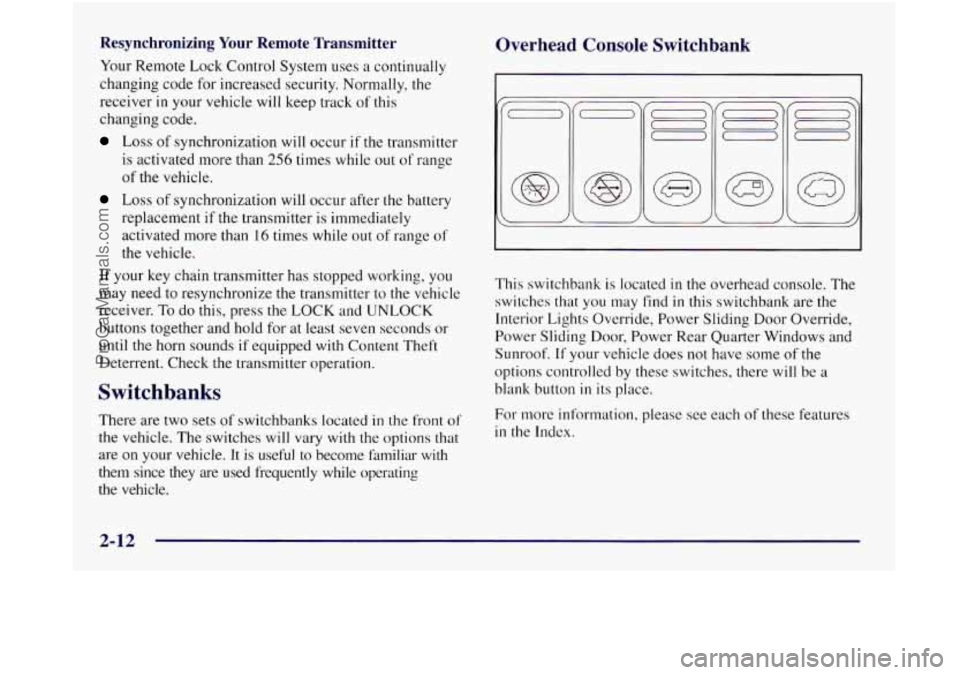
Overhead Console Switchbank
This switchbank is located in the overhead console. The
switches that you may find
in this switchbank are the
Interior Lights Override, Power Sliding Door Override,
Power Sliding
Door, Power Rear Quarter Windows and
Sunroof.
If your vehicle does not have some of the
options controlled by these switches, there
will be a
blank button
in its place.
For more information, please see each of these features
in the Index.
2-12
ProCarManuals.com