brake OLDSMOBILE SILHOUETTE 1997 Owner's Manual
[x] Cancel search | Manufacturer: OLDSMOBILE, Model Year: 1997, Model line: SILHOUETTE, Model: OLDSMOBILE SILHOUETTE 1997Pages: 436, PDF Size: 21.87 MB
Page 186 of 436
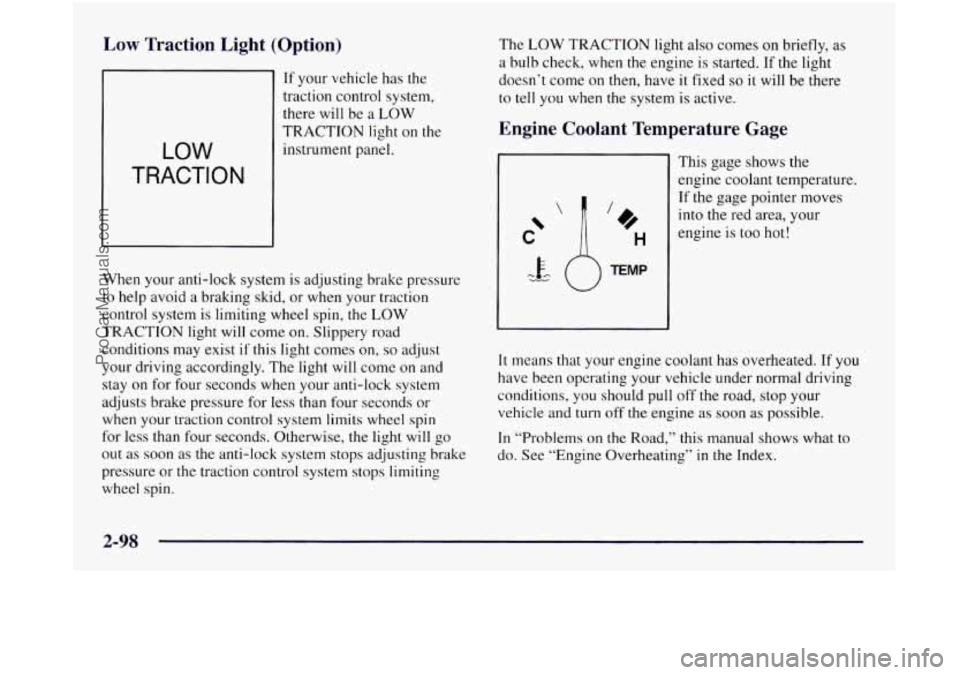
Low Traction Light (Option)
If your vehicle has the
traction control system,
there will be a LOW
LOW
TRACTION
TRACTION light on the
instrument panel.
When your anti-lock system is adjusting brake pressure
to help avoid
a braking skid, or when your traction
control system is limiting wheel spin,
the LOW
TRACTION light will come on. Slippery road
conditions may exist
if this light comes on, so adjust
your driving accordingly. The light will come on and
stay on for four seconds when your anti-lock system
adjusts brake pressure for less than four seconds or
when your traction control system limits wheel spin
for less than four seconds. Otherwise, the light will go
out as soon as the anti-lock system stops adjusting brake
pressure or the traction control system stops limiting
wheel spin. The
LOW TRACTION
light also comes on briefly, as
a bulb check, when the engine is started. If the light
doesn’t come on then, have it fixed
so it will be there
to tell you when the system is active.
Engine Coolant Temperature Gage
This gage shows the
engine coolant temperature.
If the gage pointer moves
into the red area, your
engine is too hot!
It means that your engine coolant has overheated. If you
have been operating your vehicle under normal driving
conditions, you should pull off the road, stop your
vehicle and turn off the engine as soon as possible.
In “Problems on the Road,” this manual shows what to
do. See “Engine Overheating”
in the Index.
2-98
ProCarManuals.com
Page 193 of 436
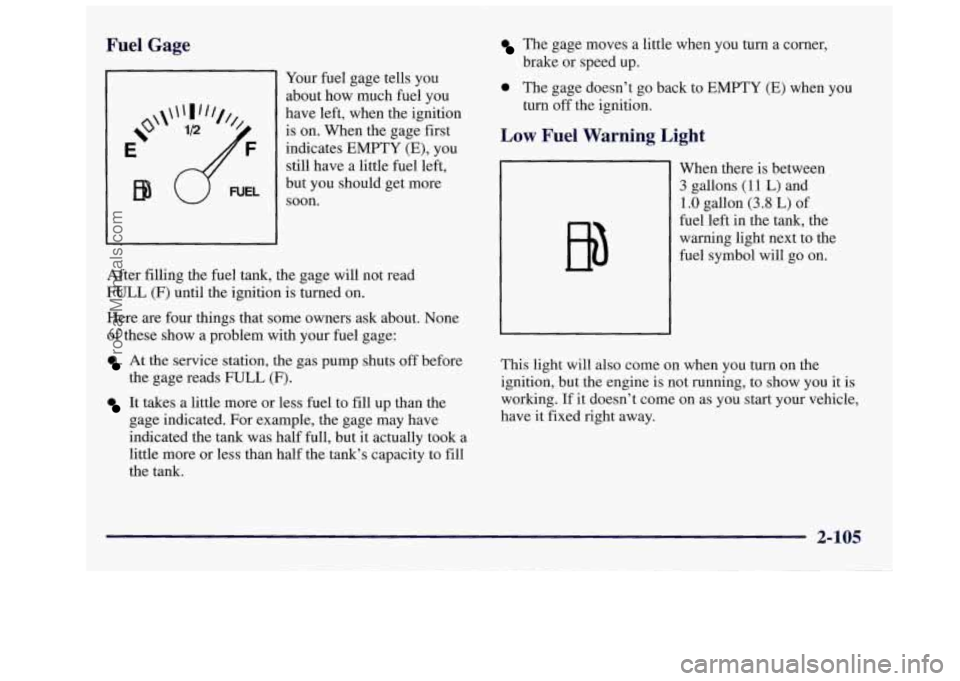
Fuel Gage
Your fuel gage tells you
about how much fuel you
have left, when the ignition is on. When the gage first
indicates EMPTY
(E), you
still have a little fuel left,
but you should get more
soon.
After filling the fuel tank, the gage will not read
FULL (F) until the ignition is turned on.
Here
are four things that some owners ask about. None
of these show a problem with your fuel gage:
At the service station, the gas pump shuts off before
the gage reads FULL
(F).
It takes a little more or less fuel to fill up than the
gage indicated. For example, the gage may have
indicated the tank was half full, but it actually took a
little more or less than half the tank’s capacity to fill
the tank.
The gage moves a little when you turn a corner,
0 The gage doesn’t go back to EMPTY (E) when you
brake or speed up.
turn
off the ignition.
Low Fuel Warning Light
EN
When there is between
3 gallons (1 1 L) and
1 .O gallon (3.8 L) of
fuel left in the tank, the
warning light next to
the
fuel symbol will go on.
This light will also come
on when you turn on the
ignition, but the engine is not running,
to show you it is
working. If it doesn’t come on as you start your vehicle,
have
it fixed right away.
2-105
ProCarManuals.com
Page 227 of 436
Section 4 Your Driving and the Road
Here you’ll find information about driving on different kinds of roads and in varying weather conditions. We’ve also
included many other useful tips on driving.
4-2
4-3
4-6
4-6
4-7
4-9 4- 10
4-1 1
4-13
4- 13
4- 15 Defensive Driving
Driving
Drunk
Having Control of Your Vehicle
Your Braking System Information
Anti-Lock Brake Information
Traction Control System
Braking in Emergencies
Steering Tips
Off-Road Recovery
Passing Other Vehicles
Loosing Control
of Your Vehicle 4-
16
4-
17
4-20
4-2
1
4-22
4-22
4-25
4-27
4-29 4-29
4-3
1
Night Driving
Driving
in Rain and on Wet Roads
City Driving
Freeway Driving
Tips Before Leaving on
a Long Trip
Avoiding Highway Hypnosis
Winter Driving
If You’re Caught in
a Blizzard
Loading Your Vehicle
Electronic Level Control
Helpful Hints for Towing
a Trailer
ProCarManuals.com
Page 228 of 436
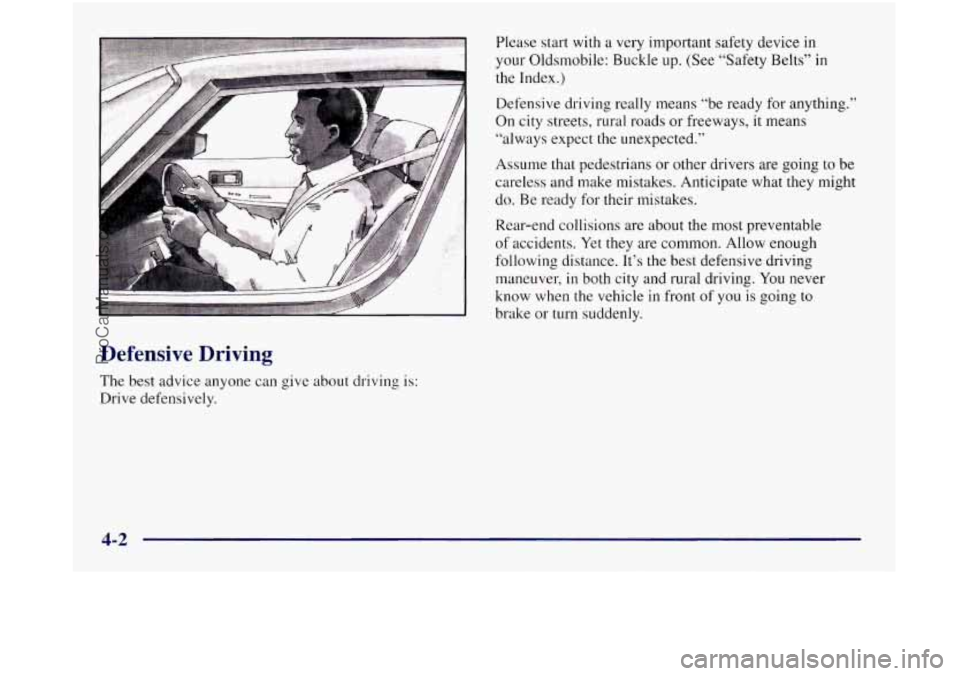
Please start with a very important safety device in
your Oldsmobile: Buckle
up. (See “Safety Belts” in
the Index.)
Defensive driving really means “be ready for anything.”
On city streets, rural roads
or freeways, it means
“always expect
the unexpected.”
Assume that pedestrians or other drivers are going to be
careless and make mistakes. Anticipate what they might
do. Be ready for their mistakes.
Rear-end collisions are about the most preventable
of accidents.
Yet they are common. Allow enough
following distance. It’s
the best defensive driving
maneuver,
in both city and rural driving. You never
know when the vehicle in front of you
is going to
brake or turn suddenly.
Defensive Driving
The best advice anyone can give about driving is:
Drive defensively.
4-2
ProCarManuals.com
Page 232 of 436
Control of a Vehicle
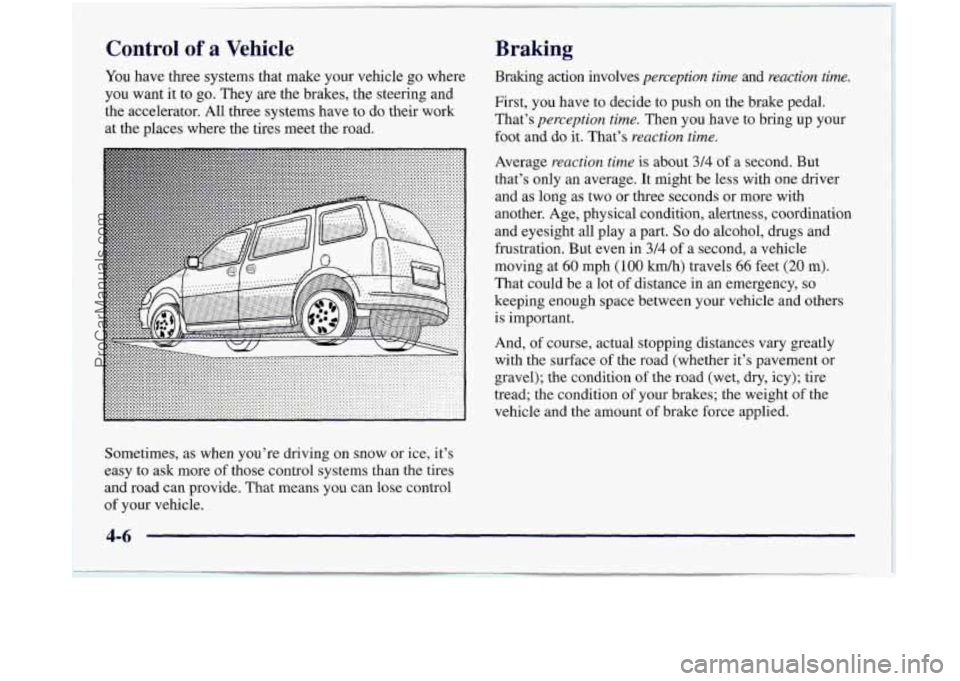
You have three systems that make your vehicle go where
you want it to go. They are the brakes, the steering and
the accelerator. All
three systems have to do their work
at the places where the tires meet the road.
Braking
Braking action involves perception time and reaction time.
First, you have to decide to push on the brake pedal.
That’s
perception time. Then you have to bring up your
foot and do it. That’s
reaction time.
Average reaction time is about 3/4 of a second. But
that’s only an average. It might be less with one driver
and as long as two or three seconds or more with
another. Age, physical condition, alertness, coordination
and eyesight all play a part.
So do alcohol, drugs and
frustration. But even in
3/4 of a second, a vehicle
moving at
60 mph ( 100 kmh) travels 66 feet (20 m).
That could be a lot of distance in an emergency,
so
keeping enough space between your vehicle and others
is important.
And,
of course, actual stopping distances vary greatly
with the surface
of the road (whether it’s pavement or
gravel); the condition of the road (wet, dry, icy); tire
tread; the condition of your brakes; the weight
of the
vehicle and the amount
of brake force applied.
Sometimes, as when you’re driving on snow or ice, it’s
easy to ask more
of those control systems than the tires
and road can provide. That means you can lose control
of your vehicle.
4-6
ProCarManuals.com
Page 233 of 436
Avoid needless heavy braking. Some people drive
in spurts
-- heavy acceleration followed by heavy
braking
-- rather than keeping pace with traffic. This
is a mistake. Your brakes may not have time to cool
between hard stops. Your brakes will wear out much
faster if you do a lot
of heavy braking. If you keep pace
with the traffic and allow realistic following distances,
you will eliminate a lot of unnecessary braking. That
means better braking and longer brake life.
If your engine ever stops while you’re driving, brake
normally but don’t pump your brakes. If you do, the
pedal may get harder to push down.
If your engine
stops, you will still have some power brake assist. But
you will use it when you brake. Once the power assist is
used up,
it may take longer to stop and the brake pedal
will be harder
to push.
Anti-Lock Brakes (ABS)
Your vehicle has anti-lock brakes (ABS). ABS is an
advanced electronic braking system that will help
prevent a braking skid.
When you start your engine, or when you begin to drive
away, your anti-lock brake system
will check itself.
You may hear a momentary motor or clicking noise
while this test is going on, and you may even notice
that your brake pedal moves
a little. (You may also hear
a clicking noise
if you leave the ignition in the RUN
position for about four seconds before starting the
vehicle.) This is normal.
If there’s a problem with the
anti-lock brake system, this
warning light will stay on or
flash. See “Anti-Lock
Brake System Warning
Light” in the Index.
ProCarManuals.com
Page 234 of 436
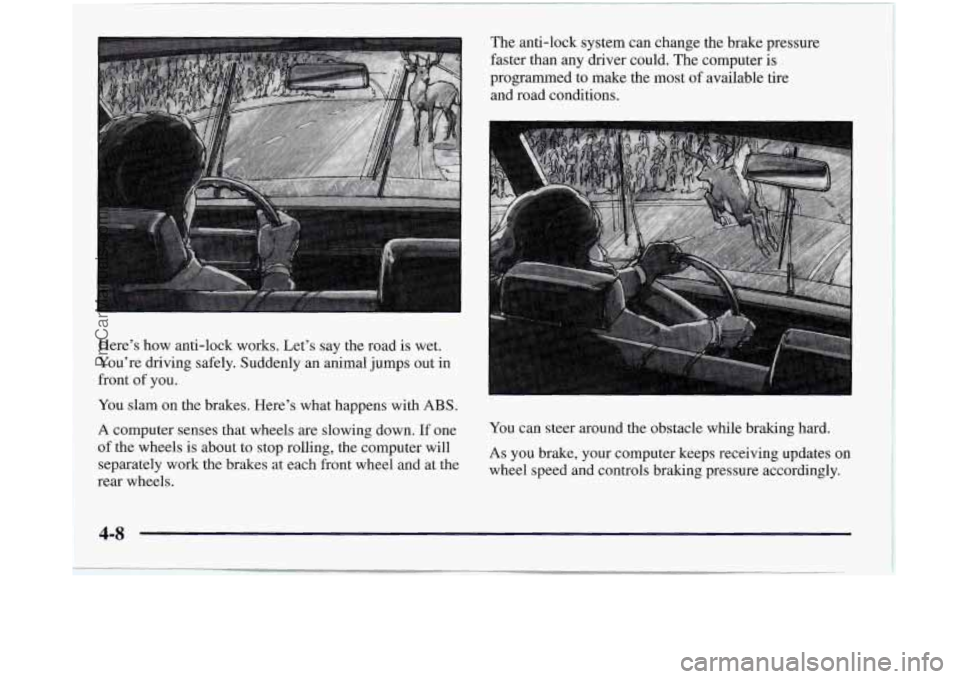
You slam on the brakes. Here's what happens with ABS.
4-8
ProCarManuals.com
Page 235 of 436
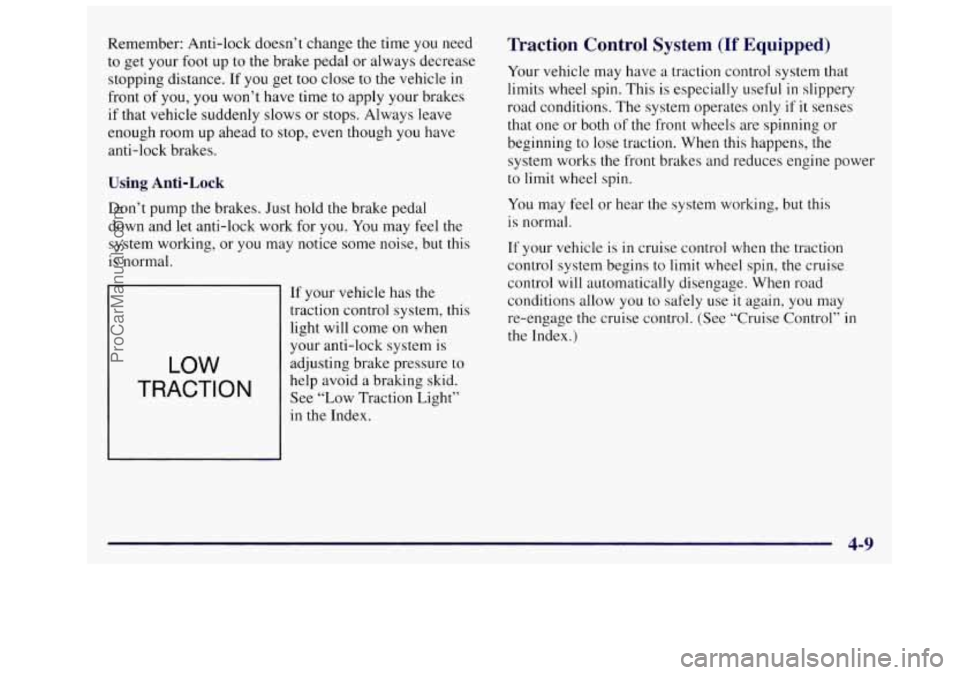
Remember: Anti-lock doesn’t change the time you need
to get your foot up to the brake pedal or always decrease
stopping distance.
If you get too close to the vehicle in
front of you, you won’t have time to apply your brakes
if that vehicle suddenly slows or stops. Always leave
enough room up ahead to stop, even though you have
anti-lock brakes.
Using Anti-Lock
Don’t pump the brakes. Just hold the brake pedal
down and let anti-lock work for you. You may feel the
system working, or you may notice some noise, but this
is normal.
LOW
TRACTION
If your vehicle has the
traction control system, this
light will come on when
your anti-lock system is
adjusting brake pressure to
help avoid a braking skid.
See “Low Traction Light”
in the Index.
Traction Control System (If Equipped)
Your vehicle may have a traction control system that
limits wheel spin. This is especially useful in slippery
road conditions. The system operates only if
it senses
that one or both of the front wheels are spinning or
beginning to lose traction. When this happens,
the
system works the front brakes and reduces engine power
to
limit wheel spin.
You may feel or hear the system worlung, but this
is normal.
If your vehicle is in cruise control when the traction
control system begins to limit wheel spin, the cruise
control will automatically disengage. When road
conditions allow you to safely use
it again, you may
re-engage the cruise control. (See “Cruise Control” in
the Index.)
4-9
ProCarManuals.com
Page 236 of 436
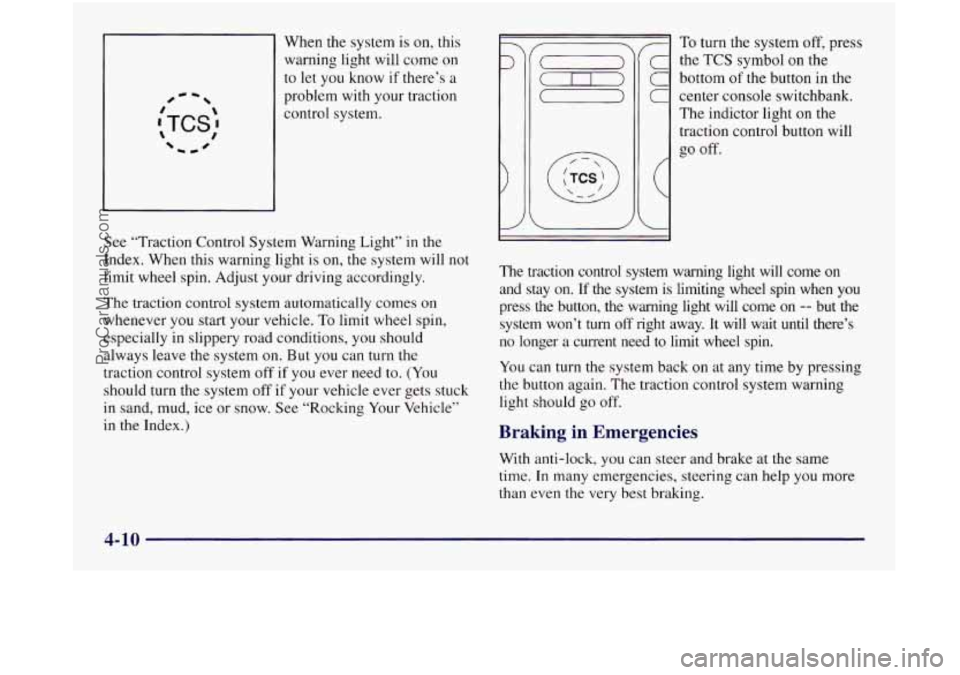
When the system is on, this
warning light will come on
to let you know if there’s
a
problem with your traction
control system.
See “Traction Control System Warning Light” in the
Index. When this warning light is on,
the system will not
limit wheel spin. Adjust your driving accordingly.
The traction control system automatically comes on
whenever you start your vehicle.
To limit wheel spin,
especially
in slippery road conditions, you should
always leave the system on. But you can turn
the
traction control system off if you ever need to. (You
should turn the system off if your vehicle ever gets stuck
in sand, mud, ice or snow. See “Rocking Your Vehicle”
in the Index.)
7
C
C
C
L
To turn the system off, press
the
TCS symbol on the
bottom of the button in the
center console switchbank.
The indictor light on the
traction control button will
go off.
The traction control system warning light will come on
and stay on. If the system
is limiting wheel spin when you
press the button, the warning light will come on
-- but the
system won’t
turn off right away. It will wait until there’s
no longer a current need
to limit wheel spin.
You can turn the system back on at any time by pressing
the button again. The traction control svstem warning
light should go
off.
Braking in Emergencies
With anti-lock, you can steer and brake at the same
time. In many emergencies, steering can help you more
than even the very best braking.
4-10
ProCarManuals.com
Page 238 of 436
Steering in Emergencies
There are times when steering can be more effective
than braking. For example, you come over a hill and
find a truck stopped in your lane, or a car suddenly pulls
out from nowhere, or a child darts out from between
parked cars and stops right in front of you. You can
avoid these problems by braking
-- if you can stop in
time. But sometimes you can’t; there isn’t room.
That’s the time for evasive action
-- steering around
the problem.
Your Oldsmobile
can perform very well in emergencies
like these. First apply your brakes. (See “Braking
in
Emergencies” earlier in this section.) It is better to
remove as much speed
as you can from a possible
collision. Then steer around
the problem, to the left or
right depending
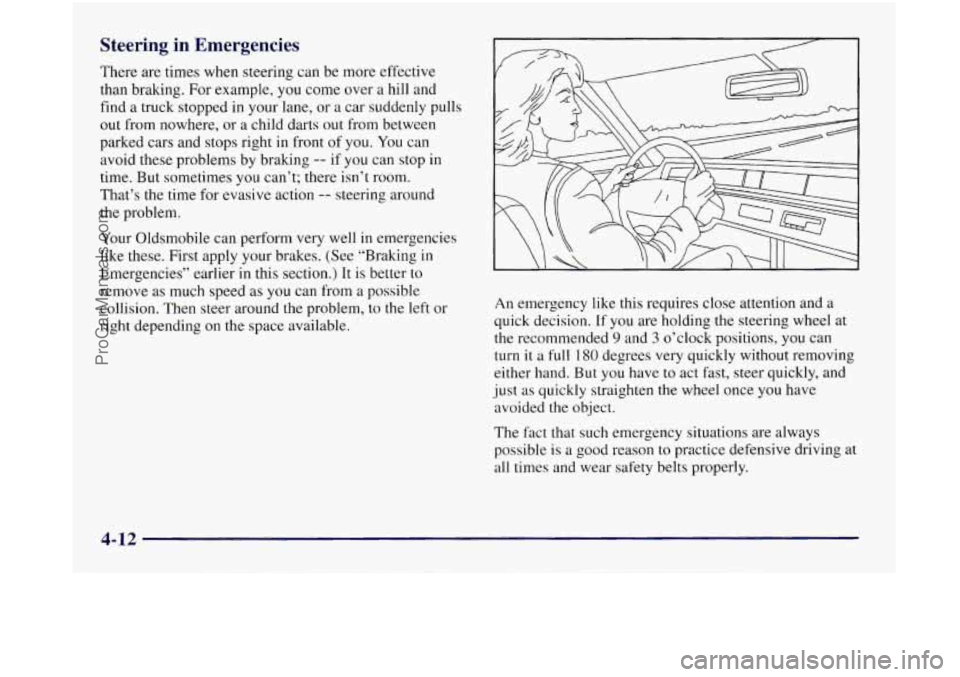
on the space available. An
emergency like this requires close attention and a
quick decision. If you are holding the steering wheel at
the recommended
9 and 3 o’clock positions, you can
turn
it a full I80 degrees very quickly without removing
either hand. But you have to act fast, steer quickly, and
just as quickly straighten the wheel once you have
avoided the object.
The fact that such emergency situations are always
possible is a good reason to practice defensive driving at
all times and wear safety belts properly.
4-12
ProCarManuals.com