towing OLDSMOBILE SILHOUETTE 1997 Owners Manual
[x] Cancel search | Manufacturer: OLDSMOBILE, Model Year: 1997, Model line: SILHOUETTE, Model: OLDSMOBILE SILHOUETTE 1997Pages: 436, PDF Size: 21.87 MB
Page 114 of 436

New Vehicle “Break-In”
NOTICE:
Your modern Oldsmobile doesn’t need an
elaborate “break-in.” But it will perform better
in the long run if you follow these guidelines:
Don’t drive at any one speed -- fast or
slow
-- for the first 500 miles (805 km).
Don’t make full-throttle starts.
200 miles (322 km) or so. During this time
your new brake linings aren’t yet broken
in. Hard stops with new linings can mean
premature wear and earlier replacement.
Follow this breaking-in guideline every
time you get new brake linings.
Don’t tow a trailer during break-in. See
“Towing a Trailer” in the Index for
more information.
Avoid making hard stops for the first
Ignition Positions
With the ignition key in the ignition switch, you ILA turn
the switch
to five positions.
E
ACCESSORY (A): An on position in which you can
operate your electrical power accessories. Press in the
ignition switch
as you turn the top of it toward you.
2-26
ProCarManuals.com
Page 117 of 436
3. If your engine still won’t start (or starts but then
stops), it could be flooded with too much gasoline.
Try this:
Wait
15 seconds to let the starter motor cool down.
Then push your accelerator pedal
all the way to the
floor. Hold
it there. Then hold the key in START.
This clears the extra gasoline from
the engine. When
the engine starts,
let go of the key and the accelerator
pedal.
If the engine still doesn’t start, wait another
15 seconds and repeat this step.
NOTICE: I
Your engine is designed to work with the
electronics in your vehicle.
If you add electrical
parts or accessories, you could change the way
the engine operates. Before adding electrical
equipment, check with your retailer.
If you don’t,
your engine might not perform properly.
If you ever have to have your vehicle towed, see
the part of this manual that tells how to do it
without damaging
your vehicle. See “Towing
Your Vehicle” in the Index.
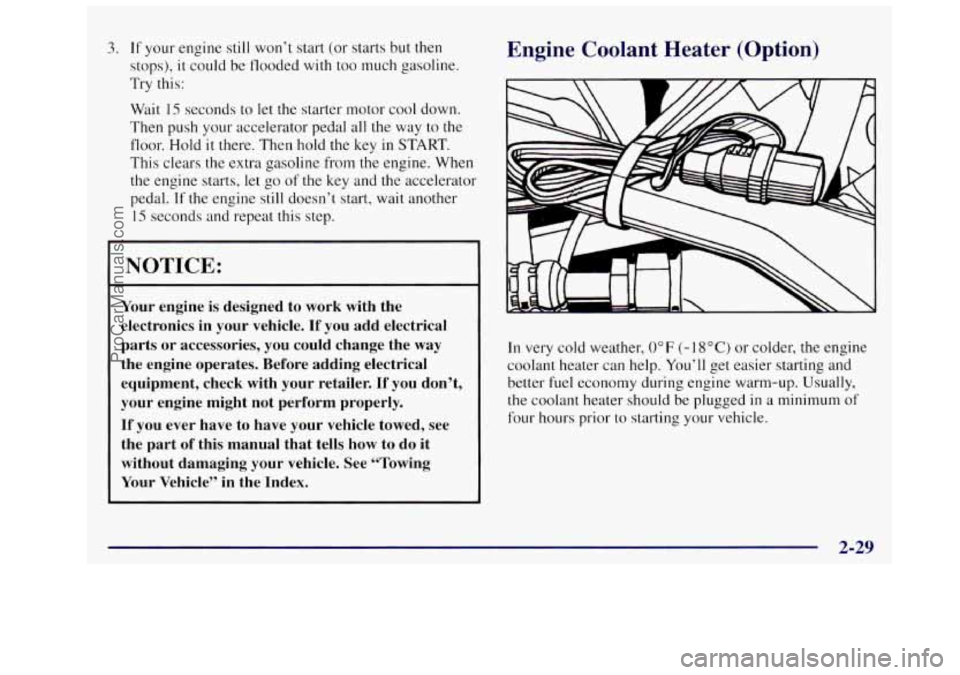
Engine Coolant Heater (Option)
In very cold weather, 0” F (- 18°C) or colder, the engine
coolant heater can help.
You’ll get easier starting and
better
fuel economy during engine warm-up. Usually,
the coolant heater should be plugged in a minimum of
four hours prior to starting your vehicle.
2-29
ProCarManuals.com
Page 119 of 436
Automatic Transaxle Operation
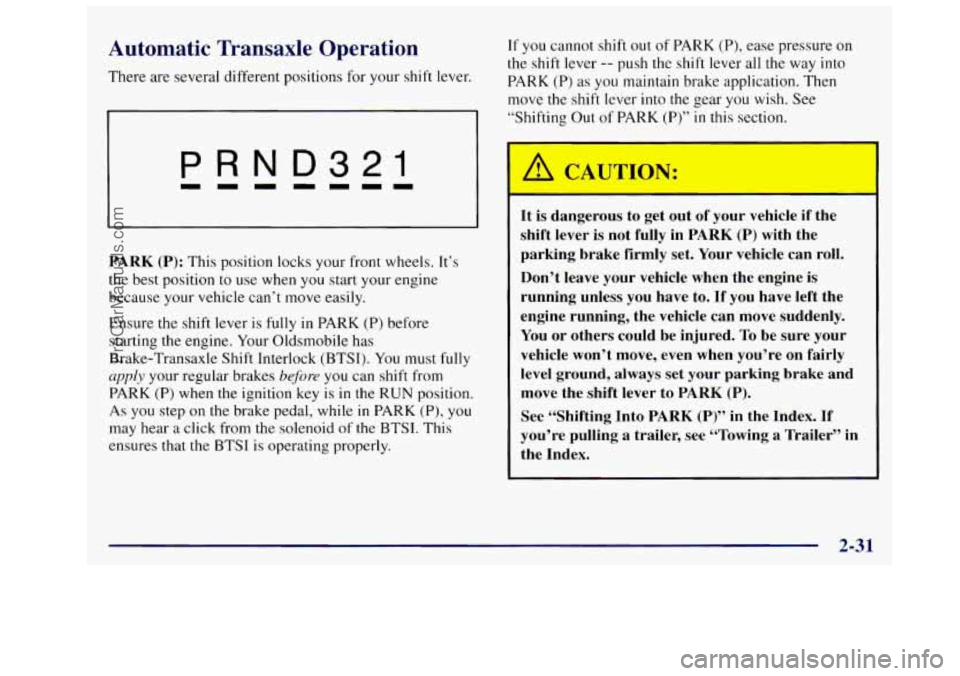
There are several different positions for your shift lever.
PRND321
PARK (P): This position locks your front wheels. It’s
the best position to use when you start your engine
because your vehicle can’t move easily.
Ensure the shift lever is fully in PARK (P) before
starting the engine. Your Oldsmobile has
Brake-Transaxle Shift Interlock
(BTSI). You must fully
apply your regular brakes before you can shift from
PARK (P) when
the ignition key is in the RUN position.
As you step on the brake pedal, while in PARK (P), you
may hear a click from the solenoid of the BTSI. This
ensures that the BTSI
is operating properly.
If you cannot shi.ft out of PARK (P), ease pressure on
the shift lever
-- push the shift lever all the way into
PARK
(P) as you maintain brake application. Then
move the shift lever
into the gear you wish. See
“Shifting Out
of PARK (P)” in this section.
1 A CAUTION:
It is dangerous to get out of your vehicle if the
shift lever is not fully in
PARK (P) with the
parking brake firmly set. Your vehicle can roll.
Don’t leave your vehicle when the engine is
running unless you have to. If you have left the
engine running, the vehicle can move suddenly.
You or others could be injured.
To be sure your
vehicle won’t move, even when you’re on fairly
level ground, always set your parking
brake and
move the shift lever to
PARK (P).
See “Shifting Into PARK (P)” in the Index. If
you’re pulling a trailer, see “Towing a Trailer” in
the Index.
I
2-31
ProCarManuals.com
Page 121 of 436
AUTOMATIC OVERDRIVE (D): This position is
for normal driving.
If you need more power for passing,
and you’re:
Going less than 35 mph (56 kdh), push your
Going about 35 mph (56 km/h) or more, push the
accelerator
pedal about halfway down.
accelerator
all the way down.
You’ll shift down to the
next gear and have more power.
THIRD (3): This position is also used for normal
driving, but
it offers more power and lower fuel
economy than AUTOMATIC OVERDRIVE (D).
Here are some times
you might choose THIRD (3)
instead of AUTOMATIC OVERDRIVE (D):
0 When driving on hilly, winding roads.
0 When towing a trailer (so there is less shifting
between gears).
0 When going down a steep hill.
SECOND (2): This position gives you more power, but
lower fuel economy. You can use SECOND
(2) on hills.
It can help control your speed as you go down steep
mountain roads, but then you would also want
to use
your brakes off and on.
NOTICE:
Don’t drive in SECOND (2) for more than 25 miles
(41 km), or at speeds over 55 mph (88 km/h), or
you can damage your transaxle. Use
THIRD (3) or
AUTOMATIC OVERDRIVE
(D) as much as
possible. Don’t shift into SECOND (2) unless you
are going slower than
65 mph (105 km/h) or you
can damage your engine.
2-33
ProCarManuals.com
Page 123 of 436
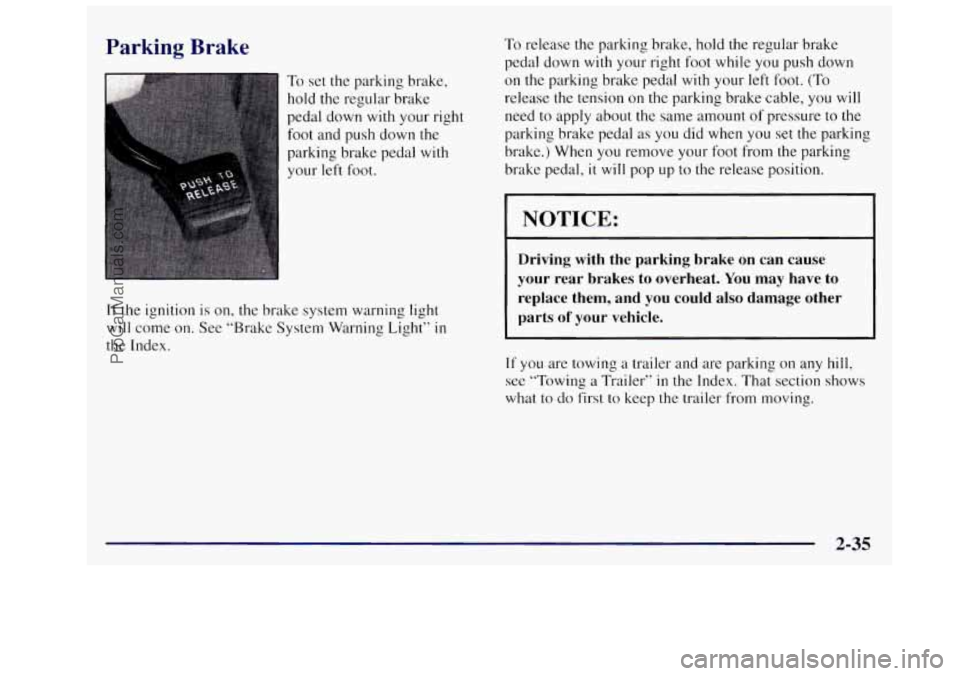
Parking Brake
To set the parking brake,
hold the regular brake
pedal down
with your right
foot and push down
the
parking brake pedal with
your left foot.
If the ignition is on, the brake system warning light
will come on. See “Brake System Warning Light” in
the Index.
To release the parking brake, hold the regular brake
pedal down
with your right foot while you push down
on the parking brake pedal with your left foot. (To
release the tension on the parking brake cable, you will
need to apply about the same amount of pressure to the
parking brake pedal as you did when you set the parking
brake.) When you remove your foot from the parking
brake pedal,
it will pop up to the release position.
I NOTICE:
Driving with the parking brake on can cause
your rear brakes to overheat. You
may have to
replace them, and you could also damage other
parts
of your vehicle.
If you are towing a trailer and are parking on any hill,
see “Towing a Trailer” in the Index. That section shows
what to
do first to keep the trailer from moving.
2-35
ProCarManuals.com
Page 124 of 436
Shifting Into PARK (P)
It can be dangerous to get out of your vehicle if
the shift lever is not fully in
PARK (P) with the
parking brake firmly set. Your vehicle can roll.
If you have left the engine running, the vehicle
can move suddenly. You
or others could be
injured.
To be sure your vehicle won’t move,
even when you’re on fairly level ground,
use the
steps that follow.
If you’re pulling a trailer, see
“Towing
a Trailer” in the Index.
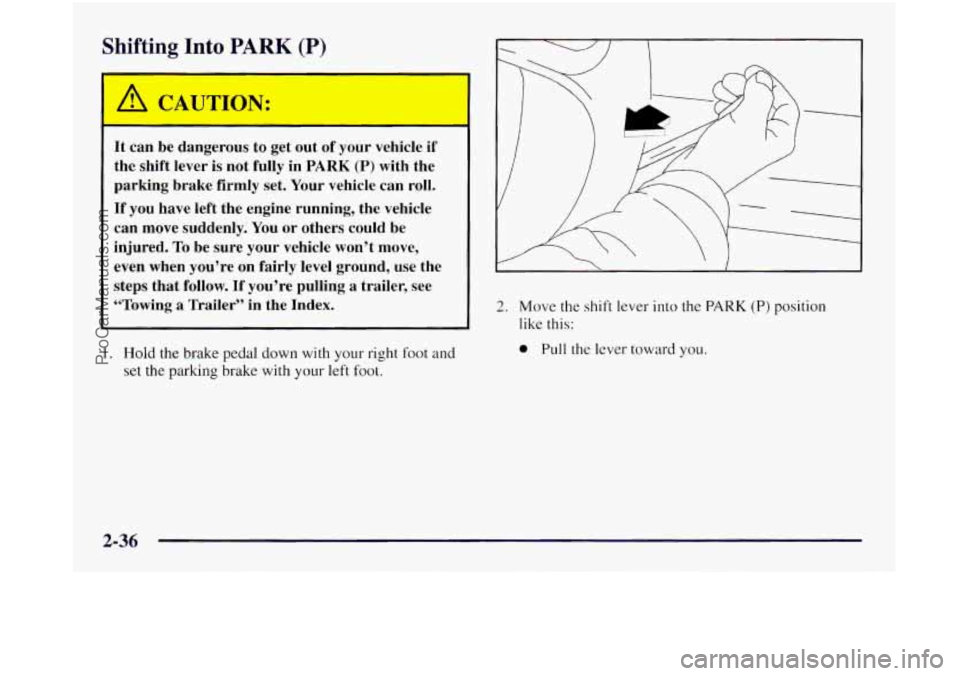
1. Hold the brake pedal down with your right foot and
set the parking brake with your left foot.
II
I
2. Move the shift lever into the PARK (P) position
like this:
0 Pull the lever toward you.
2-36
ProCarManuals.com
Page 128 of 436
Running Your Engine While
You’re Parked
It’s better not to park with the engine running. But if you
3ver have to, here are some things to know.
A CAUTION:
Idling the engine with the air system control
off could allow dangerous exhaust into
your vehicle (see the earlier Caution under
“Engine Exhaust”).
Also, idling in a closed-in place can let deadly
carbon monoxide
(CO) into your vehicle even
if the fan switch is at the highest setting. One
place this can happen
is a garage. Exhaust -- with
CO -- can come in easily. NEVER park in a
garage with the engine running.
Another closed-in place can be a blizzard. (See
“Blizzard” in the Index.) It
can be dangerous
to get out of your vehicle if
the shift lever is not fully in PARK (P) with the
parking brake firmly set. Your vehicle can
roll.
Don’t leave your vehicle when the engine is
running unless you have to.
If you’ve left the
engine running, the vehicle can move suddenly.
You or others could be injured.
To be sure your
vehicle won’t move, even when you’re on fairly
level ground, always set your parking brake and
move the shift lever
to PARK (P).
Follow the proper steps to be sure your vehicle won’t
move. See “Shifting Into
PARK (P)” in the Index.
If you’re pulling a trailer, see “Towing a Trailer” in
the Index.
2-40
ProCarManuals.com
Page 141 of 436
Turn Signal and Lane Change Indicator
The turn signal has two upward (for right) and two
downward (for left) positions. These positions allow you
to signal a turn or
a lane change.
To signal a turn, move the lever all the way up or down.
When the turn is finished, the lever will return automatically.
An arrow on the instrument panel will flash in the
direction of the turn or lane change.
To signal a lane change, just raise or lower the lever
until the arrow starts to flash. Hold it there until you
complete your lane change. The lever will return by
itself when
you release it.
As you signal a turn or a lane change, if the arrow
flashes faster than normal, a signal bulb may be burned
out and other drivers won’t see your turn signal.
If a bulb is burned out, replace it to help avoid an
accident. If the arrows don’t go on at all when you
signal
a turn, check for burned-out bulbs and check the
fuse (see “Fuses and Circuit Breakers”
in the Index).
If you have a trailer towing option with added wiring for
the trailer lamps, the signal indicator will flash at a
normal rate even
if a turn signal bulb is burned out.
Check the front and rear turn signal lamps regularly to
make sure
they are working.
Turn Signal Reminder Chime
If either turn signal is left on for more than 3/4 of a mile,
a chime will sound to let the driver know to turn it off.
If you need to leave the signal on for more than 3/4 of a
mile, turn off the signal and then turn it back on.
Headlamp HigWLow Beam Changer
To change the headlamps from high to low beam, or low
to high, simply pull
the turn signal lever all the way
toward you. Then release it.
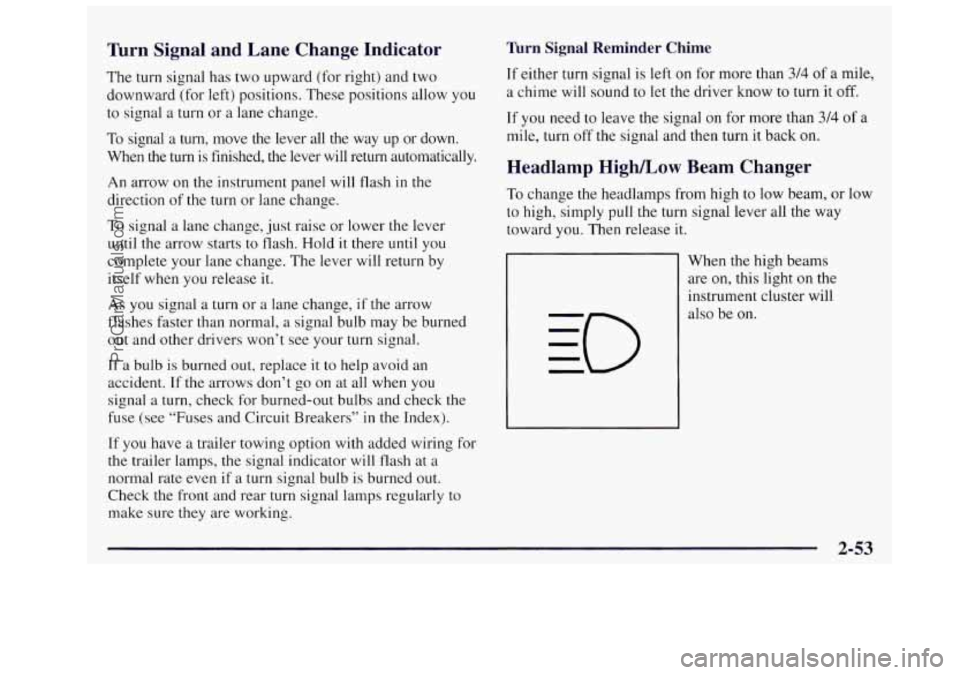
When the high beams
are on, this light on the
instrument cluster will
also be on.
2-53
ProCarManuals.com
Page 183 of 436
Brake System Warning Light
Your Oldsmobile’s hydraulic brake system is divided
into two parts. If
one part isn’t working, the other part
can still work and stop you. For good braking, though,
you need both parts working well.
If the warning light comes on, there could be a brake
problem or the brake fluid level could be low. Have your
brake system inspected right away.
BRAKE
This light should come on
briefly when you turn the
ignition
key to RUN. If it
doesn’t come on then, have
it fixed so it will be ready to
warn you
if there’s a
problem.
If the light comes
on while you are driving, pull off the
road and stop carefully. You may notice that the pedal
is
harder to push. Or, the pedal may go closer to the floor.
It may take longer to stop. If the light is still on, or if the
anti-lock brake system warning light is flashing, have
the vehicle towed for service. (See “Anti-Lock Brake
System Warning Light” and “Towing Your Vehicle”
in
the Index.)
Your brake system may not be working properly
if the brake system warning light is on. Driving
with the brake system warning light on can lead
to an accident. If the light is still on or if the
anti-lock brake system warning light is flashing
after you’ve pulled
off the road and stopped
carefully, have the vehicle towed
for service.
. UTIO--:
4
When the ignition is on, the brake system warning light
will also come on when you set your parking brake. The
light
will stay on if your parking brake doesn’t release
fully. If it stays on after your parking brake is fully
released,
it means you have a brake problem.
2-95
ProCarManuals.com
Page 184 of 436
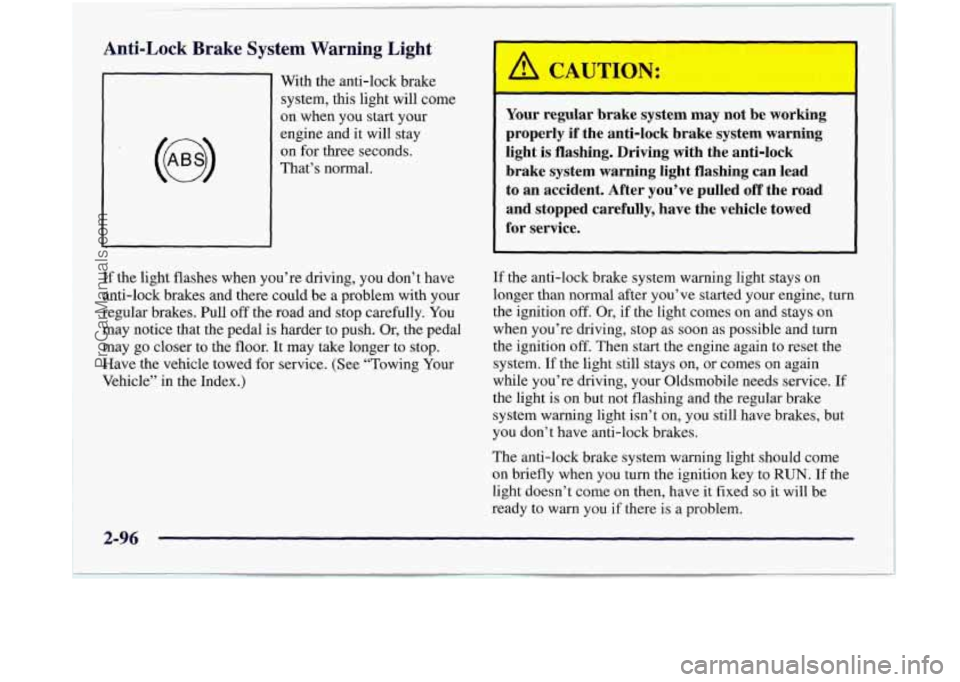
Anti-Lock Brake System Warning Light
With the anti-lock brake
system,
this light will come
on when you start your
engine and
it will stay
on for three seconds.
That’s normal.
Your regular brake system may not be working
properly if the anti-lock brake system warning
light is flashing. Driving with the anti-lock
brake system warning light flashing can lead
to an accident. After you’ve pulled off the road
and stopped carefully, have the vehicle towed
for service.
If the light flashes when you’re driving, you don’t have
anti-lock brakes and there could be a problem with your
regular brakes. Pull
off the road and stop carefully. You
may notice that the pedal is harder to push. Or, the pedal
may go closer to the floor. It may take longer to stop.
Have the vehicle towed for service. (See “Towing Your
Vehicle” in the Index.) If
the anti-lock brake system warning light stays on
longer than normal after you’ve started your engine, turn
the ignition
off. Or, if the light comes on and stays on
when you’re driving, stop as
soon as possible and turn
the ignition off. Then start the engine again to reset the
system. If the light still stays on, or comes on again
while you’re driving, your Oldsmobile needs service. If
the light is on but not flashing and the regular brake
system warning light isn’t
on, you still have brakes, but
you don’t have anti-lock brakes.
The anti-lock brake system warning light should come
on briefly when you turn the ignition key to RUN. If the
light doesn’t come
on then, have it fixed so it will be
ready to warn you
if there is a problem.
2-96
ProCarManuals.com